

3.01% Average: Mortgage Rates in Spain for International Buyers, 2026
· 11 min read

Mortgage rates in Spain in 2026 average around 3.01% on new residential loans, according to provisional figures from the National Statistics Institute, with fixed-rate products still outnumbering variable ones among borrowers. For international buyers, the single most useful step before reserving a property is to request a FEIN from each shortlisted lender and compare the APR (TAE), fees and instalment examples side by side, rather than relying on the headline rate alone.
TL;DR:
- Buyers should request and review FEIN documents from lenders before reserving a property to ensure accurate comparison of APR, fees, and instalment costs.
- A one-point increase in Euribor can raise monthly payments by approximately €58 to €100 on a €150,000 loan, depending on loan conditions.
- Non-residents typically face lower loan-to-value ratios around 70-75% and must provide extensive documentation, including proof of income and deposit source.
- Despite fixed-rate mortgages averaging 3.01%, variable rates depend heavily on Euribor movements influenced by ECB policies, risking payment swings if rates rise.
- Market conditions suggest fixed rates still dominate new loans, but competition and supply constraints mean affordability includes price growth, deposit, and transaction costs beyond just interest rates.
Table of Contents
- Current headline rates and market averages in Spain
- How Euribor and ECB policy affect your mortgage payments in 2026
- Mortgage types and what international buyers should expect
- How to compare mortgage offers properly in 2026
- Practical timeline and steps to get a Spanish mortgage in 2026
- How Fiesta Properties helps international buyers secure mortgage terms
- Predictions and factors shaping mortgage rate trends in Spain
- Impact of inflation and economic outlook on mortgage conditions
- Government policies or incentives affecting mortgage rates in 2026
- The strategic trade-off buyers face in 2026
- How Fiesta Properties can help you get started
- Sources
- FAQ
Current headline rates and market averages in Spain
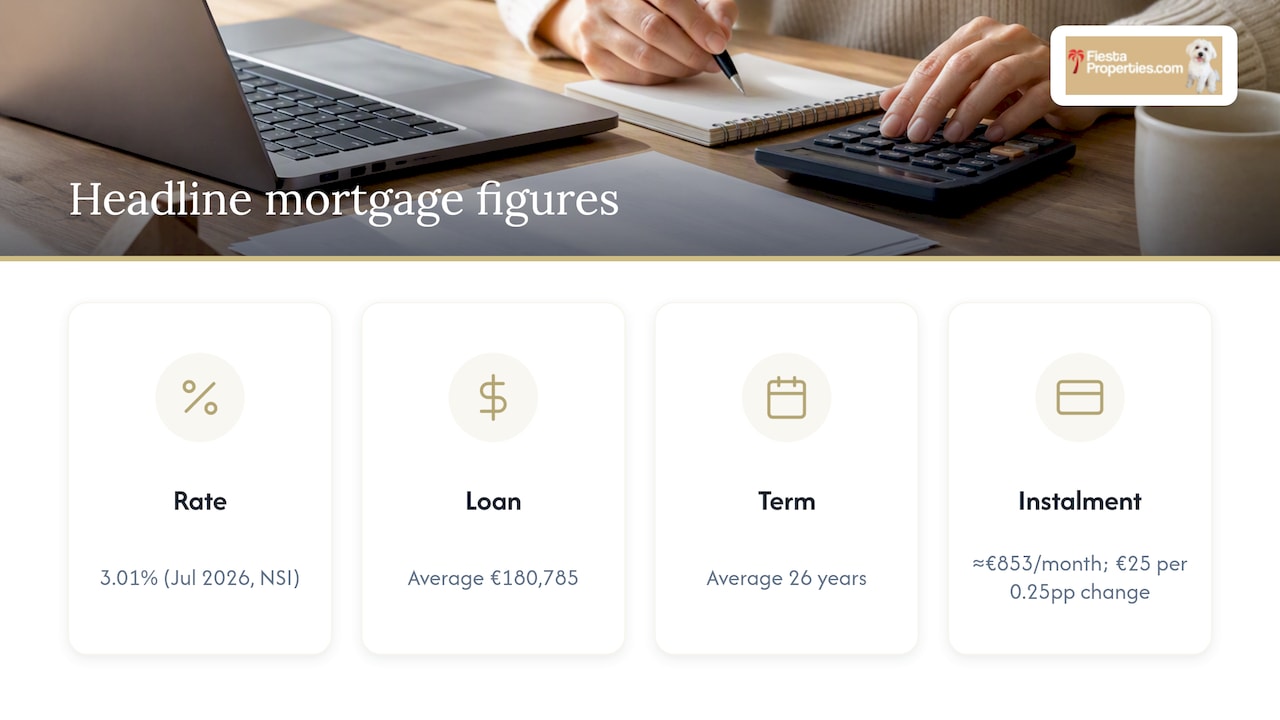
The most reliable snapshot comes from the National Statistics Institute’s July 2026 mortgage release, which reported an average interest rate of 3.01% on new home mortgages, an average loan amount of €180,785, and an average term of 26 years.
Average new mortgage rate in Spain: 3.01%, based on July 2026 provisional data from the National Statistics Institute. That figure reflects completed mortgage registrations rather than live quotes, so it tends to lag what lenders are actually offering in real time. Non-resident buyers typically see individually underwritten pricing that sits a little above this national average, since lenders treat overseas income and cross-border risk with extra caution.
The monthly instalment on that loan works out to roughly €853 before any linked-product discounts or fees are applied. A quarter-point difference in the rate, up or down, moves that instalment by around €25 a month, which is why comparing more than one lender’s offer matters more than it might first appear.
How Euribor and ECB policy affect your mortgage payments in 2026
Most variable and mixed mortgages in Spain are priced against the 12-month Euribor plus a fixed spread set by the lender. The Banco de España confirms that 12-month Euribor remains the most widely used official reference rate for tracker mortgages, and it moves in response to the European Central Bank’s policy decisions and broader market expectations. Euribor climbed during September 2026, reaching levels close to its highest point since 2024. This is according to reporting on the September rate movement.
For a buyer with a tracker mortgage, that kind of move is not abstract:
- A one-point rise in Euribor can add roughly €58 to €100 a month on a €150,000 loan, depending on the differential and how often the rate resets, based on media analysis of the September movement.
- Fixed-rate mortgages usually carry a higher headline rate than variable ones, but they lock in the instalment for the full term, which suits buyers who want certainty over their monthly budget.
- Variable and mixed products can reward buyers with lower payments while Euribor stays subdued, but they expose the borrower to the kind of swing shown above whenever rates climb.
Mortgage types and what international buyers should expect
Fixed-rate mortgages in Spain currently tend to be commonly offered with rates generally in a moderate range, while variable products track 12-month Euribor plus a spread that varies by lender and borrower profile. Terms commonly run up to 25 or 30 years, and some lenders extend repayment until the borrower turns 80.
Non-resident applicants face a noticeably different underwriting process to residents:
- Loan-to-value ratios for non-residents typically cap out around 70%, rising to 75% with a small number of lenders willing to stretch further for strong applicants.
- Documentation requirements are heavier: a NIE number, proof of income (payslips or tax returns), bank statements, and clear evidence of the source of the deposit funds.
- Non-resident files usually attract extra scrutiny and a modest rate uplift compared with the resident averages reported by the National Statistics Institute, reflecting the cross-border risk lenders price in.
- Linked products, such as a mortgage protection policy or a mandatory current account with the lender, can shift the final rate offered, sometimes lowering it in exchange for the extra product.
Buyers weighing up life or mortgage protection cover as part of a linked-product discount may find it useful to look at guidance on mortgage protection insurance in Spain before agreeing to bundle a policy into the loan.
How to compare mortgage offers properly in 2026
Spanish lenders are required to hand over a FEIN (Ficha Europea de Información Normalizada) once an application looks viable, and that document, not the advertised rate, is the one to study closely. The step-by-step guide to signing a mortgage in Spain confirms that banks must deliver the binding FEIN, along with standardised warnings, at least 10 days before signing.
When two offers land on the desk, work through this order:
- Compare the nominal interest rate first, but treat it as a starting point rather than the decision.
- Check the APR (TAE), which folds in fees and any linked-product requirements and often tells a different story to the nominal rate, as consumer comparators regularly show in their monthly analysis of leading mortgage offers.
- Read the instalment examples included in the FEIN, since they show the real monthly cost under the lender’s own assumptions.
- Ask what happens to the rate if you decline a linked product, such as home insurance or a payroll account.
Pro Tip: Ask each lender for the FEIN in writing before you commit to a reservation deposit on a property, since a verbal rate quote is not binding and can change once full underwriting begins.
On a €180,000 loan, that gap adds up to a noticeably higher total cost over the life of the mortgage, even though the advertised rate looked identical. For more detail on the fees involved, our guide to Spanish mortgage fees since Law 5/2019 breaks down what buyers typically pay.
Practical timeline and steps to get a Spanish mortgage in 2026
International buyers should gather core documents early: passport and NIE, three to six months of bank statements, recent payslips or tax returns, and clear evidence of where the deposit funds originate. Lenders will ask for all of this before issuing a formal pre-approval.
- Pre-approval typically takes a few weeks once the full document set is submitted, so start this before falling in love with a specific property.
- The binding FEIN must reach the borrower at least 10 days before the notary signing, a legal requirement covered in the guide to signing a mortgage in Spain, and rushing this step is one of the most common scheduling mistakes.
- Borrowers also receive free, individualised notary advice before the final deed is signed, which adds another appointment to the calendar.
- Beyond the deposit itself, buyers need to budget for taxes, valuation fees, and the effect of currency exchange timing on the euro value of their deposit, a point covered in more detail in our example cost of buying in Spain.
Anyone wanting the full walkthrough can follow our step-by-step guide to getting a Spanish mortgage.
How Fiesta Properties helps international buyers secure mortgage terms
Because Mike and Tatiana’s team coordinates sales, mortgage, legal and currency exchange support under one roof, FEIN timing, notary appointments and exchange bookings can be scheduled together, which protects the deposit and the completion date from the kind of last-minute delays that catch many overseas buyers out.
Predictions and factors shaping mortgage rate trends in Spain
Euribor’s path through the rest of 2026 will largely set the direction for variable and mixed mortgage pricing, and the European Central Bank’s policy stance remains the main driver of that benchmark. After the rise reported in September 2026 coverage of Euribor movements, lenders have generally kept fixed-rate offers steady rather than chasing the benchmark upward, which explains why fixed products still outnumber variable ones among new borrowers.
Competition among lenders for new business tends to keep spreads on tracker mortgages relatively tight, even when Euribor itself moves, since banks are reluctant to lose market share to a rival offering a narrower margin. Demand from overseas buyers, particularly in coastal regions, also plays a role: lenders that want a larger share of the non-resident mortgage book sometimes offer sharper pricing to attract that business, which can work in a buyer’s favour if they shop around rather than accepting the first offer.
Housing supply constraints add a separate pressure that is not about interest rates at all but affects the overall cost of buying. BBVA Research’s 2026 outlook points to supply-driven price growth continuing even where financing conditions are relatively supportive, which means a buyer securing a decent rate can still face a squeeze from rising purchase prices. The practical takeaway for anyone watching the market through the rest of 2026 is that the rate itself is only one part of a wider affordability picture that includes prices, deposit size and transaction costs.
Impact of inflation and economic outlook on mortgage conditions
Inflation feeds into mortgage pricing indirectly, through its effect on the European Central Bank’s policy decisions and, from there, on Euribor. When inflation runs above target, the central bank tends to hold or raise policy rates, which keeps Euribor elevated and, in turn, keeps tracker mortgage payments higher than they would be in a lower-inflation environment.

The broader economic outlook for 2026 also shapes how generously lenders price risk. BBVA Research’s analysis notes that even with financing conditions holding up reasonably well, rising property prices and the accompanying deposit and tax costs can make affordability a genuine challenge for buyers, particularly those bringing funds from abroad. A buyer converting savings from pounds or dollars into euros, for example, is exposed to currency swings on top of any change in the mortgage rate itself, and that risk deserves as much attention as the interest rate quoted by a lender. Our partners at Karin Rotem’s guide to currency exchange and real estate purchases explain how the timing of a currency transfer can materially change the euro value of a deposit.
For buyers assessing whether a variable mortgage is sensible under current conditions, the Banco de España’s guidance on mortgage scenarios recommends stress-testing affordability against an adverse Euribor scenario rather than assuming today’s rate will hold for the life of the loan. That approach matters more in an inflationary environment, where the gap between a comfortable instalment and a stretched one can narrow quickly if the benchmark moves against the borrower.
Government policies or incentives affecting mortgage rates in 2026
Spain does not currently operate a broad, buyer-facing subsidy scheme that directly lowers mortgage interest rates for the general market, so most of the policy influence on rates in 2026 runs through regulation rather than incentives. The consumer protection framework around the FEIN and the mandatory 10-day pre-signing window, both confirmed in the guide to the mortgage-signing process, exists to make sure borrowers can compare offers properly before committing, which shapes how lenders present their pricing even though it does not set the rate itself.
The Banco de España’s published resolution of reference rates is the official statutory record lenders and regulators use to track average mortgage pricing across the market, and it underpins how variable-rate contracts written against official reference indices are calculated. This kind of regulatory oversight, rather than a tax break or cash incentive, is the main lever available to policymakers when it comes to mortgage conditions in the current market. Buyers should not expect a government scheme to meaningfully move their personal rate; the more direct value of policy in 2026 lies in the transparency rules that make it easier to compare what different lenders are actually offering.
The strategic trade-off buyers face in 2026
Choosing fixed or variable in 2026 comes down to how much payment uncertainty you can tolerate, not which one is objectively cheaper. Prioritise your deposit and FEIN timing over chasing a marginally better headline rate.
— Mike Kalia
How Fiesta Properties can help you get started
Buying in Spain involves more moving parts than the mortgage alone, and that is where having a family-run team handling sales, aftersales, mortgage, legal and currency exchange together under one roof makes a practical difference. Fiesta Properties provides legal and currency exchange support to clients, and their mortgage specialist can assist with pre-checks against current lender terms before you put down a reservation deposit.

- We coordinate FEIN timing, notary appointments and currency transfers so a mortgage delay does not put your reservation at risk.
- You should still request FEINs from your own shortlisted lenders and compare the APR, fees and instalment examples, since that comparison protects you regardless of who arranges your viewing.
Anyone ready to talk through a property shortlist alongside mortgage pre-approval can visit our mortgages page to get started.
This article is general information, not a substitute for advice from a qualified financial advisor. Consult a qualified financial professional about your own circumstances before acting on anything here.
Sources
- Press release: Mortgage Statistics (M). July 2026. Provisional data.
- Official mortgage market reference rates - Cliente Bancario, Banco de España
- OCU: analysis of best mortgages (September 2026)
FAQ
What is the best mortgage rate in Spain?
There is no single “best” rate, since pricing depends on residency status, deposit size, income and whether you accept linked products. Fixed rates were averaging around 3.01% on new mortgages in mid-2026 according to the National Statistics Institute, so comparing FEINs from several lenders remains the only reliable way to find the best deal for your own situation.
Is it wise to buy a property in Spain now?
Whether now is a sensible time depends on your own finances and the property, not just the mortgage rate. BBVA Research’s 2026 outlook notes that rising prices and deposit costs can offset relatively supportive financing conditions, so it is worth weighing the full cost of buying, not the rate alone.
How high will mortgage rates be in 2026?
New mortgages in Spain averaged 3.01% in the National Statistics Institute’s provisional July 2026 data, and the 12-month Euribor climbed close to its highest level since 2024 in September, according to media reporting on that movement. Variable rates will continue to track Euribor plus the lender’s spread, so the direction largely depends on the European Central Bank’s policy path.
Can a UK citizen still get a mortgage in Spain?
Fiesta Properties’ mortgage specialist can arrange pre-approval on fixed or variable rates, with actual rates depending on market conditions and buyer profile.


