

UK Buyers: Verify Costa Blanca Quiet Areas with 55/45 dB Noise Maps
· 15 min read

Yes, genuinely quiet residential areas exist across the Costa Blanca and Costa Cálida, and they can be verified before you buy. The first steps are practical: check the municipal noise map for the area, arrange viewings at different times of day, and ask for any acoustic study already carried out on the development. Such checks can be run alongside a buyer, with technical documents explained in plain terms.
TL;DR:
- Noise maps show residential areas typically aim for 55 dB(A) during the day and 45 dB(A) at night, but actual levels vary based on zoning and proximity to traffic or industry.
- Visiting at different times and using a basic sound meter or voice memos helps assess real noise exposure, especially in seasonal and evening conditions.
- Checks should include requesting acoustic studies, community meeting records, and confirming habitability certificates to ensure no unresolved noise issues exist.
- Living further from main roads, in inland pockets or hillside areas, generally results in lower noise levels than beachfront or resort corridor locations.
- Seasonal increases in traffic, flights, and nightlife during summer months can significantly raise noise levels, making multiple visits at different times essential.
Table of Contents
- What “quiet” means in Spanish planning and acoustic terms
- How to check noise levels before you commit
- What to do on viewings and low-cost ways to measure noise
- Due diligence that reduces noise risk: legal checks and documents
- Buyer checklist and quick scorecard for quiet-area selection
- How Fiesta Properties helps UK buyers find and secure quiet homes
- Common noise sources on the Costa Blanca and Costa Cálida
- Practical mitigation and what to expect from new builds
- Specific towns and neighbourhoods known for lower noise levels
- Impact of seasonal fluctuations on noise levels in quiet areas
- Comparing noise levels between coastal and inland quiet zones
- Local community rules that help keep residential areas quiet
- A buyer’s honest view on chasing quiet
- Finding your quiet Costa Blanca home with Fiesta Properties
- Sources
- FAQ
What “quiet” means in Spanish planning and acoustic terms
Spanish municipalities are required to prepare mapas acústicos, or strategic noise maps, under Ley 37/2003, the national noise law. These maps record measured and modelled sound levels across a town, plotted as isophones (lines connecting points of equal noise) and expressed as LAeq, an average sound level over a defined period. Residential zones are usually assigned an acoustic quality objective of around 55 dB(A) during the day and 45 dB(A) at night, figures repeated in local plans such as Torrevieja’s own acoustic study and in the Almassora municipal acoustic plan, which sets a higher tertiary-use threshold of 65 dB(A) day and 55 dB(A) night for commercial and nightlife zones. A property sitting in a purely residential zoning band has a materially different noise profile from one bordering a tertiary or industrial zone, so the zoning category on the map matters as much as the raw decibel figure.
How to check noise levels before you commit
Municipal noise maps are usually published on the town hall’s own planning or environment pages, sometimes as static PDFs and occasionally as interactive viewers showing colour-coded isophone bands. Reading one takes a little patience: look for the LAeq figure attached to the street or block you are considering, then compare it against the residential objective for that zone. Regional strategic maps, such as those published for the Murcia region, cover a wider area and are useful for cross-checking a town’s overall exposure pattern.
Beyond the map itself, several checks build a fuller picture:
- Ask the developer or selling agent for the estudio acústico, the acoustic study carried out for the development, along with the licencia de primera ocupación, the first occupation licence confirming the building meets habitability standards.
- Visit or telephone the town hall’s planning department to ask about pending works, recorded noise complaints, or licensing irregularities tied to the specific plot.
- Request community meeting minutes if the property sits within a shared development, since these often mention recurring noise disputes or planned remedial works.
- For a borderline property, commission an independent acoustic consultant to take readings on site rather than relying solely on the published map.
Local acoustic studies commonly identify road traffic as the dominant source and propose corrective measures, ranging from resurfacing to enhanced façade insulation, when the objective is exceeded, as set out in Torrevieja’s acoustic study documentation. Where such measures are proposed but not yet completed, that is worth knowing before exchange.
What to do on viewings and low-cost ways to measure noise
A single daytime viewing rarely tells the full story. Noise on the Costa Blanca shifts by time of day and by season, so the most reliable approach is to build a small routine around each visit:
- Book a weekday daytime viewing to hear normal traffic and any nearby construction.
- Return on a weekday evening or night to check for bar noise, traffic changes, or a persistent hum from air conditioning units or nearby industry.
- If possible, visit again on a weekend, when local nightlife or market activity can change the character of a street entirely.
- Use a smartphone voice memo to capture a short recording at each visit, useful later for comparing impressions rather than as a scientific measurement.
- For a property you are seriously considering, a calibrated sound meter (inexpensive models are widely available) gives a more objective decibel reading against the local LAeq objective.
While on site, note distance to major roads, rail lines and the flight paths into Alicante-Elche Miguel Hernández Airport or Valencia Airport, since these are predictable and recurring noise sources rather than occasional disturbances. Ask locally whether noise spikes seasonally, particularly near beach bars or seasonal markets.
Pro Tip: Ask a neighbour rather than the seller how the street sounds on a summer weekend; residents tend to give a franker answer than anyone with a stake in the sale.
Treat a few signs as genuine red flags: a persistent night-time hum with no obvious source, a developer unwilling to share the acoustic report, or unresolved noise complaints logged at the town hall.
Due diligence that reduces noise risk: legal checks and documents
The Nota Simple, a land registry extract, confirms ownership and registered charges but does not always capture unregistered licences or unreported community debts. Buyers are better served treating it as a starting point rather than a complete record. As the official Spanish guidance for foreign buyers explains, the notary is an independent public officer whose role is to counsel both parties and confirm the contract meets Spanish legal requirements, a safeguard that UK buyers accustomed to a different conveyancing system should not skip. The same guidance stresses combining notarial checks with local searches, since the legal protections and processes differ meaningfully from those in England and Wales.
A short list of checks worth completing before exchange:
- Confirm the licencia de primera ocupación and any habitability certificate are in place and match the property as built.
- Request community meeting minutes and ask specifically about planned works, since these sometimes include road resurfacing or acoustic barriers tied to a nearby noise issue.
- Check for pending road, rail or commercial projects near the plot through the town hall’s planning register.
- If a UK lender is involved, ask whether their required survey extends to noise exposure, since an independent survey can flag insulation standards that a basic valuation would miss.
Fiesta Properties’ own guidance on legal requirements for buying in Spain sets out these steps in more detail, and the resale property checks guide covers the additional documents worth requesting on an existing home rather than a new build.
Buyer checklist and quick scorecard for quiet-area selection
A simple scorecard helps compare properties on a consistent basis rather than on gut feeling alone. For each property worth shortlisting, note the following:
- The municipal noise band or LAeq figure recorded for the street, compared against the 55 dB(A) day / 45 dB(A) night residential objective.
- Straight-line distance to the nearest main road, rail line, airport flight path or industrial zone.
- Whether the developer has supplied an acoustic study and, if so, what corrective measures it proposes.
- The building’s orientation and façade insulation specification, since these affect how much external noise reaches the living space.
- Any planned nearby works, from road resurfacing to new commercial developments, recorded at the town hall.
As a rough classification, a property within the published residential objective, away from major roads and airport paths, with no pending works nearby, sits comfortably in the “quiet” category. One close to a main road or with an unresolved acoustic study sits in “acceptable, worth checking further,” and a property with unresolved noise complaints or a refused acoustic report belongs in “avoid until clarified.” Fiesta Properties’ new-build inspection guidance covers the specific questions to raise with a developer during this stage.
How Fiesta Properties helps UK buyers find and secure quiet homes
An established local agency has helped hundreds of international buyers find homes across the Costa Blanca and Costa Cálida, earning a consistently high Google review rating along the way. For noise-sensitive buyers, searches can be filtered by proximity to main roads and known noise sources, with access to acoustic studies arranged where available, and timed viewings accounting for evening and weekend conditions.
Specialists handle town-hall and licence checks, mortgage pre-approval, and currency exchange support, without legal or exchange fees charged to clients. Buyers can begin with the viewing trip checklist, which includes neighbourhood noise checks as a standard step, or contact the team directly to brief a quiet-area search.
Common noise sources on the Costa Blanca and Costa Cálida
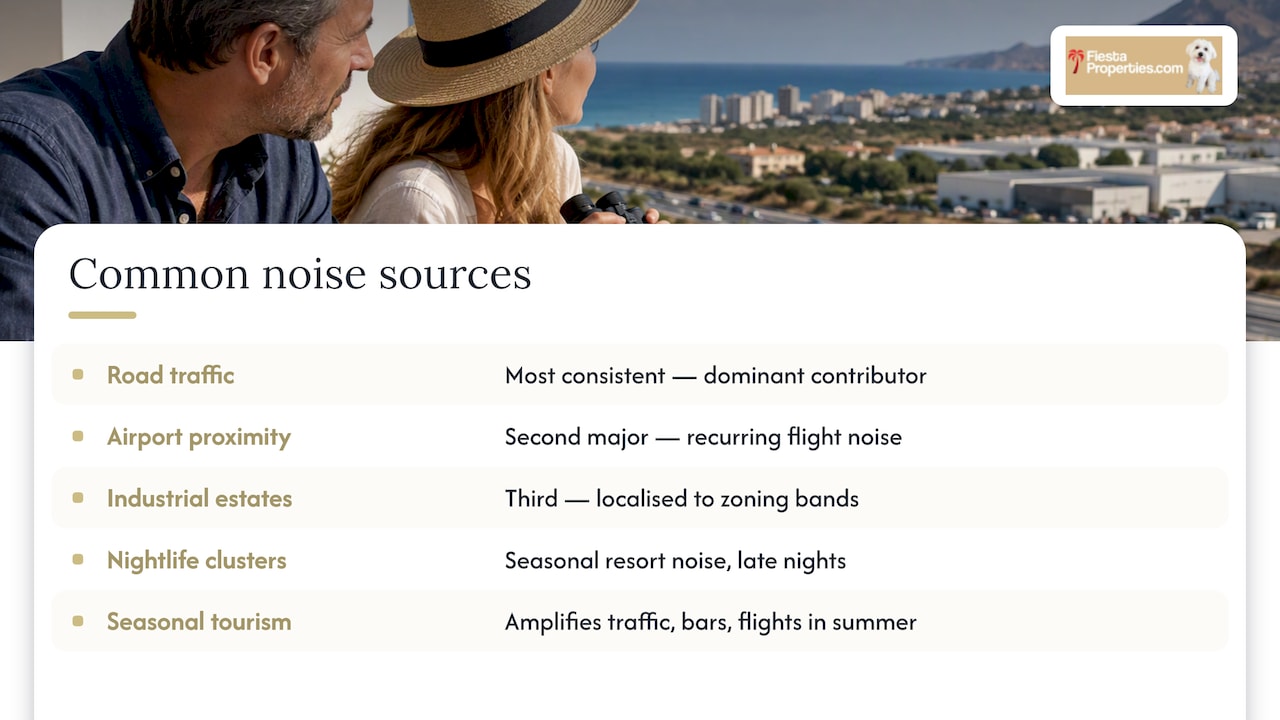
Traffic is the most consistent source of noise across both coasts, particularly along the N-332 corridor and the approach roads into towns such as Torrevieja and Guardamar del Segura. Acoustic studies for the region repeatedly identify road traffic as the dominant contributor to exceeded objectives, ahead of any other single source, as Torrevieja’s own study confirms.
Airport proximity is the second major factor. Properties under or near flight paths into Alicante-Elche or Valencia carry a predictable, recurring noise pattern rather than an occasional one, and checking scheduled destinations and traffic gives a sense of frequency. Industrial estates, common around Torre Pacheco and parts of Cartagena in the Murcia region, add a third and more localised source, usually confined to specific zoning bands rather than spread across a town.
Nightlife clusters in resort centres such as Benidorm create seasonal noise that can extend well past midnight in summer, while quieter towns further from the main strips rarely experience this at all. Seasonal tourism amplifies several of these sources at once: heavier traffic, busier beach bars, and more frequent flights during peak months, all of which drop back closer to the municipal baseline outside the summer season.
Practical mitigation and what to expect from new builds
New-build developments on the Costa Blanca are increasingly built with acoustic performance in mind, particularly where an estudio acústico has flagged a site as exposed to road noise. Common corrective measures include enhanced façade insulation, double or triple glazing rated for sound reduction, and building setbacks from the road edge, all of which reduce the noise reaching a living space even when the external reading remains above the residential objective.
Spain’s Código Técnico de la Edificación sets minimum sound insulation standards (DB-HR) that new builds must meet, and lenders or town halls can require these to be verified before granting a licencia de primera ocupación, as noted in the Torrevieja acoustic documentation. In practice, this means a well-specified new build on a moderately busy road can still deliver a genuinely quiet interior, provided the insulation specification has been properly implemented rather than assumed. Buyers should ask specifically what glazing and wall insulation standard has been used, since specifications vary between developments even within the same town. Fiesta Properties’ guidance on inspecting a new build covers the documents to request to confirm this has been done.
Specific towns and neighbourhoods known for lower noise levels
Within the Costa Blanca South, inland pockets around Algorfa, Benijófar and Formentera del Segura tend to sit away from the busiest coastal roads and resort centres, giving them a quieter baseline than beachfront strips. San Miguel de Salinas and parts of Ciudad Quesada offer a similar pattern, with residential streets set back from through traffic and no significant industrial zoning nearby.
Further north, Altea’s old town and the hillside areas around Alfaz del Pí and Moraira sit apart from Benidorm’s nightlife corridor while remaining close to the coast, giving buyers a genuinely different noise profile within a short drive of a livelier resort. Jávea and Dénia similarly combine coastal access with residential zones that fall outside the tertiary-use bands seen in busier resort centres.
In the Murcia region, San Pedro del Pinatar and quieter stretches around the Mar Menor lagoon offer a lower baseline than the more developed strips nearer Los Alcázares, though this varies street by street rather than uniformly across a town. In every case, the municipal noise map for the specific street remains the more reliable check than a town’s general reputation, since reputation can lag behind new development or a change in road use.
Impact of seasonal fluctuations on noise levels in quiet areas
A town that reads as quiet in a March viewing can sound very different in August. Seasonal tourism brings heavier traffic on approach roads, more frequent flights into Alicante-Elche, and longer hours of activity around beach bars and seasonal markets, all of which lift the ambient noise level well above the figures recorded on a winter baseline map.

This is one of the clearest reasons a single viewing is not enough. A property that appears comfortably within the residential acoustic objective in low season may sit closer to the threshold, or beyond it, during peak months, particularly in towns with a strong summer tourism draw such as Torrevieja or Benidorm. Inland and residential-only zones, away from resort centres and beach access points, tend to show a smaller seasonal swing simply because they attract less passing tourist traffic in the first place. Asking a local resident or the selling agent directly how a street sounds in July and August, rather than relying on a single visit, closes this gap more reliably than any single measurement taken out of season.
Comparing noise levels between coastal and inland quiet zones
Coastal properties carry a built-in trade-off: proximity to the beach and sea view often means proximity to promenade traffic, seasonal beach bars and, in resort towns, nightlife corridors that inland streets simply do not have. Even in a generally quiet coastal town, the streets closest to the seafront tend to register higher on the municipal noise map than those a few streets back.
Inland zones, by contrast, are further from these seasonal pressures but can carry their own sources, particularly where a property sits near a main inland road connecting coastal towns or near agricultural and light industrial activity common in parts of the Costa Blanca South and the Murcia region. The acoustic objective itself does not change between coastal and inland residential zones, both are typically held to the same 55 dB(A) day / 45 dB(A) night standard, but the sources contributing to that reading differ, which is why the noise map for the specific plot matters more than a general coastal-versus-inland assumption.
Local community rules that help keep residential areas quiet
Many residential developments on the Costa Blanca operate under community statutes (estatutos de la comunidad) that set house rules on matters such as pool hours, permitted renovation times, and noise from terraces or shared areas. These are set and enforced by the community of owners rather than the town hall, and they vary significantly between developments, so reviewing them before purchase is worth the time.
At the municipal level, some town halls maintain ordenanzas de ruido, local noise ordinances that set quiet hours and can be more restrictive than the national baseline in residential zones. Checking with the town hall whether such an ordinance exists for a specific street, alongside any record of enforcement action, gives a more complete picture than the noise map alone. Community meeting minutes are a useful secondary source here too, since disputes over noise from a neighbouring bar, building site or terrace often surface there well before they appear on any official map.
A buyer’s honest view on chasing quiet
Quietness on the Costa Blanca is verifiable, not a matter of luck or local reputation. A noise map reading, a timed viewing and an honest conversation with a neighbour will tell you more than any glossy brochure. The trade-off most buyers face is distance from town centres and beach access against genuine peace, and there is no universally right answer to that balance. What matters is making the choice with the numbers in front of you rather than after moving in. Buyers working with Fiesta Properties on a quiet-area brief are welcome to bring us that list of priorities early, before falling for a view that turns out to sit on a flight path.
— Mike Kalia
Finding your quiet Costa Blanca home with Fiesta Properties
Once you know which streets pass the noise checks, the next challenge is finding available property that actually sits there, and that is where a family-run agency with local reach makes the practical difference. Fiesta Properties covers new build, key-ready and off-plan homes across Costa Blanca South, Costa Blanca North and the Murcia region, with the property search and shortlisting service built to filter listings against a buyer’s own criteria, noise included.

Because the team runs sales, aftersales, mortgage arrangement, currency exchange and legal support under one roof, with no legal or currency exchange fees charged to clients, buyers can move from a shortlist of quiet streets to a signed contract without juggling separate providers for each step. If you already have a noise-sensitive brief in mind, whether that is a specific dB threshold, distance from a main road, or a town away from summer nightlife, get in touch through Fiesta Properties to start a shortlist built around it.
Sources
Municipal and regional noise maps, the official safe-purchase guidance, and airport destination data each add a different layer of confirmation before a purchase decision. A foreign buyer’s guide to the Spanish property search process also covers the wider procedural steps worth understanding alongside these noise-specific checks.
- Safely purchasing a house in Spain — official guidance
- Estudio acústico — Torrevieja (municipal document)
- Publication: Map strategic of noise, Murcia — BORM
FAQ
How can I check if an area in Spain is noisy before buying?
Consult the municipal mapa acústico for the street in question, which records measured or modelled noise levels against the residential objective of around 55 dB(A) by day and 45 dB(A) by night, as set out in local acoustic studies such as Torrevieja’s. Combine this with viewings at different times of day and a check with the town hall for any recorded complaints or pending works.
What is a Nota Simple and does it show noise problems?
A Nota Simple is a land registry extract confirming ownership and registered charges on a property, but it does not reliably show unregistered licences or unreported community disputes, including those tied to noise. The official Spanish buyer guidance recommends pairing it with local searches and community certificates for a fuller picture.
Which areas of the Costa Blanca are known for being quiet?
Inland pockets such as Algorfa, Benijófar and San Miguel de Salinas, along with hillside areas around Altea and Alfaz del Pí, tend to sit away from major roads and resort nightlife. The specific street’s noise map reading remains a more reliable check than a town’s general reputation, since conditions vary block by block.
Does noise on the Costa Blanca change with the seasons?
Yes, noise levels typically rise in peak summer months due to heavier traffic, busier beach bars and more frequent flights, compared with a lower baseline recorded in winter. Asking locally how a street sounds in July and August gives a more realistic picture than a single off-season viewing.
Can Fiesta Properties help find a quiet property specifically?
Fiesta Properties can filter a property search by noise-related criteria, including distance from main roads and known noise sources, and can arrange timed viewings and access to any existing acoustic study for a development. Enquiries can start through the property search and shortlisting service.


