

Spanish Mortgage Fees Since Law 5/2019: What International Buyers Pay
· 13 min read

Since 2019, Spanish banks pay the notary, land registry and stamp duty on the mortgage deed itself. Buyers cover the valuation, any agreed opening fee, and administrative extras, which usually add up to somewhere between a few hundred euros and around €2,000, depending on the loan size. Before signing anything, ask the lender for the FEIN and the valuation report, since both determine exactly what you will owe.
TL;DR:
- The bank now covers notary, land registry, and stamp duty costs on the mortgage deed, while buyers pay only for valuation, opening fees, and copies.
- The responsabilidad hipotecaria, often 20 to 40% above the loan amount, determines the actual fees like AJD and notary tariffs, requiring careful review.
- The typical valuation costs range from €250 to €600, with opening fees usually between 0.5% and 1% of the loan, and AJD rate varies from 0.5% to 1.5%.
- Non-resident buyers tend to have smaller loans and may face higher opening fees, but the legal fee distribution remains unchanged regardless of residency.
- Additional costs such as bank cheques, translations, and linked product fees can add to the total, so buyers should verify all charges upfront.
Table of Contents
- Mortgage fees in Spain: who pays what under Law 5/2019
- What each mortgage fee actually is (and typical ranges)
- How the main fees are calculated (and what the FEIN tells you)
- When are mortgage fees paid, and can they be financed?
- Insurance and the recurring costs banks quietly expect
- Worked examples: two typical mortgage budgets
- Does your borrower profile change your mortgage fees?
- Banks versus non-bank lenders: how fee structures differ
- Regional differences that go beyond AJD
- The fees that don’t show up on the headline list
- What’s changing in Spanish mortgage regulation
- Fiesta Properties’ practical checklist for budgeting mortgage fees
- Get your mortgage fees mapped out before you sign anything
- Sources
- FAQ
Mortgage fees in Spain: who pays what under Law 5/2019
Before 2019, Spanish buyers routinely covered nearly every cost tied to arranging a mortgage, including the notary and land registry fees for the mortgage deed itself. That changed with Ley 5/2019, which shifted the bulk of those charges onto the lender. Since then, banks have been legally required to pay the notary, land registry and gestoría costs, along with the AJD stamp duty linked to formalising the mortgage deed.
Buyers still pay for the valuation and any copies of the deed they request.
It’s worth separating two different sets of costs that international buyers often conflate:
- Mortgage-deed costs (notary, registry, gestoría, AJD on the loan): paid by the bank.
- Purchase-deed costs (transfer tax or ITP, or VAT on new builds, plus notary fees for the sale itself): paid by the buyer, entirely separate from the mortgage.
Non-resident buyers sometimes assume “mortgage fees” and “buying costs” are the same bill. They are not. The property purchase tax bill (often 8 to 11% of the price, depending on the region) sits on top of whatever the mortgage itself costs to arrange.
What each mortgage fee actually is (and typical ranges)
Once the legal split is clear, the remaining question is simple: what will you, as the buyer, actually be asked to pay? The list is shorter than it used to be, but each item still needs a number attached to it.
| Fee | Who pays | Typical range |
|---|---|---|
| Tasación (valuation) | Buyer | €250–€600 |
| Comisión de apertura (opening fee) | Buyer, often financed | 0.5–1% of the loan |
| AJD (stamp duty on mortgage deed) | Bank (statutory) | 0.5–1.5% of the responsabilidad hipotecaria |
| Notary and land registry (mortgage deed) | Bank | Several hundred euros, bank-borne |
| Gestoría fees | Bank (for the mortgage deed) | Included in bank’s costs |
| Deed copies, bank cheques, translations | Buyer | usually less than — combined. |
A few of these deserve more context than a table cell allows.
- Tasación is the one fee you pay regardless of outcome. If the bank rejects the loan after the valuer has been out, you still owe the fee, and you’re entitled to a copy of the report.
- The opening fee is the most negotiable line item on this list. Some lenders waive it entirely for strong applicants; others charge close to 1% and expect you to ask for a reduction.
- AJD is technically the bank’s tax to pay, but it still shapes pricing. Lenders in high-AJD regions sometimes build that cost into their rates or fees elsewhere, so don’t assume it’s invisible to you just because your name isn’t on that particular invoice.
- Gestoría fees cover the paperwork trail between notary, land registry and the tax office. Since the bank now pays for the mortgage deed’s gestoría, this cost rarely lands on the buyer’s side any more, though it still applies separately to the purchase deed.
How the main fees are calculated (and what the FEIN tells you)
Almost every mortgage-related fee traces back to one figure: the responsabilidad hipotecaria, or mortgage liability. This is not the loan amount you’re borrowing. It’s a larger figure that typically includes the principal plus ordinary interest, default interest, and costs, often pushing the base 20 to 40% above the loan itself.
That inflated base is what AJD and notary tariffs are actually applied to. A €150,000 loan might carry a responsabilidad hipotecaria closer to €200,000, and it’s that higher number the AJD percentage and notary brackets use, even though the bank, not you, settles both.
Two things worth checking on the FEIN before you sign anything:
- The TAE (APR), which folds in interest and mandatory fees for genuine cost comparison between lenders.
- An itemised breakdown of every fee, including anything linked to insurance or account products.
Pro Tip: Ask your lender to state the responsabilidad hipotecaria figure explicitly on the binding offer, not just the loan amount. If it looks unusually high relative to the loan, ask why before signing.
When are mortgage fees paid, and can they be financed?
Fees don’t all land on the same day. Here’s the rough sequence:
- At application or valuation stage: the tasación fee is charged first, often before the lender has even confirmed approval.
- At signing (completion): the opening fee, deed copies and any remaining administrative charges are settled, usually deducted from the loan disbursement or paid directly.
- Over the loan term: if the opening fee is financed rather than paid upfront, it accrues interest for the life of the mortgage, meaning a 1% fee ends up costing more than 1% in real terms.
If a lender charges an opening fee without disclosing it clearly on the FEIN, that’s grounds for a complaint. The Banco de España’s consumer guidance and local consumer offices both handle these disputes, and UK government guidance recommends using the 10-working-day reflection period to query anything unclear before committing.
Insurance and the recurring costs banks quietly expect
Life insurance and home insurance aren’t strictly mandatory by Spanish law, but most lenders make preferential rates conditional on holding one or both. Home insurance covering the property’s rebuild value is the one condition you’ll see most consistently attached to mortgage offers.
The cost gap between bank-packaged insurance and open-market alternatives is where budgets quietly bleed. Open-market policies can save thousands of euros over a 25-year mortgage term compared with the bundled product a bank pushes at signing.
- Bank-packaged life and home insurance: often priced above open-market equivalents, sometimes by several hundred euros a year.
- Open-market policies: usually cheaper, provided the bank accepts an “equivalence clause” confirming similar cover.
Always ask your lender in writing whether an external policy is accepted, and get that confirmation before you buy elsewhere.
Worked examples: two typical mortgage budgets
Numbers land better with real figures attached. Here’s how the fees translate for two common loan sizes.
If the opening fee is financed into the loan instead of paid upfront, the medium-mortgage buyer’s day-one cost drops closer to €650, but that €1,500 then accrues interest over the full term. It’s rarely the cheapest route, even if it looks that way on completion day.
Does your borrower profile change your mortgage fees?
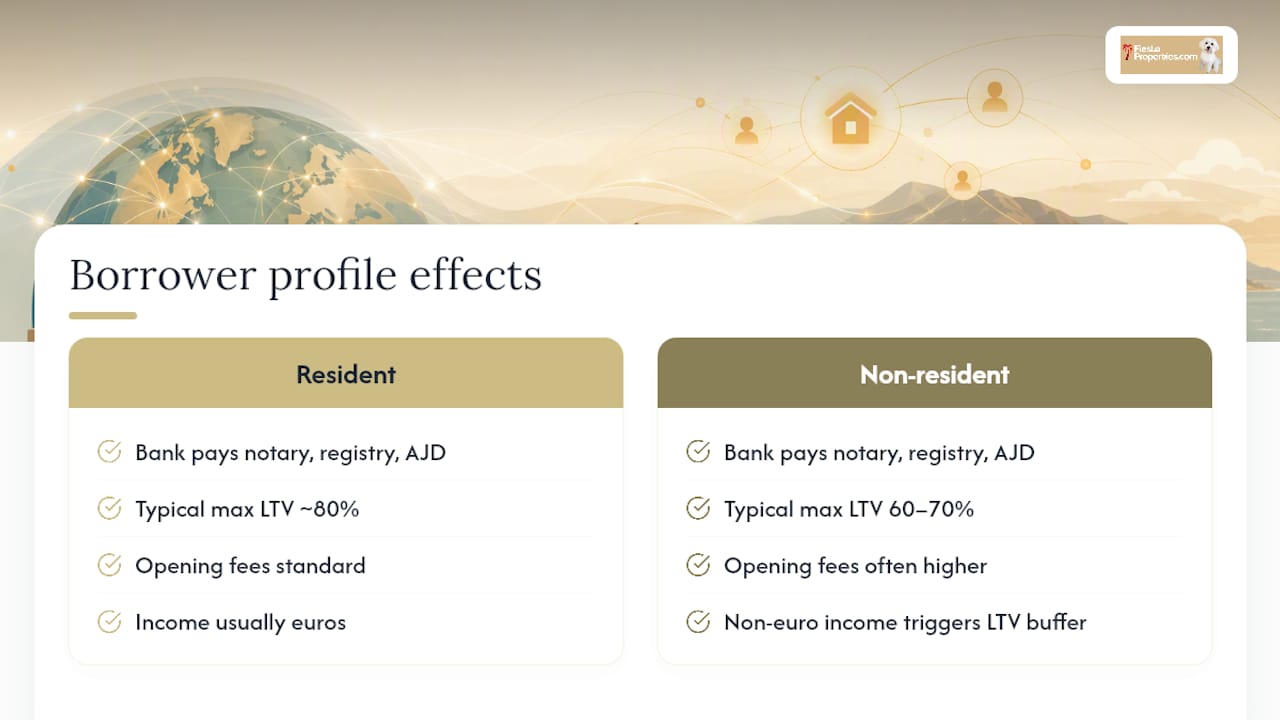
Being a non-resident doesn’t change the legal allocation of fees under Law 5/2019. The bank still pays notary, registry and AJD on the mortgage deed regardless of your residency status. What changes is everything around that framework.
Non-resident buyers typically face lower maximum loan-to-value ratios, commonly around 60 to 70% of the property’s value rather than the 80% sometimes available to residents, so the loan itself is smaller relative to the purchase price. That doesn’t reduce percentage-based fees like AJD, but it does mean a smaller responsabilidad hipotecaria base, which trims the euro amount those percentages are calculated against.
Where non-residents often see a real difference is in opening fees and underwriting costs. Some lenders treat non-resident applications as higher administrative work, given the currency transfers, foreign income verification and NIE processing involved, and price the opening fee slightly higher to reflect that. It’s not universal, but it’s common enough to ask about directly when comparing offers.
Income currency also matters indirectly. If your income arrives in pounds, dollars or another non-euro currency, some lenders apply a buffer to the loan-to-value calculation to account for exchange rate risk, which can mean a marginally larger deposit rather than a higher fee as such.
The practical takeaway: request quotes tailored to your actual residency status rather than assuming a generic rate. A mortgage specialist familiar with non-resident lending across Spanish banks will usually flag these variations faster than a general enquiry to a single branch.
Banks versus non-bank lenders: how fee structures differ
Traditional Spanish banks remain the default route for most buyers, and their fee structure now follows the pattern set by Law 5/2019 closely: they absorb notary, registry and AJD costs on the mortgage deed, and typically charge a valuation fee and, in some cases, an opening fee.
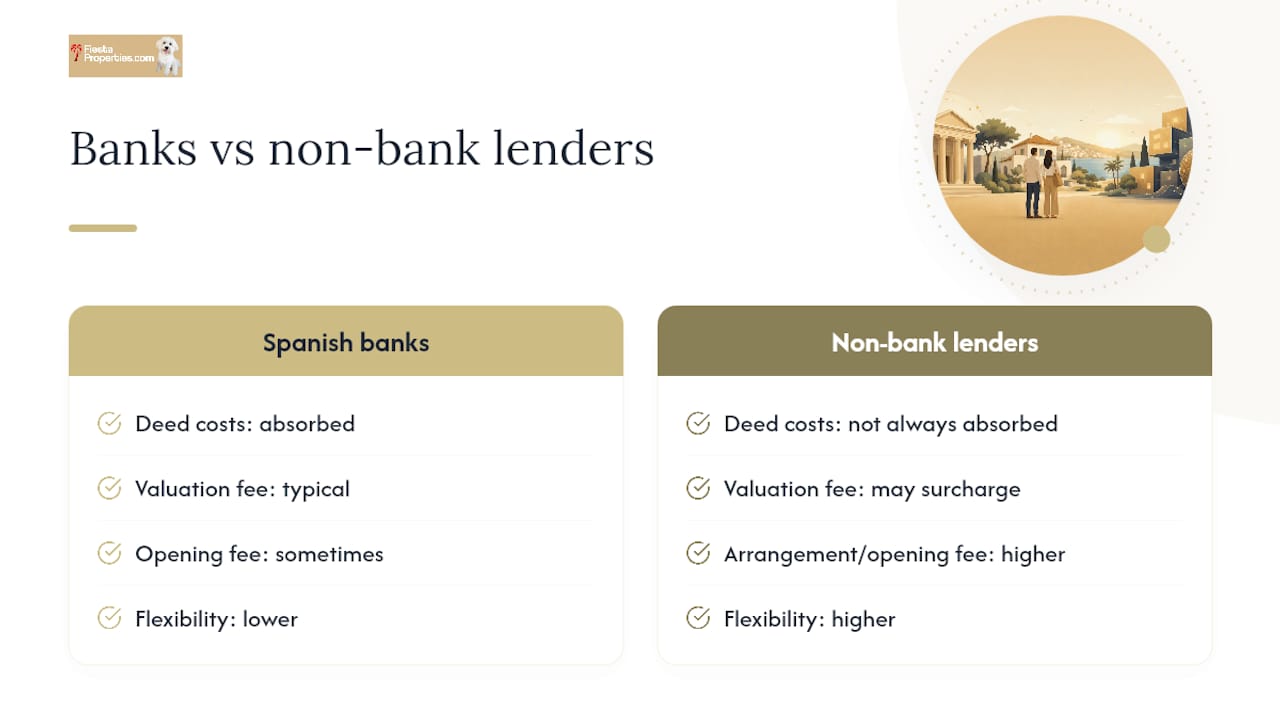
Non-bank lenders, including some specialist or international finance providers, don’t always follow identical pricing logic. Because many operate under different regulatory frameworks or serve niche segments (non-resident investors, higher loan-to-value cases, or buyers with complex income structures), their fee schedules can include items a mainstream Spanish bank wouldn’t typically charge, such as higher arrangement fees or valuation surcharges for non-standard properties.
The trade-off usually comes down to flexibility versus cost. A non-bank lender might approve a case a mainstream bank declines, but that flexibility is rarely free. Expect higher percentage-based fees, tighter timeframes for opening-fee negotiation, and less standardised disclosure than the FEIN format Spanish banks are obliged to provide.
For most international buyers purchasing straightforward residential property, a mainstream Spanish bank remains the more cost-predictable option, precisely because Law 5/2019’s disclosure and cost-allocation rules apply cleanly to that channel. Where a case is unusual, comparing both routes side by side, with full fee disclosure from each, is the only reliable way to know which actually costs less once every charge is added up.
Regional differences that go beyond AJD
AJD gets most of the attention because it varies clearly by region, sitting anywhere between roughly 0.5% and 1.5% depending on the autonomous community. But it isn’t the only place where geography changes your bill.
Notary and land registry fees follow a nationally regulated tariff, so they don’t vary much by region in principle. In practice, though, complexity varies: properties with irregularities in the land registry, rural plots without a clear cadastral reference, or new builds still going through initial registration can all generate extra notarial work and therefore higher charges, regardless of which region you’re in.
Some regions also offer AJD reductions or exemptions for specific buyer categories, most commonly young buyers, large families, or buyers of primary residences under a certain value threshold. These exemptions are set at regional level and change periodically, so a rate that applied last year in one community may not still apply, or may apply to a narrower group.
Gestoría costs, while now mostly bank-borne for the mortgage deed itself, can still show regional pricing differences on the purchase side, since gestoría firms set their own rates and regional markets vary in competitiveness. Costa Blanca and Murcia, both popular with international buyers, tend to have well-established gestoría networks used to handling non-resident paperwork, which can mean smoother processing even where the base fee is similar to elsewhere in Spain.
The practical lesson: don’t budget using a single national AJD figure without checking the rate for the specific autonomous community where you’re buying, and ask whether any regional exemption might apply to your situation.
The fees that don’t show up on the headline list
Standard disclosures cover the big items well: valuation, opening fee, AJD, notary and registry. What they don’t always flag clearly are the smaller charges that accumulate around the edges of a mortgage transaction.
Bank cheque issuance, used to pay the seller or settle existing charges on the property at completion, often carries its own fee, typically modest but easy to overlook when tallying costs in advance. Document translation and certification, needed for non-resident buyers submitting foreign income documents or identification, adds a cost most disclosures never mention because it happens outside the mortgage process itself.
NIE (foreigner identification number) processing isn’t a mortgage fee in the strict sense, but it’s a prerequisite most non-resident buyers need before a Spanish bank will proceed, and the administrative cost of obtaining it should sit in the same budget line as everything else.
Linked-product costs are the least transparent category. Some lenders offer a lower headline rate in exchange for taking out a bank account, credit card, or insurance product you didn’t specifically want. These aren’t hidden exactly, since Law 5/2019 requires disclosure, but they’re easy to skim past on a FEIN if you’re focused on the interest rate alone. Read the itemised fee section of the FEIN in full, not just the TAE figure at the top, and ask specifically whether any quoted rate depends on additional products.
What’s changing in Spanish mortgage regulation
Law 5/2019 remains the core framework governing how mortgage fees are allocated and disclosed, and there’s no indication of a wholesale rewrite on the horizon. What continues to evolve is enforcement and interpretation, particularly around how clearly lenders present the FEIN and whether opening fees are being disclosed with sufficient prominence.
Regulatory attention from the Banco de España has increasingly focused on transparency around linked products and the accuracy of TAE calculations, an area where complaints have periodically prompted clarifying guidance rather than new legislation. Buyers should expect continued tightening of disclosure practice rather than a change to who pays what.
Regional exemptions on AJD are the area most likely to shift year to year, since autonomous communities adjust thresholds and eligibility for reduced rates as part of their own budget cycles. If a specific exemption matters to your purchase, confirm its current status directly rather than relying on a figure from a previous tax year.
For international buyers, the safest approach is treating the legal allocation of fees, bank pays the mortgage deed costs, buyer pays valuation and extras, as stable, while treating regional rates, linked-product practices and disclosure enforcement as details worth re-checking at the point of application rather than assuming they match what applied a year or two earlier.
Fiesta Properties’ practical checklist for budgeting mortgage fees
When clients come to us weighing up a purchase on the Costa Blanca or in Murcia, the fee conversation starts early, not after an offer is already on the table. A mortgage specialist works with clients to review the FEIN details before commitment, highlighting anything unusual in the responsabilidad hipotecaria figure and assisting with pre-approval so valuation and opening fees are clearer.
Because fees cover mortgage-related as well as currency conversion, legal checks on the purchase deed, and document translation, our approach integrates currency exchange support and legal guidance into the same process. Our service includes legal and currency exchange support without additional fees, which keeps the fee conversation focused on what the bank and notary actually require, not extra charges.
— Mike Kalia
Get your mortgage fees mapped out before you sign anything
Mortgage support is offered as part of an integrated process, helping buyers understand valuation costs, FEIN terms, and currency logistics more clearly.

Getting started is straightforward: gather proof of income, ID or NIE documentation, and details of the property you’re considering, then get in touch through our mortgages page for a tailored breakdown of costs, including valuation, opening fee expectations and how currency exchange affects your final transfer. Jamie’s currency exchange support and Carlos’s legal guidance sit alongside the mortgage process at no extra legal or exchange cost to you, so the numbers you’re quoted early on tend to hold up at completion. If you’re still narrowing down where to buy, our Costa Blanca South property search is a practical next stop before locking in loan terms.
Sources
For readers who want to check the underlying rules directly rather than take a summary on trust:
FAQ
How much does it cost to get a mortgage in Spain?
Most buyers pay somewhere between a few hundred euros and around €2,000 at signing, covering the valuation, any opening fee, and administrative copies. The bank covers notary, registry and AJD on the mortgage deed itself under Law 5/2019.
What fees do you pay when buying a house in Spain?
Mortgage-related fees are separate from purchase-related taxes like ITP or VAT. On the mortgage side, expect to pay the tasación and possibly an opening fee, while transfer tax and notary costs for the purchase deed itself sit on top as a distinct cost.
How much is a typical mortgage opening fee?
Opening fees commonly range from 0.5% to 1% of the loan amount, though some lenders waive it for strong applicants. It’s one of the few genuinely negotiable fees on a Spanish mortgage, and it can be financed into the loan rather than paid upfront.
Is it wise to buy a property in Spain now?
That depends on your finances and goals rather than timing alone, but understanding mortgage fees upfront makes the decision clearer either way. Fiesta Properties’ mortgage team can map out pre-approval terms and total costs before you commit to a specific property.


