

UK Movers: Get Healthcare in Costa Blanca Before Your SIP Arrives
· 12 min read
If you qualify for Spain’s public system through S1, employment, or residency, register for a SIP card and use it as your main route; if not, private health insurance covers the gap, and either way, 112 is the number to call in a genuine emergency. Most UK arrivals end up using a blend of both, at least in the first year.
TL;DR:
- Most residents qualify for a SIP card through employment, residency, or holding an S1 form, which grants access to public healthcare once registered.
- Private insurance is often necessary initially, especially for visa compliance and quicker access to specialists, but should be verified carefully with written hospital network confirmations.
- Finding English-speaking doctors is straightforward at private hospitals or dedicated clinics, with options like IMED Levante and Medcare Spain available for residents.
- In emergencies, calling 112 immediately is essential for life-threatening situations, with regional dispatch routing to the nearest appropriate hospital.
- Healthcare costs rise with age, and assumptions about EHIC or GHIC coverage are false for residents; long-term planning should include proper registration or private coverage.
Table of Contents
- How does public healthcare in Costa Blanca actually work?
- Is private health insurance worth it on the Costa Blanca?
- Where can I find English-speaking doctors on the Costa Blanca?
- What number do I call for a medical emergency?
- How do I register for a SIP card and set up GVA +Salut?
- What does healthcare cost, and what mistakes catch people out?
- How do prescriptions work and what will they cost?
- Are dental treatments covered by public healthcare?
- How do you renew healthcare cover once you’re settled?
- What Fiesta Properties clients ask us about healthcare
- Choosing a home with the right healthcare access nearby
- Sources
- FAQ
How does public healthcare in Costa Blanca actually work?
Public healthcare on the Costa Blanca is run by the Valencian health authority, the Conselleria de Sanitat, and access hinges on one document: the Tarjeta Sanitaria Individual, known locally as the SIP or TSI card. Without it, you cannot be assigned a GP or a local health centre, and most public services simply aren’t available to you.
Spain’s public system ranks 7th globally by the World Health Organization, a fact worth knowing when British buyers assume private care is automatically better. It often isn’t. The care itself tends to be excellent; the friction, where it exists, is administrative and linguistic, not clinical.
Eligibility for a SIP card comes through a handful of routes:
- Paying into the Spanish social security system through employment or self-employment
- Holding an S1 form as a UK state pensioner, which entitles you to Spanish public healthcare paid for by the UK
- Registering as a resident and meeting the specific criteria your local centro de salud requires (these vary slightly by town, so it pays to check in person)
Once registered, your assigned médico de familia (GP) becomes your gatekeeper for almost everything: repeat prescriptions, referrals to specialists, and access to hospital treatment. The regional app, GVA +Salut, lets registered patients book GP appointments, check test results, and manage prescriptions digitally, which cuts down considerably on phone queues at the health centre.
Is private health insurance worth it on the Costa Blanca?
Private insurance isn’t a luxury add-on for most British arrivals. It’s often the only realistic option in the early months, and for visa applicants, it’s a legal requirement.
Two structural choices matter most. A cuadro médico policy gives you a fixed network of hospitals and specialists you must use, usually with lower premiums. A reembolso (reimbursement) policy lets you choose almost any provider and claim costs back afterwards, at a higher price. Within either, you’ll also see copago (co-payment) versus sin copago variants, and Non-Lucrative Visa applicants generally need a sin copago policy with no excess, since Spanish consulates reject plans that leave gaps.
There are three reasons private cover appeals even to people who could eventually qualify for public care: it satisfies visa requirements immediately, it gets you in front of a specialist in days rather than months, and it usually comes with English-speaking administrative staff.
Before signing anything, check the following:
- Confirm in writing which hospitals near your new home actually sit in the insurer’s cuadro médico
- Verify the policy meets Non-Lucrative Visa or Digital Nomad Visa rules if you’re applying on that basis
- Read the exclusions list carefully, particularly around pre-existing conditions and dental or maternity cover
Premiums climb sharply with age, and insurers such as Sanitas, Generali, and DKV price plans differently depending on the Costa Blanca postcode, so a quote for Torrevieja won’t match one for Jávea.
Pro Tip: Ask your insurer to email a PDF or screenshot confirming the exact hospital name and provider code, not just a verbal “yes, that’s covered.” Brokers’ spoken assurances have led to disputes when patients turned up at a hospital that had quietly dropped out of the network.
Where can I find English-speaking doctors on the Costa Blanca?
Finding a doctor who consults comfortably in English takes a little groundwork, but the region has no shortage of options built specifically for international patients.
- Start with private hospitals that market international patient services. IMED Levante in Benidorm is the largest private hospital in Alicante province following its expansion, running a 24-hour emergency department and multiple specialties, with staff used to treating British and Scandinavian patients.
- Look at dedicated English-language GP practices. Medcare Spain runs a British GP-style service across several Costa Blanca towns, while Scandinavian International Clinics operate in Albir and Dénia with English-speaking doctors on staff.
- Ask before you book, not after. A quick email or phone call confirming the consulting doctor’s English level and current appointment availability saves an awkward first visit.
- If your assigned public GP’s English is limited, request an interpreter through the health centre or book a private initial consultation to get a diagnosis explained clearly before returning to the public pathway.
Clinic hours, phone lines, and language support all shift over time, so treat any listing, including this one, as a starting point rather than gospel. Confirm directly before you rely on it.
What number do I call for a medical emergency?
For anything life-threatening, the answer is simple: dial 112. It’s Spain’s universal emergency number, and on the Costa Blanca, calls are routed through 112 Comunitat Valenciana to the health emergency coordination centre, CICU, which dispatches ambulances and directs you to the nearest appropriate hospital.
Call 112 immediately for chest pain, breathing difficulty, sudden severe weakness, heavy bleeding, or loss of consciousness. For anything urgent but stable, such as a minor fracture or a bad infection, your centro de salud’s out-of-hours service or the hospital’s urgencias department is the right first stop, not an ambulance callout.
112 covers every EU member state, not just Spain, so the number works exactly the same whether you’re calling from your new home in Orihuela Costa or on holiday elsewhere on the continent.
Bring your SIP card or insurance policy number and photo ID. If you’re not yet registered in either system, expect to be treated first and billed afterwards for anything beyond immediate stabilisation.
How do I register for a SIP card and set up GVA +Salut?
The registration sequence follows a fixed order, and skipping a step tends to cause delays rather than shortcuts.
- Register your address at the town hall (empadronamiento). Nearly everything downstream depends on this certificate.
- Obtain your NIE and, if applicable, register with Spanish social security or lodge your S1 form.
- Take your documents to the local health centre to apply for your SIP or TSI card. Pensioners using an S1 typically need an appointment for this handover, and the whole process can take a few weeks from S1 registration to a working SIP card.
- Once issued, download GVA +Salut and register your SIP number to start booking GP appointments and managing prescriptions online.
You’ll typically be asked for your passport, NIE certificate, empadronamiento certificate, and either your S1 form or proof of social security contributions. If none of that applies to you yet, private or travel insurance is the sensible bridge until your public entitlement comes through.
What does healthcare cost, and what mistakes catch people out?
The most expensive mistake British arrivals make is assuming their EHIC or GHIC card covers a house move. It doesn’t. Gov that these cards are for temporary stays, such as holidays, not for residents building a life in Spain.
The other recurring errors are avoidable with a bit of diligence:
- Buying the cheapest private policy available without checking whether your nearest hospital is actually in its network
- Assuming a policy is visa-compliant when it carries an excess or copago, which most consulates reject
- Not keeping copies of referral authorisations and receipts, which matter enormously if you later need to claim reimbursement
Premiums rise steeply with age. A policy that costs relatively little in your fifties can look very different by your seventies, which is one reason many retirees weigh S1 eligibility carefully against private cover before committing long-term.
Pro Tip: Request written cuadro médico confirmation for your specific address, not a generic regional list. Provider networks can vary between towns just a few miles apart along the coast.
How do prescriptions work and what will they cost?
Once you hold a SIP card, your GP can issue electronic prescriptions through the Valencian system, which you collect at any pharmacy (farmacia) using your card. Public system prescriptions carry a co-payment based on income and pensioner status, generally a modest percentage of the medicine’s cost, capped monthly for many categories rather than charged in full.

Retirees using an S1 are typically treated the same as Spanish pensioners for prescription charges, which usually means a lower co-payment rate than working-age contributors. If you’re relying on private insurance instead, prescription cover varies enormously between policies. Some reimburse medicine costs as part of the package; many do not, treating prescriptions as an out-of-pocket expense even when hospital and specialist care is fully covered.
For anyone bridging the gap before SIP registration, or relying purely on private cover, it’s worth asking your insurer directly whether prescribed medication is included or excluded, since this detail is often buried in the small print rather than the headline summary. Pharmacies across the Costa Blanca are generally well stocked and pharmacists themselves often speak reasonable English, particularly in areas with large British populations such as Torrevieja, Benidorm, and the Orihuela Costa strip.
Keep every prescription receipt if you’re on a reimbursement-style private policy. Claims without paperwork are routinely rejected.
Are dental treatments covered by public healthcare?
Dental care is where the public system falls noticeably short compared with the rest of Spanish healthcare, and it’s worth knowing this before you assume your SIP card covers a check-up. Public dental provision through the SIP system is limited largely to emergency extractions, basic paediatric dentistry for children, and a small number of preventative treatments. Fillings, crowns, root canals, and anything cosmetic sit outside public coverage almost entirely.
In practice, this means most residents, British and Spanish alike, use private dentists for anything beyond a genuine dental emergency. Private dental clinics are plentiful along the coast, with pricing typically lower than UK private dental rates for comparable work, though quality and English-language support vary between practices just as they do with medical clinics.
Some private health insurance policies include a basic dental add-on, usually covering check-ups and cleaning, with more involved treatment charged separately or through a discount scheme rather than full cover. If dental care matters to you, and for most people it does, check this specifically when comparing policies rather than assuming it’s bundled in with general medical cover. It rarely is by default.
How do you renew healthcare cover once you’re settled?
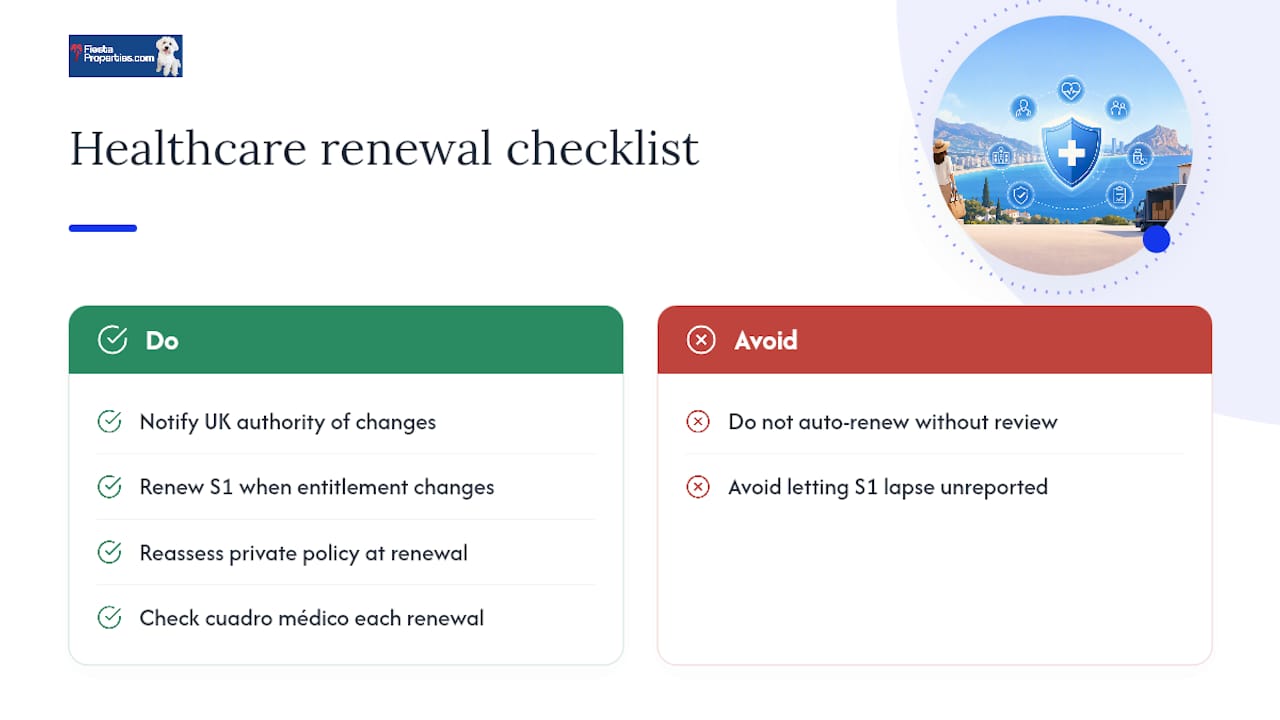
Healthcare entitlements aren’t a one-time setup. SIP cards themselves don’t typically expire in the way a passport does, but the underlying eligibility behind them can change, particularly if your residency status, S1 arrangement, or social security contributions shift.
If you’re relying on an S1, you’re responsible for notifying the relevant UK authority of any change in circumstances, and for renewing the paperwork if your pension or entitlement basis changes. Letting this lapse without informing the Spanish system can create gaps that only surface when you actually need treatment.
For private policyholders, annual renewal is the moment to reassess rather than auto-renew blindly. Insurers can adjust premiums at renewal, sometimes sharply as you move into a new age bracket, and hospital networks occasionally change too. It’s worth checking your cuadro médico confirmation again at each renewal, not just at the point of purchase, since a hospital that was in-network last year isn’t guaranteed to stay there.
Anyone planning healthcare costs decades into retirement, rather than just the first few years, may find it useful to see how comparable long-term healthcare cost planning is approached in other retirement markets, even though the specific rules differ from Spain’s system.
What Fiesta Properties clients ask us about healthcare
Healthcare comes up in nearly every serious conversation with a British buyer, particularly retirees. The two questions we hear most often are how close a property sits to a hospital with a proper emergency department, and whether there’s an English-speaking GP nearby.
We’re not clinicians, and we don’t advise on insurance or medical matters. But when we shortlist properties, proximity to facilities like IMED Levante, or to towns with established English-language clinics, is something we factor into the conversation, because it genuinely shapes which areas suit which buyers.
Choosing a home with the right healthcare access nearby
Fiesta Properties is a family-run agency, not a healthcare provider, so we won’t pretend to advise on insurance or clinical matters. What we can do is help you shortlist properties with a clear eye on what actually matters to you day to day, including how close a home sits to a hospital with an emergency department or a town with established English-speaking clinics.

Mike and Tatiana lead sales and aftersales from first enquiry through to completion, and beyond, while our specialists cover the practical side of a move: Tim on mortgages, Jamie on currency exchange, and Carlos on the legal process. If proximity to hospitals or English-speaking care providers is a priority for your move, browse our Costa Blanca South property search and get in touch. We’ll help build a shortlist around the location factors that matter most to you.
This article is general information, not a substitute for advice from a qualified doctor. Consult a qualified healthcare professional about your own circumstances before acting on anything here.
Sources
- Health care in Spain — Wikipedia
- Healthcare navigation on the Costa Blanca: A resident’s guide to hospitals, doctors and emergencies — Euro Weekly News
- IMED Levante hospital — IMED Hospitales
- Gov
FAQ
Do I qualify for public healthcare in Costa Blanca as a UK retiree?
You qualify if you hold a valid S1 form as a UK state pensioner, which transfers your healthcare cost to Spain’s public system. You’ll still need to register for a SIP card at your local health centre before you can see a GP or access hospital care.
Can I use my GHIC card to live in Costa Blanca long-term?
No. GOV.UK confirms EHIC and GHIC cards cover temporary stays only, such as holidays, not residency. If you’re relocating permanently, you need either an S1-based SIP registration or private health insurance.
How do I check if a hospital is in my insurer’s network?
Contact your insurer directly and ask for written confirmation, ideally a PDF or screenshot naming the specific hospital and provider code. Verbal assurances from brokers have led to disputes when patients arrived at hospitals no longer in the cuadro médico.
What should I do in a medical emergency on the Costa Blanca?
Call 112 immediately for anything life-threatening, such as chest pain or severe bleeding. The call routes through 112 Comunitat Valenciana to the regional emergency coordination centre, which dispatches an ambulance to the nearest suitable hospital.
Can Fiesta Properties help me find a property near good hospitals?
Yes. Fiesta Properties factors proximity to hospitals and English-speaking clinics into property shortlists when clients raise it as a priority, alongside its usual property search and bilingual negotiation support.


