

Find Live Costa Blanca New Builds, Local Shortlist for Overseas Buyers
· 12 min read

New build homes are widely available across Costa Blanca North, Costa Blanca South and the neighbouring Costa Cálida, spanning villas, apartments and townhouses at price points from modest inland budgets to premium beachfront developments. Buyers pay VAT rather than transfer tax on these purchases, which shapes the overall budget from the outset. The most reliable next step is contacting a local agent who can confirm live availability and arrange viewings around a realistic shortlist.
TL;DR:
Buyers should verify live availability of new build homes through a local agent, as portal listings may lag behind actual sales.
Proximity to the sea is the main price determinant, with beachfront properties costing significantly more than inland villas or townhouses.
Reserve the property with a deposit and sign a private contract that includes staged payments and guarantees the deposit in a bank account for off-plan purchases.
Mortgage options for non-residents typically cover up to 70-75% of the purchase price with terms up to 30 years, requiring pre-approval and careful currency transfer timing.
Vet developers thoroughly by checking licenses, bank guarantees, and completion track records, and always seek independent legal advice before reserving off-plan.
Table of Contents
-
What types of new builds are available, and what do they cost?
-
Finance, mortgages and currency transfer for international buyers
-
Get a tailored shortlist of new builds from Fiesta Properties
Where to search for new build homes on the Costa Blanca
Property portals are the natural starting point. Sites listing “obra nueva” (new build) inventory show several hundred new-build homes and developments across the Costa Blanca region, and most let you filter by completion date, property type and budget, which narrows a broad search into something manageable within minutes.
Developer websites are worth a second look once a portal listing catches your eye. Developers frequently run early-bird pricing or phase-release promotions that never make it onto the main portals, and the asking price on a developer site can differ from the portal listing for the same unit, so cross-checking both before you get attached to a figure saves disappointment later.
A local estate agent earns their place in this process by doing the verification legwork you cannot do from another country: confirming a unit is genuinely available, arranging viewings around your travel dates, and staying involved after completion when snagging issues or paperwork questions arise.
A practical workflow looks like this:
-
Scan portals first, filtering for new build status and realistic completion windows.
-
Cross-reference any development you like on the developer’s own site for current pricing and promotions.
-
Ask a local agent to confirm live availability, since portal listings can lag behind actual sales.
-
Book viewings and request the development’s licence and completion documentation before reserving.
An agent who already tracks completion dates and tourist-licence status across multiple developments can pre-filter dozens of options down to a handful worth your time.
What types of new builds are available, and what do they cost?
Three property types dominate new build listings on the Costa Blanca, and each tends to cluster in particular settings.
-
Villas appear mostly in golf resorts, gated communities and quieter coastal towns, offering private pools and larger plots.
-
Apartments dominate beachfront and town-centre developments, usually with shared pools, gardens and sometimes a concierge service.
-
Townhouses sit between the two, common in family-oriented developments slightly inland, offering private outdoor space without villa-level land or price.
Price bands vary sharply by sub-region. Costa Blanca South towns such as Torrevieja, Guardamar del Segura and Pilar de la Horadada tend to offer the most accessible entry points for apartments and townhouses, while Costa Blanca North locations like Jávea, Moraira and Altea command a premium for sea views and established infrastructure. Costa Cálida, around Mar Menor and the surrounding towns, has become popular precisely because it offers similar coastal living at comparatively lower price points than the more established Costa Blanca resorts.
Proximity to the sea is the single biggest price driver. Beachfront apartments carry the highest per-square-metre cost and the highest community fees, since shared pools, lifts and landscaped grounds all need maintaining. Inland villas and townhouses cost less to buy and less to run, though you trade that saving for a longer drive to the beach.
Off-plan pricing is usually lower than the price for a finished, key-ready home in the same development, since developers reward early commitment. The trade-off is a wait, sometimes 12 to 24 months, before you can move in or start renting the property out.
The new-build buying process: steps, timeline and key costs
Buying a new build in Spain follows a fairly fixed sequence, whether you are reserving off-plan or buying a completed unit.
-
Reserve the property with a holding deposit, typically a few thousand euros, which takes it off the market while contracts are prepared.
-
Sign the private purchase contract, which sets out the payment schedule, specifications and completion date.
-
Pay staged deposits if buying off-plan, usually tied to construction milestones rather than paid all at once.
-
Arrange your mortgage or confirm funds, completing any lender valuation the bank requires.
-
Sign the escritura (the public deed) before a notary at completion, at which point the balance is paid and keys are handed over.
Timelines differ by product. A completed, key-ready home can close in as little as four to eight weeks once funds and paperwork are ready. Off-plan purchases run on the developer’s build schedule, commonly 12 to 24 months from reservation to handover.
Budget for roughly a moderate percentage of the purchase price on top of the sticker figure. That estimate covers VAT, notary fees, land registry charges and legal management together, and it is the figure most buyers underestimate when they first budget for a Spanish purchase.
The reason new builds cost differently from resale property comes down to which tax applies. New build purchases carry VAT, whereas second-hand homes are subject to ITP (transfer tax) instead, and the two are calculated differently depending on region and property value. Confirming which regime applies to your specific purchase, rather than assuming, avoids a nasty surprise on completion day.
Finance, mortgages and currency transfer for international buyers
Spanish lenders do offer mortgages to non-residents, though terms are more conservative than for locals. Expect loan-to-value ratios generally up to around 70%, occasionally stretching to 75% with certain lenders, over terms that can run up to 25 to 30 years or until around age 80, whichever comes first.
Fixed and variable rate products both exist, and the right choice depends on how long you plan to hold the property and your appetite for rate movement. Getting pre-approved before you start viewing seriously puts you in a stronger negotiating position with sellers and developers alike.
Currency transfer timing matters more than most buyers expect. A shift of a few cents in the euro exchange rate on a €300,000 purchase can move the final cost by thousands, so locking a rate or using a specialist transfer service at the right moment protects your budget.
Before applying, gather:
-
Proof of income and recent bank statements.
-
Passport and, where applicable, residency documentation.
-
Proof of the deposit source (banks ask for this routinely).
-
Credit history from your home country if requested.
Pro Tip: Get mortgage pre-approval in principle before you reserve a property. Developers move fast on popular units, and a buyer with financing already lined up is far more attractive than one still shopping for a lender.
How to vet a developer before reserving off-plan
Reserving off-plan means trusting a company to deliver a home that does not exist yet, so the vetting stage matters more than any other part of the process.
-
Check the developer’s licence and track record, including whether they have completed similar projects on time in the past.
-
Confirm bank guarantees protect your deposit, meaning your staged payments sit in a guaranteed account rather than the developer’s general funds.
-
Ask direct questions about the projected completion date, what warranty applies, current community charges, and exactly which fittings and finishes are included versus optional extras.
-
Watch for vague contractual language around specifications or completion dates, and treat any refusal to provide deposit protection as a serious warning sign.
Planning and environmental issues can also delay or derail a scheme. Objections to proposed developments near protected natural areas have held up projects over flood and fire risk, so checking a development’s planning status before committing is not excessive caution.
Pro Tip: Independent legal advice, separate from the developer’s own lawyer, is the cheapest insurance you will buy during this entire process.
Handover, warranties and aftersales for new build owners
Handover day is when small oversights become expensive ones if you rush it. Walk every room, test every switch, tap, and appliance, and check communal areas match what the brochure promised before signing off.
-
Confirm all systems (electrics, plumbing, air conditioning) work correctly before accepting keys.
-
Request full documentation: the certificate of habitation, warranty paperwork and utility connection details.
-
Log any defects (snags) in writing immediately, since most developer warranties cover structural issues for years but finish-related snags for a much shorter window.
-
Ask what the typical rectification timeline is for anything you flag.
An agent offering genuine aftersales support, rather than disappearing after the sale closes, is often the difference between a snag being fixed in weeks or dragging on for months.
Fiesta Properties’ local perspective on new-build buying
A local estate agency with over 16 years’ experience matches international buyers with new-build homes across the Costa Blanca and Costa Cálida, operating as a family business from Torrevieja. That local grounding means every enquiry is handled by people who know which developments are genuinely close to completion and which are still finding their feet.
Clients may receive support from a dedicated team throughout the buying process, including sales and aftersales support, mortgage pre-approval assistance, currency exchange guidance, and legal advice, with no additional fees for these services. If you want a shortlist matched to your budget and preferred region, that request can start today.
The legal steps for buying a new build in Spain
Spanish property law treats new build purchases with a specific sequence of legal checkpoints, each protecting a different stage of your money.
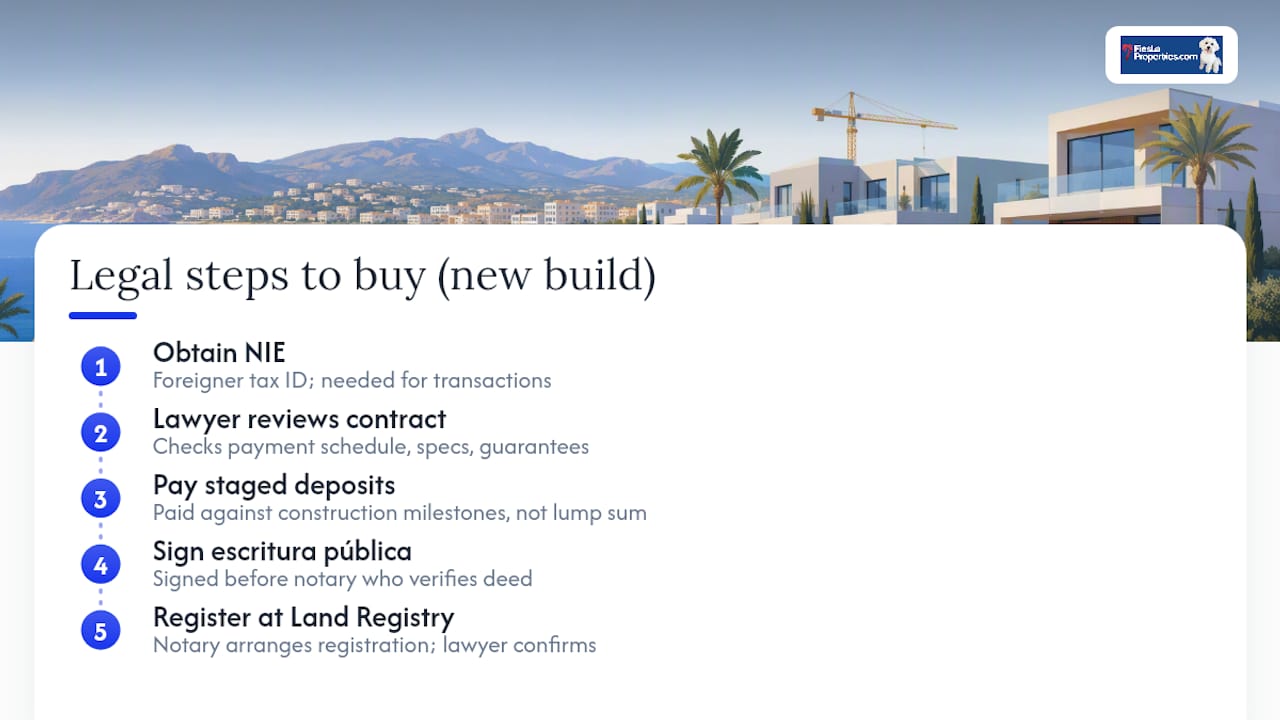
The process begins with an NIE number (Número de Identificación de Extranjero), a foreigner’s tax identification number required for any property transaction, mortgage application or utility contract in Spain. Apply for this early, since delays here can hold up everything downstream.
Once you have chosen a property, your lawyer reviews the private purchase contract before you sign it, checking the payment schedule, specifications list, penalty clauses for delayed completion, and confirmation that staged deposits sit in a bank-guaranteed account rather than the developer’s operating funds. This is the single most important legal check in an off-plan purchase, because it is the document that protects your money if the developer runs into financial trouble.
Staged deposits, if buying off-plan, are paid against construction milestones set out in that contract, never as one lump sum upfront.
At completion, you sign the escritura pública before a notary, who verifies both parties’ identities and confirms the deed’s terms match what was agreed. The notary then arranges registration of the property at the Land Registry, formally recording your ownership. Your lawyer should confirm this registration completes, since an unregistered deed leaves your ownership unprotected against third-party claims.
Choosing a local agent for Costa Blanca new builds
Not every estate agent working the Costa Blanca specialises in new build property, and the distinction matters more than buyers expect. New builds involve developer contracts, staged payment schedules and construction timelines that a resale-focused agent may rarely handle.
Look for an agency with a physical office in the area you are targeting, a portfolio that spans multiple towns rather than a single development, and a team structure that covers more than just sales. An agency offering mortgage guidance, currency transfer support and legal coordination under one roof saves you from coordinating separate providers across time zones.
Ask directly how many completed new build developments the agency has handled, whether they offer aftersales support once you have the keys, and how they verify a developer’s licensing before listing a property. A good agent should answer these without hesitation, because verification is part of their daily work.
Reviews matter here too. An agency with a consistently high Google rating built over years, rather than a handful of recent reviews, tends to reflect a longer track record of following through after the sale closes rather than disappearing once commission is paid.
Common mistakes buyers make with new build purchases
The most frequent mistake is treating the advertised price as the total cost.
A second common error is skipping independent legal review of the purchase contract, relying instead on the developer’s own paperwork or a lawyer recommended by the seller. This creates a conflict of interest at exactly the point where a buyer most needs impartial advice.
Underestimating off-plan timelines causes real frustration too. Construction delays happen, and a buyer who has committed to a rental start date or a fixed moving date without buffer time can find themselves paying for temporary accommodation while waiting on a handover.
Finally, many buyers skip the currency transfer conversation entirely, assuming their bank’s standard exchange rate is competitive. On a purchase of several hundred thousand euros, that assumption can cost thousands more than using a dedicated transfer specialist.
Why the standard buying checklist misses the point
Most guides to buying a new build reduce the process to a checklist: get an NIE, hire a lawyer, budget for taxes, sign the contract. None of that is wrong, but it treats every buyer as facing the same risk, and they are not.
The real risk in a new build purchase is timing, not paperwork. Off-plan buyers are exposed to construction delays and developer solvency for a year or two before they see a finished home, while resale buyers face almost none of that. Yet most advice spends equal weight on both scenarios, leaving off-plan buyers under-prepared for the specific patience and contractual scrutiny their purchase actually demands.
What I would prioritise first is not the tax calculation, useful as that is, but the strength of the deposit protection in the private contract. A buyer who gets that one clause wrong can lose staged payments entirely if a developer fails. A buyer who gets the tax estimate slightly wrong just adjusts their budget. The conventional advice treats these as equally important checklist items. They are not.
— Mike Kalia
Get a tailored shortlist of new builds from Fiesta Properties
A local property agency can provide verification of development statuses and bank-guaranteed deposit schemes, helping buyers avoid extensive cross-checking. Clients typically work with a team covering sales, mortgage, currency, and legal matters throughout the purchasing process, often without extra legal or currency exchange fees.

Browse the current new build properties across Costa Blanca, or use the property search tool to filter by area and budget. If Orihuela Costa is on your shortlist, the area guide breaks down what that stretch of coast offers.
Once you have a shortlist in mind, contact Fiesta Properties directly to arrange viewings. A short call is usually enough to confirm live availability, outline realistic timelines for your chosen development, and get mortgage pre-approval moving in parallel, so you are not starting the finance conversation from scratch once you find the right home.
FAQ
Where can I find new build houses in Spain?
Property portals listing “obra nueva” inventory are the fastest starting point, showing several hundred new-build homes across the Costa Blanca, followed by checking developer sites directly and instructing a local agent like Fiesta Properties to confirm live availability.
Is it cheaper to buy or build a house in Spain?
Buying an existing new build is generally simpler and faster than commissioning a self-build, since off-plan purchases from an established developer come with fixed contracts, staged payments and a set completion date rather than the variable costs and timelines of a custom build.
Where is the cheapest place to live in Costa Blanca?
Costa Blanca South towns such as Torrevieja, Guardamar del Segura and Pilar de la Horadada typically offer the most accessible entry prices for new build apartments and townhouses, while nearby Costa Cálida offers comparable coastal living at generally lower price points still.


