

After Golden Visa Closed, UK Citizens' Spanish Residency Options
· 11 min read

UK citizens can still gain residency in Spain, but the route depends on individual circumstances: passive income points towards the Non-Lucrative Visa, remote work towards the Digital Nomad Visa, a Spanish job offer towards a work visa, and family ties towards reunification. The Golden Visa property route closed in April 2025, so most applicants now start with a consular appointment in the UK and early document apostilling.
TL;DR:
- Most UK residents now need to apply for a visa before traveling to Spain, as the Golden Visa route closed to new applicants in April 2025.
- Proof of income or means must meet specific thresholds based on the visa type, with passive income for retirees and employment income for work visas.
- Necessary documentation includes apostilled civil documents, private health insurance, criminal record certificates, and certified translations, all prepared before booking the consulate appointment.
- Application involves a two-stage process: obtaining the visa in the UK and then registering your address and residence card in Spain within specified timeframes.
- Continuous residence of five years qualifies most visa holders for long-term residency, while permanent citizenship typically requires around ten years of legal residence.
Table of Contents
- Spanish residency options UK citizens can choose from
- What documents do you need before booking the consulate?
- How do you apply at the consulate and register once you arrive in Spain?
- What is Withdrawal Agreement beneficiary status?
- How long until you reach permanent residency or citizenship?
- What does the process cost, and what about Spanish tax residence?
- Checklist and pitfalls before you submit your application
- Practical timing advice from Fiesta Properties
- An underestimated administrative step, and what to do about it
- Fiesta Properties: settling in Spain with property support that removes the guesswork
- Official pages and consular links to bookmark
- Sources
- FAQ
Spanish residency options UK citizens can choose from
Which route fits depends almost entirely on where the income comes from and what the applicant plans to do once in Spain. Since 1 January 2021, UK nationals have been treated as third-country nationals for immigration purposes, meaning anyone wanting to stay beyond 90 days in any 180-day period needs a visa applied for at a Spanish consulate before travelling, not on arrival.
The six main routes cover most circumstances:
- Non-lucrative visa (NLV): for those living off pensions, savings, or investment income, with no permission to work in Spain. Initial grant runs for one year, renewable for longer periods afterwards.
- Digital Nomad Visa (DNV): for remote employees or freelancers whose clients or employer sit outside Spain. It requires monthly income of roughly 200% of the Spanish minimum wage, around €2,520 in 2026, and can unlock the flat 24% Beckham Law tax rate on Spanish-source income under specific conditions.
- Work visa (cuenta ajena): for those with a firm job offer from a Spanish employer. The employer generally has to demonstrate the role cannot easily be filled by an EU candidate, a labour market test that adds weeks to the timeline.
- Student visa: for enrolment on a recognised course of more than 90 days. Time spent on a student visa counts only partially towards long-term residency, so students planning to stay should budget for that shortfall.
- Entrepreneur / Startup Law visa: for founders with an innovative or scalable business plan endorsed by Spain’s entrepreneurship agency (ENISA). It has effectively become the successor to the investment-based Golden Visa for people wanting a business rationale for residency rather than a straightforward property purchase.
- Family reunification (reagrupación familiar): for spouses, registered partners, dependent children, and in some cases dependent parents of someone already legally resident in Spain. Documentary requirements are comparatively lighter, focused on proving the relationship and the sponsor’s ability to support the family member.
Retirees moving on pension income tend to gravitate towards the NLV because it explicitly accepts passive income, though it comes with a clear catch: it does not permit remote work for foreign clients, even casual freelance work. Anyone earning money from a UK employer or client base needs the DNV instead.
What documents do you need before booking the consulate?
Every route above shares a common documentary backbone, and getting it wrong is the single biggest cause of delay. Before booking anything, gather the following:
- Proof of income or means, calculated against IPREM (Indicador Público de Renta de Efectos Múltiples), the reference figure Spain uses to set minimum income thresholds for visas and benefits. For the NLV, expect to show savings or passive income well above the base IPREM rate per applicant, with additional amounts for dependants. Acceptable evidence includes pension statements, dividend records, rental income contracts, and recent bank statements.
- Private health insurance with no co-payments and full coverage in Spain, taken out with an insurer authorised to operate there. UK nationals holding an S1 form for state pension healthcare often assume it covers this requirement; it frequently does not, because registration with Spanish social security can take months to process and most consulates want an insurance policy in place from day one.
- A criminal record certificate from ACRO Criminal Records Office, apostilled and no older than three months by the time you apply.
- A medical certificate confirming you do not suffer from any disease with serious public health implications, again usually valid for around three months.
- Certified Spanish translations of every foreign-language document, plus apostilles on any UK-issued civil documents such as birth or marriage certificates.
Pro Tip: Apostilling ACRO certificates through the Foreign, Commonwealth & Development Office can take several weeks during busy periods, so order yours the moment you decide to apply rather than waiting for a consular appointment slot to appear.
Confirm your consular district before you do anything else. Applications go to the consulate covering your UK postcode, and a file submitted at the wrong office is simply refused rather than forwarded on.
How do you apply at the consulate and register once you arrive in Spain?
The process runs in two distinct phases: the visa application in the UK, then residence registration once you land in Spain.
- Identify your consulate and book an appointment. UK applicants use the consular network in London, Edinburgh, Manchester, or Belfast depending on postcode. Appointment slots can run several weeks out, particularly in spring and early autumn when relocation demand peaks.
- Attend the appointment with your full document set. Staff check originals against apostilled copies and translations, take biometric data, and confirm the visa category. Missing a single document usually means resubmitting rather than a quick fix on the day.
- Wait for a decision, typically a matter of weeks rather than days, then collect your visa sticker, which activates from a date you choose within its validity window.
- Travel to Spain and register your address (empadronamiento) at the local town hall within days of arrival. This step underpins almost everything that follows, from healthcare access to school places.
- Apply for your TIE (Tarjeta de Identidad de Extranjero) within 30 days of entry, usually via an appointment at the local Oficina de Extranjería or police station. The TIE is your physical residence card and the document you’ll use for everything from opening a bank account to signing a rental contract.
- Track your entry date carefully. Your 90-day Schengen allowance stops applying once your visa is active, but any pre-arrival trips to Spain on a tourist basis still count against it, so avoid burning those days while your application is pending.
What is Withdrawal Agreement beneficiary status?
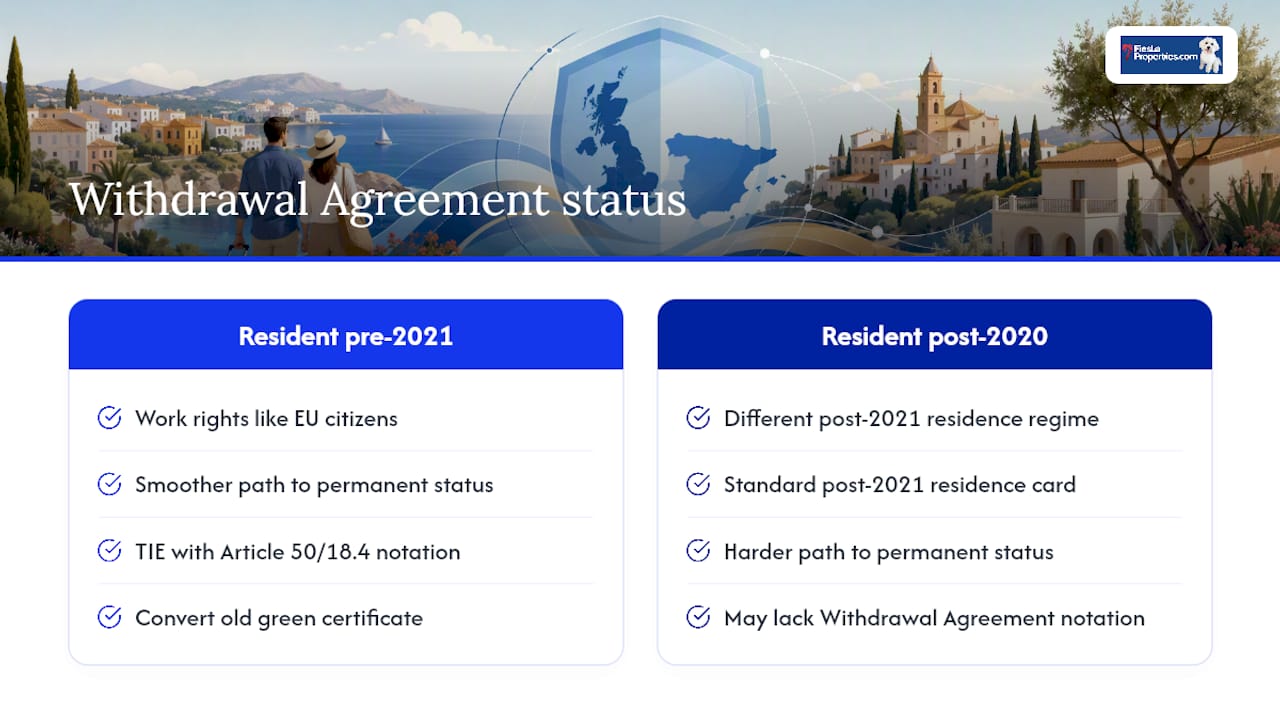
If you were legally resident in Spain before 31 December 2020, you fall under a materially different category. Withdrawal Agreement beneficiaries retain rights closer to those of EU citizens before Brexit, including continued work rights and a smoother path to permanent status, and this group’s documentation route is genuinely simpler than for anyone who arrived after the cut-off date.
Beneficiaries are issued a TIE carrying a specific notation referencing Article 50 TEU or Article 18.4 of the Withdrawal Agreement, distinguishing it from a standard post-2021 residence card. Some beneficiaries never formalised this status at the time and are still living on old green residency certificates; if that’s you, it’s worth converting to the biometric TIE now, since some institutions increasingly expect the newer format.
Anyone unsure of their status should gather old empadronamiento certificates, utility bills, or tax records from before the end of 2020 as evidence of residence, then approach their local Oficina de Extranjería to regularise the paperwork rather than assuming the older documents remain sufficient indefinitely.
How long until you reach permanent residency or citizenship?
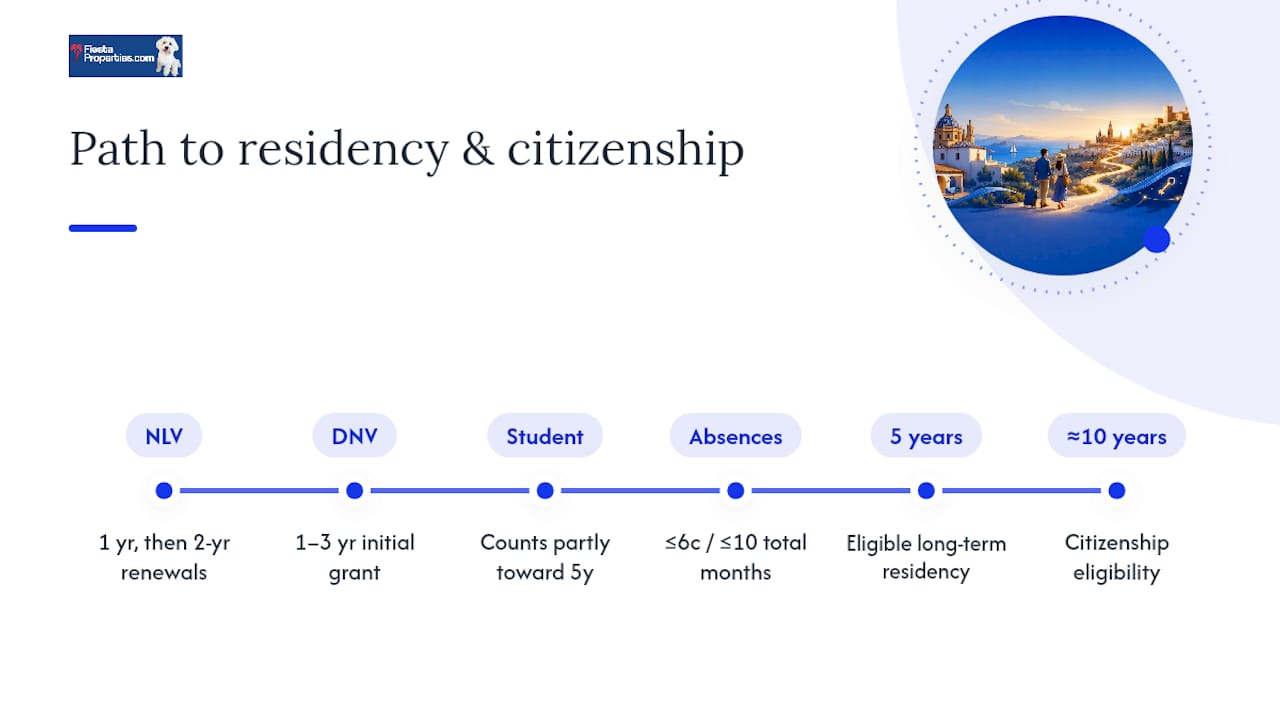
The NLV starts with a one-year grant, then renews in two-year blocks provided you still meet the income and insurance conditions. The DNV follows a similar pattern, typically starting at one to three years depending on the specific grant. After five years of continuous, lawful residence, most visa holders become eligible to apply for long-term residency, which removes the renewal cycle entirely.
Continuous residence allows for limited absences, generally no more than six consecutive months or ten months cumulatively across the five-year period, so extended trips back to the UK need tracking carefully. Time on a student visa only partially counts towards this five-year clock, which catches out people who arrive to study and later decide to stay.
Citizenship requires a longer period of legal residence, often around ten years, though this can be shorter for nationals of some countries, but not specifically shortened for UK citizens. Spain generally does not permit dual nationality with the UK outside specific historical exceptions, so anyone pursuing Spanish citizenship needs to weigh renouncing UK citizenship, a decision worth taking independent legal advice on well before the ten-year mark arrives.
What does the process cost, and what about Spanish tax residence?
Costs vary by route, but a few figures come up consistently in every application:
- Consular visa fees plus biometric and administrative charges typically add up to a few hundred pounds per applicant, on top of any translation and apostille costs.
- Private health insurance suitable for visa purposes generally runs from a few hundred to over a thousand pounds a year per person, depending on age and coverage level, and the policy must carry no co-payments to satisfy consular requirements.
Tax residence in Spain triggers once you spend more than 183 days in the country in a calendar year, regardless of which visa you hold. From that point, you become liable for Spanish tax on worldwide income, not just income earned in Spain, and you’ll need to file an annual return. The UK and Spain have a double-taxation treaty that prevents the same income being taxed twice, but it does not exempt you from declaring everything to the Spanish tax authority. Digital nomads meeting the Beckham Law conditions may secure a flat 24% rate on Spanish-source income for a limited window, which is worth raising with a tax adviser rather than assuming automatic eligibility.
Given how much this varies by personal circumstance, treat these figures as a planning guide and get a proper tax consultation before you commit to a move.
Checklist and pitfalls before you submit your application
A short pre-appointment review catches most of the errors that cause delay or refusal:
- Apostilles obtained on every UK-issued civil document, not just the criminal record certificate.
- Certified Spanish translations attached to each apostilled document.
- Originals plus one certified copy of everything, since consulates keep copies but verify against originals.
- Evidence of passive income (NLV) or a signed remote contract with income proof (DNV) matching current IPREM-based thresholds.
- Health insurance policy confirmed as having no co-payments, issued in your name and covering the full validity period.
The most common pitfalls are quietly avoidable: insufficient insurance cover, relying on tourist-visa days while an application drags on, forgetting the criminal record check entirely, or submitting to the wrong consular district.
Pro Tip: Book your consular appointment as soon as you’ve decided to move, then work backwards on your document checklist. Consulate slots fill up faster than the paperwork usually takes to gather, so the appointment date, not the documents, is usually the bottleneck.
Practical timing advice from Fiesta Properties
Buyers regularly assume a property purchase and a residency application can run on entirely separate timelines, but in practice they overlap. Completion dates, empadronamiento, and TIE appointments all depend on having a fixed address in Spain, so timing a purchase to close before your visa activation date avoids weeks of temporary accommodation costs.
Mortgage pre-approval, local legal guidance, and currency exchange support all reduce the friction of that overlap, particularly for buyers purchasing off-plan, where completion dates can shift and catch a visa clock out of sync. Getting these elements aligned early saves considerable stress later.
An underestimated administrative step, and what to do about it
The most common delay isn’t a rejected visa. It’s an ACRO certificate apostilled too late, paired with health insurance that quietly excludes co-payments cover. Fix both before booking your appointment: build a document checklist first, then start the apostille process immediately.
— Mike Kalia
Fiesta Properties: settling in Spain with property support that removes the guesswork
Fiesta Properties is the practical next step once your residency paperwork is moving, offering a route through property, mortgages, legal support and currency exchange in one place rather than through separate providers. Buyers arranging their move often need a fixed Spanish address quickly to satisfy empadronamiento and TIE deadlines, and having a dedicated legal specialist and mortgage adviser on hand shortens that gap considerably.

Currency exchange support can be important when converting sterling for a deposit against a moving exchange rate. Buyers weighing residency alongside a property purchase, whether an entrepreneur-style investment structure or a straightforward family home, can browse properties across Costa Blanca South or check mortgage options directly with Fiesta Properties to see how a purchase timeline fits around a visa application.
Official pages and consular links to bookmark
Bookmark the Spanish government’s Brexit residence guidance, the Digital Nomad Visa page, and Gov for income thresholds, visa forms, and appointment updates.
This article is general information, not a substitute for advice from a qualified lawyer. Consult a qualified legal professional about your own circumstances before acting on anything here.
Sources
FAQ
Can UK citizens still get residency in Spain?
Yes. UK citizens can apply through the Non-Lucrative Visa, Digital Nomad Visa, work visa, student visa, entrepreneur visa, or family reunification, though the Golden Visa property route closed to new applicants in April 2025. The right route depends on whether your income is passive, remote, or tied to a Spanish employer.
How much money do you need in the bank to get Spanish residency?
Requirements are set against IPREM, the official reference income figure, and vary by visa type and number of dependants.
Can I live in Spain as a UK pensioner?
Yes, and the Non-Lucrative Visa is the route most retirees use, since it’s designed around pension income, savings, and investments rather than employment. It does not permit remote work for foreign clients, so it suits pensioners who don’t intend to keep working in any capacity.
Can I move to Spain with no savings?
Not through the standard residency routes, which all require proof of financial means, whether passive income, a job offer, or family sponsorship. Family reunification is the closest exception, since the sponsoring family member’s income is assessed rather than the applicant’s own savings, though the sponsor still has to meet minimum thresholds.


