

NIE First: Mortgage Pre Approval Spain for Residents and Non Residents
· 12 min read

Yes: you can get a mortgage pre-approval in Spain, whether you are a resident or a non-resident, and it gives you a non-binding borrowing range that carries real weight. It sets a realistic budget before you start viewing property, strengthens your position when negotiating with a seller, and speeds up the formal approval once you find the right home. Pre-approval is not the final loan offer. That comes later, in the form of the FEIN.
TL;DR:
- Mortgage pre-approval in Spain provides an indicative borrowing range that helps shape your property search and enhances negotiation strength.
- The pre-approval is non-binding and lasts only a few months, requiring timely renewal with updated documents if your search extends.
- Residents can typically access loans up to 80% of the purchase price, whereas non-residents usually face limits of 60% to 70%, with larger deposits required.
- Early preparation of NIE, income proof, translations, and multiple bank applications can significantly streamline the mortgage approval process.
- Most rejections result from income mismatches, incomplete documentation, or low property valuation, all avoidable with proper early planning.
Table of Contents
- What mortgage pre-approval covers and how it differs from the FEIN
- Eligibility for residents and non-residents and typical loan-to-value expectations
- Documents checklist: NIE, income proof, translations and apostilles
- How Spanish lenders assess your application
- Timelines and costs to budget for
- Step by step: turning a pre-approval into a binding offer
- Common mistakes and practical tips for international buyers
- Common reasons a mortgage pre-approval gets rejected
- How pre-approval strengthens your position with a seller
- How long a pre-approval lasts and what to do if it expires
- Agent perspective: why early pre-assessment pays off
- How Fiesta Properties can help with pre-approval and beyond
- Sources
- FAQ
What mortgage pre-approval covers and how it differs from the FEIN
A mortgage pre-approval, or preaprobación, is a bank’s early assessment of how much it is likely to lend you, based on your income, existing debts and the documents you provide at that stage. It is indicative rather than binding: the bank is not yet committed, and the figure can shift once a specific property and its valuation enter the picture.
The binding step comes later, with the FEIN, the Ficha Europea de Información Normalizada. Under Law 5/2019, lenders must deliver the FEIN, along with other pre-contractual documents, at least ten calendar days before signing, and this document does carry binding terms. The gap between the two matters in practice:
- Pre-approval gives you a working budget so you know what to search for.
- The FEIN confirms the actual rate, term and monthly payment once a property is agreed.
- Signing a reservation or arras contract before pre-approval risks losing your deposit if the mortgage later falls short of what you need.
Getting pre-approval sorted before you commit to any deposit is the safest order of operations for both residents and non-residents.
Eligibility for residents and non-residents and typical loan-to-value expectations
Residency status shapes how much a Spanish bank will lend and on what terms. Residents commonly see loan-to-value (LTV) ratios of up to around 80% of the purchase price, reflecting the bank’s greater confidence in a borrower with local income, tax history and an established credit footprint.
Non-residents typically face a lower ceiling, with LTV limits generally sitting between 60% and 70%. Banks apply closer scrutiny to overseas income, and non-resident applicants may encounter marginally higher rates or shorter repayment terms as a result. The practical effect is straightforward:
- Residents may need a deposit as low as 20% of the purchase price, plus costs.
- Non-residents should plan for a deposit of 30% to 40%, depending on the lender and profile.
- On top of the deposit, buyers should budget for the additional purchase costs of roughly 10% to 14% that cover taxes, notary and registration fees.
A non-resident buying a property priced at 300,000 euros, for example, might need to find 90,000 to 120,000 euros in deposit funds alone, before adding those purchase costs. Knowing this early avoids an unpleasant surprise midway through a search.
Documents checklist: NIE, income proof, translations and apostilles
Preparing documents in the right order saves weeks. The NIE, Spain’s foreign identification number, is usually the first hurdle and often the slowest, since appointment slots for obtaining it can be limited, so applying for it as early as possible avoids it becoming the bottleneck that delays everything else.
- NIE and passport or national ID, applied for well ahead of any viewing trip.
- Proof of income: recent payslips, employment contract, or the last one or two years of tax returns for the self-employed.
- Bank statements from the past three to six months, showing regular income and outgoings.
- A credit report from your home country, such as an Experian or Schufa-equivalent record, where the lender asks for one.
- Evidence of the deposit funds, showing the money is available and its origin is traceable.
- Certified translations and, where required, apostilled versions of foreign documents.
Once a property is chosen, a nota simple (the land registry extract) and the arras (deposit) contract become relevant. These sit slightly later in the sequence than the core pre-approval file.
Pro Tip: Start your NIE application and open a Spanish bank account in parallel with gathering payslips and tax returns. Running these in tandem, rather than one after another, can shave weeks off the overall timeline.
How Spanish lenders assess your application
Behind every pre-approval decision sits a set of criteria that Spanish banks apply fairly consistently. The most important is the debt-to-income (DTI) ratio.
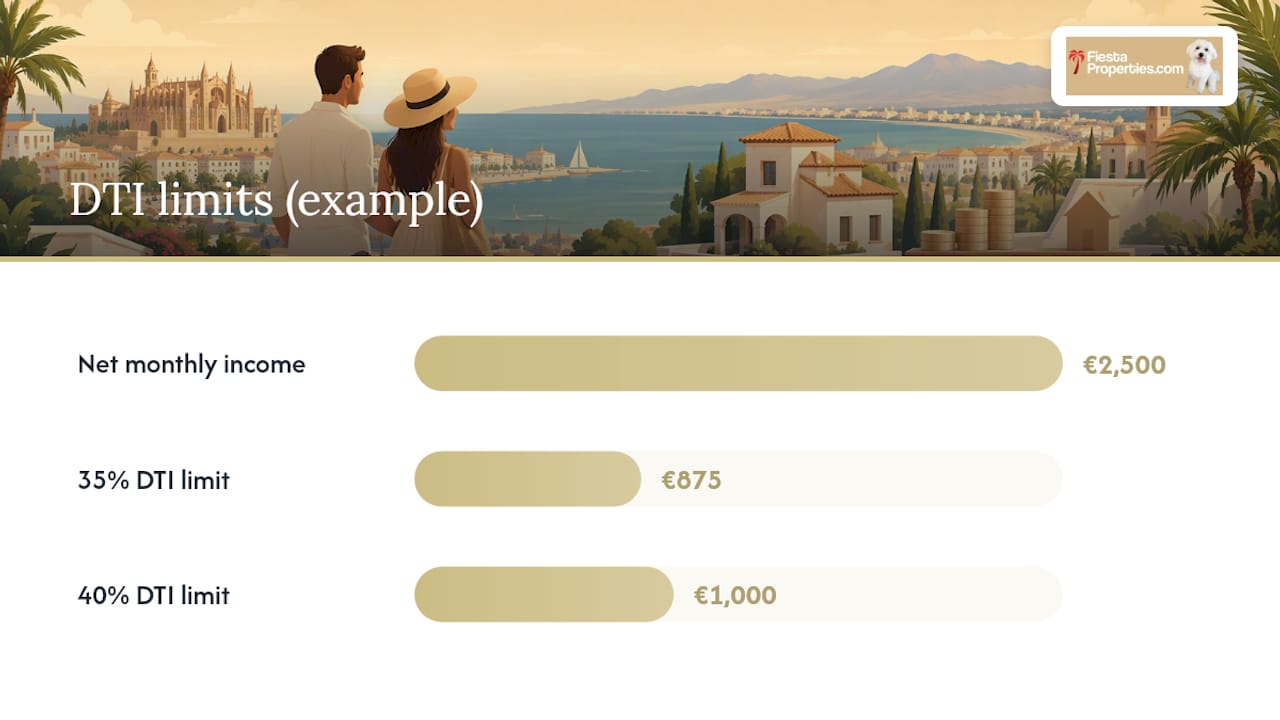
Spanish banks typically require total monthly debt commitments to stay below 35% to 40% of net monthly income, a threshold that covers the new mortgage payment plus any existing loans or credit obligations. A borrower earning 2,500 euros a month net, for instance, would generally need total debt repayments to sit below 875 to 1,000 euros to satisfy that ratio.
Age and term also matter. Many lenders require the mortgage to be fully repaid by age 75 to 80, which shortens the available term for older applicants and can mean higher monthly payments to compensate.
- DTI ratio: total monthly debt below 35% to 40% of net income.
- Age limits: full repayment typically expected by age 75 to 80.
- Tasación (valuation): the bank lends against whichever is lower, the purchase price or the appraised value.
- FEIN and notary meeting: mandatory transparency steps under Law 5/2019, including a ten-day reflection period and a notary meeting at least one day before signing.
The tasación matters more than many buyers expect. If the independent valuation comes in below the agreed purchase price, the bank calculates its LTV against the lower figure, which can leave a funding gap the buyer has to cover from their own funds.
Timelines and costs to budget for
Pre-approval itself moves relatively fast. Most buyers can expect an indicative decision within one to two weeks of submitting a complete file. Full approval, the point at which the FEIN is issued, generally takes four to eight weeks from reservation, depending on how quickly the valuation is arranged and how complete the paperwork is from the outset.
Costs need planning alongside the timeline. The appraisal itself carries a fee, usually paid by the buyer, and sits on top of the wider costs of purchase. Overall, buyers should set aside roughly 10% to 14% of the purchase price for taxes, notary fees, registration and the appraisal combined.
A few habits keep the timetable realistic:
- Apply for the NIE and open a Spanish bank account before you start viewing property.
- Submit pre-approval applications to more than one bank rather than relying on a single lender.
- Have translations and apostilles ready before the file reaches underwriting, not after.
- Ask early which party is expected to pay for the tasación, since practice varies by lender.
Buyers who front-load the paperwork tend to move from reservation to signing far more smoothly than those who start gathering documents only once a property is under offer.
Step by step: turning a pre-approval into a binding offer
The path from first enquiry to notary signing follows a fairly consistent sequence across Spanish lenders.
- Gather your documents and apply for the NIE, then open a Spanish bank account.
- Seek pre-assessment from two or three banks, or work with a broker who can compare offers across a wider panel.
- Compare the indicative terms: rate, term and maximum LTV each bank is willing to offer.
- Once you have chosen a property, submit your full file and arrange the tasación, following the practical sequence many Spanish buying guides recommend.
- Respond promptly to any underwriting queries, since delays here are a common cause of slippage.
- Receive the FEIN, attend the mandatory notary transparency meeting, and observe the ten-day reflection period before signing the loan deed.
Each step builds on the last, and skipping ahead, particularly signing a reservation before pre-approval, is where most avoidable problems start.
Common mistakes and practical tips for international buyers
The most frequent misstep is reserving a property before mortgage clarity is in place, which risks losing a deposit if the eventual loan offer falls short of what is needed. Starting pre-assessment first avoids that entirely.
Begin the NIE and bank account process the moment you decide to buy, and prepare certified translations and apostilles in parallel rather than waiting until a bank asks for them. Applying through both a broker and directly with one or two banks broadens your chances of finding a good fit, since different lenders use different risk models for the same borrower profile. Commissioning your own appraisal can also be worthwhile, since it lets you present the same valuation report to multiple lenders rather than paying for a fresh one each time.
Pro Tip: A mortgage specialist who works daily with international buyers will usually know which lenders are currently most flexible on non-resident LTV, which can save weeks of trial and error.
Common reasons a mortgage pre-approval gets rejected
Rejections at pre-approval stage are rarely random. A handful of causes account for most of them.
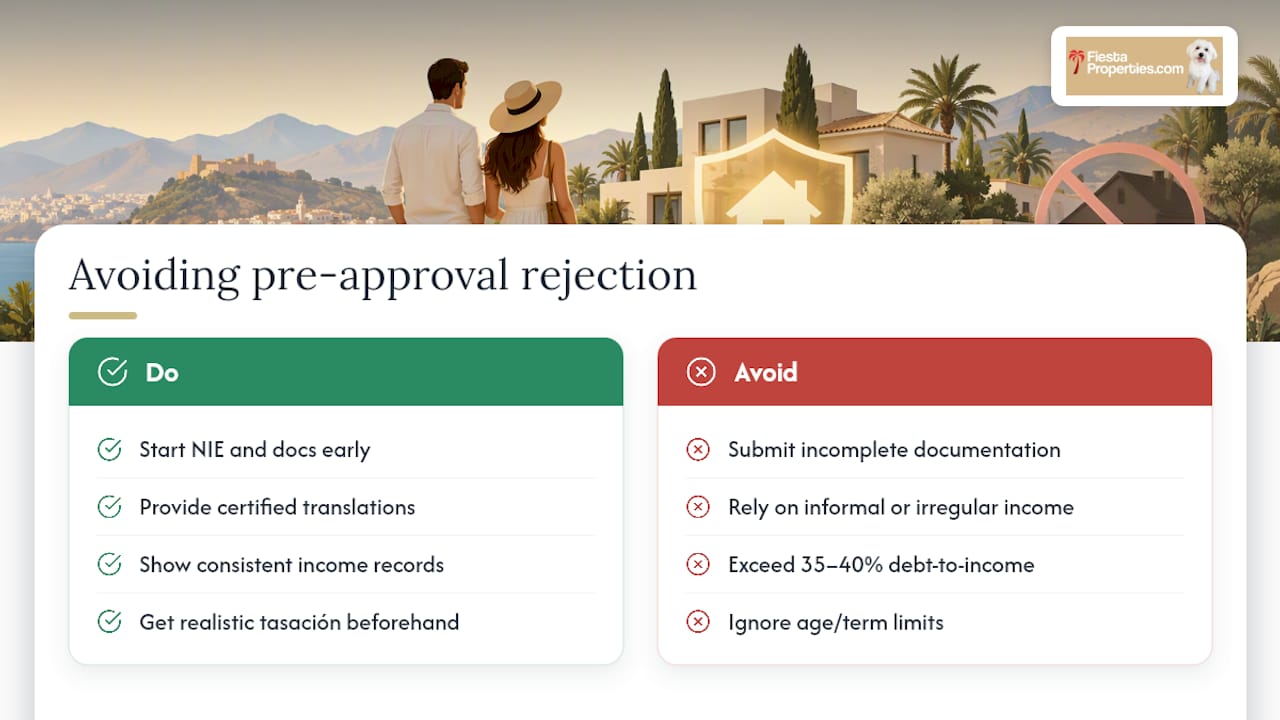
An income mismatch is common: irregular or informal income, or income that does not translate cleanly into the payslips and tax returns a Spanish bank expects to see, makes it harder for underwriters to verify affordability. Self-employed applicants who cannot show consistent returns across at least the last full tax year often run into the same problem.
A debt-to-income ratio above the 35% to 40% threshold that Spanish banks generally apply is another frequent cause, particularly for buyers who already carry a mortgage or significant credit commitments in their home country. Age can also work against an applicant when the requested term would push repayment beyond the typical cap of 75 to 80 years old, forcing either a shorter term or a decline.
Incomplete or inconsistent documentation causes more rejections than most buyers expect. Missing certified translations, an expired NIE application, or bank statements that do not match the income claimed on tax returns all slow or sink an application. Finally, a low tasación relative to the agreed purchase price can undermine an otherwise sound application, since the bank will not lend against a value it does not recognise.
Most of these causes are avoidable with early preparation, which is why starting the NIE, documents and bank comparison process well before viewing property makes such a difference.
How pre-approval strengthens your position with a seller
A buyer with a mortgage pre-approval in hand is a different proposition to a seller than one who is still guessing at their budget. It signals that a bank has already reviewed the buyer’s income and debts and is willing to lend within a defined range, which removes much of the uncertainty that makes sellers nervous about accepting an offer.
In a competitive market, that clarity can be decisive when two buyers make similar offers on the same property. A seller, or their agent, will generally favour the buyer whose financing looks more certain, since it reduces the risk of the sale collapsing weeks into the process. Pre-approval also shortens the gap between an accepted offer and the point at which a formal FEIN can be issued, since much of the underwriting groundwork is already done.
It is worth being clear about what pre-approval does not do. It is not a guarantee, and a seller who understands the Spanish process will know that the final figure depends on the tasación and the completed FEIN. Even so, arriving with a defined borrowing range, current documents and a bank already engaged puts a buyer in a noticeably stronger negotiating position than one who has not yet started that process.
How long a pre-approval lasts and what to do if it expires
A mortgage pre-approval in Spain is not open-ended. Most banks treat it as valid for a limited window, typically a matter of months, because the assessment is based on income, debts and interest rates at a specific point in time, all of which can shift.
If your property search runs longer than expected and the pre-approval lapses, renewing it usually means resubmitting updated documents: recent payslips, current bank statements and, if enough time has passed, an updated tax return. Lenders want reassurance that your financial position has not materially changed since the original assessment, and that market interest rates used in the original indicative offer are still applicable.
The practical lesson is to time your pre-approval to your search. Applying too early, before you are seriously viewing property, risks the approval expiring before you find somewhere to buy. Applying once you are actively looking, with a realistic sense of the market and price range, keeps the pre-approval useful for the length of a typical search and reservation process.
Agent perspective: why early pre-assessment pays off
Buyers who start mortgage pre-assessment before they seriously view property tend to move through the rest of the process with far less friction. It shortens the gap between finding the right home and being ready to commit, and it removes the anxiety of not knowing what is realistically affordable. For anyone starting a search, arranging a free mortgage assessment early is one of the simplest ways to buy with confidence rather than guesswork.
— Mike Kalia
How Fiesta Properties can help with pre-approval and beyond

Coordinating a mortgage pre-approval alongside a property search, currency transfer and legal checks usually means dealing with several separate parties. Some property agencies offer services that coordinate mortgage, valuation and legal steps together for greater convenience.
- Specialist support to help arrange pre-approval and guide clients through the mortgage process.
- Assistance with currency exchange when transferring funds.
- Legal guidance to navigate the Spanish purchase process.
- Property search and aftersales support when clients are ready to view homes.
If you are starting to plan a purchase, book a free mortgage assessment and get a clear picture of your borrowing range before you begin viewing.
Sources
The claims in this guide draw on the Banco de España’s client guidance, which sets out how lenders assess DTI and structure the FEIN; its explainer on Law 5/2019, covering the mandatory notary meeting and reflection period; and practical timing detail from Hipotecas.me and Naked Hipotecas on typical approval sequences and costs. For repayment shapes and how term length affects monthly payments, David Mordue’s rates page offers useful context.
- Real estate credit agreements. New regulations. - Banco de España (clientebancario)
- Hipotecas
- Steps to buy a property with a mortgage in Spain - Naked Hipotecas
FAQ
Can a UK citizen still get a mortgage in Spain?
Yes, UK citizens can still apply for a mortgage in Spain as non-residents, though they typically face the lower non-resident LTV limits of around 60% to 70% rather than the higher ratios available to residents. The application process and documents required are broadly the same as for other non-resident buyers.
Is it easy to get a mortgage pre-approval in Spain?
Getting pre-approval is manageable when your documents are in order, though non-residents face closer scrutiny of foreign income and credit history than residents do. Preparing your NIE, payslips, tax returns and translations in advance, and applying to more than one bank, makes the process considerably smoother.
How much will I pay monthly for a mortgage in Spain over 30 years?
The monthly payment depends entirely on the loan amount, interest rate and term agreed in your FEIN, so there is no single figure that applies to every buyer. A mortgage specialist can model this against your specific pre-approval terms once a lender has reviewed your file.
Is it easier to get a mortgage in Spain as a resident than a non-resident?
Yes, residents generally find the process easier, with higher LTV limits of up to around 80% compared with the 60% to 70% typically available to non-residents. Residents also tend to face less scrutiny of their income documentation, since it is already in a format Spanish banks recognise.


