

Golden Visa Gone: Costa Blanca Property Buyers' 2026 Residency Options
· 14 min read

Spain’s property golden visa is gone. Ley Orgánica 1/2025 repealed the investment residency route effective 3 April 2025, and buying a home in Spain, regardless of price, no longer grants residency. Buyers who still want to relocate must qualify through separate routes: the Non-Lucrative Visa, the Digital Nomad Visa, entrepreneur authorisation, or family reunification. Each has its own income tests and paperwork, covered below.
TL;DR:
- The property-based golden visa was officially abolished on April 3, 2025, and owning property no longer grants residency eligibility in Spain.
- Existing golden visas and applications filed before the law change remain valid and can be renewed under the previous rules, provided documentation is maintained.
- Visa options for property buyers now rely on income or business activity, such as the Non-Lucrative Visa, Digital Nomad Visa, or entrepreneur authorization, not property ownership alone.
- Purchasing property still incurs costs of roughly 12-15% above the purchase price for taxes, legal fees, and registration, regardless of visa status.
- Long-term residency can still be achieved through income, work, or family ties, but the property no longer automatically supports residency applications.
Table of Contents
- What changed: the repeal, scope and transitional protection
- Residency routes that still work for property buyers in 2026
- Taxes, purchase costs and ongoing obligations to budget for
- Transitional rules and what to do if you were mid-process
- Practical next steps if you still want to live in Spain after buying
- Comparison of golden visa property requirements versus similar programmes in other EU countries
- Detailed legal and procedural steps for property purchase under new residency routes as of 2026
- Implications of the golden visa closure on investment immigration appeal and alternatives for securing long-term residency
- Impact on property market demand and prices for foreign buyers
- What buying property now actually gives you
- Local market perspective from Fiesta Properties
- How Fiesta Properties can help you plan the property side
- Sources
- FAQ
What changed: the repeal, scope and transitional protection
The closure did not happen quietly. Under Ley Orgánica 1/2025, the investor residency articles of the original 2013 law were left “sin contenido”, meaning without legal content, from 3 April 2025 onward. Articles 63 to 67 of Ley 14/2013, which had set out the property, business and public debt investment thresholds, simply stopped applying.
The repeal removed every investment pathway the golden visa once offered, not just the property route. What it did not do is reach backward and cancel visas already granted or applications already filed.
- Applications submitted before 3 April 2025 continue under the rules that existed when they were filed.
- Golden Visas already granted remain valid and can be renewed under their original terms.
- Anyone unsure of their filing date should check directly with their consulate or the Unidad de Grandes Empresas (UGE-CE) before assuming they have lost eligibility.
If you are mid-process, the practical step is confirmation, not panic. A dated receipt or case reference from before 3 April 2025 is usually enough to establish protected status, though an immigration lawyer should verify it against your specific file.
Residency routes that still work for property buyers in 2026
Property ownership on its own no longer opens a door to residency, but several existing visa categories remain open to buyers who also meet other conditions. None of them treats a home purchase as the qualifying test, though a property can support an application as evidence of stability.
- Non-Lucrative Visa (NLV): built for people living off savings or passive income rather than Spanish employment, with private health insurance required and an initial one-year authorisation before renewal.
- Digital Nomad Visa (DNV): designed for remote workers employed by, or contracting for, companies outside Spain, allowing them to live in Spain while continuing that work.
- Entrepreneur authorisation (UGE-CE): aimed at founders bringing an innovative or economically significant business to Spain, assessed on the strength of the project rather than a set investment figure.
- Family reunification and work or study visas: available to those joining a resident family member, taking up sponsored employment, or enrolling in Spanish education.
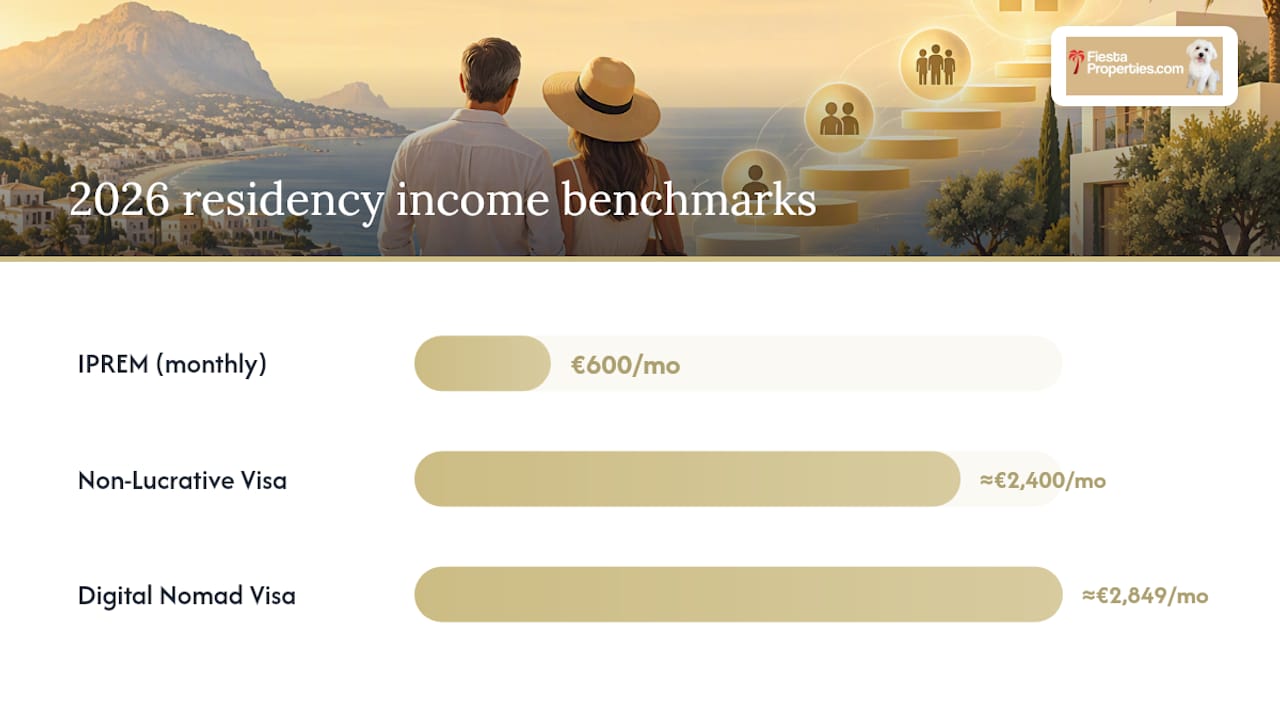
The Non-Lucrative Visa guidance sets the main applicant’s income requirement at 400% of the IPREM index.
With IPREM set at €600 a month in 2026, that implies around €2,400 a month(https://www.inclusion.gob.es/documents/410169/2260168/6.+Autorización+inicial+de+residencia+temporal+no+lucrativa.pdf/45b9fbcd-798f-fb27-068d-540e19112bea?t=1763546305028) in demonstrable means for the principal applicant, alongside private medical cover.
The Digital Nomad Visa uses a different benchmark tied to the Spanish minimum wage (SMI), and its 2026 headline figure sits at roughly €34,188 a year, or about €2,849 a month, for the main applicant.
The entrepreneur authorisation has no fixed capital threshold at all. It is handled by the UGE-CE and hinges on a business plan demonstrating genuine economic interest, sometimes supported by a favourable ENISA report. For an investor with a serious project rather than a one-off asset purchase, it can be a realistic substitute for the old capital-based route, though it demands considerably more preparation than writing a cheque for a flat.
In every case, owning a Spanish property can help demonstrate ties, stability or intent to settle, but the visa is granted on income, work status or business merit, never on the deed itself.
Taxes, purchase costs and ongoing obligations to budget for
Buying in Spain carries costs whether or not residency is on the table, and these figures do not move regardless of which visa route you choose. Resale properties attract Impuesto de Transmisiones Patrimoniales (ITP), a transfer tax set regionally, while new-build purchases carry VAT (IVA) plus Actos Juridical Documentados (AJD) stamp duty instead.
- Notary fees, Land Registry inscription and legal fees sit on top of whichever tax applies.
- Buyers should budget roughly 12 to 15% above the purchase price to cover the full acquisition stack, as an illustrative estimate since regional rates vary.
- Non-resident owners pay Impuesto sober la Renta de No Residentes (IRNR) on Spanish-sourced income, plus annual local property tax (IBI), and capital gains levies such as plusvalía municipal on sale.
There is one figure that changes everything about your tax position: spend 183 days or more in Spain within a calendar year and you become a tax resident, with worldwide income in scope rather than just Spanish-sourced income. Anyone planning a long stay while pursuing a residency visa should map that threshold against their travel plans well before booking flights.
Transitional rules and what to do if you were mid-process
Buyers who filed a golden visa application, or already hold one, are not caught in limbo. The transitional protection built into the reform means cases lodged before 3 April 2025 are assessed, and renewed, under the rules that applied on that date, not the current, more restrictive framework.
For anyone in that position, or close to it, the practical checklist looks like this:
- Confirm your exact filing date with your consulate or the UGE-CE, since this single detail determines which rules apply to you.
- Gather a dated Land Registry extract, known as a certificado de dominio y cargas, alongside your public deed or a pre-contract showing deposit proof.
- Assemble your passport, criminal record certificates and evidence of health insurance, since these accompany most applications regardless of route.
- Instruct an immigration lawyer to review your file before any renewal deadline, and request updated registry certificates within 90 days of use, matching the document-dating rules consulates already apply to property evidence.
Practical next steps if you still want to live in Spain after buying
Once the property purchase is settled, the residency question runs on its own track. The first decision is which route fits your circumstances: passive income points towards the Non-Lucrative Visa, remote employment towards the Digital Nomad Visa, a business plan towards entrepreneur authorisation, and a resident relative towards family reunification.
- Gather route-specific evidence early: income statements and bank records for the NLV, an employment or client contract for the DNV, a business plan for entrepreneur authorisation.
- Arrange your NIE (foreigner identification number) and a Spanish bank account as soon as the purchase completes, since most visa and tax processes depend on both.
- Secure private health insurance before applying, and register with the tax authorities if you expect to pass the 183 day threshold.
- Expect consular applications to run on fixed visa windows, while in-Spain applications follow a different, often faster, calendar, so confirm timelines with your consulate before committing to a moving date.
Pro Tip: Book your NIE and bank account appointments in the same week as your property completion. Both take longer to arrange from outside Spain, and most visa applications stall without them.
Comparison of golden visa property requirements versus similar programmes in other EU countries
Spain is not the only country to have rethought its investor visa. Several EU states have tightened or removed property-linked residency in recent years, following concerns similar to those raised in Spain about house prices and speculative demand. The direction of travel across the bloc has generally been the same: shrink or eliminate the real estate option while leaving business investment or job-creation routes intact.
That leaves non-EU buyers comparing a patchwork of remaining options rather than a single, comparable golden visa product. Some countries still permit qualifying investment in government bonds or company shares, others have shifted entirely towards entrepreneurship or high-net-worth criteria, and a few have closed investor programmes altogether. Spain’s current position, with property removed but entrepreneur and income-based routes intact, sits closer to the stricter end of that spectrum, but not at the extreme.
For a non-EU buyer weighing options across Europe, the practical difference tends to come down to substance over asset value. Where a property purchase alone once sufficed in several countries, most remaining programmes now expect either job creation, a functioning business, or income sufficient to support the applicant without relying on local employment. Spain’s Non-Lucrative and Digital Nomad Visas fit that second pattern closely, asking for demonstrable income rather than a fixed lump sum.
Anyone comparing programmes seriously should treat each country’s rules as separate legal systems rather than variations on a theme, since eligibility tests, processing times and renewal conditions differ meaningfully even where the underlying policy logic looks similar.
Detailed legal and procedural steps for property purchase under new residency routes as of 2026
Buying a Spanish property in 2026 follows the same legal mechanics it always has, since the golden visa’s closure changed residency law, not conveyancing law. The process still runs through a notary, and the deed, known as the scripture, still needs registering at the local Land Registry to be fully enforceable against third parties.
A buyer pursuing residency through one of the remaining routes should sequence the two processes carefully rather than treating them as one transaction. Securing an NIE typically comes first, since it is required to sign contracts, open a bank account and pay taxes. A reservation contract with a deposit, followed by a private purchase contract, usually precedes the final notarised deed, giving the buyer time to arrange financing and complete due diligence on the property’s registry status.
Once the deed is signed, the buyer pays the applicable transfer tax or VAT and stamp duty, registers the property, and can then use the completed purchase and its documentation, such as the certificado de dominio y cargas, as supporting evidence in a separate visa application. That evidence helps establish ties and financial stability but does not substitute for the income, employment or business criteria the chosen visa route actually requires.
Anyone applying for a Non-Lucrative or Digital Nomad Visa alongside a purchase should keep dated copies of every property document, since consulates have historically required registry extracts issued within a set window before submission, a practice that continues under the current framework.
Implications of the golden visa closure on investment immigration appeal and alternatives for securing long-term residency
Removing the property route changes who is a golden visa style programmes appeal to. The old model let a buyer secure residency through a single asset purchase with no obligation to work, run a business or demonstrate ongoing income beyond the initial threshold. That option no longer exists, and the routes that remain all ask for something closer to genuine ties: passive income, remote employment, a functioning business or family connection.
For many buyers who had treated the €500,000 property threshold as a shortcut to residency, the practical effect is a longer, more document-heavy process. Long-term residency in Spain now depends on demonstrating a genuine basis for staying, not on the size of a bank transfer.
That shift does not remove long-term residency as a goal, only the fastest route to it. Buyers with steady passive income can still pursue the Non-Lucrative Visa, those with remote employment can use the Digital Nomad Visa, and founders with a credible business plan retain the entrepreneur authorisation. Each of these can lead to permanent residency after five years of continuous legal stay, the same milestone the golden visa eventually offered, just reached through a different door.
The appeal for investment migration specifically has narrowed, since Spain no longer offers a route where the investment itself is the qualifying act. What remains is closer to conventional immigration law: prove your means, your work, or your family ties, and residency follows from that, with property ownership as one supporting document among several rather than the central pillar of the application.
Impact on property market demand and prices for foreign buyers
The closure has not stopped foreign buyers purchasing in Spain, but it has changed who is buying and why. Demand driven purely by the residency shortcut has fallen away, while demand from buyers seeking a holiday home, a retirement base or a straightforward investment property continues largely unaffected, since ownership rights remain unchanged regardless of visa eligibility.
Regions that leaned heavily on golden visa buyers at the very top of the market, particularly in Madrid and Barcelona where minimum thresholds concentrated demand, are more exposed to any pullback than the Costa Blanca and Costa Cálida, where the typical buyer was already purchasing a home to live in or let out rather than chasing a residency threshold. Coastal areas built around lifestyle and retirement demand tend to see steadier interest from British, Northern European and increasingly North American buyers who were never applying for the golden visa in the first place.
For sellers and developers in these regions, the practical effect is less about falling demand and more about buyers asking sharper questions before committing. Purchasers now weigh property purely on its merits as a home or investment, separate from any residency benefit, which tends to favour well-located, realistically priced new builds over speculative stock bought mainly for its visa value. That is a healthier foundation for a local market than one propped up by a single legal shortcut, even if it removes a segment of buyers who were purchasing for immigration reasons alone.

What buying property now actually gives you
Ownership itself has not changed. A foreign buyer who completes a purchase in Spain still receives full legal title, the right to use, rent, sell or pass on the property, and the same protections any Spanish property owner has under the Land Registry system. What has changed is simply that this title no longer comes bundled with a residency permit.
Buying does trigger a few practical requirements worth planning for early. You will need an NIE, the foreigner identification number that underpins almost every formal transaction in Spain, from signing the deed to paying utility bills. Most buyers also open a Spanish bank account before completion, since mortgage payments, community fees and local taxes are typically settled through it rather than from an overseas account.
Tax obligations follow ownership regardless of residency status. Non-resident owners pay IRNR on any rental income and an imputed income tax even on a property that sits empty, plus the annual IBI charge every homeowner pays to the local council. None of this depends on holding a Spanish visa. A retiree who visits for six weeks a year and a Digital Nomad Visa holder living there full-time face the same ownership taxes, though the second faces the added layer of Spanish tax residency once they cross the 183 day threshold.
Local market perspective from Fiesta Properties
After more than 16 years working across the Costa Blanca and Costa Cálida, we have watched buyers approach relocation with a mix of enthusiasm and, understandably, a fair amount of uncertainty about the rules. Owning a property still matters for anyone planning a move to Spain, even without a residency link: it gives you a real address, a foothold for opening accounts and registering locally, and often stronger footing when applying for a mortgage on a second purchase later. What we cannot do, and what no estate agency should claim to do, is give immigration advice. Our role is the property side: helping buyers find the right home and handle the practical steps around it, while pointing them towards qualified legal specialists for the visa itself.
— Mike Kalia
How Fiesta Properties can help you plan the property side
Buying with a longer relocation plan in mind calls for support that goes beyond simply finding a house. Fiesta Properties offers a family-run, end-to-end service across the Costa Blanca and Costa Cálida, built to remove friction from the practical steps a residency application also depends on.

- Property search and shortlisting tailored to your budget and preferred region, from Torrevieja to Dénia to Mar Menor.
- Mortgage guidance through our specialist, with support to explore current rates and options.
- A legal specialist supporting the purchase itself, plus introductions where buyers need separate immigration advice.
- Currency exchange support with no fees charged to clients, alongside bilingual negotiation and in-person or virtual viewings.
We also help clients gather the dated registry certificates and purchase documentation that visa applications often ask for, even though the residency decision itself sits with a qualified immigration lawyer. If you are weighing a purchase on the Costa Blanca or Costa Cálida, our primary services page is the best place to start, or explore current listings across Costa Blanca to see what fits your plans. Buyers financing from the UK may also find this expat mortgage guide useful before speaking with our team.
Sources
- Spain’s Golden Visa in 2026: it is gone, the law that killed it, and the four routes that still work | Listyco
- Autorización inicial de residencia temporal no lucrativa (Government of Spain guidance)
- One
- Spain’s visa options for international property buyers in 2026 - GIPE
FAQ
Is it wise to buy a property in Spain now?
Buying in Spain remains a sound decision for anyone drawn to the lifestyle, rental potential or long-term value of a home there, since ownership rights and taxes work exactly as before. It is simply no longer a shortcut to residency, so the decision to buy and the decision to relocate need separate planning.
Can I live in Spain permanently if I buy a property?
No, a property purchase alone no longer grants residency of any kind following the repeal under Ley Orgánica 1/2025. You would need to qualify separately through routes such as the Non-Lucrative Visa, the Digital Nomad Visa, entrepreneur authorisation or family reunification.
How much money do you need in the bank to get Spanish residency?
It depends entirely on the visa route: the Non-Lucrative Visa requires proof of means around €2,400 a month for the main applicant, based on 400% of the 2026 IPREM figure. The Digital Nomad Visa instead asks for income of roughly €34,188 a year, and the entrepreneur route has no fixed financial threshold at all.
Why is Spain’s property golden visa route considered finished?
The route was formally repealed, not just curtailed, when Ley Orgánica 1/2025 took effect on 3 April 2025, leaving the relevant articles of the original law without legal content. Applications filed before that date remain protected under the old rules, but no new property-based applications are accepted.


