

British Nationals: TIE in One Month, Camposol with UK practical help
· 13 min read

A British national can live in Camposol, provided the correct residency route is followed from the outset. The single most urgent action is to check your visa or residency category before travelling, then register on the local padrón and book a TIE appointment soon after arrival. Reliable guidance comes from GOV.UK, the Spanish consulate, the Camposol Residents Association and, for the property side, our team at Fiesta Properties.
TL;DR:
- British nationals must apply for the non-lucrative visa in the UK before moving, with applications taking up to three months, so early planning is essential.
- Registering on the padrón is mandatory regardless of property ownership or rental status, and the TIE application is due within one month of arrival.
- Private comprehensive health insurance is required for non-lucrative visa holders until the S1 form can be registered with Spanish social security.
- Regularly updating pension, banking, and tax information with UK authorities prevents payment interruptions and ensures compliance after relocating.
- Most property transactions in Camposol involve legal checks, community fees, utility setup, and local registration, making professional support highly advisable.
Table of Contents
- Residency steps: visas, padrón and getting your TIE
- Healthcare and insurance: how to get covered in Spain
- Tax, pensions and banking: what to do before and after you move
- Housing in Camposol: how to rent or buy and what to budget for
- Local practicalities: shops, transport, utilities and day-to-day living
- Cost of living: realistic monthly and one-off budgets
- Joining the community: Camposol Residents Association and local support
- Local language and cultural nuances relevant to living in Camposol
- Education options and schooling for families
- Safety and security considerations in Camposol
- Local employment opportunities and working regulations for residents
- Author perspective from Mike Kalia
- Fiesta Properties: how we help people move to Camposol
- FAQ
- Sources
Residency steps: visas, padrón and getting your TIE
Most British nationals settling in Camposol for longer than 90 days need a residency visa arranged before leaving the UK, most commonly the non-lucrative visa. This route suits retirees and those with independent income rather than local employment, and applications are submitted at a Spanish consulate or approved visa centre in the UK. The non-lucrative visa requires proof of sufficient financial means, often referenced against multiples of Spain’s IPREM index, full health insurance for the first year, and an in-person appointment. Decisions typically take up to three months from submission, so applying early matters.
Once you arrive in Spain, two further steps follow in sequence. First comes registration on the padrón, the municipal register held by the Mazarrón town hall, which Camposol falls under. This record is needed for almost everything that follows, from healthcare access to schooling and vehicle registration, so it is worth treating as a priority rather than an afterthought. Second comes the TIE, the foreigner identity card that formalises your residency status. According to Gov, the TIE application must be made within one month of arrival, and appointments are booked through the relevant police station or foreigner’s office.
Before travelling, prepare the following:
- A valid passport with at least six months remaining.
- Proof of financial means, such as bank statements covering the period requested by the consulate.
- A comprehensive private health insurance policy valid in Spain.
- A police certificate, where requested, confirming no criminal record.
- Proof of address in Spain, such as a rental contract or property deed, for the padrón application.
The non-lucrative visa fee for UK citizens stood at £516 as of 2024, according to GOV.UK, so budgeting for this alongside travel and insurance costs avoids any awkward surprises; households with combined earnings can often move more swiftly, as explained in why dual income households invest in property faster. Appointments at consulates and BLS centres can book up weeks in advance, particularly in spring and autumn when relocation activity peaks, so starting the process several months ahead of a planned move gives more room to manoeuvre.
Healthcare and insurance: how to get covered in Spain
Access to Spain’s state healthcare system depends on your circumstances. UK state pensioners who hold a valid S1 form can register with the Spanish social security system and receive state-funded care on broadly the same basis as Spanish nationals. Those without an S1, or who are not yet of pension age, generally need private comprehensive health insurance, which is also a formal requirement for the non-lucrative visa.
- Confirm whether you qualify for an S1 before applying for a visa, since this changes your insurance obligations.
- Choose a policy described as “comprehensive” with no excessive co-payments, as Spanish consulates specifically check for this when processing non-lucrative applications.
- Register at your local health centre once your padrón certificate and TIE are in hand, bringing your passport, NIE and proof of address.
- Keep private cover in place during the gap between arrival and any S1 registration being processed, since state access is not automatic on day one.
According to GOV.UK’s healthcare guidance, S1 registration is accepted once correctly lodged with the Spanish social security system, while non-lucrative visa holders must maintain comprehensive private insurance throughout their first year. For those weighing up property alongside healthcare planning, it is worth reading how to arrange healthcare in Costa Blanca before an S1 arrives, since the paperwork timeline rarely matches moving day exactly.
Tax, pensions and banking: what to do before and after you move
Spain and the UK operate under a double taxation convention, which prevents the same income being taxed twice. This matters most for pensioners and anyone drawing UK-sourced income while resident in Spain, since Spanish tax residency rules determine where income is ultimately declared.
- Notify the International Pension Centre of your change of address and bank details before moving, so state pension payments continue without interruption.
- Declare Spanish tax residency to HMRC where required, particularly once you spend more than 183 days a year in Spain.
- Open a Spanish bank account early, since many utility and community fee payments are collected by direct debit from a local account.
- Use a currency exchange specialist rather than a standard bank transfer for larger sums, such as a property purchase or pension lump sum, to reduce the margin lost on the exchange rate.
Official guidance confirms that proactively notifying pension administrators of address or banking changes prevents payment interruptions, a step many retirees leave until too late. Getting banking and tax notifications sorted in the weeks either side of your move removes one of the more tedious sources of friction in settling into Camposol life.
Housing in Camposol: how to rent or buy and what to budget for
Camposol is best known for its bungalows and villas set within a gated, estate-style layout, many with private pools and shared green spaces. Renters will find a mix of long-term lets and seasonal properties, while buyers can choose between key-ready resales and newer builds across the wider Mazarrón area.
- Renting: expect a viewing, a written tenancy agreement, an inventory of fixtures, and a deposit typically equivalent to one or two months’ rent.
- Buying: start with an NIE (foreigner tax identification number), then instruct a solicitor to carry out legal checks before any deposit is paid.
- Exchange and completion: funds are transferred, the notary formalises the sale, and the property is registered in your name.
- Ongoing costs: factor in community fees, which vary by development and cover shared pools, gardens and security, alongside standard utility and maintenance costs.
Pro Tip: Ask for the community of owners’ minutes before buying, so you know whether any special levies have been approved for upcoming repairs.
Our team supports buyers through each of these stages: property search and shortlisting, mortgage arrangement through our mortgage specialist, legal guidance through our in-house legal specialist, and currency exchange support to reduce the cost of transferring funds from the UK. For a broader sense of what draws British buyers to the wider region, our guide to moving to the Costa Blanca and Costa Cálida sets out the context beyond Camposol itself.
Local practicalities: shops, transport, utilities and day-to-day living
Camposol has its own commercial centre with supermarkets, pharmacies and everyday services, though it is worth checking current local listings before relying on any single shop still being open, as turnover happens. The nearest hospitals are in Mazarrón and the wider Murcia region, and many residents also use private clinics for routine care.
- A car is close to essential, since Camposol’s layout spreads across several residential sectors away from the nearest town centres.
- Car insurance must meet Spanish minimum requirements, and a UK driving licence may need to be exchanged for a Spanish one after residency is formalised.
- The nearest airports are Murcia-Corvera and Alicante-Elche, both within reasonable driving distance for visits home or welcoming family.
- Regional bus routes connect Camposol to Mazarrón and onward to larger towns, though services are limited compared with city routes, and taxis fill the gaps.
- Utilities such as electricity, water and internet are generally straightforward to register once you hold an NIE and a signed tenancy or deed, though lead times for new connections can run to a few weeks.
Cost of living: realistic monthly and one-off budgets
Monthly budgets in Camposol typically cover utilities, groceries, community fees and transport, with community fees varying noticeably between developments depending on shared facilities. One-off costs around a move include the non-lucrative visa fee, TIE application charges, NIE registration, legal fees for a property purchase and the practical costs of relocating belongings.
- Visa and residency fees: budget for the £516 non-lucrative visa charge as a starting reference point, according to GOV.UK.
- Property-related one-off costs: legal fees, notary charges and registration costs apply on top of the purchase price.
- Ongoing costs: community fees, utilities and private insurance premiums recur monthly or annually.
- Money-saving tip: a currency specialist handling a lump-sum transfer, rather than a standard bank transfer, typically secures a better exchange rate on larger amounts.
Joining the community: Camposol Residents Association and local support
Newcomers settle in faster when they engage with the Camposol Residents Association, a volunteer-run body that acts as an intermediary with Mazarrón town hall on matters from road maintenance to rubbish collection. Local Facebook groups and community channels are equally useful for day-to-day questions, from recommended tradespeople to social events.
- Contact the Camposol Residents Association early to understand which local issues are currently being raised with the town hall.
- Expect municipal matters to move at a different pace than in the UK, and treat the Residents Association as the practical first point of contact for persistent problems.
- Keep a bilingual translation of key documents ready when dealing with local offices, since this often speeds up processing.
On the property side, our aftersales support continues well after completion, covering the practical questions that come up once a buyer has settled in, alongside the mortgage, legal and currency exchange specialists who support the purchase itself.
Local language and cultural nuances relevant to living in Camposol
Camposol has a sizeable British and international community, which means English is widely spoken in shops, bars and among neighbours. That said, basic Spanish goes a long way with the town hall, healthcare staff and tradespeople, where formal paperwork and appointments are conducted in Spanish by default.
Spanish daily rhythms differ from the UK in small but noticeable ways: shops often close for a few hours in the early afternoon, and social life tends to run later into the evening, particularly in warmer months. Learning a handful of practical phrases, rather than aiming for fluency immediately, tends to smooth interactions with local officials and tradespeople far more than relying solely on translation apps. Many new residents find that joining a local language exchange or evening class, often advertised through community groups, offers a sociable route into picking up enough Spanish for everyday life.
Education options and schooling for families
Families moving to Camposol with school-age children generally choose between the Spanish state school system, which is free and taught in Spanish (with some regional bilingual provision), and private or international schools, which charge fees but often teach wholly or partly in English. State schools in the wider Mazarrón area are the default option for most local families and tend to have capacity, though places should be arranged well ahead of the school year.
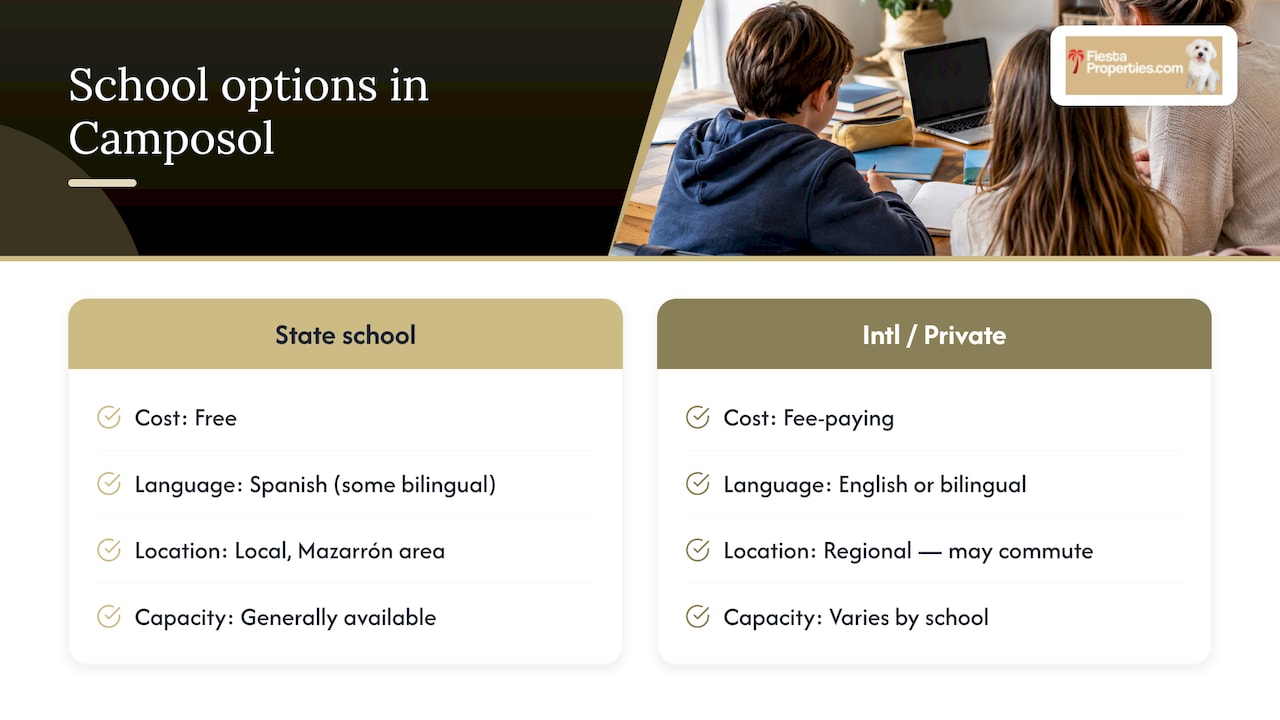
International and British curriculum schools exist across the Murcia region, with some families choosing to commute a reasonable distance for access to English-medium education. Registering a child with the local town hall via the padrón is typically a prerequisite for enrolment in the state system, which is another reason to prioritise that registration step soon after arrival rather than treating it as paperwork for later.
Safety and security considerations in Camposol
Camposol is generally regarded as a quiet, low-crime residential area, popular in part because of its gated-community feel and the high proportion of owner-occupied properties. As with any community of holiday and permanent homes, opportunistic burglary on unoccupied properties is the most common concern raised locally, rather than violent crime.
Simple precautions help: joining neighbourhood watch-style groups run informally through community channels, fitting basic security measures such as alarms or shutters, and asking neighbours to keep an eye on a property during extended absences. Community of owners’ associations sometimes fund private security patrols in addition to standard police coverage, so it is worth checking what arrangements exist for a specific development before buying or renting.
Local employment opportunities and working regulations for residents
Employment opportunities directly in Camposol itself are limited, reflecting its character as a residential rather than commercial hub, so most working-age residents either commute to Mazarrón and the wider Murcia region, work remotely, or run their own business locally. British nationals wanting to work in Spain, rather than live on a non-lucrative visa, need a residency category that permits employment, since the non-lucrative route does not allow local work.
Self-employment and remote work for a UK-based employer fall under different rules and tax treatment than local employment, so anyone planning to work while living in Camposol should clarify their visa category and tax position before assuming they can simply continue working as before. Many expats in the area find opportunities in property, hospitality or services catering to the international community, alongside remote roles that do not depend on a local employer.
Author perspective from Mike Kalia
The single piece of advice worth repeating is this: get independent legal and financial checks done before any deposit changes hands, whether on a rental or a purchase. The most common pitfall is relying solely on verbal assurances about community fees, outstanding charges or boundary lines, which a proper legal check resolves in days rather than months.
— Mike Kalia
Fiesta Properties: how we help people move to Camposol
Settling in Camposol becomes far more manageable when the property side is handled by people who do it daily. We offer a family-run, end-to-end service that covers the parts of a move most likely to cause delays or unexpected costs.

- Property search and shortlisting: we narrow down developments and resales that match your budget and priorities across Costa Blanca and Costa Cálida.
- Mortgages: our in-house mortgage specialist arranges financing options suited to international buyers.
- Legal specialist: our legal support covers the checks a purchase requires, at no legal fee to you.
- Currency exchange: our currency specialist secures competitive rates on transfers, with no exchange fee charged to clients.
- Aftersales: support continues once the keys are handed over, for the practical questions that come up after you move in.
If you are ready to see what is available, browse our current property search or get in touch for a virtual viewing to see Camposol-area homes before committing to a trip.
This article is general information, not a substitute for advice from a qualified financial advisor. Consult a qualified financial professional about your own circumstances before acting on anything here.
FAQ
Can I live in Spain as a UK pensioner?
Yes, UK pensioners can live in Spain, typically under the non-lucrative visa route, and those holding a valid S1 form can register for state healthcare on broadly the same terms as Spanish nationals. Notifying the International Pension Centre of your move prevents payment interruptions.
What is the best place in Spain for English expats to live?
There is no single official “best” location, and the right choice depends on budget, climate preference and proximity to amenities, but areas along the Costa Blanca and Costa Cálida, including Camposol, are popular with British residents for their established expat communities and milder winters. Checking local amenities, healthcare access and transport links against your own priorities is the most reliable way to judge fit.
Is life better in Spain or the UK?
This depends entirely on personal priorities such as climate, cost of living, pace of life and proximity to family, so there is no single correct answer. Many British residents in areas like Camposol cite warmer weather and a lower cost of living as reasons for moving, while others miss aspects of UK convenience and familiarity.
Do I need to register on the padrón if I rent rather than buy in Camposol?
Yes, registering on the padrón is required regardless of whether you rent or buy, since it is tied to your address rather than ownership status. It is also a prerequisite for accessing local services such as healthcare registration and school enrolment, according to GOV.UK.
How soon after arriving in Spain must I apply for my TIE?
British nationals must apply for their TIE within one month of arrival in Spain, following the padrón registration and the initial visa approval. Appointments should be booked as early as possible, since local offices can have limited availability, according to GOV.UK.


