

UK Buyers: 8 Steps to Buy in Spain After Brexit (NIE, Funds & Visas)
· 12 min read
Yes, you can still buy property in Spain after Brexit, and ownership rights for UK citizens remain exactly as they were before 2021. What has changed is everything around the purchase: you now buy as a non-EU national, subject to the 90/180-day stay rule, with new visa requirements if you want to live there long-term. Start by applying for your NIE, arranging euro funds through an FX broker, and instructing a Spanish lawyer early.
TL;DR:
- UK citizens can still purchase and sell property in Spain without restrictions, but residency is limited to 90 days unless holding a visa.
- The property purchase process remains similar, but securing an NIE, arranging financing, and handling customs now require careful planning and timely application.
- Moving belongings, pets, and vehicles involves customs declarations and Transfer of Residence relief, with coordination essential to prevent delays or additional costs.
- Outdated online advice predating 2021 often misrepresents current rules; buyers should focus on current procedures, early documentation, and integrated professional support.
Table of Contents
- What has actually changed since Brexit for buyers
- How does the Spanish property purchase process work?
- How long can UK citizens stay in Spain without a visa?
- What are the taxes and costs of buying in Spain?
- What are the mortgage and currency options for UK buyers?
- How do you move belongings, pets and vehicles to Spain?
- What mistakes do UK buyers commonly make?
- How does local support help UK buyers navigate this process?
- Author perspective: what matters most for 2026 buyers
- Get help buying property in Spain after Brexit
- Official guidance and primary sources
- Sources
- FAQ
What has actually changed since Brexit for buyers
The core right hasn’t moved. UK citizens retain the full right to purchase, own and sell property in Spain, and no new licence or permit governs the transaction itself. What changed sits around that right, not inside it.
Residency is now a separate question entirely. Before 2021, freedom of movement meant a British buyer could simply live in their Spanish property indefinitely. Now you’re capped at 90 days within any 180-day period unless you hold a visa, which turns “I’ll just spend summers there” into a legal decision requiring paperwork.
Moving your belongings changed too. Bringing furniture, a car, or personal effects into Spain now involves the Transfer of Residence process and customs declarations that simply didn’t exist for UK nationals a few years ago.
Banks have also tightened up. Spanish lenders now ask UK applicants for more extensive proof of income and source of funds than they once did, treating British buyers the same way they treat other non-EU applicants.
That last point matters more than most buyers expect, because a lot of the advice still circulating online predates all of this.
- Ownership itself: unchanged, no restrictions on UK buyers
- Length of stay: capped at 90/180 days without a visa
- Moving possessions: now requires customs declarations and Transfer of Residence relief
- Mortgage underwriting: stricter documentation for non-resident applicants
- Old guides: many blogs and forum posts still describe pre-2021 rules as current
Treat any guide written before 2021 as unreliable on residency, customs, or financing. The ownership rules have not changed, but almost everything procedural around them has.
How does the Spanish property purchase process work?
The process itself hasn’t been rewritten by Brexit, but the order in which you tackle each step matters more now than it used to, because visa and NIE timelines run in parallel with the property search.
- Get mortgage pre-approval first, if financing. A pre-approval letter from a lender strengthens your offer and gives you a realistic budget before you fall for a property you can’t actually finance.
- Apply for your NIE as soon as you have a specific reason to. Spanish consulates in the UK generally want evidence you’re actively buying, such as a reservation agreement, so many buyers wait until they’ve found a property before starting this step.
- Sign the reservation contract and pay a holding deposit. This typically takes the property off the market for two to four weeks while your lawyer carries out checks.
- Sign the contralto de arras (private purchase contract). This usually commits you to a deposit of around 10% of the purchase price and sets a completion date, with penalty clauses if either side pulls out.
- Have your lawyer complete due diligence. This means checking the title at the Land Registry, confirming there are no outstanding charges or embargoes, verifying habitation licences, and checking community fee arrears.
- Arrange the mortgage formalities, if applicable, including the property valuation and final loan offer.
- Sign the escritura (public deed) before a notary. You must attend this in person, or arrange a specific power of attorney in advance; there’s no way to complete this final step remotely from the UK.
- Register the property at the Land Registry, which your lawyer typically handles after signing.
Timelines vary sharply depending on how you’re paying. A cash buyer typically completes in around four to five months from starting the NIE application to collecting keys. A financed purchase usually takes six to seven months, once mortgage underwriting and notary scheduling are factored in. The most common bottleneck isn’t the property search at all. It’s waiting on NIE appointments and mortgage document requests that arrive one at a time rather than all at once.
How long can UK citizens stay in Spain without a visa?
Ninety days in any rolling 180-day period, no exceptions for property owners. Owning a Spanish villa doesn’t buy you extra time; the Schengen rule applies to all short-stay visitors regardless of whether they own property in the country. In practice, that means a couple who spend January to March in their Costa Blanca apartment, then fly home, then come back for three weeks in July, need to track their days carefully. Overstaying can mean fines and, in more serious cases, entry bans on future visits.
If you want to live in Spain for longer than that, you need a visa. The two most relevant routes for property buyers are:
- The non-lucrative visa, aimed at people who want to reside in Spain without working there. It requires proof of passive income, broadly around €2,400 a month or €28,800 a year for the main applicant, plus private health insurance and a clean criminal record check. You cannot work for a Spanish company or freelance locally on this visa.
- The digital nomad visa, suited to remote workers employed by non-Spanish companies or freelancers with mostly overseas clients. It has its own income and contract evidence requirements and, unlike the non-lucrative route, actually permits you to work while resident.
Once you’re legally resident, registering for your TIE (the residence card that replaces the old NIE-only status for residents) opens the door to Spain’s public healthcare system, though your GHIC won’t cover routine care once you’ve relocated permanently. Anyone drawing a UK State Pension may also be able to use an S1 form to access Spanish healthcare, which is worth checking with the NHS Overseas Healthcare Team before you commit to a visa route.
Pro Tip: Apply for your NIE and start the visa paperwork in parallel rather than sequentially. Consulate appointment slots and visa processing both run on their own clocks, and stacking them saves months.
What are the taxes and costs of buying in Spain?
Budget for purchase costs on top of the property price, not instead of a deposit. Buyers typically add roughly 10 to 13% of the purchase price in taxes and fees, and which taxes apply depends on whether you’re buying new or resale.
| ITP (transfer tax, resale property) | 6% to 10% | Rate varies by region; applies instead of AJD. | AJD / VAT (new build property) | 10% VAT plus AJD | Applies to new builds bought from a developer. | Notary fees | 0.5% | Scales with property value | | Land Registry fees | 0.5% | Registers the deed and confirms your legal title | | Independent legal fees | 1% | Covers due diligence, contract review, completion |
Once you own the property, the costs don’t stop. Non-resident owners pay IBI (the local property tax, roughly comparable to council tax), comunidad fees if the property sits within a managed development, and basura (refuse collection charges), typically totalling a few hundred euros a year depending on the property and location.
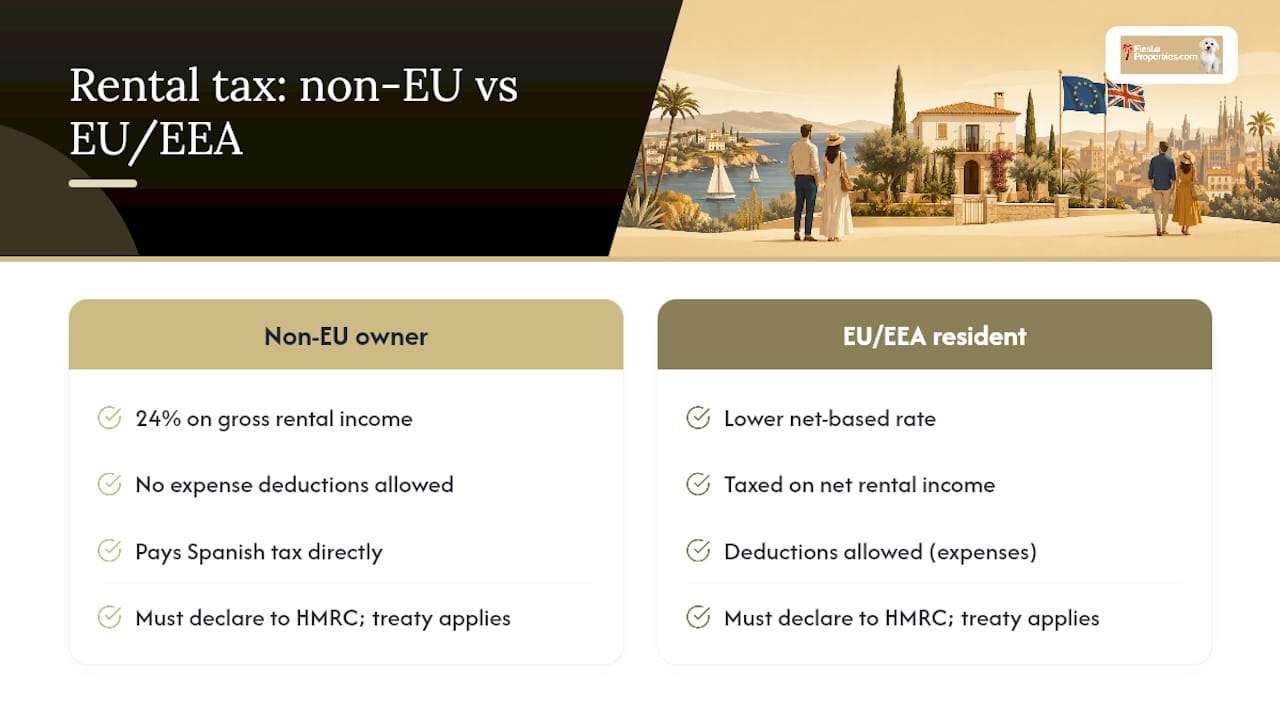
If you rent the property out, tax treatment differs sharply from residents. Non-EU owners pay 24% tax on gross rental income, with no deductions for expenses, compared with the lower net-based rate EU/EEA residents receive. You’ll also need to declare that rental income to HMRC; the UK-Spain double taxation treaty prevents you paying tax twice on the same income, but it doesn’t exempt you from reporting it.
Inheritance planning deserves early attention too. UK-domiciled owners of Spanish property can face Spanish succession tax on that asset regardless of UK domicile status, and the rules interact with UK inheritance tax in ways that catch people out. A conversation with a cross-border tax adviser before you buy, not after, tends to save the most money.
What are the mortgage and currency options for UK buyers?
Financing splits into three realistic routes, and each has a different risk profile once you factor in currency movement.
Buying with cash via an FX broker avoids financing altogether and tends to be the cheapest route overall. Using a specialist FX broker rather than converting through a high-street bank typically saves 1.0% to 1.8% on the exchange rate, which on a purchase of a typical mid-range price can mean a few thousand pounds saved simply by choosing where you convert.
Remortgaging or taking a further advance in the UK keeps your finance entirely within a familiar system, but ties your Spanish purchase to your UK property’s equity and availability depends heavily on your existing lender’s criteria.
A Spanish non-resident mortgage lets you borrow against the property itself. Lenders continue to serve UK applicants, though loan-to-value ratios for non-residents typically range between about sixty and seventy percent, appraisal fees run €300 to €500, and the full mortgage process usually takes six to ten weeks. Expect to provide tax returns, bank statements, proof of income, and a credit reference from the UK.
- Compare all-cash FX savings against mortgage leverage before deciding
- Lock in a forward FX contract if there’s a gap between your arras deposit and completion
- Ask any lender for a full document checklist before you start the search, not after an offer is accepted
UK banks now treat transfers to Spain as international payments, which usually means closer anti-money-laundering scrutiny and worse exchange rates than a dedicated broker offers.
How do you move belongings, pets and vehicles to Spain?
Bringing your possessions over now runs through UK customs and Spanish import rules that didn’t exist before 2021. To claim Transfer of Residence relief and avoid import VAT or duty, you’ll need to prove you’re genuinely relocating, not simply furnishing a holiday home.
- Supply a detailed, itemised inventory of your belongings, valued and translated into Spanish
- Provide evidence of genuine relocation, such as an empadronamiento (local registration) or a baja consular declaration
- Apply for Transfer of Residence relief before your goods arrive, not after
- Arrange a GB-EU Animal Health Certificate for pets, timed to fall within the window the certificate remains valid
- Think carefully before importing a UK car; the registration and tax process is complex enough that many buyers simply sell up in the UK and buy locally instead
Coordinate your removals firm, customs paperwork, and residency timing together. A shipment that arrives before your ToR relief is approved can get held at the border, adding unplanned costs and delay to what should be a straightforward move.
What mistakes do UK buyers commonly make?
Most of the costly errors aren’t about the property itself. They’re about timing and outdated assumptions.
- Relying on advice written before 2021, when UK buyers were still treated as EU citizens
- Delaying the NIE application until after finding a lawyer, rather than as soon as a reservation contract exists
- Failing to buffer for currency movement between signing the arras contract and completing at the notary
- Assuming a UK power of attorney lets you skip attending the notary signing in person
Pro Tip: If you can’t attend the escritura signing in person, arrange a specific Spanish power of attorney with your lawyer well in advance. A generic UK POA usually won’t be accepted by the notary.
How does local support help UK buyers navigate this process?
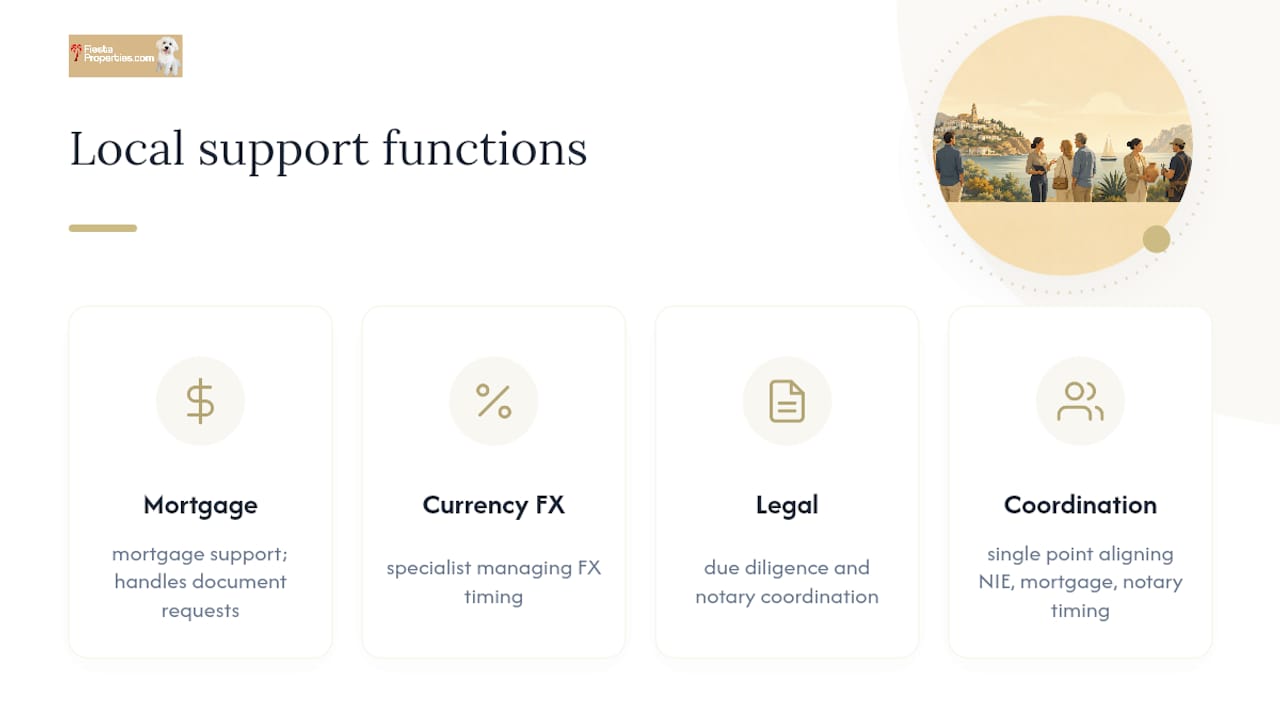
Buying as a non-EU national means more moving parts, not fewer, and coordinating them separately is where most delays happen. A family-run agency structures its support around exactly this problem: sales and aftersales guidance, mortgage support from a specialist, a currency exchange specialist to manage FX timing, and a legal specialist handling due diligence and notary coordination.
Having those functions under one roof matters practically. NIE timing, mortgage document requests, and notary scheduling all need to line up, and a single point of coordination reduces the chance one step stalls the rest.
The agency has experience working with international buyers in the region, building local knowledge of specific towns covered in this guide, from Torrevieja to Jávea to Los Alcázares.
Author perspective: what matters most for 2026 buyers
If there’s one thing worth repeating to anyone starting this process now, it’s that documentation discipline beats enthusiasm. Buyers who start their NIE application early, lock in their visa route before falling in love with a property, and treat currency exchange as a planned decision rather than an afterthought consistently have smoother completions.
The buyers who struggle are usually working from advice that’s a few years out of date. Get independent legal counsel, get your funds strategy sorted before you sign anything, and don’t assume last year’s forum post still applies.
— Mike Kalia
Get help buying property in Spain after Brexit
UK buyers can benefit from a single point of contact for parts of this process that often involve multiple providers such as mortgage brokers, currency specialists, lawyers, and estate agents, each working on their own timeline. This integrated support can reduce complexity without adding extra cost beyond usual budgets.

If financing is part of your plan, Fiesta Properties’ mortgage service can help you secure pre-approval with fixed rates from 2.4% and terms of up to 30 years, strengthening your position before you make an offer. If you’re ready to start looking, browse available properties across Costa Blanca South and request a shortlist tailored to your budget and preferred area. A conversation with the team costs nothing and can save weeks of guesswork later in the process.
Official guidance and primary sources
Cross-check anything in this guide against the primary sources it draws on, since rules can shift and your specific circumstances may differ.
- Spain: entry requirements for the current Schengen and visa position
- Transfer of Residence to Spain from the UK for customs relief on household goods
- Schengen area policy for the EU’s own explanation of short-stay limits
This article is general information, not a substitute for advice from a qualified financial advisor. Consult a qualified financial professional about your own circumstances before acting on anything here.
Sources
- Spain: entry requirements (Foreign travel advice)
- Buying property in Spain as a UK citizen: the non‑EU process
FAQ
Can UK citizens buy property in Spain after Brexit?
Yes. Ownership rights for UK citizens are unchanged, and no special licence is required to purchase Spanish property. What’s changed is that buyers now go through the non-EU process, including NIE registration and stricter mortgage documentation.
What are the downsides of buying property in Spain from the UK?
Currency movement between signing the contract and completion can also add unexpected cost if left unmanaged.
Can I still buy property in Lanzarote after Brexit?
Yes, the same rules apply across all of Spain, including the Canary Islands. Ownership rights are unchanged nationally, while residency, tax and customs rules follow the same non-EU framework covered throughout this guide.
Is it wise to buy a property in Spain now?
Whether it’s wise depends on your own finances, visa plans and risk tolerance, not on Brexit itself, since ownership rights haven’t changed. Buyers who plan their NIE application, visa route and currency strategy in advance, ideally with support such as Fiesta Properties’ integrated legal and mortgage services, tend to avoid the delays that catch out those relying on outdated guidance.


