

Non-resident mortgage in Spain: UK buyer’s guide 2026
· 15 min read

UK non-residents can obtain a Spanish mortgage, and the headline numbers are straightforward to plan for. As of Q1 2026, lenders typically offer 60–70% loan-to-value for non-residents, meaning a cash deposit of 30–40% of the purchase price. On top of that deposit, buyers should budget an additional 10–13% of the purchase price to cover taxes, notary fees, and legal costs. Brexit changed the classification of UK buyers — they are now treated as non-EU non-residents — but it did not remove access to Spanish mortgage products.
Before going further, here are the immediate steps worth starting this week:
-
Apply for your NIE (Número de Identidad de Extranjero) — it is mandatory for any property purchase and deed signing, and processing times vary by office.
-
Gather three to six months of bank statements and your most recent tax returns or SA302 forms.
-
Request an Agreement in Principle from a lender or broker to understand your borrowing ceiling before making an offer.
-
When you sign an arras (deposit contract), insist on a mortgage-financing clause that protects your deposit if the loan is declined.
These four actions alone prevent the most common delays agents see in non-resident purchases.
Table of Contents
-
What documents do you need and how does the application work?
-
What agents actually see stall deals — and what moves them forward
-
How Fiestaproperties helps UK buyers through the mortgage process
Can UK non-residents get a Spanish mortgage?
Post-Brexit, UK citizens are classified as non-EU non-residents by Spanish banks. That classification matters for two reasons: it typically reduces the maximum LTV available (residents can often borrow up to 80% or more) and it increases the documentation burden. What it does not do is bar UK buyers from the market. Spanish lenders continue to offer mortgage products to UK applicants, and the process, while more paperwork-intensive than a domestic mortgage, follows a clear and manageable path.
Lenders assess non-resident applications on several fronts. The Banco de España’s lending guidelines set a debt-to-income cap of roughly 30–40% of net monthly income, meaning total monthly debt commitments including the new mortgage should not exceed that threshold. Age limits also apply: most lenders require the mortgage to be fully repaid by the time the borrower reaches 70–75 years old, so a 55-year-old buyer may find the maximum term is 15–20 years rather than 25–30.
Banks also evaluate country risk and anti-money laundering compliance. Because UK documents are no longer EU-standard, non-Spanish paperwork often requires sworn translation and, in some cases, apostille certification. Self-employed applicants face additional scrutiny: lenders want to see two or three years of audited accounts alongside SA302 forms, and any gaps in income documentation tend to result in tighter terms or outright declines.
Pro Tip: If you are self-employed, prepare a brief cover letter summarising your income history and business stability. Banks respond better to a well-packaged file than to a pile of documents with no context.
How much can you borrow and what deposit do you need?
The standard LTV for non-residents in Spain sits at 60–70%, compared with 80% or above for residents. That gap is significant: on a €250,000 property, a resident might borrow €200,000, while a non-resident would typically borrow €150,000–€175,000, requiring €75,000–€100,000 in cash before purchase costs are added.

How the bank valuation (tasación) affects your loan
Spanish lenders lend against the lower of the agreed purchase price or the bank’s own valuation, known as the tasación. If you agree to pay €250,000 but the bank values the property at €230,000, the maximum loan is calculated on €230,000, not €250,000. At 70% LTV on a €230,000 valuation, the loan is €161,000, leaving a cash gap of €89,000 plus the 10–13% purchase costs. Always model your borrowing against the bank valuation, not the agreed price, because valuation shortfalls are one of the most common causes of renegotiation.
A worked example
| Item | Amount (€) |
|---|---|
| Agreed purchase price | 250,000 |
| Bank valuation (tasación) | 230,000 |
| Maximum loan at 70% LTV | 161,000 |
| Cash deposit required | 89,000 |
| Purchase costs at 10–13% of price | 23,000–28,750 |
| Total cash needed | 112,000–128,750 |
The affordability calculation runs alongside the LTV check. The 30–40% debt-to-income cap means total monthly debt payments should not exceed a portion of your net monthly income. Any existing mortgage, car finance, or credit card minimum payments reduce that ceiling further. UK buyers with existing liabilities should calculate their residual borrowing capacity before approaching a Spanish lender.
-
Calculate your net monthly income after tax.
-
Multiply by 0.35 (the midpoint of the DTI range) to find your maximum total monthly debt.
-
Subtract existing monthly debt commitments.
-
The remainder is the maximum monthly mortgage payment a Spanish bank will typically accept.
-
Use a lender’s mortgage simulator to convert that monthly payment into a loan amount at current rates.
What mortgage types are available to non-residents?
Spanish lenders offer variable, fixed, and mixed mortgage products to non-resident borrowers, though the range available to non-residents is sometimes narrower than for residents.
Variable-rate mortgages are priced as 12-month Euribor plus a lender margin. The margin varies by lender, borrower profile, and the level of product bundling (insurance, current accounts) the borrower accepts. When Euribor moves, the monthly payment adjusts at each annual review, which introduces payment uncertainty for GBP earners whose income does not move in line with European interest rates.
Fixed-rate products eliminate that uncertainty. Banks sometimes steer non-resident borrowers towards fixed deals precisely because predictable repayments reduce the lender’s credit risk on a cross-border loan. For UK buyers with sterling income, a fixed rate also removes the compounding effect of both exchange-rate movement and Euribor fluctuation hitting the same monthly payment.
Mixed mortgages offer a fixed rate for an initial period (typically five to ten years) before switching to a variable rate. They can suit buyers who expect to sell or remortgage within the fixed window, but the variable tail carries the same currency-risk considerations as a fully variable product.
Interest-only options exist but are rare for non-residents and typically reserved for high-net-worth borrowers with substantial assets. Most buyers should plan on a capital-repayment structure.
When comparing quotes, look beyond the headline rate. The annual percentage rate (TAE in Spanish) captures fees and insurance costs alongside the interest rate and gives a more accurate picture of the true annual cost. Early repayment penalties, arrangement fees, and the cost of any tied insurance products all affect the lifetime cost of the loan.
Pro Tip: Ask each lender for a quote both with and without their insurance bundle. Banks cannot legally require you to buy their insurance products, and comparing the lifetime cost of a bundle against the margin discount it offers often reveals the bundle is more expensive over the full term.
What are the full costs of buying with a Spanish mortgage?
Budget 10–13% of the purchase price on top of the deposit to cover the taxes and fees that accompany every Spanish property purchase. The exact percentage depends on the region, the property type, and the purchase price.
| Cost item | Typical range | Who pays |
|---|---|---|
| Transfer tax (ITP) — resale properties | 6–10% of price (varies by region) | Buyer |
| VAT (IVA) — new build properties | 10% of price | Buyer |
| Stamp duty (AJD) — new builds | varies by region | Buyer |
| Notary fees | — | Buyer |
| Land registry fees | — | Buyer |
| Legal / solicitor fees | 1% | Buyer |
| Bank valuation fee (tasación) | — | Buyer |
| Mortgage arrangement fee | 0–1% of loan | Buyer |
For new-build properties, IVA at 10% replaces the resale transfer tax, and stamp duty (AJD) is charged separately. The full breakdown of Spanish buying costs varies by autonomous community, so confirm the regional rate for the specific property location.
One cost that catches buyers off guard: the bank valuation fee is typically payable upfront and is not refunded if the mortgage is declined. Budget for it as a sunk cost and factor it into the decision to apply. Buildings insurance is effectively required by lenders as a condition of the mortgage. Life or loan insurance is frequently offered alongside the mortgage as a bundle, but it is not legally mandatory. Always obtain an independent insurance quote before accepting a lender’s tied product.
What documents do you need and how does the application work?
The document checklist
Preparing a complete, well-organised file before approaching a lender materially reduces processing time. The standard set for a UK non-resident applicant includes:
-
Valid passport and NIE certificate (the NIE is mandatory for deed signing — apply early)
-
Last two to three years of tax returns (SA302 forms or full self-assessment returns for self-employed applicants)
-
Three to six months of personal bank statements showing income and existing liabilities
-
Proof of deposit and source of funds (savings statements, sale completion paperwork if funds come from a property sale)
-
Most recent payslips (typically three months for employed applicants)
-
Nota simple (property registry extract) for the property being purchased
-
Sworn translations of non-Spanish documents, and apostille certification where required
For detailed guidance on the full document set, including translation and apostille requirements, Fiestaproperties provides a buyer-facing checklist tailored to UK applicants.
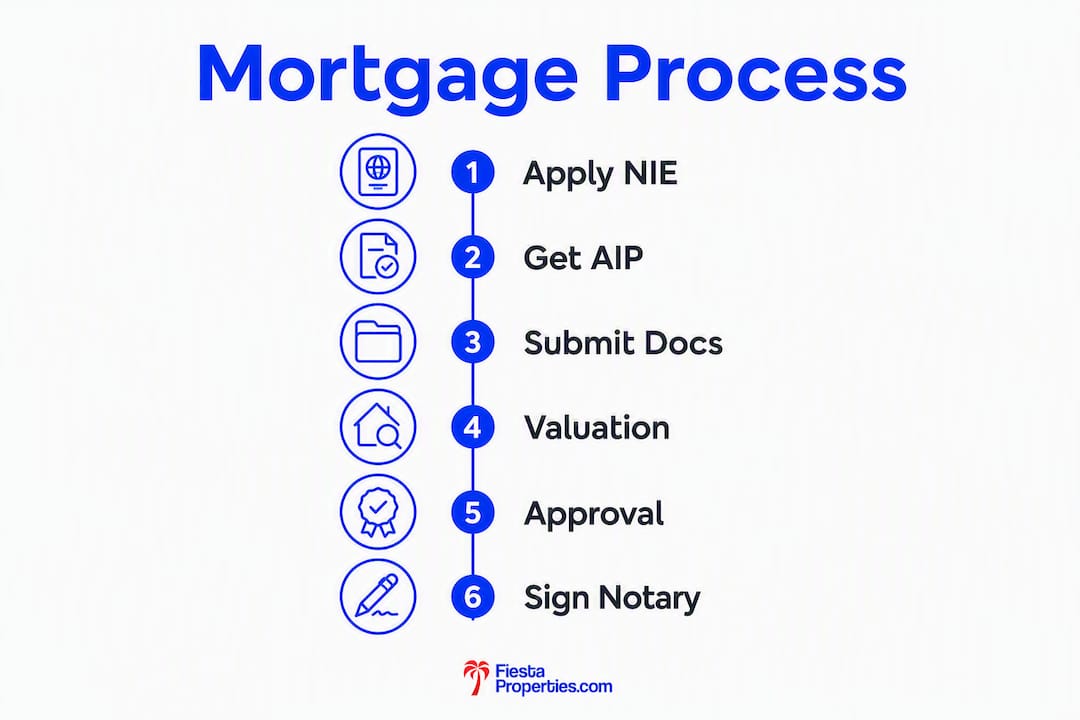
The application process, stage by stage
-
Agreement in Principle (pre-approval): Submit income and liability details for an indicative loan amount. Takes one to two weeks.
-
Full application: Submit the complete document file. The lender begins formal underwriting. Allow two to three weeks.
-
Valuation (tasación): The bank instructs a valuer. Takes one to two weeks after instruction.
-
Underwriting decision: The lender reviews the valuation and issues a conditional approval or requests further documents. One to two weeks.
-
FEIN (binding mortgage offer): The lender issues the Ficha Europea de Información Normalizada. Under Spanish mortgage law, a mandatory 10-day reflection period follows before signing. This period cannot be shortened.
-
Notary signing: Buyer and lender sign the mortgage deed. Funds transfer and keys are released.
The realistic window from first application to notary signing is 6–12 weeks. When negotiating the arras (deposit contract), set the financing contingency window to comfortably exceed 12 weeks and include an explicit clause releasing the deposit if the mortgage is declined within that period. Banks charge a valuation fee even if the mortgage is refused, so the arras clause protects the deposit, not the valuation cost.
Signing remotely and transferring funds from the UK
Physical presence at the Spanish notary is not required. A poder notarial (power of attorney) allows a buyer to appoint a lawyer or trusted representative in Spain to sign the mortgage deed and complete the purchase on their behalf. This is standard practice for UK buyers and is accepted by all Spanish notaries. The power of attorney itself is typically prepared by a Spanish solicitor and, if signed in the UK, will require apostille certification before it is valid in Spain.

Source-of-funds scrutiny is thorough. Banks will want a clear paper trail for the deposit: savings statements showing the funds accumulating over time, or sale completion paperwork if the money comes from selling a UK property. Non-Spanish documents in this category typically require sworn translation. Preparing this documentation before application, rather than in response to a bank request, avoids delays.
For the actual transfer of funds, services such as Wise offer lower-cost international transfers compared with standard bank wire fees, and they generate clear transfer receipts that satisfy the bank’s and notary’s audit requirements. Time transfers to clear into the Spanish account at least two to three working days before completion to avoid any last-minute hold.
Pro Tip: Keep a dedicated folder of all transfer receipts, bank statements showing the funds arriving, and the corresponding source-of-funds documents. The notary and the bank may both request this trail independently, and having it organised in advance avoids duplicating effort under time pressure.
How to improve your chances of mortgage approval
Several practical actions materially affect both approval odds and the margin a lender offers.
-
Increase the deposit. Offering 35–40% rather than the minimum 30% reduces lender risk and can improve the margin offered, particularly for variable-rate products.
-
Reduce visible monthly debt. Pay down credit card balances and close unused credit facilities before applying. Every £100 of monthly commitment reduces the loan a Spanish bank will approve.
-
Open a Spanish bank account early. Some lenders require the mortgage to be serviced from a Spanish account. Having one open before application demonstrates organisation and removes a potential condition.
-
Translate and apostille documents in advance. Waiting for a bank to request translations adds two to three weeks to the timeline. Prepare sworn translations of payslips, tax returns, and bank statements before submission.
-
For self-employed applicants, use audited accounts. SA302 forms alone are sometimes insufficient. A set of accountant-certified accounts for the last two to three years gives underwriters the income stability evidence they need.
Before making an offer on a property, complete these five tasks: obtain an Agreement in Principle, apply for the NIE, open a Spanish bank account, assemble the full document file with translations, and confirm the deposit source-of-funds trail is documented and auditable.
Should you use a broker or apply direct to a bank?
The right route depends on the complexity of the application and the buyer’s existing relationships in Spain.
Going direct to a large Spanish bank makes sense when the applicant has a straightforward salaried income, an existing Spanish banking relationship, or has already been pre-approved by a lender’s non-resident desk. Large banks such as Banco Santander operate dedicated non-resident mortgage desks and publish indicative terms online. For a buyer with clean documentation and a standard employment profile, a direct application can be faster and avoids broker fees.
A broker adds most value when the income is complex (self-employed, multiple income streams, or a mix of rental and employment income), when the buyer is unfamiliar with the document requirements, or when speed matters and access to multiple lenders simultaneously is useful. Specialist non-resident mortgage brokers maintain relationships with lenders who do not advertise widely and can often shortlist suitable products within days rather than weeks. They also handle document translation coordination and can flag valuation risks before the formal application is submitted. For a review of how different lenders approach UK buyers, Fiestaproperties maintains a practical guide based on direct buyer experience in Costa Blanca and Murcia.
Key questions to ask any lender or broker: What is the maximum LTV for my profile? What is the typical margin over Euribor for a non-resident applicant? How long does the valuation take? What insurance products are required versus optional? What is the realistic FEIN timescale?
Red flags worth noting: a lender who cannot explain how valuation differences are handled, a broker who refuses to add a financing clause to the arras, or any party who presents insurance bundling costs as non-negotiable without providing an independent comparison.
Realistic timeline and your week-one checklist
A realistic example timeline for a Spanish home purchase runs as follows, assuming a well-prepared document file:
-
Week 1–2: Request Agreement in Principle; apply for NIE; open Spanish bank account.
-
Week 2–4: Submit full application with complete document file.
-
Week 4–6: Bank instructs valuation; valuation completed and returned.
-
Week 6–8: Underwriting decision; conditional approval issued.
-
Week 8–10: FEIN issued; mandatory 10-day reflection period begins.
-
Week 10–12: Notary signing and completion.
Set the financing contingency window in the arras to at least 12 weeks, with a short extension clause if the FEIN is delayed. If the valuation comes in below the purchase price, the options are to renegotiate the price with the seller, increase the cash contribution, or withdraw under the financing clause. Having the clause in place before the valuation is the only reliable protection.
For week one specifically: apply for the NIE through the Spanish Ministry of Foreign Affairs, collect three to six months of bank statements, request an SA302 from HMRC, and contact a lender or broker for an Agreement in Principle. These four actions set the foundation for everything that follows.
Key takeaways
UK non-residents can secure a Spanish mortgage in 2026, but success depends on a 30–40% deposit, a complete document file, and a realistic 6–12 week timeline built into the arras contract.
| Point | Details |
|---|---|
| Deposit and LTV | Non-residents typically need a 30–40% deposit; lenders offer 60–70% LTV against the lower of purchase price or bank valuation. |
| Total cash required | Budget an additional 10–13% of the purchase price for taxes, notary, registry, and legal fees on top of the deposit. |
| Timeline and FEIN | Allow 6–12 weeks from application to completion; the mandatory 10-day FEIN reflection period cannot be shortened. |
| NIE and documents | Apply for the NIE immediately — it is mandatory for deed signing — and prepare sworn translations of non-Spanish documents before submission. |
| Fiestaproperties | For Costa Blanca and Murcia buyers, Fiestaproperties offers property shortlisting, NIE guidance, and mortgage introductions to help reduce friction in the buying process. |
What agents actually see stall deals — and what moves them forward
The gap between a smooth purchase and a stressful one usually comes down to preparation, not the mortgage product itself. The most common stall agents working in Costa Blanca and Murcia observe is a missing or late NIE. Buyers who treat the NIE as something to sort out after finding a property routinely lose two to four weeks at the worst possible moment, when the arras clock is already running.
The second most frequent problem is an arras window that is too short. Buyers and sellers often agree on eight weeks because it feels reasonable, without accounting for the mandatory 10-day FEIN reflection period or the possibility that the bank requests additional documents mid-underwriting. A 12-week window with a short extension clause costs nothing to negotiate and removes significant pressure.
Valuation shortfalls are the third sticking point. A buyer who has modelled their borrowing against the purchase price rather than the tasación can find themselves needing an extra €10,000–€20,000 in cash at short notice. The fix is straightforward: always run the worked example against a conservative valuation estimate before making an offer, not after.
On the positive side, a larger deposit genuinely opens doors. Buyers who offer 35–40% rather than the minimum 30% often find lenders more willing to accommodate complex income structures or shorter employment histories. A pre-arranged Spanish bank account and a well-organised document folder signal to underwriters that the buyer is serious and low-risk, which can translate into faster processing and marginally better margins.
How Fiestaproperties helps UK buyers through the mortgage process
For UK buyers focused on Costa Blanca and Murcia, the practical challenge is not just finding the right property — it is coordinating the NIE, the mortgage, the legal checks, and the completion timeline without being physically present in Spain for most of it.

Fiestaproperties has been working with buyers in this region since 2010, and the team understands where the friction points are. From helping buyers access NIE guidance and local legal contacts, to making mortgage introductions and managing completion timing around the FEIN reflection period, the support is practical and specific to the Costa Blanca and Murcia market. The property portfolio covers over 3,000 listings, including new-build, off-plan, and resale homes, so buyers can shortlist properties that fit their mortgage budget before approaching a lender.
The clearest next step is to start the buying process with Fiestaproperties, where the team can provide a property shortlist matched to your budget and a mortgage-preparation pack covering the documents and contacts you will need.
Useful sources and tools to check
The following authoritative sources are worth bookmarking for the research and application stages:
-
Banco de España — lending, consumer protection and AML guidance — the primary regulatory source for Spanish mortgage rules, DTI caps, and borrower protections.
-
Boletín Oficial del Estado (BOE) — mortgage law and FEIN rules — the official legislative source for the mandatory reflection period and mortgage deed requirements.
-
Spanish Ministry of Foreign Affairs — NIE guidance and consular services — the official source for NIE applications and power of attorney (poder notarial) procedures.
-
Bankinter mortgage simulator and non-resident FAQ — useful for an initial affordability check and to understand how a large Spanish lender presents non-resident products.
-
Fiestaproperties — Spanish property buying guide — a practical overview of the legal and administrative steps for UK non-resident buyers in Costa Blanca and Murcia.
-
Fiestaproperties — how to get a Spanish mortgage — a step-by-step walkthrough of the mortgage process for buyers working with the Fiestaproperties team.
This article provides general information about Spanish mortgage products for UK non-residents. It is not financial, legal, or tax advice. Mortgage terms, tax rates, and regulatory requirements change; confirm current figures with a qualified Spanish mortgage adviser, solicitor, or the relevant Spanish authority before making any financial commitment.


