

Spain’s digital nomad visa: a guide for UK nationals
· 17 min read

UK nationals can apply for Spain’s digital nomad visa, formerly known as the International Remote Work Residence Visa or telework visa, and the process is well within reach for anyone who prepares their paperwork carefully. The single most important first action is to confirm that your employer will provide written consent for you to work remotely from Spain, along with a letter detailing your salary and the length of your contract. Without that letter, the application stalls before it begins.
To qualify, you need either a recognised undergraduate or postgraduate degree, or at least three years of professional experience in your field. Your primary work must be for an employer or clients based outside Spain, and your income must meet at least double the Spanish Minimum Interprofessional Wage (SMI). The visa itself is not a subsidy or payment scheme; it is a legal authorisation to reside and work remotely on Spanish soil.
Two application routes are available to UK nationals:
- From the UK: Apply at the Spanish Consulate in London or through the BLS Spain Visa Application Centre. This route issues a visa valid for up to one year.
- From within Spain: If you are already legally present in Spain (for example, on a tourist entry), you can apply directly for a three-year residence permit without first obtaining a consular visa, provided you meet all eligibility conditions.
Start by checking employer consent, gathering proof of earnings (payslips or invoices covering at least three months), and confirming your health insurance will be valid in Spain for the full duration of the authorisation.
Table of Contents
- Who qualifies for Spain’s digital nomad visa?
- What documents do you need to prepare?
- How much income do you need, and how do you prove it?
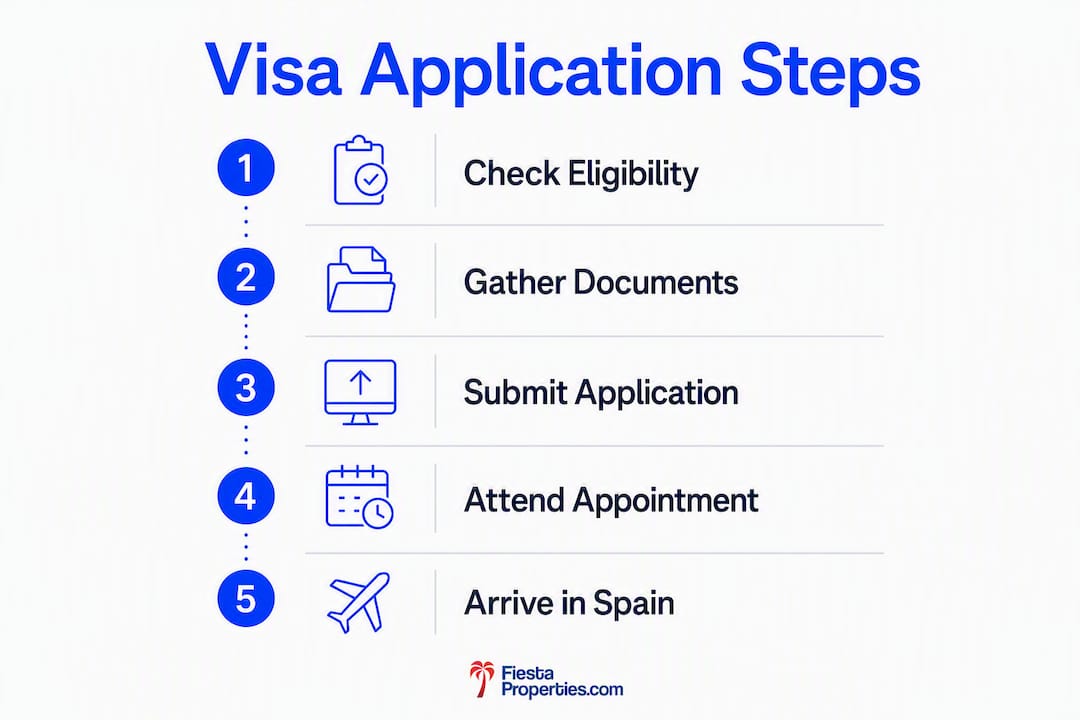
- How to apply from the UK: a step-by-step process
- What are the fees and how long does processing take?
- How long is the visa valid, and how do you extend it?
- Tax and residency consequences for UK nationals
- What to do when you arrive in Spain
- Common reasons for delays or refusals, and how to avoid them
- How property fits into your relocation plans
- Key takeaways
- Finding your home in Spain: how Fiestaproperties can help
- Useful sources and further reading
Who qualifies for Spain’s digital nomad visa?
The eligibility rules are specific, and understanding each one before you gather documents saves considerable time.

Education or professional experience. You must hold a recognised undergraduate or postgraduate degree from a university or accredited institution, or demonstrate at least three years of professional experience directly relevant to your current role. Both routes are equally valid; the key is being able to document whichever applies to you with official certificates or an employment history record.
Remote work for a non-Spanish employer. Salaried employees must work exclusively for companies based outside Spain. If you are self-employed or a freelancer, you may take on some Spanish clients, but that work cannot exceed approximately 20% of your total professional activity. This distinction matters: a salaried worker with any Spanish employer on their books will not qualify, whereas a freelancer with a predominantly international client base can.
Minimum professional relationship of three months. Before applying, you must have been working with your current employer or primary clients for at least three months. The consulate expects to see evidence of this continuity, typically through payslips, invoices, or a formal employment contract showing the start date.
Company age requirement. Your employer’s company, or the entity you contract with, must have been incorporated for at least one year. A commercial registry extract or equivalent company registration document proving the incorporation date is commonly requested. Self-employed applicants need to show equivalent business registration from their home country.
UK-specific considerations. UK nationals can request an employment history record through the HMRC online service or Gov.uk to help evidence professional experience. UK documents such as criminal record certificates (from the Disclosure and Barring Service or Disclosure Scotland) and degree certificates will generally need an apostille from the Foreign, Commonwealth and Development Office, along with a sworn translation into Spanish where the consulate requires it.
Pro Tip: Contact your employer’s HR department now and ask specifically for a letter that names the company, confirms your salary, states the start date of your employment, and explicitly authorises you to work remotely from Spain. Consulate guidance identifies the absence of that explicit authorisation as one of the most frequent reasons for requests for additional documentation.
What documents do you need to prepare?
Organising your paperwork in the right order prevents the most common delays. Some documents take weeks to obtain; others can be gathered in a day.
Get these first (allow 4–8 weeks)
- Company incorporation extract: — A Companies House certificate or equivalent showing your employer has been registered for at least one year.
Can wait until closer to your appointment (allow 2–4 weeks)
- Payslips or bank statements: Typically the last three months’ payslips or equivalent invoices for self-employed applicants, alongside bank statements showing consistent income.
- Health insurance policy: Must be valid in Spain for the full duration of the authorisation. Travel insurance is not acceptable; you need a dedicated private health insurance policy or proof of equivalent public cover.
- Proof of accommodation in Spain: A rental contract, property deed, or a letter from a host. This does not need to be permanent; a short-term rental contract is generally sufficient at the application stage.
- NIE application forms: The Número de Identidad de Extranjero (foreigner identification number) is required for many administrative tasks in Spain. Some applicants apply for the NIE at the consulate at the same time as the visa.
- National visa application form: Available from the Spanish Consulate in London or the BLS Spain Visa Application Centre.
On originals and translations: The consulate requires original documents, not photocopies, at the appointment. Where a sworn translation is needed, use a translator accredited by the Spanish Ministry of Foreign Affairs. If you appoint a representative to submit documents on your behalf, a notarised power of attorney is required.
How much income do you need, and how do you prove it?
The financial threshold is set at 200% of the Spanish Minimum Interprofessional Wage (SMI) for the primary applicant. The SMI is reviewed periodically by the Spanish government; always check the current figure on the official Spanish government website before calculating your threshold, as the amount changes.
For family members accompanying the applicant, additional income is required: 75% of the SMI for the first dependent family member, and 25% of the SMI for each additional dependent.
Worked examples
| Applicant scenario | Income requirement (as % of SMI) | Notes |
|---|---|---|
| Single applicant | 200% SMI | Primary threshold only |
| Applicant + 1 dependent | 200% + 75% SMI | First family member supplement |
| Applicant + 2 dependents | 200% + 75% + 25% SMI | Each additional dependent adds 25% |
Because the SMI is expressed as a monthly figure, present your income evidence in monthly terms. A UK applicant earning in sterling should provide bank statements and payslips showing consistent monthly deposits, alongside a currency note explaining the sterling-to-euro conversion at the time of application. The consulate does not convert currencies on your behalf; the responsibility for demonstrating that your sterling income meets the euro-denominated threshold sits with you.
Pro Tip: Present a monthly income average calculated across at least three consecutive months, supported by payslips or invoices for each month. A single large bank transfer does not demonstrate sustained income; consecutive monthly evidence does. Applicants frequently miscalculate by dividing their gross annual salary by 12 without checking whether the resulting monthly figure, converted to euros at the current exchange rate, actually clears the SMI threshold.
How to apply from the UK: a step-by-step process
The standard route for UK nationals is through the Spanish Consulate in London or the BLS Spain Visa Application Centre, which handles appointments and document submission on behalf of the consulate.
- Complete the national visa application form — The form is available from the Spanish Consulate in London or through the Plataforma ONE (the Spanish government’s official online procedure portal). Complete it in full; incomplete forms are a common cause of delays.
Jurisdiction note: The Spanish Consulate in London covers England, Wales, and Northern Ireland. Scottish residents fall under a different consular jurisdiction; confirm which consulate covers your area of residence before booking.

What are the fees and how long does processing take?
Budgeting for the full cost of the application means accounting for more than just the consular visa fee.
| Cost item | Typical range | Notes |
|---|---|---|
| Consular visa fee | Varies (check current schedule) | Reciprocity rules may apply for UK nationals post-Brexit |
| BLS Spain service fee | Set by BLS; check their website | Covers appointment handling and document submission |
| Apostille (per document) | — | Criminal record and degree certificates typically required |
| Sworn translation (per document) | — | Varies by translator and document length |
| Criminal record certificate | — | AccessNI and Disclosure Scotland have their own fee structures |
| Health insurance (annual) | Varies widely by provider and age | Must cover Spain for the full visa period; travel insurance not accepted |
| Courier or collection costs | Variable | If using a representative or postal collection |
Processing times quoted by the Spanish Consulate in London and the Plataforma ONE typically range from several weeks to a few months, depending on application volume and the completeness of the submission. Peak periods (summer months and January) tend to see longer waits. Submitting an incomplete application resets the clock, so a thorough pre-submission check is worth the time.
Allow a contingency budget for re-appointments or additional document requests. If the consulate asks for supplementary evidence, you will usually have a set period to respond; missing that window means restarting the process.
How long is the visa valid, and how do you extend it?
The consular visa issued from the UK is valid for up to one year. During that year, it serves as your legal title to reside and work remotely in Spain. It is not automatically renewable; the path to longer-term residency requires a separate application.
-
Understand the one-year visa. The initial visa allows you to enter Spain and begin working remotely. It does not convert automatically into a residence permit; you must take active steps before it expires.
-
Apply for the three-year residence permit via UGE-CE. The UGE-CE (Unidad de Grandes Empresas y Colectivos Strategics, or Large Companies and Strategic Groups Unit) is the Spanish government body that processes applications for the longer-term digital nomad residence permit. The standard advice is to begin this application approximately two months before your one-year visa expires to maintain continuity of legal status.
-
Prepare the Initial Residence Authorisation application. The UGE-CE route typically requires submitting an Initial Residence Authorisation application, which mirrors many of the documents from the original visa application but must reflect your current circumstances (updated payslips, renewed health insurance, and so on).
-
Apply for your TIE card. Once your residence permit is granted, you can apply for a Tarjeta de Identidad de Extranjero (TIE), the physical residence card. Many nomads find the TIE simplifies banking, property contracts, and everyday administration considerably.
-
Plan for the in-Spain route if applicable. If you are already legally present in Spain when you decide to apply, you can apply directly for the three-year residence permit without first obtaining a consular visa. This route, available through the Plataforma ONE, is increasingly used by those who can enter Spain visa-free and want to avoid consular appointment bottlenecks in the UK. It requires careful timing to ensure your legal presence in Spain is uninterrupted throughout the application process.
Legal note: For complex employment structures, multi-company arrangements, or situations where the company age or employer relationship is borderline, consulting a qualified Spanish immigration specialist before submitting is advisable.
Tax and residency consequences for UK nationals
Securing the visa is one thing; understanding what it means for your tax position is equally important, and the two are closely linked.
The 183-day rule. Spain uses the 183-day rule as the primary test for tax residency: spend more than 183 days in Spain in a calendar year and you become a Spanish tax resident. Additional factors, such as having your primary economic interests or family in Spain, can also trigger tax residency even before you reach 183 days. Once you are a Spanish tax resident, you are liable to declare your worldwide income to the Spanish tax authority (Agencia Tributaria).
Non-resident vs resident tax treatment. Before reaching tax-resident status, income from foreign sources is generally taxed at a flat non-resident rate. Once resident, you are subject to Spain’s progressive income tax rates on worldwide income. The difference is material for most UK nationals, and the transition point deserves careful planning.
The Beckham Regime. Some digital nomads may be eligible for Spain’s special expatriate tax regime, commonly known as the Beckham Regime, which allows qualifying new residents to be taxed on Spanish-source income only (at a flat rate) for up to six years. Eligibility conditions are specific and have changed over time; a qualified UK/Spain tax adviser should assess whether this applies to your situation before you commit to a move.
Social Security considerations:
- Employed applicants may be able to rely on portability of social security rights from the UK, subject to any bilateral agreements in place post-Brexit. A certificate of coverage from HMRC may be required.
- Self-employed applicants will generally need to register with Spain’s RETA (Regimen Especial de Trabajadores Autonomous), the self-employed social security scheme.
- The Plataforma ONE guidance confirms that proof of social security registration, or a responsible declaration committing to comply, is part of the application.
Practical tax checklist:
- Notify HMRC of your change of residence status (use the P85 form if leaving UK employment).
- Obtain a certificate of fiscal residence from HMRC if required for the Spanish tax authority.
- Retain all payslips, invoices, and bank statements for the tax year of your move.
- Confirm your UK pension and investment income position with a UK/Spain dual-qualified tax adviser.
Pro Tip: Time your move carefully relative to the UK and Spanish tax years. The UK tax year runs from 6 April to 5 April; Spain’s runs from 1 January to 31 December. Moving in late spring rather than autumn can reduce the period in which you are simultaneously subject to obligations in both countries. A qualified tax adviser who handles both UK and Spanish returns is worth the fee before you relocate.
What to do when you arrive in Spain
Arriving with the visa is the start of a separate administrative process. Getting these steps right in the correct order makes everything from banking to healthcare significantly easier.
Empadronamiento (municipal registration). Register with your local town hall (ayuntamiento) as soon as you have a fixed address. Empadronamiento is the foundation for accessing local public services, healthcare registration, and school enrolment for children. Most town halls require your passport, proof of address (rental contract or property deed), and the completed registration form.
NIE (Número de Identidad de Extranjero). The NIE is your foreigner identification number and is required for almost every significant transaction in Spain: opening a bank account, signing a rental contract, purchasing property, and registering utilities. You can apply for the NIE at the Spanish Consulate in London before you travel, or at a National Police station in Spain after arrival. For a practical guide to obtaining the NIE without unnecessary delays, Fiestaproperties has a dedicated resource on getting your Spanish NIE.
TIE card (Tarjeta de Identidad de Extranjero). Once your residence permit is in place, applying for the TIE is strongly recommended. It is not strictly required for the visa to serve as evidence of residency, but the physical card simplifies banking, property contracts, and routine administration considerably.
Opening a Spanish bank account. Most Spanish banks require a passport, NIE, and empadronamiento certificate to open a current account. Some banks are more straightforward for recent arrivals than others; Wise (Wise UK) offers a multi-currency account that many UK nomads use as a practical bridge while establishing local banking. Once you have your NIE and empadronamiento, a local Spanish bank account becomes straightforward to open.
Healthcare registration. Private health insurance valid in Spain is mandatory for the visa application. Once you are registered as a resident and contributing to Spanish Social Security (or have portability cover), you may become eligible for the Spanish public health system. Until that point, your private policy remains your primary cover. Register with a local health centre (centre de salud) once public entitlement is established.
Common reasons for delays or refusals, and how to avoid them
Most application problems are preventable. The issues below account for the majority of requests for additional documentation and outright refusals.
- Criminal record certificate obtained too early — These certificates have a limited validity period (typically three to six months). Obtaining one too far in advance of your appointment means it may have expired by the time you submit. Time this carefully.
What to do if the consulate requests more documents. You will receive a formal notification specifying what is missing and the deadline to respond. Act promptly: gather the requested documents, have them apostilled and translated if necessary, and submit through the same channel (BLS or consulate) within the stated timeframe. Missing the deadline typically means restarting the full application.
Pro Tip: Before booking your appointment, run through the consulate’s published document checklist line by line and physically place each document in a folder. If any item is missing or incomplete, resolve it before booking. A pre-submission check of this kind takes an hour and can save weeks of delay.
How property fits into your relocation plans
Securing the digital nomad visa and establishing residency in Spain opens a more straightforward path to property ownership. Spanish banks are generally more willing to offer mortgages to residents than to non-residents, and the administrative process of purchasing property is considerably simpler once you hold a NIE and are registered locally.
Many UK nomads who initially rent in Spain find that after six to twelve months of residency, they are well placed to consider purchasing. The Costa Blanca and Murcia regions are particularly popular choices, offering a combination of year-round sunshine, good transport links to the UK, and a well-established community of British residents.
Fiestaproperties assists UK nationals at this stage of the process:
- Local market knowledge across Costa Blanca and Murcia, with particular depth in new-build and off-plan developments.
- Access to over 3,000 properties across the network, including key-ready homes that suit nomads wanting to move in without a construction wait.
- Guidance through the buying process, from initial search to completion, with an understanding of the specific needs of UK buyers establishing residency.
Fiestaproperties is a property search and purchase specialist, not a visa or tax adviser. For immigration and tax questions, readers should consult a qualified Spanish immigration lawyer and a UK/Spain dual-qualified tax adviser. For the property side of the relocation, the Spanish property buying guide on the Fiestaproperties website is a practical starting point.
Key takeaways
Spain’s digital nomad visa is a realistic route for UK nationals who can demonstrate remote work for a non-Spanish employer, meet the 200% SMI income threshold, and prepare their UK documents with apostilles and sworn translations before their consulate appointment.
| Point | Details |
|---|---|
| Employer consent is non-negotiable | Your employer’s letter must explicitly authorise remote work from Spain and include salary details. |
| Income threshold requires monthly evidence | Present monthly averages in euros, supported by at least three consecutive payslips or invoices. |
| UK documents need apostilles | Criminal record certificates and degree certificates must be apostilled by the FCDO before submission. |
| The one-year visa leads to a three-year permit | Apply to UGE-CE approximately two months before your visa expires to maintain continuous legal status. |
| Tax residency follows the 183-day rule | Spending more than 183 days in Spain triggers full Spanish tax residency; seek specialist advice early. |
| Fiestaproperties supports the property step | Once residency is established, Fiestaproperties helps UK nationals find new-build and key-ready homes across Costa Blanca and Murcia. |
A note from the property side of the process
What stands out, looking at the pattern of UK nationals who move through the visa process and then begin a property search, is how often the property decision is made too late. Many people secure their residency, spend a year renting, and then begin looking at property just as their one-year visa is about to convert to a three-year permit. That timing is not wrong, but it does mean they are making a significant financial decision under mild time pressure, often without having spent enough time in different areas to know where they actually want to be.
The nomads who tend to make the most considered property decisions are those who use the rental period deliberately: visiting different towns along the Costa Blanca, spending time in both the north and south of the coast, and noting which areas suit their working rhythm and lifestyle. By the time they are ready to buy, they have a clear preference and are not simply choosing the first development they viewed.
One consistent piece of advice: do not conflate the visa process with the property decision. They are separate steps, and trying to do both simultaneously adds unnecessary complexity. Get the residency right first, with qualified immigration and tax advisers, and let the property search follow once you are settled and clear on where you want to be.
Finding your home in Spain: how Fiestaproperties can help
For UK nationals who have secured their digital nomad visa and are ready to establish a permanent base in Spain, Fiestaproperties offers something specific: direct access to new-build properties across Costa Blanca and Murcia, with local expertise built over more than a decade of working with British buyers in the region.

The practical advantage for nomads is straightforward. Fiestaproperties holds over 3,000 properties across its network, including key-ready homes that allow buyers to move in without waiting for construction to complete, and off-plan developments for those who want to choose finishes and plan ahead. The team understands the specific documentation UK buyers need once residency is in place, including NIE requirements and the steps involved in the Spanish conveyancing process.
To be clear on scope: Fiestaproperties is a property agency, not a visa or tax adviser. For immigration and tax questions, always use a qualified specialist. For the property search itself, browse the current listings or contact the team directly through fiestaproperties.com to arrange viewings and discuss which areas and property types suit your situation.
Useful sources and further reading
The rules governing Spain’s digital nomad visa are set by Spanish law and administered by the consulates and the Plataforma ONE. Always check the official pages before submitting, as requirements and fees are updated periodically.
-
Spanish Consulate in London: Digital Nomad Visa — The primary source for UK applicants. Contains the official document checklist, eligibility criteria, and contact details for the London consular district. Check here for the current fee schedule and any jurisdiction-specific requirements.
-
Plataforma ONE: Application for the Digital Nomad Visa — The Spanish government’s official online procedure portal. Covers both the consular visa route and the in-Spain residence permit route, with guidance on the UGE-CE process and Social Security obligations.
-
Telework Visa (Digital Nomad Visa) — Exteriores Washington — Useful supplementary reference for employer letter requirements and the three-month professional relationship rule, consistent with London consulate guidance.
Before submitting your application, cross-reference the London consulate’s published checklist with the Plataforma ONE guidance, as minor variations in document requirements can exist between consular districts. For tax residency decisions, consult a UK/Spain dual-qualified tax adviser rather than relying on general guidance; the interaction between UK and Spanish tax obligations is specific to individual circumstances and changes as bilateral arrangements evolve.


