

10% VAT on New Build Property in Spain: Buyers Pay in Stages, Plus AJD
· 8 min read

Yes, buying a new build home from a developer in mainland Spain means paying 10% VAT (IVA) on the purchase price, plus stamp duty (AJD) at completion, which adds a further regional percentage. Exceptions exist for officially protected housing at 4%, and for the Canary Islands, which use IGIC instead of VAT.
TL;DR:
- VAT on new build homes in mainland Spain generally applies at 10%, but can be reduced to 4% for officially protected housing meeting specific criteria.
- For properties in the Canary Islands, IGIC at 7% replaces VAT, and commercial properties are taxed at 21%.
- VAT is charged incrementally during construction on each payment stage for off-plan purchases, with developers required to provide bank guarantees covering these amounts.
- The two-year rule can reclassify a property as resale, shifting the tax from VAT to transfer tax (ITP) if it has been occupied continuously for over two years.
- Additional costs such as stamp duty (AJD), notary, land registry, and legal fees significantly increase the total expenditure at completion, with AJD rates varying by region.
Table of Contents
- VAT on new build Spain: rates by property type and region
- VAT or transfer tax: which applies to your purchase?
- Stamp duty and the other costs at completion
- How VAT gets charged during construction
- Exceptions: VPO, the Canary Islands, and mixed-use annexes
- Worked example: total tax on a new build purchase
- Documents to request before you sign
- Common mistakes buyers make with VAT and AJD
- Get your new build tax questions answered before you commit
- Sources
- FAQ
VAT on new build Spain: rates by property type and region
The standard VAT rate on new build residential property in mainland Spain is 10%, charged on the full purchase price when a developer sells a home for the first time. This is the figure most buyers need for their budgeting, and it applies whether you are buying a two-bedroom apartment in Torrevieja or a five-bedroom villa near Dénia.
Not every property or region follows that rule, and the variations matter for anyone comparing costs across Spain:
- Mainland Spain, standard residential: 10% IVA
- Canary Islands: 7% IGIC replaces IVA entirely, a distinct indirect tax with its own rules
- Commercial premises and building plots: 21% IVA, regardless of location
- Garages and storage rooms: usually taxed at the same rate as the main dwelling, provided they are sold together and located in the same building
That last point catches people out more often than any other. Buy a garage as a separate unit in a different block, and it can be reclassified as commercial space, pushing the rate to 21% instead of 10%. Always ask your solicitor to confirm how annexes are described in the purchase contract, according to Agencia Tributaria guidance on property VAT.
VAT or transfer tax: which applies to your purchase?
Spain runs two entirely separate tax regimes for property, and only one applies to any given sale. Understanding which one governs your purchase changes your entire budget.
- First delivery triggers VAT. When a developer sells a home for the first time, that sale counts as a “first delivery” under Spanish tax law, and VAT applies rather than transfer tax. This is the scenario nearly every new build buyer faces.
- The two-year rule can flip the treatment. If a property has been continuously occupied by someone (often a tenant, or the developer’s own show-home arrangement) for two years or more before your purchase, tax authorities may treat the sale as a resale rather than a new delivery, shifting it to Transfer Tax (ITP) instead of VAT, per Agencia Tributaria’s own explanation of the rule.
- You never pay both. VAT and ITP are mutually exclusive on the same transaction. If your solicitor mentions both taxes applying to one sale, that is worth querying immediately, since legal guidance on new build taxation confirms the two never overlap.
Ask the developer directly whether the property has ever been rented, used as a show home, or occupied before your purchase agreement. That single question often resolves any doubt about which regime applies.
Stamp duty and the other costs at completion
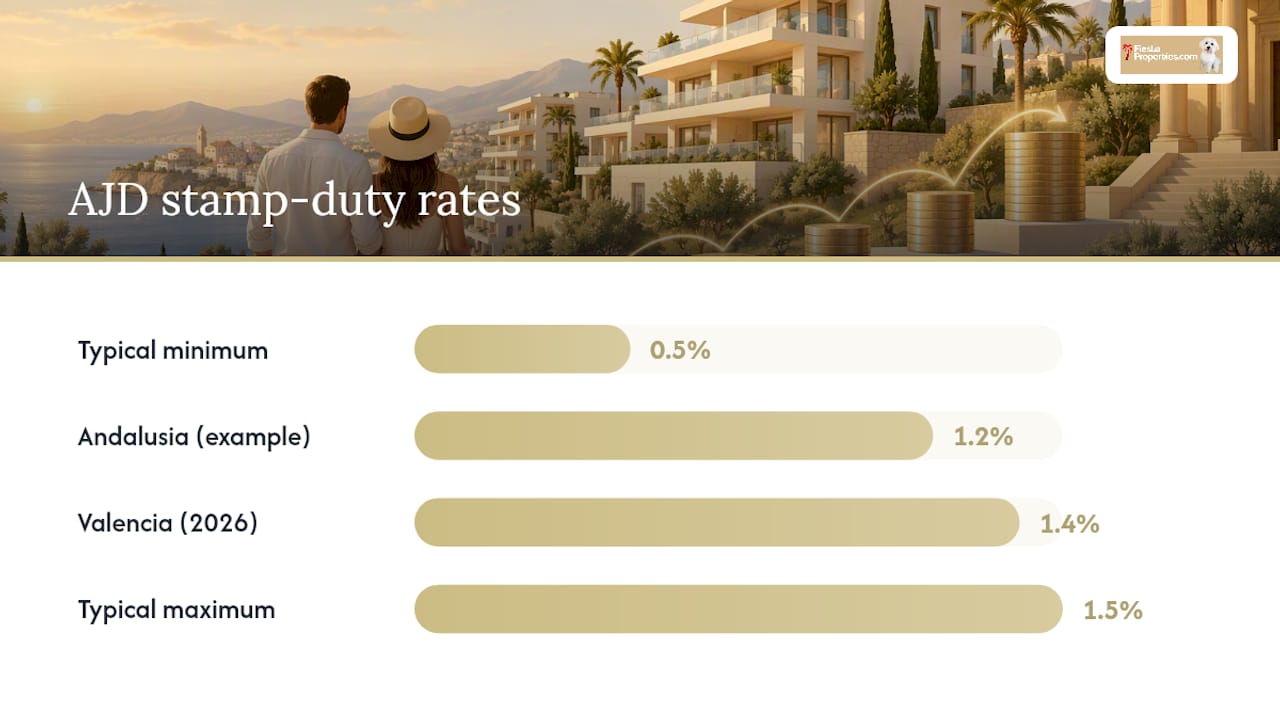
AJD, or Actos Jurídicos Documentados, is Spain’s stamp duty on the legal documents used to formalise a property purchase. It is paid when you sign the public deed (escritura) in front of a notary, separately from VAT, and it is calculated as a percentage of the purchase price set by each autonomous community.
Budgeting for completion day means accounting for several line items beyond the property price itself:
- AJD variable rate: typically 0.5% to 1.5% depending on the region, with Andalusia charging 1.2% and Valencia recently reducing its rate to 1.4% for 2026, as reported by regional property advisers
- Notary fees, set on a regulated scale but varying with property value
- Land registry fees for recording the deed
- Legal fees, usually a percentage of the purchase price
- Mortgage AJD, a separate stamp duty component on the loan itself, which lenders typically require the buyer to cover
That gap is worth knowing before you compare a new build against an older property on price alone.
How VAT gets charged during construction
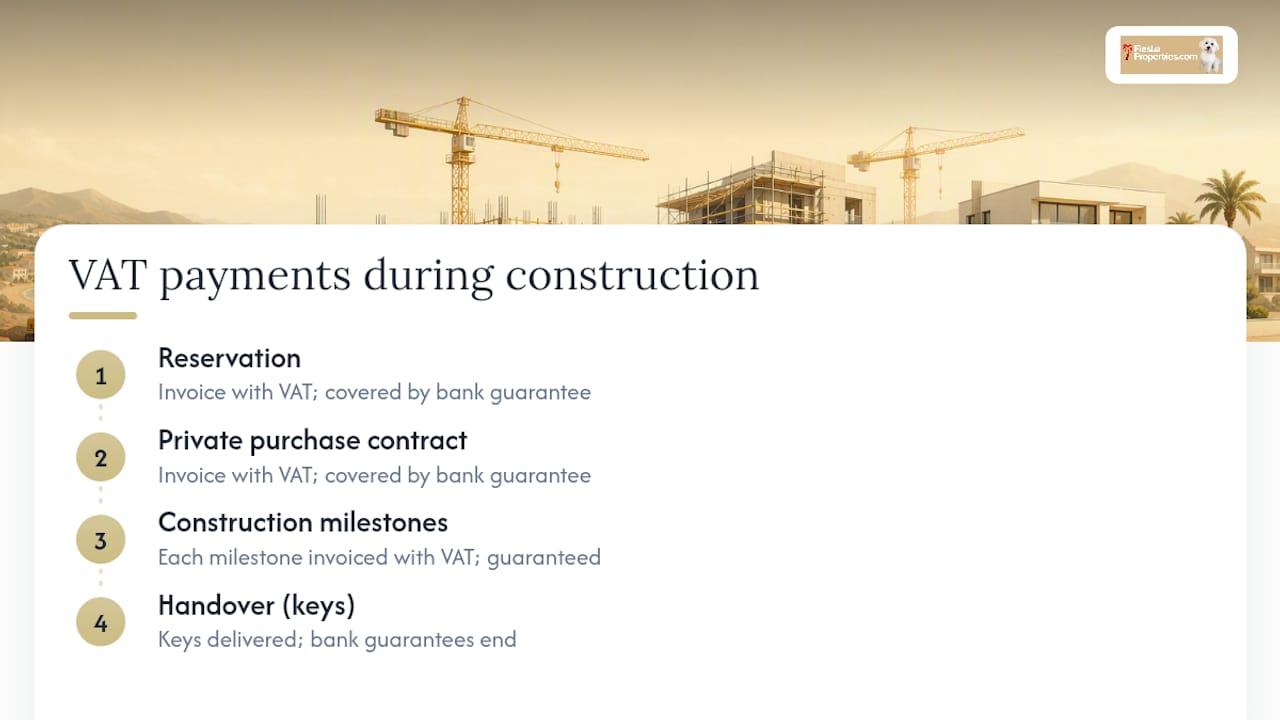
Buying off-plan means paying VAT in instalments, not as one lump sum at completion. Developers invoice buyers at each stage of the payment schedule: reservation, signing the private purchase contract, and every subsequent construction milestone. VAT applies to each of those invoices individually, according to legal guidance on Spanish new build taxation.
This has a real cashflow effect. Effectively, you finance the VAT bill gradually throughout the build rather than absorbing it in one final payment.
Law 20/2015 requires developers to provide bank guarantees covering every amount paid before the keys are handed over, including the VAT portion. These guarantees protect your money if the development stalls or the developer becomes insolvent.
Pro Tip: Insist that every stage invoice shows VAT as a separate line item, not folded into a single total. Keep copies of each invoice and the corresponding bank guarantee certificate, and check the guarantee amount matches what you have actually paid, VAT included.
Exceptions: VPO, the Canary Islands, and mixed-use annexes
A handful of situations change the standard 10% figure, and it pays to check early whether any apply to your purchase.
- VPO (vivienda de protección oficial): officially protected housing can qualify for a reduced 4% VAT rate, but only when the property meets administrative criteria for surface area, sale price, and buyer income, granted by the relevant regional housing authority, as confirmed in a recent tax ruling
- Canary Islands: IGIC at 7% applies instead of VAT across the archipelago; it is a genuinely separate tax system rather than a regional discount
- Annexes: garages and storage rooms sold alongside the main dwelling generally follow the same VAT treatment as the property itself, provided they form part of the same transaction
Courts and tax authorities increasingly focus on whether a home is objectively suitable for habitation, rather than relying solely on paperwork. Even so, a valid cédula de habitabilidad remains a practical safe harbour worth requesting, as BDO’s guidance on reduced VAT rates notes.
Worked example: total tax on a new build purchase
Andalusia example: A buyer purchasing a new build apartment pays 10% IVA plus regionally set AJD, combining to a total tax burden slightly above 10%, based on regional tax guidance for new build buyers.
Break that down by stage payment, and the VAT portion becomes clearer: a 30% stage payment of €60,000 carries an additional €6,000 in VAT, due at the same time as the instalment itself, not held back until completion.
Always check the current regional AJD table before finalising your budget, since a difference of even half a percentage point changes your completion costs meaningfully on a six-figure purchase.
Documents to request before you sign
A short paper trail protects you far more than any verbal assurance from a developer. Before signing anything, ask for developer invoices with VAT itemised on each one, the cédula de habitabilidad or equivalent habitation certificate, written proof the sale qualifies as a first delivery, and copies of the bank guarantees covering every stage payment made so far.
If VPO status is claimed, get the administrative classification in writing rather than taking it on trust. We routinely review purchase documentation with clients as part of the buying process, and can talk through what a specific invoice or guarantee should contain before you commit funds.
Common mistakes buyers make with VAT and AJD
The two mistakes I see most often are entirely avoidable. Buyers forget that VAT applies to each stage payment, not just the final balance, and end up short of cash mid-build. They also underestimate AJD by assuming it mirrors ITP rates from a resale they compared it against.
On the documentation side, the failure is usually not checking that VAT appears as a distinct line on every invoice, or not confirming the bank guarantee actually covers what has been paid, VAT included. One buyer I worked with nearly signed a stage payment without a matching guarantee certificate, simply because nobody had asked for it.
— Mike Kalia
Get your new build tax questions answered before you commit
Our agency offers a genuinely integrated team covering legal checks, mortgage arrangement, and currency exchange support.

That matters most at exactly the stage this article has covered. Our currency exchange specialist secures competitive rates on every transfer, so tax payments in euros don’t erode against a weaker pound at the wrong moment.
If you’re weighing up a new build purchase on the Costa Blanca or Costa Cálida, browse our current portfolio of new build homes or get in touch with our team to talk through your specific tax position before you sign a reservation agreement.
Sources
For rate confirmation and the two-year rule, see Agencia Tributaria’s guidance; for regional AJD variation, see the Valencia AJD update.
- Agencia Tributaria — I buy a property, do I have to pay VAT or ITP?
- Mael Abogados — VAT & Taxes on New-Build Property in Spain (2026)
- Bm
FAQ
Do you pay VAT on a new build property in Spain?
Resales between private individuals attract Transfer Tax (ITP) instead, never both taxes on the same sale.
What are the VAT rates in Spain for new homes in 2026?
Commercial property and building land are taxed at 21%, and officially protected housing (VPO) can qualify for a reduced 4% rate when administrative criteria are met.
What tax do you pay when buying a house in Spain?
Resale properties instead attract ITP, usually calculated on a sliding regional scale, with new build’s combined VAT and AJD often exceeding a comparable resale’s ITP.
What does 10% IVA mean when buying property in Spain?
It applies to the full purchase price and, for off-plan purchases, to each stage payment as it’s invoiced, rather than only at final completion.
Can Fiestaproperties help check VAT and tax documents before I buy?
Yes, Fiestaproperties’ legal specialist reviews developer invoices, bank guarantees, and VPO classifications as part of the standard buying process, with no legal fees charged to clients. Contact the team to arrange a document review before signing.


