

International Buyers: Property Survey in Spain and 10 Year Liability
· 9 min read

An independent technical survey is recommended before completing on almost any resale property in Spain, and on many off-plan purchases too. Most buyers should start with a condition report or a full building survey depending on the property’s age, then commission a RICS or equivalent qualified surveyor as the next concrete step, ideally before signing the private purchase contract.
TL;DR:
- A standard inspection is mostly visual and excludes concealed services unless commissioned; registry and cadastral checks cannot confirm permits for extensions, pools, or conversions.
- Choose a level 3 survey for older homes, fincas, or visible cracking and damp; new builds need snagging, while larger investments may require technical due diligence.
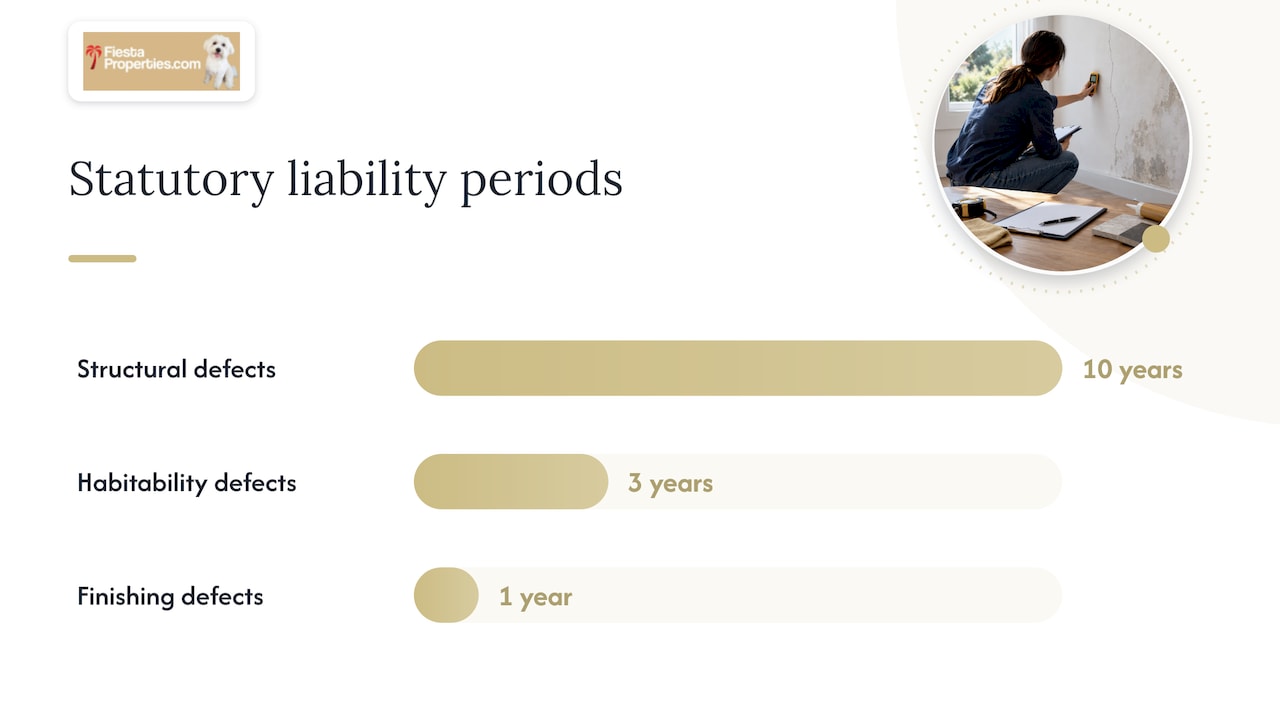
- Spanish law sets developer liability at 10 years for structural defects, 3 years for habitability defects, and 1 year for finishing defects from the completion certificate.
- Before booking, verify the surveyor’s insurance, exclusions, report language, and independence; professionals recommended and paid by the selling agent may have conflicts.
- For serious structural, roof, or damp defects, get a contractor quote before negotiating and have your lawyer document any price change or retained funds.
Table of Contents
- What a property survey in Spain inspects
- Matching the survey type to your purchase
- Why a survey is not the same as a registry check
- Choosing a surveyor you can trust
- The inspection process, timeline and cost drivers
- Reading the report and deciding what to do next
- Special cases: fincas, new builds and coastal properties
- Documents and access to prepare before a survey
- How we help coordinate surveys and what happens after the report
- A personal view: the mistakes that cost buyers the most
- Let us help you move from survey to completion
- FAQ
- Sources
What a property survey in Spain inspects
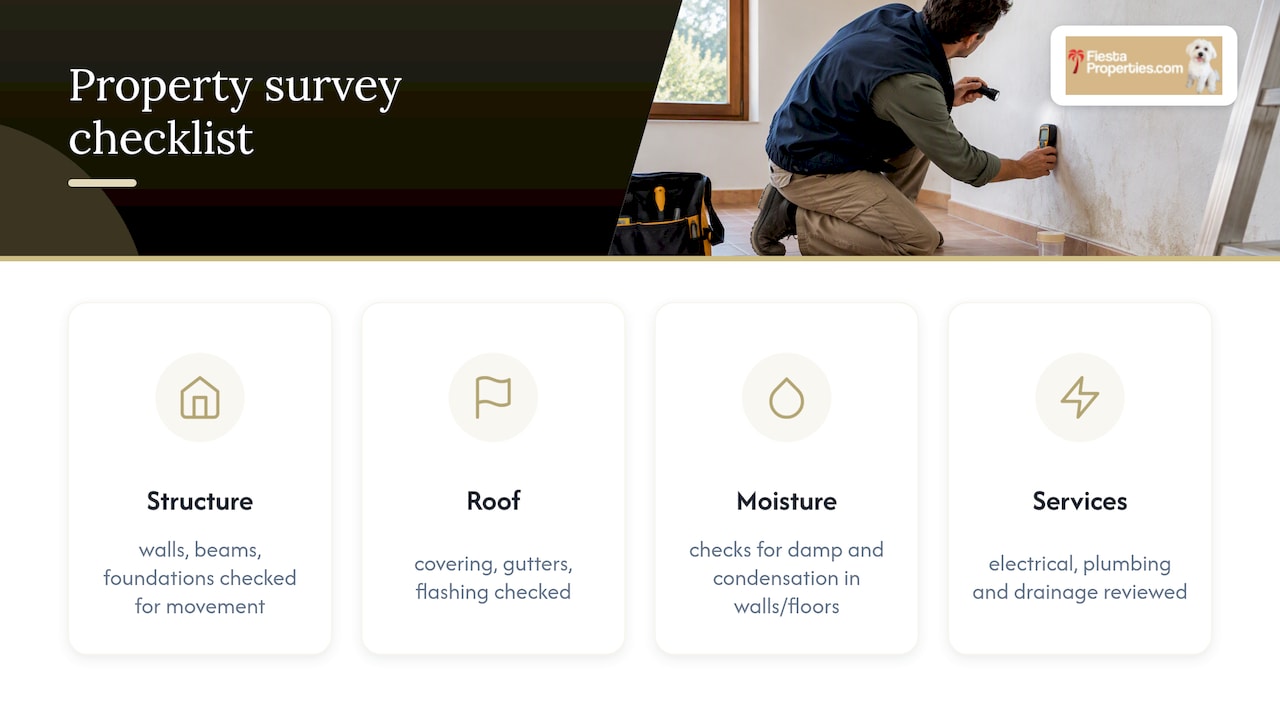
A residential survey examines the building’s physical structure and systems essential for habitability, including structural components, roof condition, signs of moisture problems, plumbing and electrical systems, drainage, and visible finishes like flooring, render, and woodwork.
Structural walls, beams and foundations checked for cracking, movement or settlement; roof covering, guttering and flashing assessed for age and water tightness; checks for damp, condensation and moisture in walls and floors; electrical, plumbing and drainage services reviewed where accessible; windows, doors, and finishes examined for wear, damage or poor workmanship
Surveyors generally will not open up walls or test concealed services unless specifically instructed, a point RICS guidance makes clear when describing tiered residential survey levels. A level 3 inspection goes further than a basic condition report, reaching into roof voids and other accessible but concealed areas, and offering probable causes for defects rather than guesswork. The finished report typically includes photographs, a risk grading for each defect, and a list of recommended remedial priorities so buyers know what needs attention first.
Pro Tip: Ask the surveyor to flag which findings are visual observations and which are based on invasive testing, since the two carry very different levels of certainty.
Matching the survey type to your purchase
Not every property needs the same depth of inspection. The right level depends on the building’s age, construction type and how the purchase is structured.
- Condition report (RICS level 1): suits newer, straightforward properties where the buyer mainly wants reassurance rather than a detailed diagnosis.
- Full building survey (RICS level 3): recommended for older resale homes, period properties, fincas or any building showing visible wear, cracking or damp.
- Snagging inspection: designed for new builds, checking finishing quality and defects against the developer’s specification before the final handover.
- Technical due diligence (TDD): used for investment purchases or larger assets, combining structural inspection with a review of licences, permits and planning history, as outlined in RICS guidance on conducting TDD in Spain.
Specialist tests, covering electrics, structural movement, waterproofing or asbestos, are added on top of any of these when the general inspection raises a specific concern that needs expert confirmation.
Why a survey is not the same as a registry check
A survey tells you what state the building is actually in. A registry or cadastral check tells you who owns it and what is officially recorded against it, which is a different question entirely.
- The Land Registry issues an excerpt listing ownership, mortgages, charges and a unique registry code, but it does not confirm the physical condition of the property
- The Spanish cadastre holds mapping and area reference data useful for location checks, but is a separate system from the title registry and is not a substitute for it
- Neither system verifies whether extensions, pools or conversions were built with proper licences
One legal fact worth knowing: under Spain’s Law 38/1999, developers and contractors carry statutory liability for structural defects for up to 10 years, for habitability defects for 3 years, and for finishing defects for 1 year from the certificate of completion, which is why confirming when a building was finished matters as much as inspecting it.
Surveyors and lawyers work together to close this gap: the surveyor reports on condition, while the lawyer cross-checks licence and planning history against the registry and cadastral records.
Choosing a surveyor you can trust
The surveyor’s independence matters as much as their qualifications. A good one works for you alone, not for the seller or the selling agent.
- Prioritise RICS-regulated or chartered surveyors, or Spanish architects and technical architects (arquitectos técnicos) with clear professional indemnity insurance
- Ask to see a sample report before booking, so you know the format and level of detail to expect
- Confirm the list of exclusions, the reporting language and the expected turnaround time in writing
- Check for conflicts of interest: a surveyor recommended and paid through the selling agent is rarely fully independent
RICS membership gives international buyers a layer of accountability that is not always guaranteed with informal local advisors, and practitioners in Spain routinely recommend confirming insurance cover and exclusions before instructing anyone, according to SurveySpain’s guidance for buyers.
Pro Tip: If English-language reporting matters to you, confirm it before booking, not after the inspection has already taken place.
The inspection process, timeline and cost drivers
A survey typically runs through three stages: booking and pre-inspection checks, the on-site visit itself, and report drafting and review.
- Booking: you supply access arrangements and any documents the surveyor requests, then agree a date.
- On-site inspection: the surveyor walks the property systematically, checking structure, roof, services and finishes, and takes photographs throughout.
- Report drafting and review: findings are written up with risk gradings, then typically sent within a standard turnaround window, with expedited options available for urgent transactions.
Larger or more complex properties, difficult access, rural locations requiring extra travel, and the need for specialist tests such as structural or electrical checks all push cost and turnaround time up. A straightforward apartment inspection will generally cost less and take less time than a large finca with outbuildings and a swimming pool.
Reading the report and deciding what to do next
A survey report is only useful if you act on it. Most reports grade defects by urgency, and the highest-graded issues are the ones most likely to justify a price adjustment or a conditional clause in the contract.
- Treat structural, roof and damp findings as priority items; cosmetic issues rarely affect the purchase decision
- Get at least one contractor quote for any significant defect before you negotiate, so the figure you discuss is grounded in reality
- Share the report with your lawyer so findings can be translated into contractual protections, such as conditions precedent, an escrow retention, or a price adjustment
Pro Tip: Where a defect is serious enough to need a retained sum, agree the mechanism and release conditions in writing before signing, not as a verbal understanding.
Special cases: fincas, new builds and coastal properties
Rural fincas carry their own risks: permitted use, access rights, water rights and local planning restrictions on suelo rústico (rural land) can all limit what you are legally allowed to do with the property, regardless of what the current owner has been doing informally.
- New builds need snagging rather than a structural survey, checking finishing quality against the developer’s specification, and buyers should confirm the bank guarantees and off-plan protections that cover stage payments
- Coastal properties face accelerated wear from salt air and humidity, so roof fixings, window seals and external render deserve particular attention during inspection
Documents and access to prepare before a survey
Having the right paperwork ready speeds up the inspection and gives the surveyor proper context for what they are looking at.
- Land Registry excerpt (certificado registral) and cadastral reference
- Title deeds and any planning licences or permits held by the seller
- IEE (building inspection certificate) or energy performance certificate, plus recent electrical or gas certificates
- Community of owners minutes, if the property sits within a managed development
- Practical access: keys, roof or loft access, working utilities, and a point of contact on the day
How we help coordinate surveys and what happens after the report
Experience shows that the handover between agent, surveyor and lawyer is where most delays happen. We help bridge that gap directly.
- We can help request the registry excerpt, cadastral reference and licence documents on your behalf, ready for the surveyor’s visit
- We liaise with your chosen surveyor to confirm access, brief them on the property’s history, and keep the timeline moving
- Once the report lands, relevant specialists can be involved if findings affect price, financing or contract terms
It is recommended to commission your surveyor independently rather than relying solely on one suggested by a selling agent, and coordination of logistics around your choice is possible.
A personal view: the mistakes that cost buyers the most
The costliest mistake we see is skipping the survey entirely because a property “looks fine” on a video call. The second is trusting marketing floor plans over an independent measurement, since Spain has no single harmonised standard for measuring building area. Get the registry extract early, and always ask for photographic evidence of anything concealed.
— Mike Kalia
Let us help you move from survey to completion

A survey report is only one piece of the puzzle, and we built our service around the rest of it. Alongside guidance on property search and shortlisting, we offer a dedicated legal specialist to interpret findings against Spanish property law, a mortgage specialist securing pre-approval where survey results affect financing, and a currency exchange specialist with no fees charged to clients.
- Coordinated document requests so your surveyor has everything needed before the visit
- Bilingual negotiation support if the report changes what you are willing to pay
- Aftersales follow-up once completion is done, not just up to signing
If you are weighing up a resale, an off-plan reservation or a finca and want a team that stays involved after the survey lands, get in touch through our guide to moving from Spain to Ireland and we will talk you through the next steps.
FAQ
How do I get a survey on a property?
You contact a RICS-regulated surveyor or a qualified Spanish architect or technical architect directly, confirm their insurance and reporting language, then book an inspection date with site access arranged. Most buyers do this after the private purchase contract is agreed but before completion, so findings can still affect the final terms.
Is it still a good idea to buy property in Spain?
Buying in Spain remains a sound option for many international buyers, provided the usual legal and technical checks, including a survey and registry verification, are carried out properly before completion. RICS and AIPP guidance specifically recommends an independent survey because registry checks alone cannot reveal structural defects or planning non-compliance.
Where is the best place to buy property in Spain?
There is no single best location since it depends on budget, lifestyle and investment goals, with coastal regions such as Costa Blanca and Costa Cálida popular for their climate and established international communities. A broader buying guide can help narrow down which area suits your priorities.
What is the difference between a survey and a Land Registry check?
A survey assesses the physical condition of the building, while a Land Registry excerpt confirms legal ownership and any charges or encumbrances against the property. The two checks are complementary, not interchangeable, and both are recommended before completion.
How long does a typical property survey take in Spain?
Turnaround varies with property size and complexity, with straightforward inspections completed faster than larger properties or those requiring specialist tests. Expedited options are often available when a transaction timeline is tight, though this can affect cost.


