

Non resident buyers need 30–40%: mortgage deposit in Spain
· 10 min read

Non-residents should plan for a deposit closer to 30 to 40%, as lenders commonly cap financing at 50 to 70% loan-to-value.
TL;DR:
- Non-residents should plan for a deposit of 30 to 40 percent, with total upfront costs including taxes and fees roughly 10 to 15 percent of the property price.
- Property type, location, and purpose influence the loan-to-value ratio, with new builds spreading payments and rural or commercial properties requiring larger deposits.
- A clear credit history and early mortgage pre-approval can reduce deposit size and speed up the buying process, especially for foreigners.
- Gifted or third-party contributions are accepted but require careful documentation and early planning to avoid delays.
- Exchange rate fluctuations can significantly impact deposit amounts and approval if funds are transferred late in the purchase process.
Table of Contents
- Typical deposit amounts: residents, non-residents and examples
- Upfront purchase costs you must budget separately (taxes, notary, registration)
- How lenders decide deposit size: LTV, affordability and lender requirements
- Reservation deposits and ‘arras’ contracts: legal risks and protection
- Practical checklist: documents, timeline and steps to avoid surprises
- How Fiesta Properties supports deposit and mortgage steps
- Impact of credit history and credit score assessment on mortgage deposit requirements
- Differences in deposit requirements: new build, resale, urban and rural
- Options and implications of using gifted deposits or third-party contributions
- How exchange rate fluctuations affect deposit amounts and approval
- Author perspective: short counsel for international buyers
- How Fiesta Properties can help
- FAQ
- Sources
Typical deposit amounts: residents, non-residents and examples
Non-residents fall into a different bracket.
Two worked examples make this concrete.
- A self-employed borrower often faces a lower loan-to-value than a salaried employee, since lenders weigh income variability more heavily.
- Buy-to-let purchases and second homes usually attract reduced financing, since banks treat them as higher risk than a primary residence.
- Luxury or unusually priced properties can trigger more conservative valuations, which indirectly increases the cash a buyer needs to find.
Upfront purchase costs you must budget separately (taxes, notary, registration)
Beyond the deposit, buyers need cash for costs that sit outside the mortgage entirely. Lenders will not fold these into the loan, so they come straight from savings.
- Transfer tax (ITP) on resale properties, or VAT plus stamp duty on new builds, varies by autonomous community and property type.
- Notary fees cover the official deed signing, a legal requirement for every property transaction in Spain.
- Land registry fees record the change of ownership and the new mortgage charge.
- Legal fees pay for a solicitor to review contracts, check the property’s legal status, and handle completion.
- A valuation fee, paid by the borrower, confirms the property’s worth to the lender.
Buyers should set aside approximately 10 to 15% of the property price for these combined costs, a figure that holds reasonably steady across regions even though the exact tax rate shifts. For a €300,000 property, that works out to somewhere between €30,000 and €45,000 in addition to the deposit itself, a detail many first-time buyers underestimate until they see the full completion statement.
How lenders decide deposit size: LTV, affordability and lender requirements
Spanish banks calculate loan-to-value using whichever figure is lower: the agreed purchase price or the bank’s own valuation. When a valuation comes in below the sale price, the deposit required rises automatically, since the loan amount shrinks while the purchase price stays the same.
Affordability checks sit alongside the loan-to-value calculation. Banks assess debt-to-income ratio, employment stability, and credit history, generally wanting total debt repayments, including the new mortgage, to stay within a manageable share of net income. Borrower age matters too, since most lenders cap the loan term so that it ends well before the borrower reaches an advanced age, which shortens the term and raises the monthly repayment for older applicants. The property’s purpose, whether it serves as a primary residence or a holiday home, and the currency in which the borrower earns their income also feed into the final offer.
Before signing anything, Banco de España guidance confirms that banks must carry out a solvency assessment and provide the European Standardised Information Sheet, along with other pre-contractual documents, at least ten days before the signing date.
- Debt-to-income ratio, employment type, and credit history drive the lender’s risk assessment.
- Borrower age and loan term interact directly, since older applicants typically receive shorter terms.
- Income currency and property purpose (primary versus holiday home) can shift the loan-to-value offered.
Pro Tip: Ask your lender for a written pre-approval early, since it tells you the real loan-to-value you qualify for before you commit to any property.
Reservation deposits and ‘arras’ contracts: legal risks and protection
Buyers often confuse the small reservation payment, usually 1 to 5% of the price, with the arras contract, a far more binding agreement commonly set at around 10%. Signing arras without the right safeguards is where many buyers come unstuck.
- Understand that a penitential arras deposit is legally binding: if the buyer withdraws, the deposit is forfeited, and if the seller withdraws, they typically owe double the amount.
- Insist on a mortgage-contingency, or suspensive, clause in the arras contract, since without one a refused mortgage still means a lost deposit.
- Route the payment through your solicitor’s escrow account rather than directly to the seller, and agree clear deadlines and remediation terms in writing.
Our guidance on arras contracts in Spain covers these clauses in more depth for buyers who want the full legal detail before signing.
Practical checklist: documents, timeline and steps to avoid surprises
A mortgage pre-approval, obtained before house-hunting seriously begins, tells you the loan-to-value and monthly repayment a bank will actually offer, which saves wasted viewings on properties outside your budget.
- Gather your NIE number, passport, recent payslips or tax returns, and bank statements showing the origin of your deposit funds.
- Open a Spanish bank account early, since most lenders and utility providers require one for ongoing payments.
- Expect a sequence of steps: property valuation, a formal mortgage offer, a minimum ten-day period for reviewing pre-contractual information, then notary signing and registration.
- Transfer deposit funds in good time, since international transfers can take several working days to clear.
- Keep arras funds in solicitor escrow and confirm the mortgage-contingency clause is in place before paying anything.
Pro Tip: Start gathering your income and identity documents the moment you decide to buy, since delays here are the most common cause of missed completion dates.
Our buying process guide walks through each of these stages in order, useful for anyone mapping out a realistic timeline.
How Fiesta Properties supports deposit and mortgage steps
In our day-to-day work with international buyers, the mortgage stage is where most questions arise. Our mortgage specialist, Tim, helps clients secure pre-approval and coordinates valuation scheduling so there are no delays once an offer is accepted. When it comes to arras contracts, we recommend holding funds in solicitor escrow and negotiating a mortgage-contingency clause as standard practice, since that single clause is what protects a buyer’s deposit if finance falls through.
We also charge no legal fees and no currency exchange fees to our clients, which keeps more of a buyer’s cash available for the deposit and purchase costs rather than being absorbed by additional charges along the way.
Impact of credit history and credit score assessment on mortgage deposit requirements
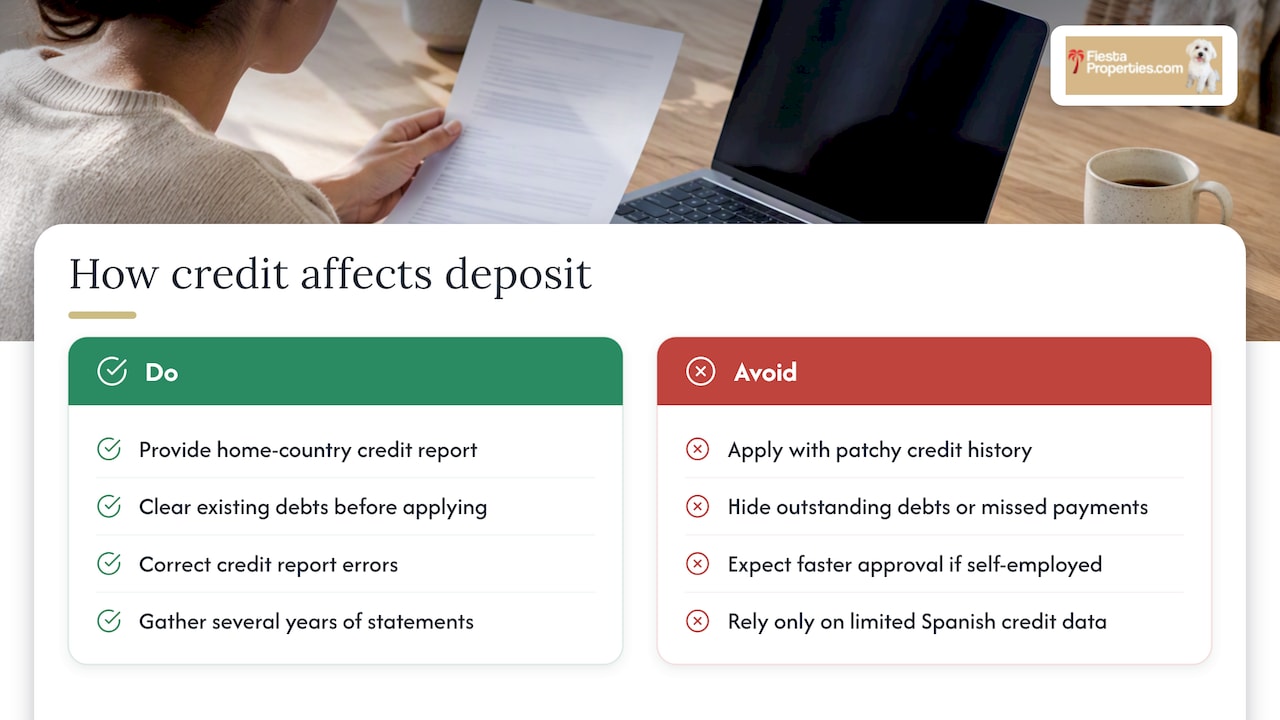
A clean credit history, both in Spain and in the buyer’s home country, generally works in a borrower’s favour during the solvency assessment that Banco de España guidance requires banks to carry out before approving a mortgage. Spanish lenders check credit registries, and for non-residents, they often request a credit report or reference letter from the applicant’s home country, since Spanish credit history for a foreign buyer is usually limited or non-existent.
A patchy credit record, missed payments, or high existing debt can push a lender towards a lower loan-to-value offer, which raises the deposit needed to close the gap. Some banks will decline an application outright rather than adjust the terms, particularly where the applicant’s income is modest relative to the loan requested.
Self-employed applicants, and those with income spread across multiple countries, often find the assessment takes longer, since banks want several years of consistent tax returns or accounts. Clearing existing debts, correcting any credit report errors, and gathering several years of financial statements before applying can all help secure a better loan-to-value and reduce the deposit required.
Buyers with UK-sourced income who want a sense of how lenders assess more complex profiles may find it useful to look at structured mortgage advice for foreign nationals, which covers lender-matching for applicants with varied income and immigration situations.
Differences in deposit requirements: new build, resale, urban and rural
Property type changes the deposit picture almost as much as residency status does. New build properties, often sold off-plan, typically follow a staged payment structure: a reservation fee, followed by stage payments during construction, with the mortgage only drawn down on completion. This spreads cash outlay over time rather than requiring the full deposit upfront, which some buyers find easier to manage.
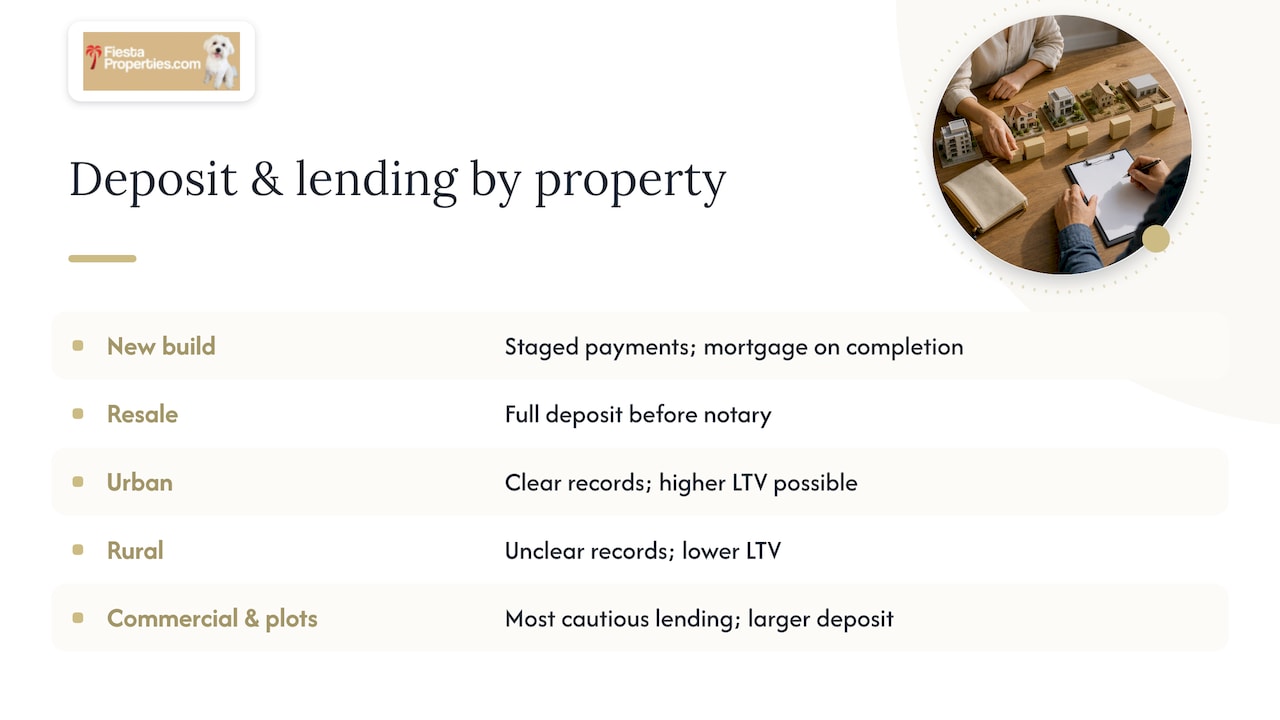
Resale properties, by contrast, usually require the full deposit and purchase costs to be in place before the notary signing, since there is no construction timeline to spread payments across.
Location and property classification also matter. Urban properties with clear planning status and straightforward land registry records tend to secure more favourable loan-to-value terms, since the valuation process is simpler and the bank’s risk is easier to quantify. Rural properties, particularly those with agricultural land, unregistered extensions, or unclear boundaries, often face more conservative valuations and lower loan-to-value offers, which pushes the required deposit higher.
Commercial properties and building plots generally attract the most cautious lending terms of all, with many banks requiring a substantially larger deposit or declining to finance them through a standard residential mortgage. Buyers considering anything outside a conventional urban home, whether a rural finca or a plot for future construction, should expect to have that conversation with a lender early, before making any financial commitment.
Options and implications of using gifted deposits or third-party contributions
Many international buyers rely on a gift from family, savings transferred from a parent, or a contribution from a partner to reach the deposit figure a Spanish lender requires. Banks generally accept gifted funds, but they will ask for a clear paper trail: a letter confirming the gift, bank statements showing the transfer, and sometimes a declaration that the funds are not a loan requiring repayment.
Proving the origin of funds matters more in Spain than in some other markets, since anti-money-laundering checks apply to property transactions. A sudden, unexplained deposit in a bank account shortly before a mortgage application can delay approval while the bank requests further documentation. Gathering this paperwork early, ideally before the funds are even transferred, avoids last-minute hold-ups during the pre-contractual review period.
Third-party contributions can also affect how a lender views the application if the contributor is added to the mortgage or property title, since that introduces a second borrower whose income and credit history then factor into the solvency assessment. Couples or family members buying together should clarify ownership shares and financial responsibility before the arras contract is signed, since changing this arrangement later is far harder than agreeing it from the outset.
How exchange rate fluctuations affect deposit amounts and approval
For buyers earning and saving in a currency other than euros, exchange rate movement between agreeing a price and completing the purchase can change the real cost of the deposit by a meaningful amount, even when the euro price never moves. A weakening home currency means more foreign currency is needed to reach the same euro figure, which can catch buyers out if funds are converted late in the process.
This matters most at two points: when transferring the initial arras deposit, and again when funding the balance at completion. A currency specialist can lock in a rate ahead of a transfer, which removes the uncertainty of market movement between agreeing a price and paying it. Using a specialist currency exchange service rather than a bank can also reduce transfer fees and secure a rate closer to the mid-market price.
Exchange rate movement can affect mortgage approval too, since lenders assessing income in a foreign currency may apply a buffer to account for volatility, which can reduce the loan-to-value offered to a borrower whose income arrives in pounds, dollars, or another non-euro currency. Buyers transferring large sums should plan the timing of currency conversion as carefully as they plan the property purchase itself, since a rate shift of even a few percentage points on a six-figure sum is a tangible amount of money.
Author perspective: short counsel for international buyers
Having watched buyers lose deposits over missing paperwork, our clearest advice is this: never sign an arras contract without a mortgage-contingency clause and proper legal representation.
— Mike Kalia
How Fiesta Properties can help
Buying with finance in place does not need to feel like guesswork. Our integrated team, from mortgage specialist to legal advisor, works together so that pre-approval, valuation, and the arras stage happen in the right order, with your deposit protected throughout.

If you would like to talk through your deposit and loan-to-value options with Tim, our mortgage specialist, visit our mortgages page to arrange a conversation, or read our buying process overview for the full step-by-step picture before you start.
FAQ
How much is a 300,000 mortgage in Spain?
Both figures sit on top of a separate 10 to 15% in purchase costs, which banks will not finance.
Can I get a 95% mortgage in Spain?
Residents typically qualify for up to 80% loan-to-value, and non-residents commonly see offers between 50 and 70%.
Is it difficult to get a mortgage in Spain?
Getting a mortgage is manageable with the right preparation, though non-residents face more documentation and lower loan-to-value offers than residents. Banks require a solvency assessment and standardised pre-contractual information, a process Banco de España sets out clearly for every applicant.
Is it possible to get a 100% mortgage in Spain?
Lenders generally finance up to 80% for residents and 50 to 70% for non-residents, with the remainder expected as a cash deposit.
What costs come on top of the mortgage deposit?
These purchase costs are separate from the deposit and are not covered by the mortgage loan.


