

Foreign buyers: 5 registry checks to expose illegal builds in Spain
· 9 min read

You can buy a Spanish property with an unpermitted extension or an unregistered structure, but you inherit the legal exposure that comes with it. The first step, before anything else, is to check the escritura against the town hall’s licence records and the entry at the registro de la propiedad. Outcomes vary considerably by region and by case, so verification always comes before assumption.
TL;DR:
- Verifying the property’s registration status involves comparing the escritura with the registro de la propiedad and municipal license records to uncover potential irregularities.
- Irregularities can lead to municipal fines, orders for corrective work or demolition, and may cause mortgage and insurance issues even after purchase.
- Regularisation is possible through fines and compliance, but outcomes depend on regional laws, land protections, and enforcement priorities, which vary significantly across Spain.
- Conducting thorough pre-purchase checks with legal assistance and ensuring contractual protections can save buyers from inheriting unresolved legal and financial liabilities.
- An estate agency with local expertise can help identify risks early by coordinating legal checks and verifying developer or property compliance before buying.
Table of Contents
- What counts as an illegal or unregistered build in Spain
- Risks and liabilities for buyers and owners
- Pre-purchase checks: a practical checklist to verify legality
- How regularisation works and likely outcomes
- Costs, timescales and practical financial planning
- What to do if you discover illegal works after purchase
- How a local estate agency can help with due diligence
- A buyer’s mindset that avoids the costliest mistakes
- Fiesta Properties: how we can help you avoid illegal-build risk
- Sources
- FAQ
What counts as an illegal or unregistered build in Spain
Not every irregularity carries the same weight. A build can lack a municipal licence entirely, or it may have been built with permission but never formally registered at the registro de la propiedad, which leaves ownership and boundaries legally uncertain. Works carried out on rustic or protected land sit in a separate, generally stricter category, since Spanish planning law treats non-urban land differently from land zoned for development.
Before relying on any property, request the documents that a compliant build should hold:
- The municipal building licence and, where issued, the certificate of first occupancy.
- The libro del edificio, the building’s technical record covering construction and materials.
- A valid energy performance certificate.
- Geo-referenced coordinates confirming the registered boundaries match what stands on the ground.
Enforcement is not uniform. Spain’s consolidated land law requires prior administrative authorisation for building works and gives town halls the power to act against what falls outside it, but how strictly that power is used depends heavily on the autonomous community, which is why identical irregularities can lead to very different outcomes depending on where the property stands.
Risks and liabilities for buyers and owners
Buying into an unresolved irregularity means buying into someone else’s unfinished problem. Town halls can issue orders requiring corrective work or, in more serious cases, demolition, and those orders attach to the property rather than disappearing with a change of owner. Neighbour disputes are common too, particularly where an extension encroaches on a boundary or a shared wall, and these can escalate into civil claims that run alongside any administrative action.
Lenders and insurers respond cautiously to properties with irregularities on record. Spain’s land legislation gives administrations the authority to demolish irregular works or to carry them out at the owner’s expense, which is precisely the exposure a mortgage lender is trying to price out before it commits funds.
The practical risks buyers face include:
- Municipal fines and formal orders to correct or remove unpermitted works.
- Civil liability towards neighbours affected by boundary or structural issues.
- Mortgage refusals or reduced loan-to-value offers once a lender’s surveyor flags an irregularity.
- Voided or restricted insurance cover where a policy excludes unregistered structures.
Liability can transfer with the deed of sale or persist as an open administrative file regardless of who holds title, which is exactly why the consolidated land law treats the obligation as attached to the property rather than to a named individual.
Pre-purchase checks: a practical checklist to verify legality
A methodical check before exchange saves far more time than a dispute after completion. Work through these steps with a lawyer who reads Spanish planning files as a matter of routine:
- Obtain the escritura and compare it against the current entry at the registro de la propiedad, checking that boundaries, built area and use match.
- Request the municipal planning file for the property, including any licences issued and, where relevant, the certificate of first occupancy.
- For apartments, ask for the libro del edificio and any community-level certificates confirming shared areas comply with regulations.
- For off-plan purchases, verify the developer’s entry in the commercial register, confirm land ownership, and check that the town hall has authorised the project.
- Confirm that any funds paid before completion sit in a construction-only escrow account, as official guidance on off-plan purchases sets out.
Once the checks are done, the contract itself should carry the protection. Insist on a suspensive clause that makes completion conditional on clean results, a seller warranty confirming the property’s legal status, and an indemnity covering costs if an irregularity later surfaces.
Pro Tip: Ask your lawyer to retain part of the purchase price in escrow until the registro annotation and municipal file are both confirmed clean.
How regularisation works and likely outcomes
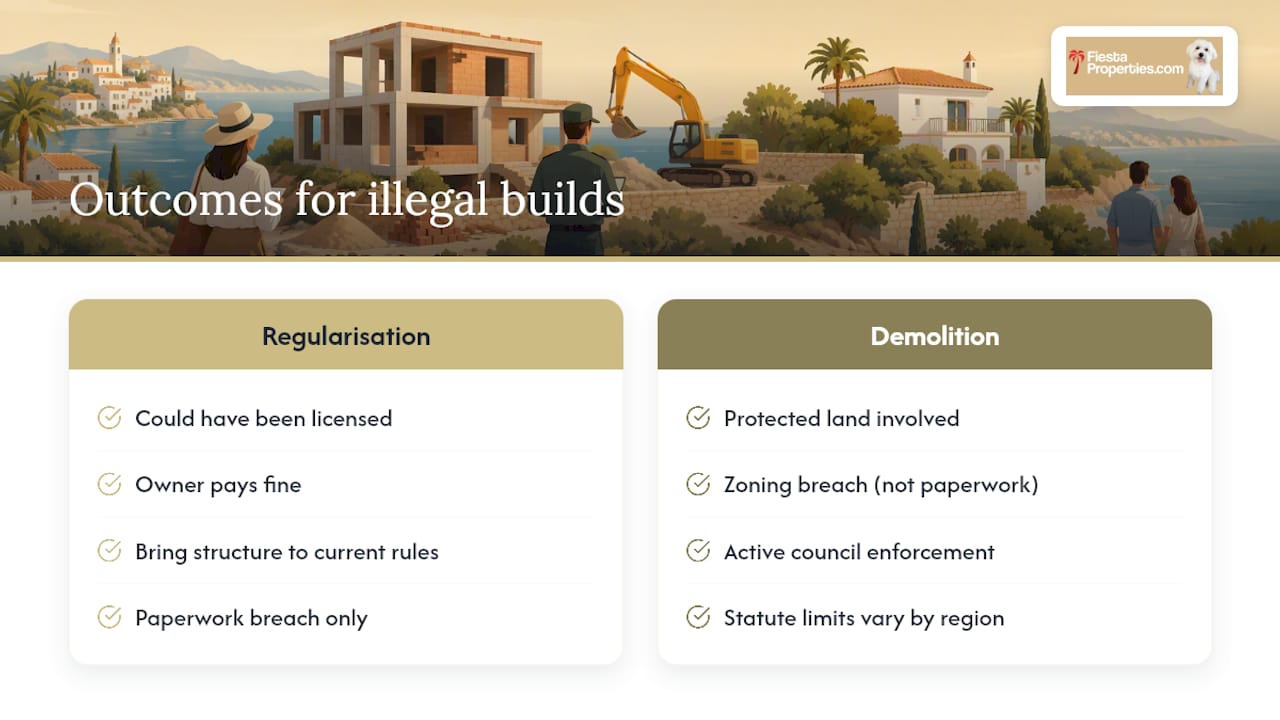
Not every irregularity ends in demolition. Councils sometimes allow remedial regularisation, where an owner pays a fine and brings the structure up to current planning rules, particularly for works that could have been licensed at the time but simply were not. Demolition becomes more likely where the land itself is protected, where the works breach zoning rather than paperwork, or where a council has an active enforcement drive.
Time limits matter and they are not the same everywhere. In the Balearics, reporting on a proposed statute of limitations change shows a statute of limitations rule of several years for illegal works on rustic land is actively debated, which illustrates how a limitation period that protects an owner in one region may not apply in another.
Some regions go further and legislate for entire clusters of irregular housing rather than dealing with properties one by one. Andalusia’s sustainability law allows for special plans of adequation covering grouped irregularities, alongside dedicated inspection bodies created to catch new cases early, which shows how regional legislators are treating this as a structural planning issue rather than a series of isolated breaches.
Costs, timescales and practical financial planning
Budgeting for an irregularity means accounting for more than a fine. Expect several possible cost categories to stack up together:
- Municipal fines, which are set locally and vary by the severity and type of breach.
- Corrective building work needed to bring the structure into compliance.
- Legal fees and independent surveyor reports to support any regularisation application.
- A reduction in resale value while the property’s status remains unresolved.
Where an owner fails to act, the administration can carry out corrective or demolition works itself and recover the cost from the owner, a power set out plainly in Spain’s land legislation. Timeframes swing widely: some regularisations move through a single planning cycle, while cases involving protected land or contested boundaries can stretch over years. Mortgage lenders often pause or reduce offers until a file is closed, and insurers may exclude the affected structure from cover until the paperwork catches up.
What to do if you discover illegal works after purchase
Finding an irregularity after completion is stressful but manageable if you move in the right order.
- Stop any further building work immediately and gather every document you hold: escritura, licences, correspondence and survey reports.
- Notify your insurer and, if you have one, your mortgage lender, since both may need to reassess cover or terms.
- Consider your options against the seller: a renegotiated price, a contractual remedy, or a claim for misrepresentation if the irregularity was concealed.
- Decide, with your lawyer, whether to pursue voluntary regularisation with the town hall or to contest any enforcement notice.
Pro Tip: Keep a dated file of every communication with the town hall, this record becomes decisive if a dispute reaches a tribunal.
Instruct a lawyer as soon as an irregularity is confirmed rather than after a fine arrives, since early legal advice widens the range of workable outcomes.
How a local estate agency can help with due diligence
An agency with local reach can spot warning signs long before a lawyer opens the file. A local estate agency can coordinate with legal specialists to check the registro de la propiedad, the escritura and municipal licensing records as a standard part of a purchase, and coordinate mortgage and currency support once a property clears those checks. For off-plan purchases, the same due diligence extends to confirming a developer’s registration and the existence of a construction-only escrow account before any funds change hands.

A buyer’s mindset that avoids the costliest mistakes
The most expensive mistake I see is not an illegal build itself, it is the decision to skip the registro de la propiedad check because a property looks finished and lived-in. A clean-looking villa can still carry an open planning file. Always involve a notary and independent legal counsel, and never sign without contractual protections written in.
— Mike Kalia
Fiesta Properties: how we can help you avoid illegal-build risk
Buying with confidence starts with knowing exactly what you are buying. A family-run estate agency can combine property search and shortlisting with legal specialist checks of licences, registry entries and, for off-plan purchases, developer and escrow arrangements, alongside mortgage and currency exchange support without legal or exchange fees to clients.

If you are considering a property on the Costa Blanca or Costa Cálida and want the legal groundwork done properly, get in touch through our property search page and our team will talk you through the next steps.
This article is general information, not a substitute for advice from a qualified lawyer. Consult a qualified legal professional about your own circumstances before acting on anything here.
Sources
- Buying real estate. Notarial offices and property registers - Purchasing and selling of immovable property - Residence - Citizens - Your rights and obligations in the EU - Tu espacio europeo - Punto de Acceso General
- Revival of statute of limitations for illegal building work in the Balearics
FAQ
What happens if you buy a property with unresolved legal issues in Spain?
You take on whatever administrative file already exists, including possible fines or corrective orders, since these attach to the property rather than to the previous owner. Checking the registro de la propiedad and municipal licences before completion is the only reliable way to know what you are inheriting.
Why do statute of limitations rules for illegal builds vary by region?
Spain’s autonomous communities set their own planning enforcement priorities and time limits, so a limitation period valid in one region will not necessarily apply in another. The Balearics’ proposed eight-year rule for rustic land illustrates how actively these rules can change.
What new property purchase safeguards should buyers know about in Spain?
Buyers should focus on registration and notarial protections rather than assume verbal assurances are enough. Official guidance stresses that the deed and property register entry confirm completion, permit conformity and occupancy status, particularly for off-plan purchases.
Can Fiesta Properties help check whether a property has legal issues?
Fiesta Properties coordinates with a dedicated legal specialist who checks registry entries, licences and, for off-plan purchases, developer registration and escrow arrangements, as part of its standard buying support. This sits alongside mortgage and currency exchange services offered without legal or exchange fees to clients.


