

UK sellers: Avoid €6,000 fines. Register the CEE in Spain
· 7 min read

Yes, an energy performance certificate is mandatory for every property sale in Spain, and the notary will refuse to authorise the deed without a valid, registered one. The seller commissions and pays for it. Before listing your home, check whether an existing certificate is still valid and note its registration number, because that code is what completion depends on.
TL;DR:
- A registered energy performance certificate is mandatory for property sales in Spain, and failure to have one can delay or invalidate the sale.
- The certificate must be issued by a qualified técnico, registered with the autonomous community, and costs vary based on property size and region.
- Certificates remain valid for ten years if rated A to F, but G-rated certificates expire after five years and require renewal.
- Ensuring the cadastral reference matches the deed and verifying the registration number before listing prevents delays at notary or registration stages.
- Displaying the correct energy rating on all advertisements is legally required and penalties for non-compliance can reach up to €6,000.
Table of Contents
- What is an energy performance certificate in Spain?
- Who issues the certificate, and who pays for it?
- How do you get an energy certificate in Spain?
- What does an EPC cost, and how long does it take?
- Does the energy rating affect your sale price?
- What mistakes commonly delay or invalidate a certificate?
- What do notaries and listings require?
- How sellers can avoid EPC surprises
- Selling in Spain? Get the paperwork right from day one
- Sources
- FAQ
What is an energy performance certificate in Spain?
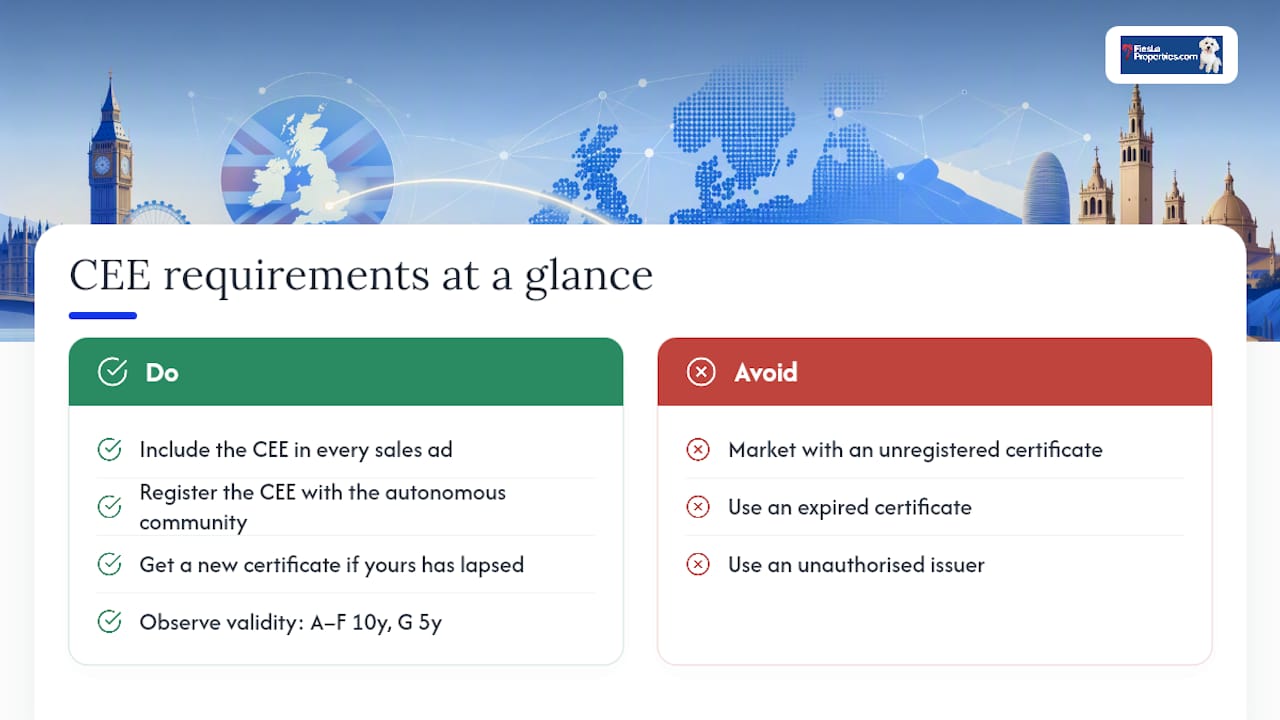
The Certificado de Eficiencia Energética, or CEE, rates a property’s energy performance on a scale from A (most efficient) to G (least efficient), based on insulation, heating systems, windows, and orientation. The rating must appear on every sales advertisement, from Idealista listings to a local estate agent’s window display.
Royal Decree 390/2021 governs the whole system, setting out who can issue a certificate, how it must be calculated, and the requirement that it be registered with the relevant autonomous community before it has any legal standing. An unregistered certificate is not worth the paper it is printed on at a notary’s office.
Validity matters too. A certificate rated A through F remains valid for ten years; a G-rated certificate expires after five, a deliberate nudge to get the least efficient homes upgraded sooner. If your existing certificate has lapsed, you need a new one before you can legally market the property.
Who issues the certificate, and who pays for it?
Only a qualified técnico can legally issue a CEE. That means an architect, a technical architect (aparejador), an engineer, or a technical engineer registered to carry out energy assessments. There is no shortcut here. A certificate produced by an unqualified provider, or one bought purely online with no site visit, will not survive scrutiny at registration or completion.
The seller pays. Buyers sometimes ask whether the cost can be split or passed along, but in practice the obligation sits with whoever is selling, since it is the seller’s legal duty to provide a valid certificate at the point of sale, as confirmed in official UK guidance for buying property in Spain.
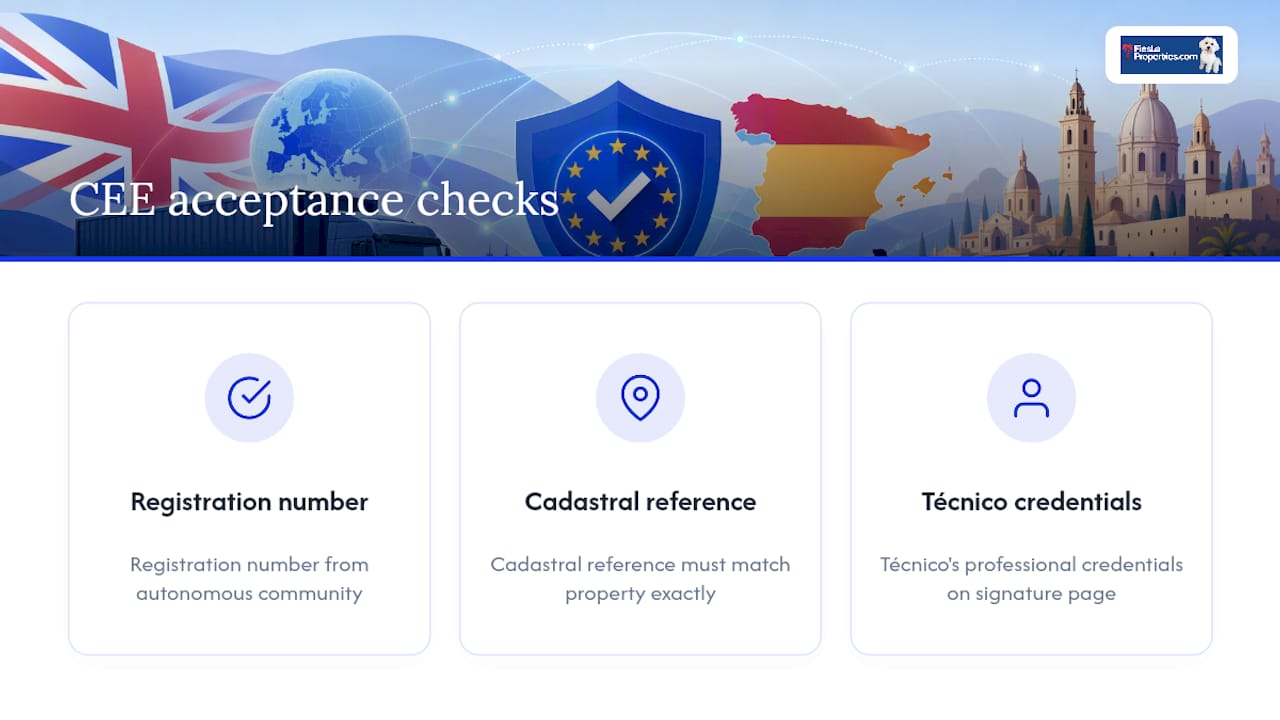
Before you accept the finished document, check three things: the registration number issued by the autonomous community, the cadastral reference (it must match the property exactly), and the técnico’s professional credentials on the signature page.
How do you get an energy certificate in Spain?
The process runs in a fairly predictable sequence, though the pace varies by region.
- Check what you already have. If a previous certificate exists, confirm it hasn’t expired and that the registration number is still logged with the autonomous community.
- Book a técnico. Have your cadastral reference ready, along with recent energy bills if you have them; they help the assessment, though they aren’t strictly required.
- Site inspection. The técnico visits in person to record wall construction, glazing, heating and cooling systems, and orientation. This step cannot be skipped or done remotely.
- Energy modelling. The técnico feeds the data into approved software such as CE3X, CERMA, or HULC, which generates the A–G rating and produces both a PDF certificate and a machine-readable data file.
- Registration. The technician submits the certificate to the autonomous community’s energy registry, which issues the official registration number that makes it legally valid.
Turnaround is normally one to two weeks from booking to registered certificate. Some regions, notably the Basque Country and Castilla y León, can take up to three months in busier periods, so build in a buffer if you’re aiming for a specific completion date.
Pro Tip: Order the certificate the moment you decide to sell, not once you have an offer on the table. A three-month wait in a slow region can quietly derail an otherwise fast sale.
What does an EPC cost, and how long does it take?
Prices depend on property size and type, and registration fees vary by autonomous community on top of the técnico’s fee.
These are indicative ranges rather than fixed tariffs, and rush fees can apply if you need a same-week appointment. Registration itself is free in some communities and charged separately in others, so ask your técnico to confirm the total upfront rather than assuming the quoted fee covers everything.
The técnico usually files the registration on your behalf once the assessment is complete, so you shouldn’t need to deal with the regional energy body directly.
Does the energy rating affect your sale price?
It can, and increasingly does. Sector analysis pointing to Bank of Spain data suggests each step down the A–G scale corresponds to a measurable dip in achievable price, and a poor F or G rating commonly triggers a buyer request for a discount once the certificate lands on the table.
You have two realistic options if your rating is weak. Small interventions, better loft insulation, sealed window frames, or a more efficient boiler, can sometimes lift a property a full band and change the negotiation dynamic. Alternatively, you price the discount in from the start rather than fighting it during negotiations. Either way, run the numbers before you list: EU energy performance directive timelines are pushing minimum standards higher through 2030 and beyond, and buyers are already factoring future compliance costs into their offers.
What mistakes commonly delay or invalidate a certificate?
A handful of avoidable errors account for most of the completion delays sellers run into.
- Presenting a certificate that was never actually registered with the autonomous community.
- A cadastral reference on the certificate that doesn’t match the one on the escritura.
- Relying on an expired certificate, particularly a G-rated one past its five-year mark.
- Using an online-only “certificate” issued without a genuine site visit, which notaries and buyers’ lawyers routinely reject.
Before listing, pull the registration number and confirm it against the regional registry, and double check the cadastral reference line by line against your title deed. Both take minutes and prevent a notary appointment grinding to a halt.
What do notaries and listings require?
Every advertisement, online or printed, must display the energy rating alongside the price and description. On completion day, the notary checks that the certificate is registered, that the cadastral reference matches, and attaches a copy to the deed itself.
Skip any of this and the consequences are real. Fines range from roughly €300 to €600 for a missing rating in adverts, rising toward €1,000 for more serious breaches, and up to €6,000 where falsification is involved. Worse for most sellers: no registered certificate on the day usually means no completion.
How sellers can avoid EPC surprises
A thorough energy certificate check before listing helps confirm validity and registration early, reducing last-minute renegotiations and ensuring smoother completions.
— Mike Kalia
Selling in Spain? Get the paperwork right from day one
Specialist agencies offer practical support for compliance in Spanish property sales, checking certificate validity and cadastral references early to avoid issues at the notary stage, and can also provide legal and currency guidance as part of their service.

If you’re preparing to sell, or buying your next property along the Costa Blanca or Murcia coast, get in touch for a free pre-listing compliance check. Browse our current new build properties in Costa Blanca or start with a property search to see what’s available, then speak to our team about coordinating your energy certificate alongside the rest of your sale.
Sources
For the legal text itself, Royal Decree 390/2021 sets out the certification framework. UK sellers should check GOV.UK’s guidance on buying property in Spain for the official UK-facing summary, and regional energy registries confirm registration numbers directly.
This article is general information, not a substitute for advice from a qualified lawyer. Consult a qualified legal professional about your own circumstances before acting on anything here.
- Gov
- Energy Certificate Spain Property Sale Price + Guide 2026 | Trustin
- Energy Performance Certificate (EPC) Spain 2026: Buyer & Seller Guide — Frank Partners
- Energy Efficiency Certificate in Spain — Almar Lawyers
FAQ
Do you need an energy certificate to sell a house in Spain?
Yes. Every property sale in Spain has required a registered CEE since 2013, and a notary will not authorise the deed without one.
Who pays for the energy certificate when selling in Spain?
The seller pays, since providing a valid certificate is a legal obligation attached to the sale, not something that can be shifted to the buyer.
How long does it take to get an EPC in Spain?
Most regions issue a registered certificate within one to two weeks, though slower regions such as the Basque Country or Castilla y León can take up to three months.
Is an Energy Performance Certificate a legal requirement in the UK too?
Yes, an EPC is a legal requirement when selling or letting a property in the UK, though the process, cost, and rating system differ from Spain’s CEE.
What happens if my Spanish energy certificate has expired?
An expired certificate, particularly a G-rated one after five years, must be renewed before the property can be legally advertised or sold.


