

Budget 10–13%: Spain Completion Costs for UK Buyers, Valencian ITP Cut
· 16 min read

Budget roughly 10% to a little over 13% on top of the purchase price to cover completion costs on a Spanish property, with the lower end applying to resale homes bought in cash and the higher end to mortgaged new-builds. The final figure shifts with the region you buy in, whether you need a mortgage, and how well you time your currency transfer.
TL;DR:
- Regional taxes vary significantly, with resale ITP ranging from 6% to 11% depending on the autonomous community, and IVA plus AJD for new builds typically totaling 11–15%.
- Additional costs include notary and land registry fees between €1,000 and €2,500, legal fees of 1–2% of the purchase price, and mortgage-related expenses if applicable.
- Paying attention to exchange rates and locking in forward currency contracts when signing the private contract can protect buyers from currency swings exceeding several thousand euros.
- Buyers should prepare all necessary documentation early, such as NIE numbers and bank accounts, to prevent delays caused by anti-money-laundering checks or administrative slowdowns.
- Budgeting conservatively, keeping separate sums for purchase price, taxes, and contingencies, significantly reduces the risk of cost overruns and last-minute surprises.
Table of Contents
- What are the completion costs on a Spain property purchase?
- How do regional taxes change your completion bill?
- What do notary, registry, legal and mortgage fees cost?
- When do you actually pay each completion cost?
- How should you transfer completion funds from the UK?
- Fiesta Properties: what we see on the ground in Costa Blanca and Costa Cálida
- What does obtaining an NIE and opening a bank account cost?
- Do you need a survey before completing in Spain?
- What utility and community fees apply after completion?
- What insurance do you need after buying in Spain?
- Can UK buyers recover VAT or deduct completion costs?
- What should UK buyers know about post-Brexit compliance?
- Three budgeting habits that actually protect your completion figure
- A practical option: how Fiesta Properties supports completion for UK buyers
- Sources
- FAQ
What are the completion costs on a Spain property purchase?
Every buyer faces the same three categories of cost at completion: the purchase tax, the regulated professional fees, and the optional but sensible legal and financial safeguards. Knowing which payments fall where in the timeline stops nasty surprises appearing on notary day.
The balance of the purchase price itself is the obvious one. You will have already paid a reservation deposit and a further sum under the private contract (the arras), so what’s left is the remaining balance, due in full on completion at the notary’s office.
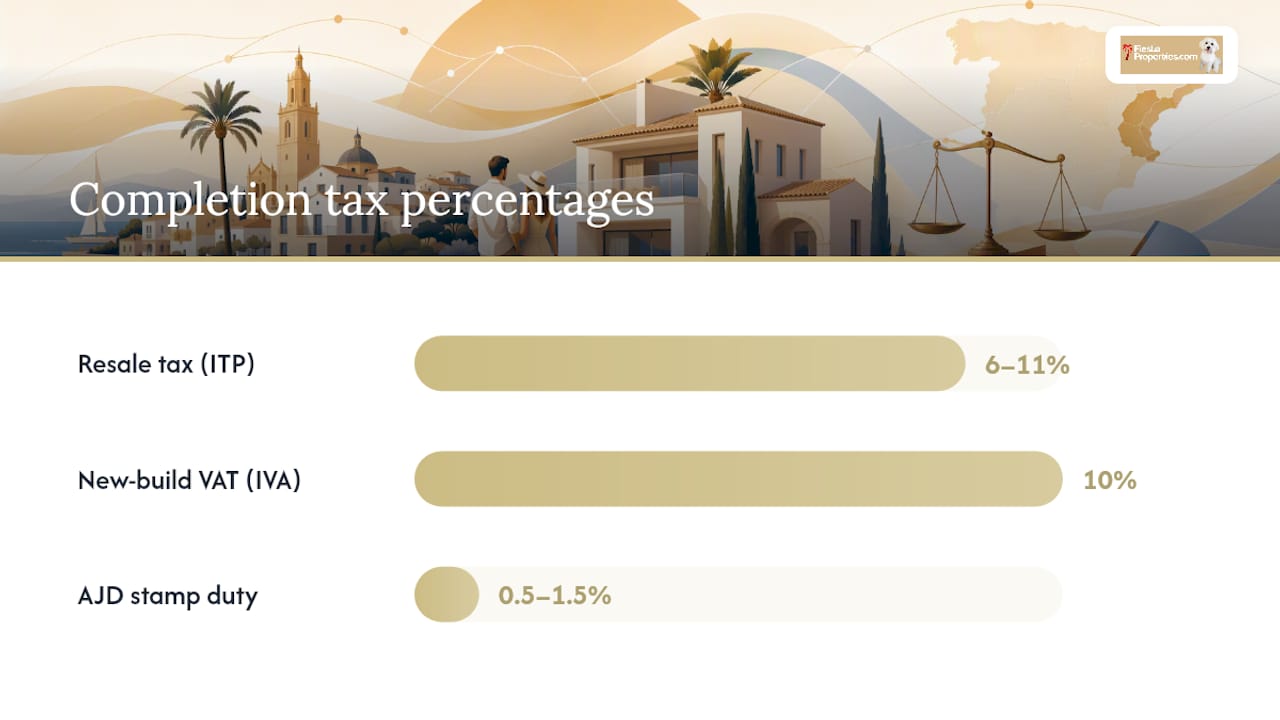
Purchase tax comes next, and which one applies depends entirely on whether the property is new or resale; for new builds, understanding the developer’s background is key, as with Acciona Inmobiliaria S.L. projects. Resale buyers pay ITP, which varies by autonomous community and typically runs between 6% and 11%. New-build buyers pay 10% IVA (Spain’s VAT) plus AJD stamp duty, generally 0.5% to 1.5% depending on the region.
Beyond tax, a cluster of smaller but unavoidable payments applies to every purchase:
- Notary fees for drawing up and signing the escritura (title deed)
- Land registry fees to record your ownership
- Gestoría charges for handling tax filings and paperwork on your behalf
- Independent lawyer’s fees for due diligence, contract review and completion support
- Translation costs if documents or the signing itself require an official translator
If you’re using a mortgage, a further set of costs layers on top: a property valuation ordered by the bank, potential arrangement fees, and the mortgage deed itself, which carries its own notary and registration charges. Since regulatory changes in Spain, banks often cover the mortgage deed’s notary, registration and gestoría costs, though the buyer still pays the purchase deed costs and the purchase tax regardless of how the property is financed.
None of these figures exist in isolation. A buyer purchasing a resale bungalow in cash on the Costa Blanca faces a noticeably lighter bill than someone financing a new-build apartment through a mortgage in a higher-AJD region. The next section breaks down exactly how much that regional difference can move your total.
How do regional taxes change your completion bill?
Region is the single biggest lever on your final completion figure, and it catches out more buyers than currency swings or legal fees combined. The tax you owe depends on where in Spain you’re buying, not just what you’re buying.
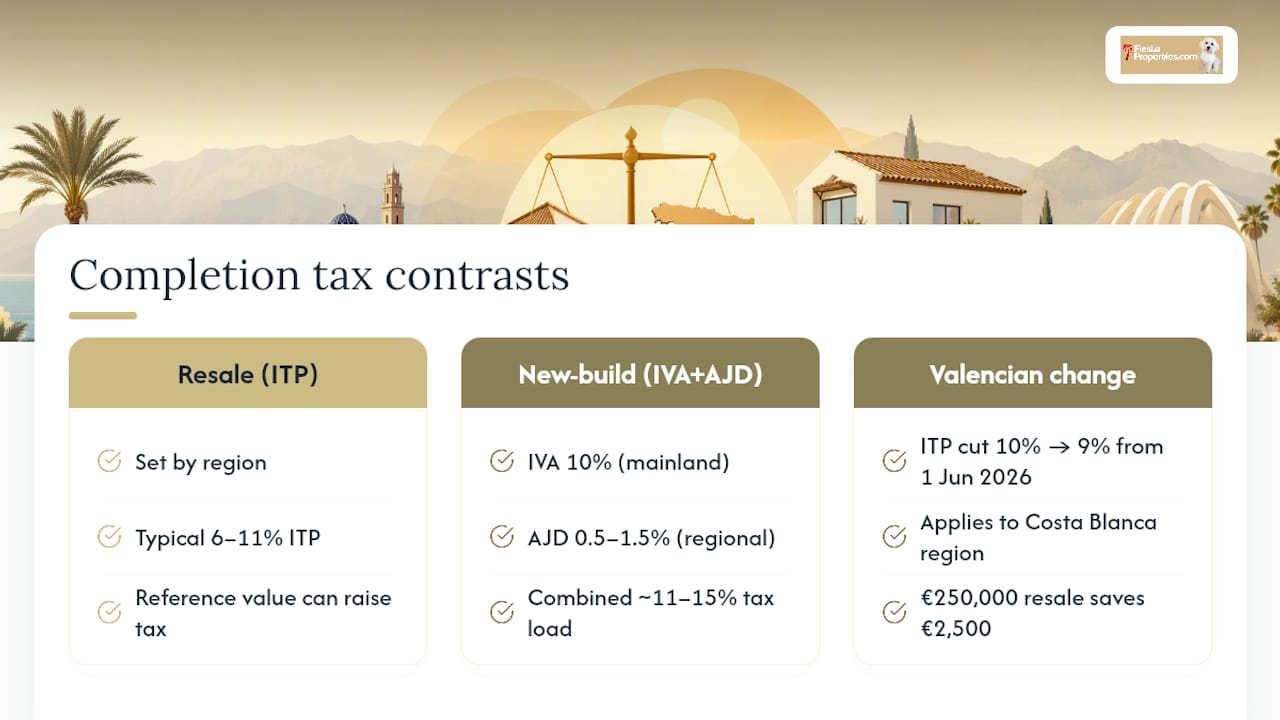
ITP for resale properties is set by each autonomous community, and the range is wide: roughly 6% to 11% of the declared purchase price. Andalusia and Murcia have historically sat towards the lower end, while other regions apply higher standard rates. Crucially, the Valencian Community, covering Costa Blanca, has just moved: ITP there drops from 10% to 9% for most residential purchases from 1 June 2026. That single change saves a buyer completing a €250,000 resale roughly €2,500 in tax alone, assuming the purchase falls within the reduced band.
IVA and AJD for new-builds work differently. IVA sits at a flat 10% across mainland Spain for most residential new-builds, and AJD stamp duty then adds a further 0.5% to 1.5% on top, again set regionally. Combined, new-build buyers typically face a heavier tax load than resale buyers in the same region, which is why guides consistently push the “all-in” figure for new-builds towards 11–15%, rather than the lower resale range.
Regional snapshot: A €300,000 resale purchase in the Valencian Community from June 2026 attracts ITP at 9%. The same price paid for a new-build, at 10% IVA plus a typical 1.5% AJD, adds up to a significantly higher tax load before notary, registry, or legal fees.
One further trap catches out bargain hunters specifically. Spanish tax offices publish a valor de referencia, a reference value for each property, and if your agreed price sits below it, ITP can be assessed on the higher reference figure rather than what you actually paid. Buying what looks like a discounted resale can therefore trigger a tax bill calculated as if you’d paid more. Because regional tax policy shifts are often announced with limited lead time, always ask your lawyer for a location-specific calculation before you exchange, not after.
What do notary, registry, legal and mortgage fees cost?
Regulated fees are more predictable than tax, but they still add up faster than most buyers expect. Notary and land registry charges together typically run between €1,000 and €2,500 or more, scaling with the purchase price and the complexity of the title.
Legal fees sit on top of that, and this is where independent representation earns its keep. Although a lawyer isn’t a legal requirement to complete a Spanish purchase, industry experts strongly advise non-resident buyers to appoint an independent Spanish lawyer to check for outstanding debts, verify planning permissions, and confirm the seller’s title is clean. Typical legal fee models run 1% to 2% of the purchase price plus 21% IVA, or a fixed fee for straightforward resale purchases.
Gestoría fees cover the administrative legwork: filing your tax returns, registering the deed, and handling the paperwork trail that follows completion. Translation costs apply if you need an official translator present at signing, or if key documents require certified translation for your own records.
Mortgage-linked costs are their own bracket:
- A bank-ordered valuation of the property, usually payable upfront
- Possible arrangement fees, depending on the lender and product
- Mortgage deed notary and registration costs, which banks frequently absorb under current practice
- Life or buildings insurance the lender may require as a lending condition
Pro Tip: Ask your lawyer for an itemised, written estimate of every fee before you sign the private contract, not after. A one-page breakdown at that stage means no surprises on notary day, and it gives you a document to challenge any fee that creeps up later.
When do you actually pay each completion cost?
Spanish completions follow a fairly fixed rhythm, and understanding it prevents cash-flow panic in the final fortnight.
- Reservation: a deposit, typically €3,000 to €10,000, taken off the market and held while due diligence begins.
- Private contract (arras): a further payment, commonly bringing your total deposit up to around 10% of the price, signed alongside a binding contract.
- Completion (escritura): the remaining balance, plus purchase tax, notary fees and registry costs, all settled on signing day at the notary’s office.
- Post-completion filings: tax payments and registration paperwork, which your gestoría typically handles within 30 days of completion.
Prepare three separate cash pots rather than one lump sum: the purchase balance, the taxes and fees, and a contingency for anything unexpected. Timing traps cluster around three things: currency movements between exchange and completion, mortgage approval delays pushing back your notary date, and lawyers needing cleared funds in their client account days before signing, not on the morning itself.
How should you transfer completion funds from the UK?
The exchange rate on the day you convert pounds to euros can swing your final cost by thousands on a typical purchase, so timing your transfer matters as much as any fee you’ll pay a professional.
Your main options are:
- Standard bank transfer: simple but usually the weakest exchange rate and the highest hidden margin
- Specialist currency providers: typically better rates than high street banks, with transparent fee structures
- Forward contracts: lock today’s rate for a transfer weeks or months ahead, useful once you’ve signed the arras and know your completion date
- Spot transfers: convert and send immediately, suited to smaller balances where rate movement matters less
Buyers who use specialist currency services or forward contracts generally protect their budget better than those relying on ad hoc bank transfers timed around other commitments.
Pro Tip: For any completion sum above roughly £50,000, get a forward contract quote the moment you sign the private contract. Locking the rate months ahead removes the single biggest variable in your entire budget, and it costs nothing extra beyond the spread you’d pay anyway.
Fiesta Properties: what we see on the ground in Costa Blanca and Costa Cálida
Handling completions across Torrevieja, Orihuela Costa and the wider Murcia region for over a decade has shown us the same handful of issues catching UK buyers repeatedly. Anti-money-laundering checks on international transfers are the most common delay, and banks on both sides can take longer than buyers expect to clear large sums, particularly around bank holidays.
We recommend buyers prepare four things well before their target completion date: an NIE number (the tax identification number every non-resident needs to complete a Spanish purchase), a notarised power of attorney if you can’t attend signing in person, proof of funds documentation your lender or lawyer will request, and confirmation of your exact tax rate for the region you’re buying in.
If you’d like a tailored estimate covering tax, fees and currency for a specific property on the Costa Blanca, our team can walk through the figures against your actual purchase price and region.
What does obtaining an NIE and opening a bank account cost?
You cannot complete a property purchase in Spain without an NIE (Número de Identificación de Extranjero), the tax number that identifies you to the Spanish authorities for every transaction, including the purchase deed itself. Applying in person at a Spanish consulate in the UK, or through a Spanish police station once you’re there, carries a modest official fee, generally a small fixed administrative charge rather than a percentage of your purchase.
Many buyers instead use a gestoría or lawyer to apply on their behalf under power of attorney, which adds a service fee on top of the official charge but saves a dedicated trip. Given the appointment waiting times at UK consulates, this route is often the more practical one for buyers working to a completion deadline.
Opening a Spanish bank account isn’t strictly mandatory for every purchase, but it’s practically essential for paying utility bills, community fees and local taxes after completion. Most Spanish banks don’t charge an account-opening fee for non-residents, though ongoing account maintenance and international transfer charges vary between providers, and some require a minimum deposit to activate the account.
Both steps take real time, not just money. NIE applications and account opening should sit at the very start of your buying timeline, ideally as soon as you’ve had an offer accepted, since neither can be rushed through in the final week before completion.
Do you need a survey before completing in Spain?
A structural survey isn’t a legal requirement in Spain the way it can feel expected in the UK, but that doesn’t make it optional for anyone buying a resale property, particularly an older villa or townhouse outside a managed development. Skipping it is one of the more expensive false economies in the entire process.
Independent building surveyors operating in Spain typically charge a fee scaled to the property’s size and age, with older or larger villas costing more to inspect thoroughly than a modern apartment. The inspection covers structural condition, damp, roof integrity and any unpermitted extensions, the kind of issue that can surface as a legal problem at the Land Registry as much as a physical one.
New-build purchases carry less survey risk since the property comes with statutory guarantees from the developer, but a snagging inspection just before final handover is still worth arranging. This checks finishes, fittings and installations against what was promised in the contract, and gives you leverage to have defects fixed before you sign for keys rather than after.
Raising a structural problem after signing the arras leaves you with far weaker negotiating ground than raising it before.
What utility and community fees apply after completion?
Moving into a Spanish property means transferring or opening several utility accounts, and each carries its own small connection or transfer charge. Water and electricity suppliers typically charge a modest administrative fee to switch the account into your name, separate from any deposit the supplier may hold against future bills.
If you’re buying a resale property, transferring existing utility contracts is usually quicker and cheaper than setting up entirely new connections, which matters more for off-plan or newly built properties without an established supply history. Your gestoría or lawyer can usually handle these transfers as part of the post-completion paperwork, for a modest additional fee.
Community fees (cuotas de comunidad) apply to almost any apartment, townhouse or villa within a managed development, covering shared pool maintenance, gardens, security and building upkeep. These are charged quarterly or annually by the community administrator and become your responsibility from the completion date, prorated for the remainder of that billing period. Ask your lawyer to confirm the seller has no outstanding community debts before completion, since unpaid fees can sometimes attach to the property rather than the previous owner.
Budget for these as an ongoing cost rather than a one-off, since they continue for as long as you own the property, alongside local council tax (IBI), which is billed annually based on the property’s cadastral value.
What insurance do you need after buying in Spain?
Home insurance isn’t a legal requirement to own a Spanish property outright, but it becomes mandatory the moment you take out a mortgage, since lenders require buildings cover as a lending condition and often bundle it into your completion costs. Even for cash buyers, going without cover on a property you may only visit part of the year is a real financial exposure, not a theoretical one.
Buildings insurance premiums vary with the property’s size, construction type and location, with coastal properties sometimes attracting slightly higher premiums due to storm or flood risk in certain zones. Contents cover is optional but sensible if you’re furnishing the property, particularly for a holiday home left empty for stretches of the year.
Spain doesn’t use title insurance in the way some other countries do; instead, the due diligence your lawyer performs before completion, checking the Land Registry for charges, debts or disputes, serves the equivalent protective function. This is another reason independent legal checks matter as much as any insurance policy you’ll take out afterwards.
Arrange buildings insurance to start from your completion date, not after, since an uninsured property between signing and your first visit is an unnecessary risk for the sake of a phone call to an insurer beforehand.
Can UK buyers recover VAT or deduct completion costs?
If you’re buying through a company structure or for a genuine commercial letting business, the position changes, and it’s worth a specific conversation with your lawyer or accountant before you commit to a structure.
Completion costs themselves, tax, notary, legal and registry fees, aren’t deductible against Spanish income tax in the year you pay them. Where they matter is later, at the point you eventually sell: these acquisition costs can generally be added to your purchase price when calculating capital gains for Spanish tax purposes, reducing your taxable gain on a future sale.
For UK tax purposes, keep every invoice and receipt from your Spanish purchase, since HMRC treats overseas property costs similarly for capital gains calculations if and when you sell. A folder of dated, itemised invoices from your notary, lawyer and gestoría is worth far more years later than it feels at the time.
What should UK buyers know about post-Brexit compliance?
Buying a Spanish property remains fully open to UK nationals after Brexit, but the process now carries a few additional administrative layers that weren’t there before 2021. The core purchase mechanics, NIE, notary, Land Registry, are unchanged; what’s changed sits around residency, tax residency status and how long you can stay without a visa.
UK buyers not seeking Spanish residency are limited to 90 days within any 180-day period under Schengen rules, which matters if you’re planning to spend extended time in the property rather than just using it as a holiday home. If you want to stay longer, routes like the non-lucrative visa involve their own separate application costs and income requirements, distinct from anything related to the property purchase itself.
Proof of funds documentation has become more heavily scrutinised under anti-money-laundering rules since Brexit, and UK buyers should expect banks and lawyers on both sides to request more detailed evidence of where completion funds originated than was typical a decade ago. Building in extra time for this, rather than assuming a transfer will clear overnight, avoids the single most common last-minute completion delay UK buyers now face.
Currency controls haven’t changed for UK residents moving money to Spain, but it’s worth confirming with your bank or currency provider that your documentation meets current source-of-funds requirements well before completion week, not during it.
Three budgeting habits that actually protect your completion figure
Most cost overruns on a Spanish purchase come down to poor planning rather than bad luck, and three habits consistently separate buyers who complete smoothly from those who don’t.
Budget conservatively and build in room for the exchange rate to move against you, not just in your favour. Keep your purchase funds, tax and fee money, and a contingency pot as three genuinely separate sums, and confirm the payment timeline directly with both your lawyer and your bank rather than assuming everyone’s working to the same date. Above all, insist on independent legal checks and itemised invoices for every fee, because the buyers who skip that step are the ones who ring us six months later asking why a bill they never saw coming has landed on their doormat.
— Mike Kalia
A practical option: how Fiesta Properties supports completion for UK buyers
Fiesta Properties removes two of the biggest cost variables covered in this guide before they ever reach your completion bill: our currency exchange specialist works to secure the most competitive rate available on your transfer, and we charge no legal or exchange fees to clients, unlike many managed routes that layer margin onto both.

Our team covers the full completion picture rather than just the property search. Carlos, our legal specialist, guides you through title checks and contract review; Tim, our mortgage specialist, can secure pre-approval with fixed rates from 2.4% and variable rates from 2%, on terms up to 25 to 30 years; and Jamie manages your currency transfer directly, so you’re not juggling separate providers for each piece of the puzzle. Mike and Tatiana stay involved from your first enquiry through to the keys in your hand, and beyond.
If you’re weighing up a purchase on the Costa Blanca or Costa Cálida and want a completion-cost estimate specific to your budget and region, start with our step-by-step buying process or get in touch through Fiestaproperties to talk through the figures against a real property.
Sources
This guide draws on idealista’s cost breakdown, Global Law Experts’ 2026 update, Movingto’s fee guide and Investropa’s tax overview. Always confirm your exact regional ITP rate and valor de referencia exposure with your lawyer or the relevant regional tax office before signing.
FAQ
Can I Get a Mortgage in the UK for a Spanish Property?
Fiesta Properties’ mortgage specialist arranges pre-approval with fixed rates from 2.4% and variable rates from 2%, on terms of up to 25 to 30 years.
Is It Wise to Buy a Property in Spain Now?
Locking in a location-specific tax and fee estimate with your lawyer before you commit remains the more reliable test than trying to time the wider market.
What Are the Rules for Brits Buying Property in Spain?
UK nationals can buy Spanish property with no restriction on ownership, but every buyer needs an NIE number before completion and faces closer anti-money-laundering scrutiny on proof of funds since Brexit. Staying longer than 90 days in any 180-day period requires a separate visa route, which sits apart from the property purchase itself.
How Long Does It Take to Complete a Property Purchase in Spain?
A straightforward cash purchase can complete in as little as four to six weeks from an accepted offer, while mortgaged purchases typically take eight to twelve weeks to allow for valuation, approval and international fund transfers. Building in three weeks specifically for large international transfers and AML checks avoids the most common cause of last-minute delay for UK buyers.


