

Micro Market Timing: Buy Costa Blanca in Sept to Oct or Nov to Feb 2026
· 11 min read

For most buyers, the strongest negotiating position falls in September and October, and again through the winter months from November to February. Micro-markets shift that window slightly. Villa-heavy areas in the north and apartment-led resale markets in the south each respond to the calendar in their own way, so the ideal month still depends on what you are buying and where.
TL;DR:
- Buyers should focus on the September to October and winter months, when seller motivation increases due to seasonal cycle and property condition clarity.
- The Costa Blanca North’s villas often see price flexibility in winter, while the south’s apartment market offers more choices in early autumn.
- Despite ongoing price increases of over 12% annually, seasonal timing enhances negotiation power and stock availability without causing price drops.
- Having financing, legal, and property condition checks pre-arranged enables buyers to act quickly and secure deals during narrow seasonal windows.
- Long-term market trends remain upward, so timing is primarily useful for negotiations and not for expecting actual price declines.
Table of Contents
- Best months to buy Costa Blanca property: the seasonal windows explained
- What the 2026 housing data tells buyers about timing
- How seasonal timing shapes negotiation and offer strategy
- Your pre-viewing checklist for moving fast in the window
- What local agents see on the ground each year
- How tourism seasons shape prices and what is actually for sale
- Thinking beyond the calendar: property cycles and long-term value
- Local economic forces that move the buying calendar
- An honest read on Costa Blanca timing
- Get expert support timing your Costa Blanca purchase
- Sources
- FAQ
Best months to buy Costa Blanca property: the seasonal windows explained
Two distinct windows favour buyers each year, and they work for different reasons.
September and October sit right after the summer rush. Holidaymakers have gone home, viewing diaries clear, and sellers who priced hopefully in June often reconsider once the peak season passes without a sale. The Mediterranean climate still cooperates at this time of year, so you can inspect a terrace, pool area, or garden in genuinely representative conditions rather than in the glare of August heat or the quiet of deep winter.
Winter, from November through February, brings a second and quite different opportunity. International buyer numbers thin out noticeably, agents have more time per client, and sellers who have carried a property through an unsuccessful summer campaign tend to be more flexible on price or completion terms. Properties also reveal themselves honestly at this time of year: a poorly insulated apartment or a villa with drainage problems is far easier to spot in January than in July.
The two coasts behave differently within these windows:
- In the Costa Blanca North, where villas and premium detached homes dominate around towns like Altea, Moraira, and Jávea, winter tends to expose sellers who overpriced for the summer market and are now open to renegotiation.
- In the Costa Blanca South, where apartment stock in areas such as Torrevieja, Orihuela Costa, and Guardamar del Segura moves in higher volumes, the September to October window tends to bring the sharpest jump in available choice as summer-let owners return units to the sales market.
What the 2026 housing data tells buyers about timing
Seasonal advantage does not mean prices are falling. The National Statistics Institute (INE) reported an annual Housing Price Index variation of 12.2% for Q2 2026, with a 3.4% quarterly increase.
INE Q2 2026 snapshot: Annual HPI +12.2% · Quarterly change +3.4% · New homes +7.4% y/y · Second-hand homes +12.9% y/y
The full regional breakdown behind those national figures sits in the INE’s detailed HPI tables, and the pattern is consistent with what registrars have been recording for a while: sustained demand and constrained supply keep pushing prices up in most coastal markets, according to the College of Registrars’ 2025 annual report.
What does this mean practically? Do not expect the autumn or winter window to deliver a dramatic discount against the national trend. What it does deliver is negotiating leverage on individual listings, faster response times from sellers and agents, and a wider pool of stock to compare. Well-located resale properties are still selling quickly once listed, while new-build pricing is climbing at a gentler, more predictable pace.
How seasonal timing shapes negotiation and offer strategy
A property that has sat unsold through July and August often comes with a seller who is tired of showings and increasingly aware of ongoing holding costs. That shift in motivation is the real reason autumn and winter buyers get better terms, not because the underlying market has softened.
Turning that timing advantage into an actual discount takes a specific approach:
- Arrive with financing sorted. A seller weighing two similar offers will usually favour the buyer who can complete without delay, so mortgage pre-approval or proof of funds carries real weight.
- Keep contingencies realistic. Overloading an offer with conditions undermines the speed advantage that makes an autumn or winter bid attractive in the first place.
- Read the seller’s position before naming a number. A relocating owner under time pressure responds differently to a discretionary seller who can simply wait for spring.
- Decide between price and concessions early. Sometimes a renovation allowance for a tired kitchen or outdated bathroom achieves more than shaving a few thousand euros off the asking price, particularly on older resale stock.
Pro Tip: If a property has been listed since spring and is still on the market by October, ask your agent directly how many viewings it has had. A high viewing count with no offers usually means the price, not the property, is the problem, and that is exactly the leverage you want going into a negotiation.
Your pre-viewing checklist for moving fast in the window
Seasonal advantage disappears quickly if you are not ready to act the moment the right property appears. Buyers who move fastest in September, October, or the winter months share a few habits in common.
- Get mortgage pre-approval sorted before you book flights, not after you find a property you like.
- Arrange your currency exchange in advance so a favourable rate is not lost while paperwork catches up, a step foreign transfer guides consistently flag as underprepared among first-time buyers.
- Apply for your NIE (Número de Identidad de Extranjero) early, since it is required before you can complete a purchase in Spain.
- For winter viewings specifically, check the heating system, look for damp around windows and skirting boards, test drainage, and note which way the property faces, since low winter sun exposes orientation problems that summer light hides.
- Ask the agent directly how long the property has been listed and whether virtual viewings are available for an initial shortlist before you commit to travel.
Resale completions typically take a few weeks once a property is chosen, assuming financing and due diligence run smoothly, so a fast decision in October can realistically mean holding keys before spring.
What local agents see on the ground each year
Patterns repeat with enough regularity that experienced local agents plan their year around them. Sellers who missed the summer window frequently come back with a renewed appetite to negotiate once September arrives, and winter viewings routinely surface issues, such as a damp wall behind a wardrobe or a heating system that has not been serviced, that never come up in a June viewing.

Local agencies familiar with this rhythm often provide sales knowledge alongside specialists for mortgages, currency exchange, and Spanish legal processes. Buyers receive in-person or virtual viewings arranged to their availability, bilingual negotiation support, and legal guidance throughout the purchase process.
How tourism seasons shape prices and what is actually for sale
Tourism does not just fill hotels along the Costa Blanca. It directly shapes what property is available and what it costs at any given point in the year. Owners who use their apartment or villa as a summer letting property rarely list it for sale during peak season, since doing so would mean losing rental income during the months it earns the most.
That pattern creates a predictable rhythm. Stock tightens through June, July, and August as sellers hold back inventory, then loosens noticeably once the season ends and owners either commit to selling or accept that another summer of letting has passed. Prices during peak months also carry a psychological premium, since buyers viewing a sun-drenched terrace in August are seeing the property at its most appealing, which makes it harder to negotiate hard on price in that moment.
Areas built around short-term rental income, particularly apartment-dense zones in the south such as La Zenia and Playa Flamenca, feel this effect most strongly. Villa markets further north, where properties tend to be primary or long-stay second homes rather than holiday lets, show a gentler seasonal swing in both pricing and available stock. Buyers focused on lifestyle rather than rental yield may find the villa segment less affected by tourist-season timing altogether.
Thinking beyond the calendar: property cycles and long-term value
Seasonal timing helps you negotiate a better deal on a specific property, but it says nothing about where the broader market sits in its longer cycle. Spain’s coastal property markets move through multi-year phases of growth, plateau, and correction, and the current run of price increases, reflected in that 12.2% annual HPI rise, sits within a growth phase that has now lasted several years.
Buyers focused purely on finding the cheapest month to transact can miss the bigger question: is this a good point in the cycle to be buying at all? For a primary residence or a long-term hold, the answer matters less, since you are not trying to time an exit. For an investment purchase, it matters considerably more. A property bought during a seasonal dip within a rising multi-year cycle will likely outperform one bought at a seasonal high during a market that has already run hot for years.
The practical takeaway is to treat seasonal timing and cycle positioning as two separate decisions. Seasonal windows like September to October or the winter months help you negotiate terms on an individual property. Cycle awareness helps you decide whether this is the right multi-year moment to be in the Costa Blanca market at all, informed by data such as the registrars’ ongoing price momentum reports rather than by which month happens to have fewer viewings booked.
Local economic forces that move the buying calendar
Property prices and buyer behaviour on the Costa Blanca do not move in a vacuum. Infrastructure investment, transport links, and policy shifts all nudge the calendar in ways that seasoned buyers watch closely.
Airport connectivity is one of the clearest examples. When new routes or expanded capacity land at Alicante or Murcia airports, international buyer interest tends to pick up within a season or two, tightening supply in the areas those routes serve best. Local infrastructure projects, road upgrades, new marina developments, or expanded amenities in towns like Guardamar del Segura or San Pedro del Pinatar, can shift buyer preference toward a specific area faster than national price trends would suggest.
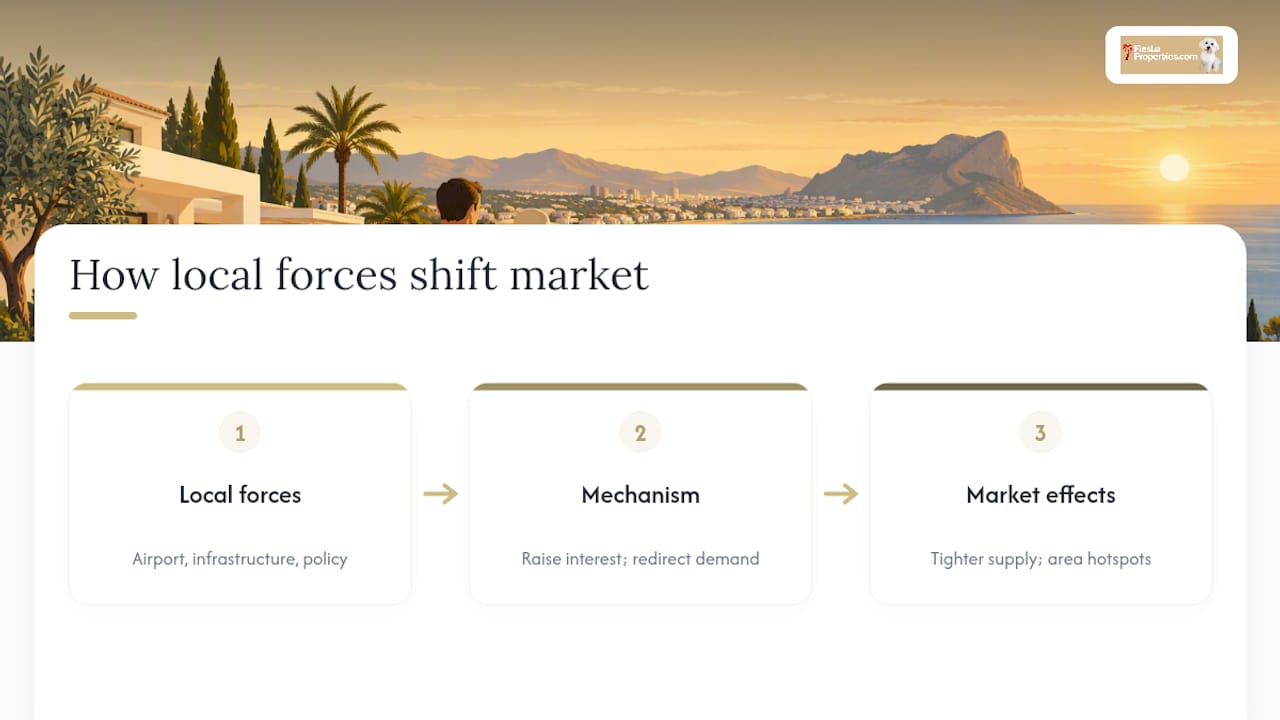
Government reporting on foreign residency also offers a useful signal. The Spanish government’s own data on foreign population and residence permits shows clear seasonality in how international residents arrive and settle, which helps explain why buyer activity thins in winter and swells again as spring approaches. Policy changes around residency requirements, mortgage regulation, or golden visa style programmes can also shift the timing calculus for particular buyer segments, sometimes creating a temporary rush ahead of a rule change and a lull afterward.
None of these factors override the seasonal patterns already discussed, but they explain why one October can feel very different from the next. A buyer watching only the calendar misses half the picture.
An honest read on Costa Blanca timing
Most advice on timing the Costa Blanca market treats the calendar as the whole story, and that is where it falls short. September and October, and the winter months that follow, genuinely do shift negotiating power toward the buyer, and the reasoning holds up: sellers grow more motivated, agents have more attention to give, and properties show their true condition once the tourist gloss fades. But the 2026 data is unambiguous that this is not a falling market.
Where conventional guidance really underserves buyers is in treating the Costa Blanca as one market. It is not. A villa buyer in the north and an apartment buyer in the south are playing by different rules, with different stock cycles and different seller psychology. My honest view is that buyers should prioritise matching their search to the right micro-market before they even think about which month to book flights. Get that fit right, then use the autumn or winter window to negotiate hard, arrive pre-approved, and move decisively when the right property appears.
— Mike Kalia
Get expert support timing your Costa Blanca purchase
An alternative to going it alone on Costa Blanca timing is to engage a dedicated team experienced in reading seasonal signals across numerous active sales monthly. Property search and shortlisting, in-person and virtual viewings, and bilingual negotiation support can be managed by local experts, supported by specialists in mortgage pre-approval, currency exchange, and guidance through the Spanish purchase process.

If you already know the area and the property, buying independently is entirely workable, particularly for cash buyers with straightforward legal circumstances. Where a dedicated team earns its place is in the areas that catch out international buyers most often: currency timing, mortgage terms, and knowing genuinely whether a seller is motivated or simply testing the market. If you want to move on a property this September, October, or through the winter window, start by browsing current villas for sale on the Costa Blanca or get in touch through the main Fiesta Properties site to arrange a viewing and mortgage pre-approval before your next trip.
Sources
- National Statistics Institute (INE) — Press release: Housing Price Index Q2 2026
- La Moncloa — News: foreign population with residence (March 2026)
FAQ
Is it wise to buy a property in Spain now?
Buying now can work well if you focus on the right micro-market and negotiate during a seasonal window rather than waiting for a price drop that the current data does not support. The 12.2% annual rise in the Housing Price Index shows a market that keeps climbing, so timing your offer well matters more than timing the wider market cycle.
How long can I stay in Spain if I buy a property there?
Buying property does not automatically grant residency or extend your stay beyond standard visa rules; non-EU buyers are typically still limited in their stay under standard visa rules unless they separately apply for a residency route. Anyone planning a longer or permanent stay should get tailored legal advice through a service like Fiesta Properties’ legal support before assuming property ownership alone changes their status.
What is the nicest part of Costa Blanca?
There is no single answer, since the north offers quieter, villa-led towns like Altea, Moraira, and Jávea with a more upmarket feel, while the south offers higher-volume apartment living around Torrevieja, Orihuela Costa, and Guardamar del Segura at generally lower price points. The right area depends on whether you want lifestyle and space or rental yield and convenience, and Fiesta Properties’ property search tool can help match your priorities to the right zone.
Are Spanish house prices falling?
No, prices are still rising nationally. INE recorded a 12.2% annual increase in the Housing Price Index for Q2 2026, with second-hand homes up 12.9% year on year and new builds up 7.4%. Seasonal buying windows in September, October, and winter improve your negotiating position on individual properties, but they do not reflect a falling overall market.


