

90 day rule Spain: what UK travellers need to know
· 14 min read

UK citizens may stay in Spain for up to 90 days in any rolling 180-day period without a visa, but that allowance covers the entire Schengen Area collectively, not Spain alone. Since Brexit, UK passport-holders are treated as third-country nationals under Schengen rules, which means the short-stay limit applies every time you cross into Spain, France, Portugal, or any of the other 27 Schengen states. If you want to stay longer, you must apply for a Spanish long-stay national visa or permit before your current short stay expires.
Three immediate steps to take right now: first, count back 180 days from today and total every day you have spent anywhere in the Schengen Area; second, run those dates through the EU short-stay calculator to confirm your remaining allowance; third, review the Gov and the Spanish Ministry of Foreign Affairs (Exteriores) visa pages to identify the correct visa route if you need more time.
Key takeaways
UK travellers must count Schengen days across all 27 member states, not just Spain, and owning a property there does not extend the 90-day short-stay allowance or replace the need for a visa.
| Point | Details |
|---|---|
| 90/180 rule is Schengen-wide | Every day in any Schengen country counts against the same 90-day total in any rolling 180-day period. |
| Use the official calculator | The EU short-stay calculator has check and planning modes to confirm compliance before booking. |
| Property ownership is not a visa | Buying in Spain creates tax obligations (including Form 210) but grants no extra immigration rights. |
| Long-stay routes exist | Non-lucrative, work, student, family, and Golden Visa routes all allow stays beyond 90 days with the correct application. |
| Fiestaproperties supports buyers | Fiestaproperties helps buyers find properties in Costa Blanca and Murcia and can connect them with local legal and tax professionals. |
Table of Contents
- What does the 90/180-day Schengen rule mean for UK travellers after Brexit?
- How do you calculate your 90 days, with worked examples?
- How does Spain enforce the rule, and what happens if you overstay?
- What are the legal routes to stay in Spain beyond 90 days?
- Are ‘visa runs’ to non-Schengen countries a reliable reset?
- What should you carry and check before travelling to Spain?
- Does buying property in Spain change your immigration rights or tax position?
- The part most guides get wrong about planning a life in Spain
- Buying property in Costa Blanca and Murcia with Fiestaproperties
- Sources
What does the 90/180-day Schengen rule mean for UK travellers after Brexit?
The rule is straightforward in principle but catches many people out in practice. For every day you wish to be in the Schengen Area, you look back at the preceding 180 days and count every day you have already spent there. That running total must never exceed 90. The window rolls forward daily, so it is not a fixed calendar period starting on 1 January.
The critical point, and the one most commonly misunderstood, is that the 90-day total applies to the whole Schengen Area collectively, not to each country separately. A week in Paris, a fortnight in Barcelona, and a long weekend in Lisbon all count against the same 90-day pot. Spain cannot change this on its own; it is an EU-level regulation, and any amendment would require agreement across all member states.
Before Brexit, UK citizens had freedom of movement and faced no short-stay limit. That changed on 1 January 2021. UK passport-holders are now in the same category as US, Canadian, and Australian citizens for Schengen entry purposes. ETIAS, the European Travel Information and Authorisation System, will add a further pre-travel authorisation requirement for visa-exempt nationals once it launches, though the scheme was still pending full implementation at the time of writing.
When you arrive at a Spanish border, officials may request:
- A passport valid for at least three months beyond your planned departure from the Schengen Area as required by official travel guidance [GOV.UK]
- Proof of sufficient funds for your stay (bank statements or cash)
- Evidence of accommodation (hotel booking, rental agreement, or an invitation letter)
- A return or onward travel ticket
- Travel insurance covering medical expenses and repatriation
- Any visa, TIE (Tarjeta de Identidad de Extranjero), or residence permit if you hold one
How do you calculate your 90 days, with worked examples?
The count-back method works like this: on any given day you want to enter or remain in the Schengen Area, identify the 180-day window ending on that day, then add up every day you spent in any Schengen country during that window. If the total is 90 or fewer, you are compliant.
Example 1: a straightforward summer holiday
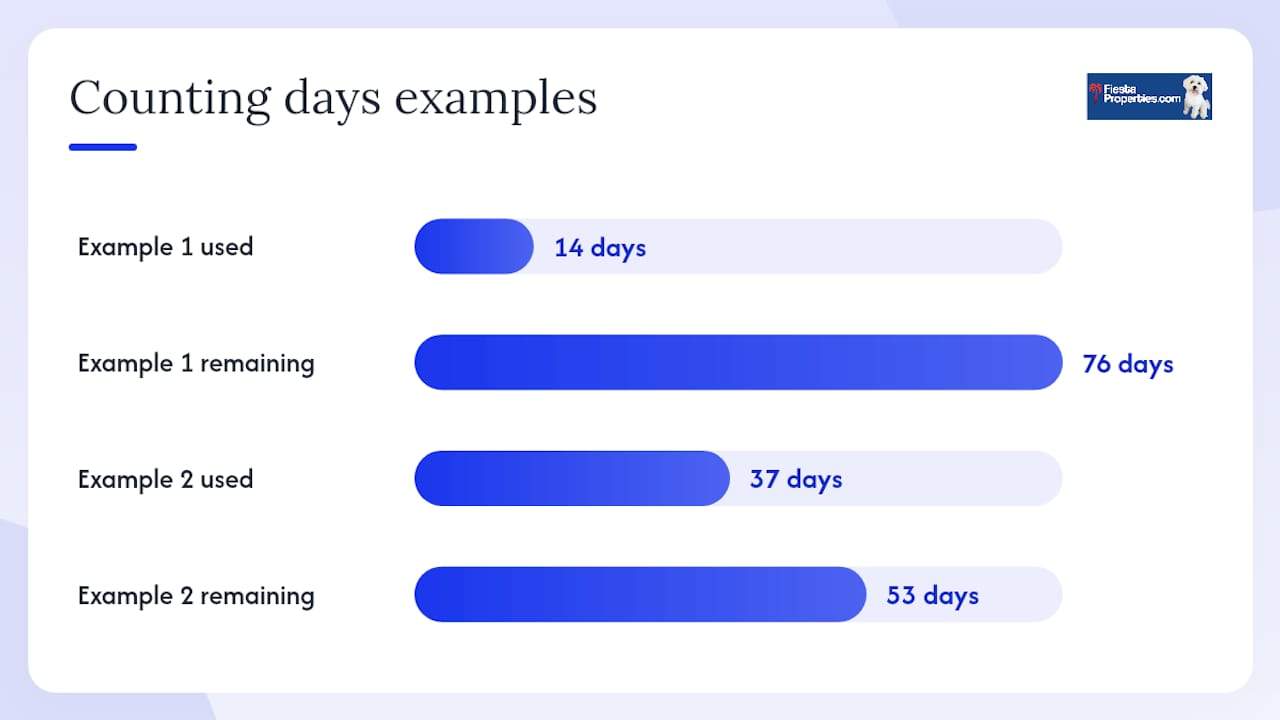
Suppose you spent two weeks in Mallorca from 1 June to 14 June (14 days) and now want to return to Alicante on 1 September. Count back 180 days from 1 September: the window opens on 5 March. Your June trip falls within that window, so you have used 14 days. You have 76 days remaining and your planned trip is well within the limit.
Example 2: a more complex multi-trip pattern
You spent Easter in Seville (10 days: 18–27 March), then a month working remotely from a rented flat in Valencia (30 days: 1–30 May), then a week in Rome (7 days: 15–21 July). On 1 October you want to return to Spain for the winter. The 180-day window looking back from 1 October opens on 5 April. Your March Easter trip falls outside that window, so it does not count. The May Valencia stay (30 days) and the July Rome trip (7 days) both fall inside it, giving a total of 37 days used. You have 53 days remaining.
The EU short-stay calculator handles this arithmetic automatically. It offers two modes: “check” (enter past stays to see how many days remain today) and “plan” (enter a proposed future stay to see whether it would breach the limit). Use the “plan” mode before booking any trip that might push you close to 90 days.
Pro Tip: Keep a dedicated folder, digital or physical, containing boarding passes, e-ticket confirmation emails, and credit-card statements showing transactions in Schengen countries. These records make it straightforward to demonstrate your travel history if border officials or immigration authorities question your day count.
Once you hold a Spanish national long-stay visa (a D-type visa) or a residence permit such as a TIE, those days are no longer counted under the short-stay rule. The 90/180 calculation applies only to short-stay, visa-exempt travel.
How does Spain enforce the rule, and what happens if you overstay?
Enforcement has become more systematic. Passport stamps remain the primary record for most travellers, but Spain and other Schengen states are progressively introducing the Entry/Exit System (EES), a digital register that will automatically record each crossing for non-EU nationals. Police checks, accommodation registration requirements, and cross-border data sharing already allow authorities to build a picture of a traveller’s movements even without a fully digital border.
The consequences of overstaying are serious. According to GOV.UK’s Spain travel guidance, overstaying can lead to fines, refusal of future entry, and bans of up to three years according to official guidance [GOV.UK]. Sector summaries indicate that administrative fines for overstaying can range from €500 to €10,000 depending on the severity and duration of the breach, and entry bans for repeated or serious overstays can extend multiple years.
Specific consequences include:
- Fines: administrative penalties issued by Spanish immigration authorities
- Refusal of entry: on any subsequent attempt to enter Spain or any other Schengen country
- Removal or deportation: in cases where the overstay is discovered during a police check or at a border
- Entry bans: typically up to three years for a first offence, potentially longer for repeated violations
- Impact on future visa applications: an overstay record can make it significantly harder to obtain any Schengen visa or Spanish long-stay permit in the future
If you discover you have overstayed, or if you are refused entry at the border, the steps to take are:
- Do not attempt to re-enter or argue at the border without documentation.
- Contact the nearest British consulate or embassy for consular assistance.
- Gather all evidence of your travel history (boarding passes, receipts, accommodation records) to demonstrate the circumstances.
- Seek advice from a qualified Spanish immigration lawyer before making any further entry attempt.
- Check the Policía Nacional short-stay extension page for the administrative procedure to apply for a prórroga de estancia de corta duración if exceptional circumstances apply.
A short-stay extension through the national police is available only in specific, documented circumstances such as a medical emergency or force majeure. It is not a routine mechanism for extending a holiday.
What are the legal routes to stay in Spain beyond 90 days?
For anyone who wants to live, work, or retire in Spain long-term, the answer lies in Spain’s national visa system. These are D-type long-stay visas issued by Spanish consulates, and once granted, they fall entirely outside the Schengen short-stay count. The Exteriores London consulate is the starting point for UK residents applying from Britain.
A few practical notes on each route:
- Non-Lucrative Visa: the most popular choice for British retirees and those with pension or investment income. You must demonstrate you will not work in Spain and can support yourself without employment.
- Employed work visa: the employer must first obtain authorisation from Spanish labour authorities, which adds time to the process.
- Self-employed / freelance visa: Spain’s autónomo route suits remote workers and consultants, but requires a credible business plan and evidence of existing clients or contracts.
- Student visa: allows limited part-time work in some circumstances; check current rules with the consulate.
- Family reunification: the sponsor must already hold a valid Spanish residence permit and meet minimum income thresholds.
- Golden Visa: the €500,000 property investment threshold is net of mortgages. The Spanish government has discussed changes to this programme; check the current position with the Spanish Ministry of Foreign Affairs or a qualified lawyer before proceeding.
Once in Spain on a long-stay visa, most holders must apply for a TIE (Tarjeta de Identidad de Extranjero), the physical residence card issued by the national police. The TIE is proof of legal residence and should be carried and shown proactively at borders to avoid being stamped as a short-stay visitor.
Most long-stay visas must be applied for from the UK, at a Spanish consulate, before entering Spain. Changing status from a short-stay visit to a long-stay permit while already in Spain is generally not permitted under Spanish immigration rules, with limited exceptions. Apply before you travel.
Are ‘visa runs’ to non-Schengen countries a reliable reset?
This is one of the most persistent misconceptions in expat communities, and it is worth addressing plainly. Leaving the Schengen Area, for example by flying to Morocco, the UK, or Turkey, and then re-entering does not automatically reset your 90-day allowance. The rolling 180-day window continues to move forward regardless of where you are. Days already spent in Schengen remain in the count until they fall outside the 180-day lookback period.
Consider this example: you spend 80 days in Spain from 1 January to 21 March. You then spend two weeks in Morocco (14 days outside Schengen). You return to Spain on 4 April. Looking back 180 days from 4 April, your 80 days in Spain are still within the window. You have only 10 days of Schengen allowance remaining, not 90.
Practical guidance on visa-run tactics:
- Do: use time outside the Schengen Area productively if you genuinely need to wait for older days to fall outside the 180-day window.
- Do: calculate the exact date on which enough prior days drop out of the window to give you the days you need.
- Do not: assume that any departure and re-entry resets the counter.
- Do not: rely on anecdotal advice from online forums or local rumour about border officers “not checking.”
- Do not: book cheap return flights on the assumption that a brief exit will give you a fresh 90 days.
The only reliable long-term solution for spending extended periods in Spain is a Spanish national visa or residence permit. Visa runs are a short-term tactic at best, and an expensive, stressful one at that.
What should you carry and check before travelling to Spain?
Border officials at Spanish entry points have the authority to request documentation at any time, and a refusal of entry is difficult to appeal once it has been issued. Preparation before travel is far more effective than trying to resolve problems at the border.
Checklist before every trip to Spain:
- Passport validity: valid for at least three months beyond your planned departure from the Schengen Area, and issued within the last ten years. Check the GOV.UK Spain entry requirements for the current standard.
- Day count: run your travel history through the EU short-stay calculator and confirm you have enough days remaining.
- Proof of funds: recent bank statements or evidence of sufficient money for the duration of your stay.
- Accommodation evidence: hotel confirmation, rental agreement, or an invitation letter from a host.
- Return or onward ticket: evidence that you plan to leave the Schengen Area before your allowance expires.
- Travel insurance: covering medical treatment and repatriation; some border officials may ask to see this.
- TIE or visa documentation: if you hold a Spanish residence permit or long-stay visa, carry it and present it proactively.
Carry both digital and paper copies of key documents. A phone with screenshots of bookings is useful, but a printed copy remains accessible if your battery dies or you lose signal at the border. The U.S. Department of State’s Spain travel advisory echoes this advice, recommending that travellers carry proof of onward travel and sufficient funds as standard practice.
Pro Tip: If you hold a TIE, show it before the border officer stamps your passport. Stamps issued in error to TIE holders can create administrative complications that take time to resolve.
Does buying property in Spain change your immigration rights or tax position?
Owning a property in Spain does not grant any additional right to stay beyond the Schengen short-stay limit. This is a common assumption among buyers, and it is incorrect. A property purchase is a financial transaction; immigration status is a separate legal matter governed by Spanish and EU rules. To stay beyond 90 days in any 180-day period, the correct visa or permit is required regardless of whether you own a home there.
That said, property ownership does create tax obligations that non-resident owners must understand. Under Spanish law, non-resident owners are subject to Non-Residents’ Income Tax (Impuesto sobre la Renta de No Residentes). The key obligations include:
- Imputed income tax: even if a property is not rented out, non-resident owners must declare a notional income based on the property’s cadastral value and pay tax on it annually.
- Rental income tax: if the property is let, rental income is taxable in Spain at rates that vary depending on whether the owner is an EU/EEA resident or a non-EU national such as a UK citizen post-Brexit.
- Form 210: the annual self-assessment return for non-resident property owners, filed with the Agencia Tributaria. Deadlines and rates depend on the type of income being declared.
- Capital gains tax: payable in Spain on any profit from the sale of a Spanish property, at rates applicable to non-residents.
Fiestaproperties helps buyers find suitable properties across Costa Blanca and Murcia, advises on the purchase process, and can connect clients with local lawyers and tax advisers. Fiestaproperties does not provide immigration advice or legal services; visa applications and tax compliance require qualified professionals.
For visa matters, contact the Spanish consulate in London or a regulated immigration solicitor. For Spanish tax obligations, consult a gestor or tax adviser registered in Spain.
This article provides general information only and is not legal, immigration, or tax advice. Verify current rules with the Spanish consulate, Agencia Tributaria, or a qualified professional before making decisions.
The part most guides get wrong about planning a life in Spain
The conversation around the 90-day rule tends to focus on the counting mechanics, and that is understandable. But the more consequential mistake is the one that happens before anyone opens a calculator: people plan their move around the assumption that circumstances will change. They hear that Spain is lobbying for a bilateral agreement with the UK, or that the rule will be relaxed, or that owning a property creates some informal tolerance at the border. None of that is reliable.
Spain cannot unilaterally alter the Schengen short-stay rules. Any change requires EU-level agreement, and there is no confirmed timeline for any bilateral arrangement between the UK and Spain that would extend short-stay rights. Planning a life around a rule change that has not happened is a genuine risk, and it is one that tends to surface at the worst possible moment, usually when someone has already committed to a property purchase or a rental agreement.
The practical implication is this: if the intention is to spend more than 90 days a year in Spain, the visa question should be resolved before the property search begins, not after. The non-lucrative visa, in particular, suits a significant proportion of British buyers in Costa Blanca and Murcia, and the application process is well-established. Getting immigration advice early, from a qualified solicitor rather than an online forum, changes the entire experience of buying and moving.
Buying property in Costa Blanca and Murcia with Fiestaproperties
For buyers who have sorted their visa position and are ready to find a home in Spain, Fiestaproperties offers access to over 3,000 properties across Costa Blanca and Murcia, from new build apartments and off-plan developments to key-ready villas and resale homes. The team has been working in this market since 2010, and the focus is on matching buyers with properties that suit their budget, lifestyle, and timeline, whether that means a beachfront apartment in Torrevieja or a new build villa in Orihuela Costa.

The buying process in Spain involves several steps beyond the property search itself, including legal checks, NIE registration, and notary appointments. Fiestaproperties guides buyers through each stage and can connect them with trusted local lawyers and tax advisers. The firm does not provide immigration or legal advice; visa applications must go through the Spanish consulate or a regulated solicitor.
Browse properties for sale in Costa Blanca South or read through the step-by-step buying process guide to understand what to expect from the purchase journey. When you are ready to take the next step, the Fiestaproperties team is available to discuss your requirements and arrange viewings.

Sources
The sources below are the authoritative references for the topics covered in this guide. For complex cases, particularly those involving visa applications, overstay records, or tax obligations, direct contact with the relevant authority or a qualified professional is always the right approach.
- Entry requirements – Spain travel advice
- Short stay calculator — European Commission (Schengen)
- Spain 90/180 Rule 2026: How long can you stay without residency?
- Conditions of entry in Spain — Exteriores (Spanish Ministry of Foreign Affairs), London consulate
- Non‑Residents’ Income Tax — Agencia Tributaria
- Spain travel advisory — U.S. Department of State
- Prórroga de estancia de corta duración — Policía Nacional


