






Residents can typically borrow up to 80% of a property’s value, while non-residents are generally capped at a lower loan-to-value percentage. Spanish banks apply a debt-to-income ceiling of around 30–35% of net income when calculating monthly affordability. For most non-resident buyers, the real constraint isn’t income at all. It’s having enough cash for the deposit and the upfront taxes and fees, which is where the worked example later in this guide proves genuinely useful.
TL;DR:
- Non-residents generally face lower loan-to-value limits, often closer to 70% or less, depending on the property type and bank policies.
- Debt-to-income caps usually restrict total monthly mortgage payments to 30-35% of net income, including existing debts like loans or credit cards.
- Upfront costs, including deposit, taxes, notary, and fees, typically total around 10-13% of the purchase price, with non-residents needing a larger deposit.
- Local taxes, such as ITP or IVA, vary by region and significantly impact the total cash needed, sometimes surpassing 8% of the property price.
- Borrowers should consider exchange rate risks and plan for additional cash buffers to cover upfront costs and currency fluctuations before finalizing any property purchase.
Table of Contents
- How much you can borrow in Spain: LTV limits, appraisal effects and exceptions
- What banks check to turn income into an affordable monthly payment
- Upfront costs to budget for: deposit, taxes, notary and fees
- How to use a mortgage calculator: inputs and a worked example
- Practical steps to improve borrowing capacity or lower monthly costs
- How to apply in practice: documents, timeline and lender conditions
- Fiesta Properties’ perspective on modelling affordability in Costa Blanca
- How Fiesta Properties helps you find property that fits your budget
- Why the standard affordability advice misses the real problem
- Sources
How much you can borrow in Spain: LTV limits, appraisal effects and exceptions
Spanish lenders set their loan-to-value ceiling largely on tax residency, not nationality. A tax resident with a stable income can usually secure financing up to 80% of the property’s value, leaving a 20% deposit to find. Non-residents face a tighter ceiling, generally somewhat lower, and sometimes lower depending on the bank and the property type.
Investment or second-home purchases, even by residents, often get a lower LTV than a primary residence, since banks treat them as higher risk. Whatever figure a lender quotes, it applies to the lower of two numbers: the agreed purchase price or the bank’s own valuation. If the valuation comes in below what you’ve agreed to pay, your borrowing ceiling shrinks with it, not the deal price.
There’s some flexibility at the edges. Banks will occasionally stretch LTV slightly higher for EU residents with strong, verifiable income, or for buyers with existing assets held at that bank. It’s the exception, not the rule.
Before accepting any mortgage offer, check:
- Whether the LTV is based on the purchase price or the bank’s valuation
- Whether the offer applies to a primary residence or a second home (rates and LTV often differ)
- Any conditions tied to opening accounts, buying insurance, or maintaining a minimum balance
- Whether the rate quoted is provisional pending a full valuation
What banks check to turn income into an affordable monthly payment
Once the LTV sets your maximum loan, the bank still has to confirm you can actually afford the repayments. This is where the debt-to-income calculation comes in, and it’s usually the tighter constraint of the two for salaried buyers.
Spanish lenders typically cap total debt repayments, including the new mortgage, at 30–35% of net monthly income. Existing commitments count against you here: car loans, personal loans, credit card balances, and even maintenance payments if they’re legally binding. Banks work from net income after tax, not gross salary, and pensions or documented rental income can usually be included if they’re stable and provable over time.
The rate that grounds every calculation: the average interest rate on new home mortgages in Spain stood at 2.98% in May 2026, with 60.9% of new mortgages fixed rather than variable. The average loan size was €174,866, up 9.7% year on year. The Bank of Spain’s own longer-run series puts the mean rate for mortgages over three years at roughly 3.077%, a useful cross-check when a bank’s initial quote looks unusually generous.
Lenders don’t just test affordability at today’s rate. Most run a stress test, assessing whether you could still meet repayments if rates rose by a percentage point or more. This is why the loan a calculator suggests using today’s headline rate can be noticeably larger than what a bank actually approves.
Before applying, check:
- Whether existing debts (even small ones) will be counted against your DTI ceiling
- Whether irregular income (bonuses, freelance earnings) will be accepted, and how it’s averaged
- What stress-test rate the bank uses internally, if they’ll disclose it
Upfront costs to budget for: deposit, taxes, notary and fees
The loan is only part of the cash you need on completion day. Deposit requirements differ sharply by residency status: tax residents typically bring 20% of the purchase price, while non-residents should budget closer to 30%, reflecting the lower LTV ceiling.
Then come the taxes. Resale properties attract Transfer Tax (ITP), which varies significantly by region. As industry data shows, buyers might pay 6% in Madrid, 7% in Andalusia, 10% in Valencia, or 8% in the Balearics. New-build properties are taxed differently, carrying 10% IVA instead of ITP, plus stamp duty. On top of tax, budget for notary fees, land registry costs, a mortgage arrangement fee, valuation fee, and typically a legal or agency fee if you’re using representation.
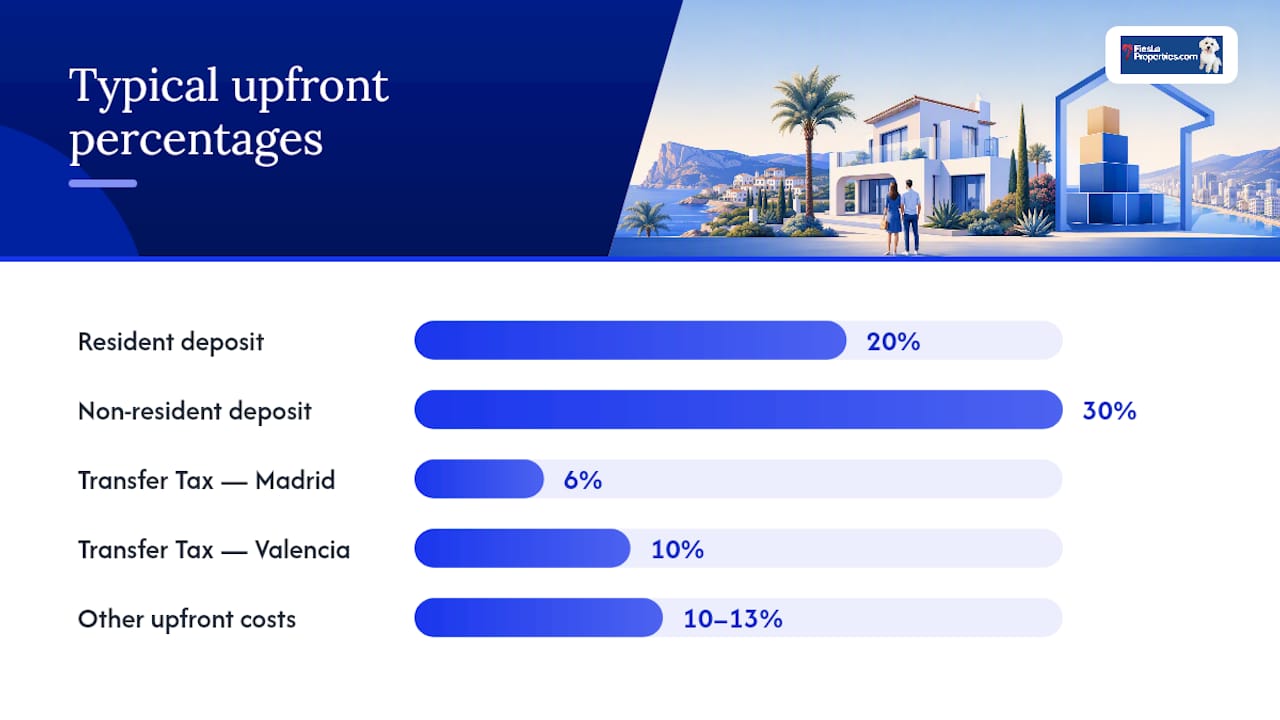
Altogether, upfront costs beyond the deposit commonly run to around 10–13% of the purchase price. With housing prices up 12.8% year on year nationally as of late 2025, that percentage is being applied to a rising base, which makes early budgeting more important than ever.
Documents you’ll typically need ready for fees and valuation:
- Signed reservation or private purchase contract
- NIE (foreigner identification number) for non-Spanish buyers
- Proof of funds for the deposit and taxes
- Bank valuation report once the property is agreed
How to use a mortgage calculator: inputs and a worked example
A calculator is only as good as the inputs you feed it. Get these ready before you start:
- Purchase price or target budget
- Net annual income (after tax, not gross)
- Monthly outgoings and existing debt repayments
- Mortgage term in years
- Interest rate assumption (fixed, variable or mixed)
- Expected LTV based on residency status
- Region, since it determines your ITP or IVA rate
The calculation runs in a fixed order. That figure gets converted back into a loan principal, using your chosen term and interest rate. Finally, the LTV ceiling determines the maximum property price that principal will support.
| Scenario change | Effect on max loan |
|---|---|
| Base case (3% rate) | ≈ €175,000 |
| Rate +0.5% (3.48%) | ≈ €167,000 |
| Term +5 years (30 years) | ≈ €174,900 |
| Deposit 10% larger | Property price ceiling rises, loan need falls |
Small rate or term changes move the numbers meaningfully, which is exactly why running a few scenarios matters more than trusting a single output.
Practical steps to improve borrowing capacity or lower monthly costs
Affordability isn’t fixed the day you start looking. Several levers can shift the numbers before you even speak to a bank.
- Pay down or consolidate existing debts, since every commitment eats into your DTI ceiling
- Save a larger deposit; it raises the property price a given loan can reach and often unlocks better rates
- Consider a longer term or a fixed rate to reduce short-term payment risk, even if it costs more in total interest
- Gather strong, translated documentation early if your income comes from abroad, since incomplete paperwork slows or weakens applications
- Compare offers across several banks rather than accepting the first quote, since the non-resident rate premium can run 0.2–0.5 percentage points and varies by lender
Pro Tip: Don’t try to time Euribor or fixed-rate cycles. Lock in a rate you can comfortably afford today rather than gambling on a better rate arriving before your reservation deposit expires.
How to apply in practice: documents, timeline and lender conditions
Once you’ve identified a property, the application process follows a fairly predictable path, though non-residents face extra steps.
Every applicant needs proof of identity (NIE for foreigners), recent payslips or tax returns, bank statements from the last three to six months, an employment contract or business accounts, and eventually a bank valuation of the property. Non-residents should expect to provide translated and officially attested versions of foreign documents, and most banks will require a Spanish bank account before completion, even if not before approval.
From pre-approval to completion typically takes six to twelve weeks, depending on how quickly documentation arrives and how busy the bank’s valuation team is. Common lender conditions include a maximum age at the end of the mortgage term (often 70 to 75) and a requirement to take out life or home insurance through the bank.
Before speaking to a broker or bank, prepare:
- A clear budget range including upfront costs, not just the loan
- Three to six months of bank statements
- Proof of income (payslips, tax returns, or audited accounts)
- Your NIE number, if you don’t already have one
Fiesta Properties’ perspective on modelling affordability in Costa Blanca
Buyers rarely arrive with a single number in mind. They arrive with a savings figure, an income figure, and a vague sense of what “affordable” means in a market they don’t fully understand yet. Fiesta Properties works through that gap daily, matching buyers against a portfolio of over 3,000 properties across new-build, key-ready, and resale stock, so the affordability conversation happens against real listings, not theoretical ranges.
The pattern in Costa Blanca is consistent: deposit shortfalls, not income, sink more purchases than anything else, and regional tax differences catch out buyers who assumed rates were the same everywhere in Spain. A personalised affordability check, run against actual stock, tends to surface these issues early rather than at the notary’s desk.
How Fiesta Properties helps you find property that fits your budget
A mortgage calculator tells you the ceiling. It doesn’t tell you which villas, apartments, or new-build developments in Costa Blanca actually sit within that ceiling once local taxes and fees are factored in, and that’s the gap Fiesta Properties closes.

Fiesta Properties has spent over a decade matching buyers to property across Costa Blanca and Murcia, drawing on an extensive network of key-ready, off-plan, and second-hand listings. Rather than working from a spreadsheet estimate, you get matched against live inventory, with guidance on how regional ITP rates, notary costs, and agency fees will actually affect your total cash needed. That combination of local market knowledge and a wide portfolio means less time chasing properties that turn out to be outside your real budget once the fees are added up.
If you’ve worked through the numbers above and want to see what actually fits, start with the property search tool to browse listings within your calculated range, or read through the buying process guide to understand what happens after you find the right one.
Why the standard affordability advice misses the real problem
Most affordability guides fixate on interest rates, and rates matter, but they’re rarely what actually stops a purchase in Costa Blanca. I’d argue the sector has trained buyers to obsess over the wrong number.
Income-based DTI calculations are straightforward and banks are transparent about them. What catches people out is the upfront cash stack: deposit, ITP or IVA, notary, registry, and agency fees, all due at once, all in a currency and tax system that’s unfamiliar to most non-resident buyers.
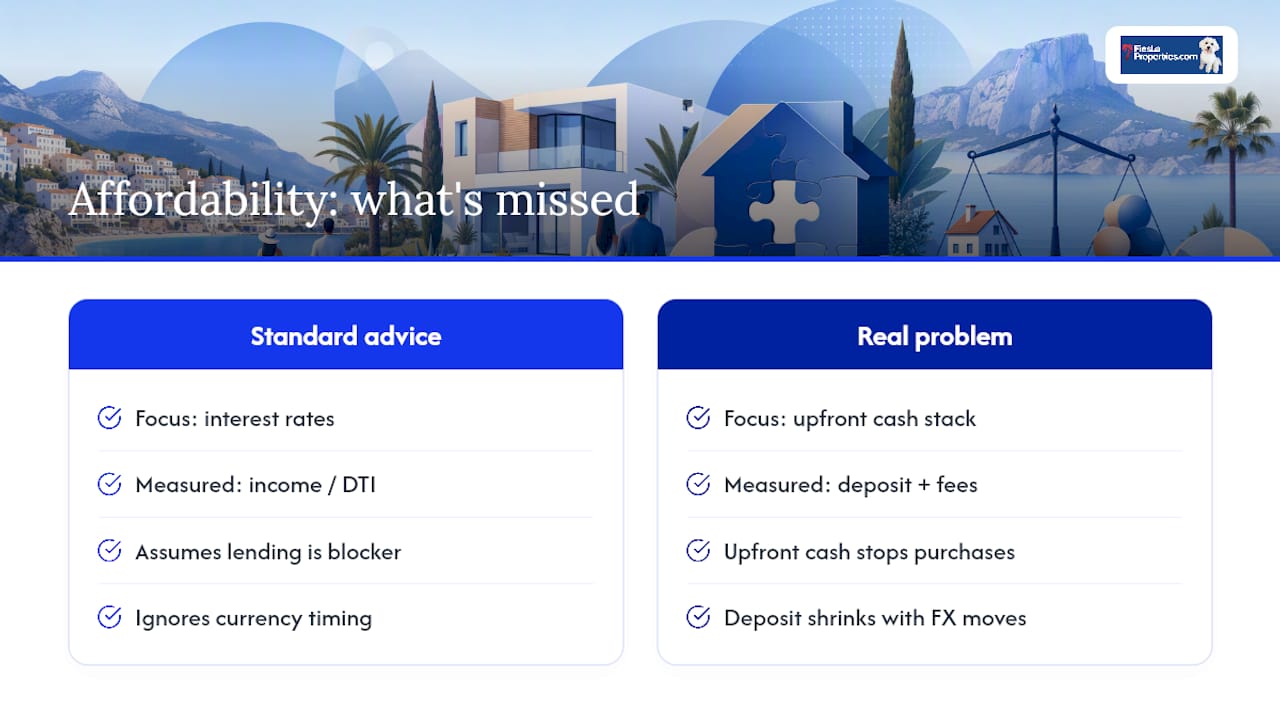
The other blind spot is exchange rate exposure. A UK or Scandinavian buyer converting savings into euros over several months can watch their effective deposit shrink by several percentage points without ever missing a mortgage payment. That’s not a lending problem. It’s a currency timing problem, and it deserves as much attention in the planning stage as the interest rate does.
Genuine affordability planning means running the numbers on cash, not just income, and building in a buffer for currency movement before you commit to a reservation deposit you can’t get back.
— Mike
This article is general information, not a substitute for advice from a qualified financial advisor. Consult a qualified financial professional about your own circumstances before acting on anything here.
Sources
Rate and price assumptions in this guide draw on INE’s mortgage statistics for May 2026, which track average lending rates and loan sizes nationally, and the Bank of Spain’s published mortgage rate series, a longer-run benchmark for comparing bank offers. For context on price pressure, INE’s Housing Price Index tracks year-on-year movement across regions. On the policy side, CaixaBank Research’s analysis of affordable housing supply sets today’s lending conditions against Spain’s broader housing shortage.