





Buying property on the Costa Blanca is genuinely achievable for UK and international buyers, and the process is more straightforward than many expect, provided you prepare the right paperwork and budget accurately from the start. The single most important first step is obtaining a Spanish tax identification number (NIE), opening a Spanish bank account, and instructing an independent Spanish lawyer before you sign anything. On the cost side, budget for roughly 10–11% above the asking price on a resale purchase after 1 June 2026, when the Comunitat Valenciana’s reduced ITP rate of 9% came into effect for properties up to €1,000,000.
On a €400,000 resale property, that means setting aside roughly €40,000 on top of the purchase price to cover all taxes and professional fees. The three immediate actions before viewing a single property:
- Obtain your NIE (Número de Identificación de Extranjero) via a Spanish consulate in the UK or in person in Spain.
- Open a Spanish bank account, which is required to pay taxes and set up utility direct debits.
- Instruct an independent Spanish lawyer or gestor who acts solely for you, not for the seller or agent.
Expect the full process from offer to registration to take between two and four months for a resale purchase, and four to eighteen months for an off-plan new build.
Key takeaways
Buying property on the Costa Blanca is achievable for UK buyers who budget accurately, obtain the NIE early, and instruct an independent solicitor before signing anything.
| Point | Details |
|---|---|
| Budget for 10–11% extra | On a €400,000 resale, transaction costs add roughly €40,000 on top of the asking price. |
| ITP cut from 1 June 2026 | Resale properties up to €1,000,000 now attract ITP at 9%, reducing the tax burden for buyers who complete after that date. |
| NIE and bank account first | Both are legal prerequisites for completing a purchase; apply for the NIE via the Spanish consulate before your first viewing trip. |
| Instruct an independent solicitor | Due diligence must cover the nota simple, community debts, planning licences, and energy certificate before contracts are signed. |
| Fiestaproperties as local partner | The agency provides property search, viewing logistics, negotiation support, and professional introductions across the Costa Blanca. |
Table of Contents
- Which towns on the Costa Blanca suit different buyer types?
- What does the 2026 Costa Blanca property market look like?
- What are the full purchase costs on the Costa Blanca?
- How do mortgages work for UK buyers after Brexit?
- What is the step-by-step buying process on the Costa Blanca?
- What legal checks should you carry out before buying?
- How should you plan viewings and make an offer?
- What are the ongoing costs of owning property on the Costa Blanca?
- How does Fiestaproperties help at each stage of the purchase?
- What buyers get wrong, and three things to do differently
- Fiestaproperties: finding your Costa Blanca property with confidence
- Sources
Which towns on the Costa Blanca suit different buyer types?
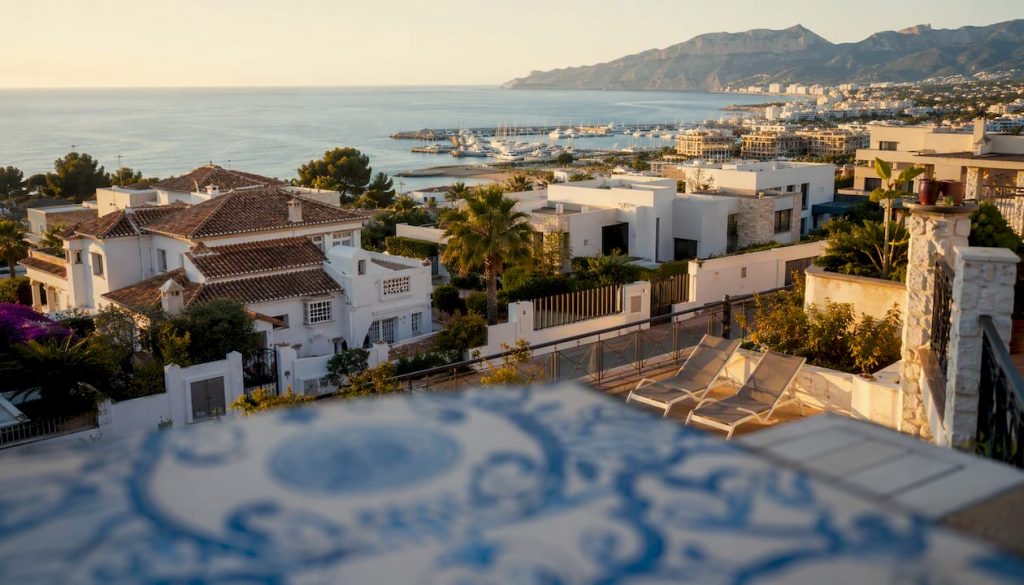
The Costa Blanca stretches roughly 200 kilometres along the Alicante province coastline, and the character of the north and south differs considerably. The northern stretch, from Dénia down to Calpe, tends to attract buyers seeking quieter, higher-quality micro-locations with a more European feel, often described as a premium alternative to the Costa del Sol for those who value authenticity alongside good infrastructure. The southern section, from Benidorm down through Torrevieja and Orihuela Costa, offers a wider range of price points, larger expat communities, and stronger rental yields for investors.
Northern Costa Blanca
Jávea (Xàbia) draws families and semi-permanent residents who want a genuinely Spanish town with good international schools, a sheltered bay, and a mix of traditional townhouses and modern villas. Prices reflect that demand, with prime areas reaching €4,753/m² and the broader range sitting between €3,279 and €4,753/m².
Moraira is smaller, quieter, and consistently popular with buyers who want privacy and quality over convenience. The marina and boutique restaurants give it a refined atmosphere, and prices typically range from €2,500 to €4,500/m².
Dénia offers a working Spanish town with a ferry connection to Ibiza and Mallorca, a large old town, and a broader price range that suits both lifestyle buyers and those seeking rental income. It tends to attract a slightly younger demographic than Moraira.
Calpe sits between the two in character, with the dramatic Peñón de Ifach rock as its landmark. It has a good mix of resale apartments and new-build developments, making it accessible for buyers at a mid-range budget.
Southern Costa Blanca
Benidorm is primarily an investor and holiday-rental market. Yields can be strong given the volume of tourism, but the environment is urban and high-rise, which suits some buyers and not others.
Torrevieja and the surrounding salt lake area offer some of the most affordable coastal property on the entire Spanish Mediterranean. It has a large British and Northern European community, good amenities, and strong rental demand from long-stay winter visitors.
Orihuela Costa (including Cabo Roig, Villamartín, and La Zenia) is a sprawling residential area with a high concentration of new-build developments, golf courses, and established expat infrastructure. It suits retirees and families who want space, a community feel, and easy access to Alicante airport.
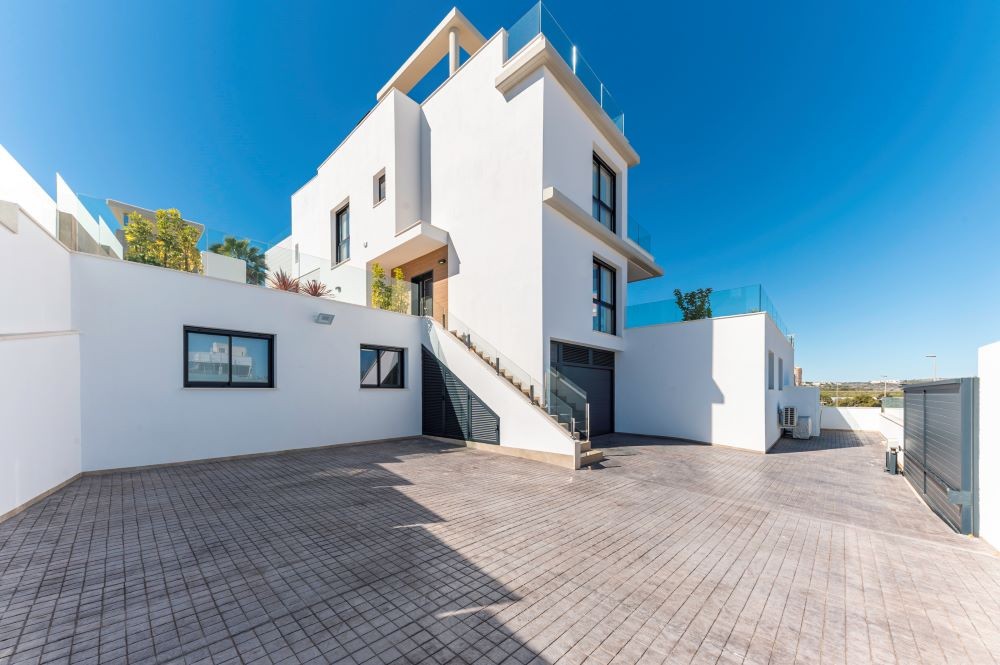
Alicante city itself is increasingly popular with buyers who want urban living, excellent transport links, and a genuine Spanish city experience, often at lower prices per square metre than the coastal resorts.
What does the 2026 Costa Blanca property market look like?
The Costa Blanca real estate market in 2026 is characterised by strong demand from international buyers and a wide inventory of both new-build and resale stock. Idealista currently lists over 37,000 properties for sale across the region, spanning everything from studio apartments to large villas, which gives buyers genuine choice but also means local price dispersion is significant. A property in Moraira and one in Torrevieja can differ by more than €2,000/m² despite being in the same province.
Foreign buyers account for a significant share of property transactions on the Costa Blanca, with British buyers represent a notable portion of purchasers in Alicante province. That sustained international demand has supported price growth across the region, particularly in the northern towns where supply of quality stock is more constrained.
Key market trends for 2026:
- Prime northern micro-locations (Jávea, Moraira) are forecasting price growth of 6–12% for 2026, driven by limited supply and continued foreign demand.
- New-build completions in Orihuela Costa and Torrevieja are adding supply in the south, moderating price growth there.
- The ITP reduction to 9% from 1 June 2026 is a meaningful market catalyst, reducing the tax burden on resale buyers and likely stimulating transaction volumes in the second half of 2026.
- Sterling/euro exchange rate movements remain a genuine variable for UK buyers; a 5% shift in the rate on a €300,000 purchase represents approximately £13,000–£15,000 in sterling terms.
The 1 June 2026 ITP reform is the single most significant tax event for resale buyers in recent years. Purchasing after that date at the 9% rate rather than the previous 10% saves €4,000 on a €400,000 property, and the saving scales with the purchase price up to the €1,000,000 threshold.
What are the full purchase costs on the Costa Blanca?
Transaction costs are the area where buyers most commonly underestimate their total outlay. Advisers consistently flag that mandatory costs add more than 10% to the final purchase price, and the precise figure depends on whether the property is a resale or a new build.
Resale purchase costs (post-1 June 2026)
New-build purchase costs
Worked example: €400,000 resale purchase (post-1 June 2026)
The percentage uplift in this example is approximately 10.04%, consistent with the 10–11% rule of thumb for resale purchases.
Pro Tip: The ITP liability is calculated on the date the notarial deed (escritura) is signed, not the date of the private contract. Confirm this timing with your solicitor, as it can represent a meaningful saving on higher-value purchases.
How do mortgages work for UK buyers after Brexit?
UK buyers are treated as non-residents for Spanish mortgage purposes post-Brexit, which affects both the loan-to-value ratio available and the documentation required. Spanish banks and specialist lenders remain willing to lend to non-residents, but the terms differ from those available to Spanish residents.
Typical non-resident mortgage conditions:
- Loan-to-value (LTV) of 60–70% of the lower of the purchase price or bank valuation, meaning a deposit of 30–40% is standard.
- For new-build purchases, some developers offer stage-payment structures that reduce the immediate cash requirement, though the mortgage still applies to the completed property.
- Interest rates are typically variable (linked to Euribor) or fixed for an initial period; fixed-rate products have become more common since 2022.
The documents most lenders require from UK buyers include:
- Valid passport and NIE number.
- Last two to three years of tax returns (SA302 or P60 for employed buyers).
- Three to six months of bank statements.
- Proof of employment or self-employment income (payslips, accounts).
- Details of any existing mortgages or financial commitments.
Obtaining an NIE and a Spanish bank account are prerequisites for completing a mortgage, and both should be arranged well before the mortgage application is submitted. UK buyers transferring funds from sterling to euros for the deposit or purchase price should consider using a specialist currency broker rather than a high-street bank, as exchange rate margins on large transfers can be significant. A forward contract, which locks in a rate for a future transfer, can protect against adverse sterling/euro movements during the conveyancing period.
What is the step-by-step buying process on the Costa Blanca?
The purchase process in Spain follows a clear sequence, and understanding each stage helps buyers avoid delays and unexpected costs.
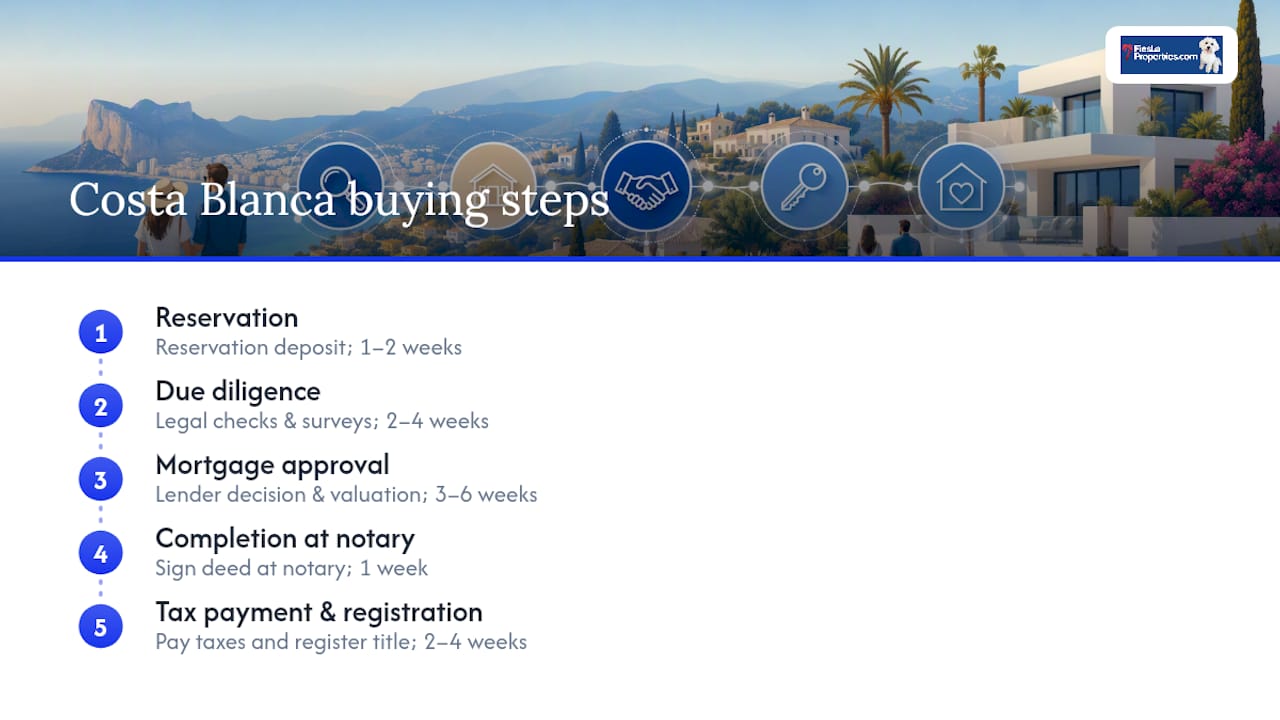
Stage 1: Reservation and offer (Week 1–2)
Once a buyer identifies a property, a reservation agreement (contrato de reserva) is signed and a deposit, typically €3,000–€6,000, is paid to take the property off the market. This is refundable if due diligence reveals a problem, but the terms vary, so read the agreement carefully before signing.
Stage 2: Due diligence and private contract (Weeks 2–6)
The solicitor conducts searches: obtaining the nota simple from the land registry, checking for debts, charges, planning permissions, community fee arrears, and the energy performance certificate. At this stage, if the buyer withdraws without legal cause, the deposit is forfeited; if the seller withdraws, they must return double the deposit.
Stage 3: Mortgage approval (Weeks 4–10, if applicable)
If financing is required, the mortgage application runs in parallel with due diligence. Spanish lenders typically take four to eight weeks to issue a formal mortgage offer, and a binding offer (FEIN) must be provided at least ten days before signing the deed.
Stage 4: Completion at the notary (Weeks 8–16)
Both parties (or their legal representatives with power of attorney) attend the notary to sign the escritura pública. The balance of the purchase price is paid, typically by banker’s draft or bank transfer. The notary registers the deed provisionally, and the buyer receives the keys.
Stage 5: Tax payment and registration (Weeks 16–20)
The solicitor or gestor submits the ITP or VAT/AJD return and pays the tax within thirty days of the deed. The title is then registered at the land registry in the buyer’s name. Utility contracts and community fees are transferred to the new owner.
Documents required at completion include the NIE, passport, proof of funds, and the signed mortgage deed if applicable. Power of attorney is strongly recommended for UK buyers who cannot attend the notary in person.
What legal checks should you carry out before buying?
Due diligence on a Spanish property covers more ground than a typical UK conveyancing search, and professional guidance consistently identifies bureaucratic friction and unresolved legal issues as common risks for foreign buyers. An independent solicitor, not one recommended solely by the selling agent, is the appropriate professional to conduct these checks.
The core due-diligence checklist:
- Nota simple: The land registry extract confirming ownership, description, and any charges or mortgages registered against the property.
- Community debts: Request a certificate from the community of owners (comunidad de propietarios) confirming no arrears; unpaid community fees transfer to the new owner.
- Planning permissions and licences: Confirm the property has a valid first occupation licence (licencia de primera ocupación or cédula de habitabilidad), particularly for new builds and rural properties.
- Energy performance certificate (EPC): Required by law for all sales; the rating affects running costs and, for rental properties, future lettability.
- Comprobación de obra: Check that any extensions or alterations are legally registered and match the land registry description; undeclared works can create problems at resale.
- Modelo 211 retention: On resale purchases from a non-resident seller, the buyer must withhold 3% of the purchase price and pay it to the Spanish tax authority (Agencia Tributaria) on the seller’s behalf.
Red flags to watch for include a nota simple that does not match the advertised description (different floor area, undeclared outbuildings), a property without a first occupation licence, community fee arrears that the seller is unwilling to settle before completion, and any outstanding mortgage that has not been formally cancelled at the registry.
When instructing a solicitor, ask directly: Do you act exclusively for buyers? What searches do you carry out as standard? What is your fee, and does it include tax submission? A clear, written engagement letter with a fixed or capped fee is standard practice with reputable firms.
How should you plan viewings and make an offer?
A well-planned viewing trip saves time and gives a much clearer picture of a property than photographs alone. The optimal time to visit the Costa Blanca for viewings is spring (March to May) or early autumn (September to October), when the weather is representative of the living experience without the peak-summer crowds that can distort a neighbourhood’s character.
Practical logistics for a viewing trip:
- Hire a car; public transport between coastal towns is limited, and distances between properties add up quickly.
- Allow at least two full days per shortlisted area, not just per property; walking the neighbourhood at different times of day reveals noise levels, parking, and local amenities.
- Bring a trusted companion or, for serious candidates, a professional building inspector who can assess structural condition, damp, and plumbing independently of the selling agent.
On the property itself, check the orientation (south-facing terraces are significantly more pleasant in winter), the condition of the roof and external walls, any signs of damp or water ingress around windows and ground-floor walls, the age and condition of the boiler and air-conditioning units, and the state of communal areas if the property is in a development. Ask the agent for the last three years of community fee receipts and the most recent AGM minutes, which often reveal planned expenditure or disputes.
Offers on the Costa Blanca are typically made verbally through the agent and then confirmed in writing with the reservation agreement. There is no standard percentage below asking price that is universally accepted; in the current market, well-priced properties in prime northern locations are selling close to asking price, while properties that have been listed for several months in the south often have more room for negotiation. A reservation deposit of €3,000–€6,000 is standard to secure the property while due diligence is completed.
What are the ongoing costs of owning property on the Costa Blanca?
Ownership costs beyond the purchase itself are a regular source of surprise for buyers who have not budgeted for them. The main annual obligations are:
Non-resident owners who do not let the property still pay Modelo 210 (IRNR) annually, calculated on an imputed rental income based on the cadastral value. This is a commonly overlooked obligation that advisers flag as a source of unexpected tax liability.
If the property is let as a tourist rental, a tourist licence (licencia turística) is required from the relevant regional or municipal authority before advertising on any platform. The rules vary by municipality; some areas of Alicante province have introduced restrictions on new licences, so checking availability before purchase is advisable if rental income is part of the plan. Rental income is taxable in Spain, and non-resident landlords must file quarterly Modelo 210 returns declaring that income.
Practical handover tips: transfer utility contracts into the new owner’s name on the day of completion, set up direct debits for IBI and community fees through the Spanish bank account, and register with the community administrator so that AGM notices and maintenance updates are received promptly.
How does Fiestaproperties help at each stage of the purchase?
Fiestaproperties has been operating on the Costa Blanca since 2010, with a focus on both new-build developments and resale properties across the region. The agency’s role in a transaction goes beyond simply matching buyers to listings.
The practical services Fiestaproperties provides at each stage:
- Property search and shortlisting: Access to over 3,000 properties across the network, including off-plan, key-ready, and second-hand stock, with filtering by area, budget, and property type.
- Viewing logistics: Coordinating viewing trips, including scheduling multiple properties across different towns efficiently and providing local context that online listings cannot convey.
- Negotiation support: Advising on realistic offer levels based on current market conditions and comparable sales, and managing the offer process with the seller’s side.
- Professional network: Introductions to independent solicitors, gestors, currency specialists, and mortgage brokers who work regularly with international buyers.
- Post-sale handover: Assistance with utility transfers, community registration, and connecting buyers with local service providers after completion.
To illustrate the practical value: a buyer relocating from the UK shortlisted six properties across Jávea and Orihuela Costa. Fiestaproperties coordinated a two-day viewing trip, identified a planning discrepancy on one property before the reservation deposit was paid, and introduced the buyer to a solicitor who resolved a community debt issue before contracts were exchanged. The purchase completed within fourteen weeks.
Buyers who enquire with Fiestaproperties can expect an initial conversation to establish budget, preferred areas, and timeline, followed by a curated shortlist of relevant properties. There is no obligation at that stage, and the agency’s fee is paid by the seller on completion, not by the buyer.
What buyers get wrong, and three things to do differently
The most common mistake buyers make on the Costa Blanca is treating the asking price as the total cost. It is not, and the gap between the asking price and the full cash outlay catches people out repeatedly, particularly those who have set a budget in sterling without accounting for transaction taxes, professional fees, and currency movement.
Three practical pieces of advice worth applying immediately:
Get the NIE before you fall in love with a property. The NIE application takes time, and without it, you cannot sign a contract, open a bank account, or pay taxes. Applying through the Spanish consulate in the UK before your first viewing trip means you arrive ready to act, not scrambling to catch up.
Instruct your own solicitor before the agent suggests one. Agents often have relationships with local law firms, and while those firms may be perfectly competent, their primary relationship is with the agent, not with you. An independently sourced solicitor, one you have chosen yourself based on recommendation or research, owes their duty entirely to your interests.
Do not underestimate the currency timing. Sterling/euro movements during a conveyancing period of two to four months can shift the effective cost of a purchase by thousands of pounds. A specialist currency broker, used at the point of signing the private contract, can lock in a rate and remove that uncertainty entirely.
Fiestaproperties: finding your Costa Blanca property with confidence
For buyers who want a knowledgeable local partner rather than navigating the Costa Blanca market alone, Fiestaproperties offers a practical starting point. The agency’s inventory spans new-build developments and resale properties across the full length of the coast, from the quieter northern towns to the more accessible southern resorts, with listings at a range of price points suited to different buyer profiles.
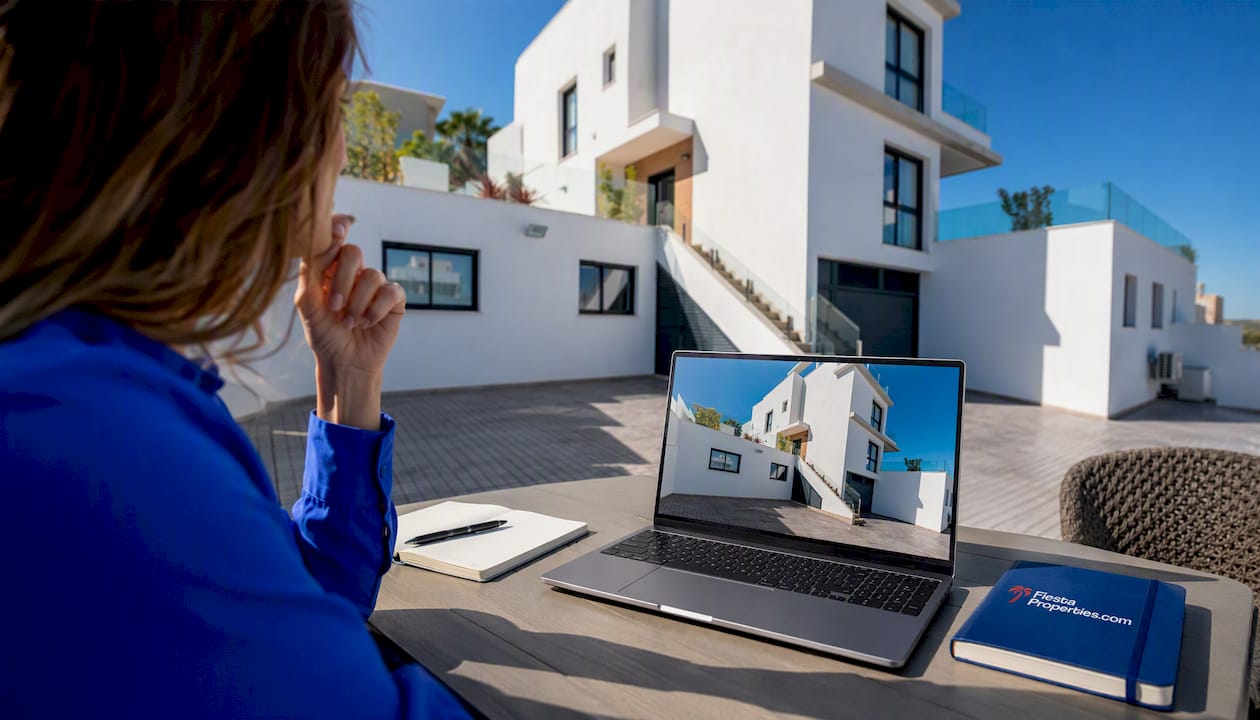
The first step is a straightforward conversation: buyers outline their budget, preferred area, and timeline, and Fiestaproperties puts together a relevant shortlist from across its network. For buyers who want to see what is currently available, a six-bedroom villa in Orihuela Costa gives a concrete example of the kind of property on offer in the southern Costa Blanca. To begin the search or ask a specific question about the buying process, visit Fiestaproperties and get in touch directly.
This article is general information, not a substitute for advice from a qualified financial advisor. Consult a qualified financial professional about your own circumstances before acting on anything here.