






If you own property in Spain or receive income from a Spanish source but live elsewhere for most of the year, you almost certainly owe Spanish non-resident income tax, known as IRNR, and must file it using Form 210. This applies to owners of empty or let holiday homes, sellers of Spanish property, and anyone receiving dividends, interest or rental payments from Spain. Before doing anything else, check the 183-day residency test, confirm you have a NIE or NIF number, and establish whether your property is let out or kept for personal use, since that single distinction changes how the tax is calculated.
-
Confirm your residency status against the 183-day rule
-
Check whether your property counts as let or owner-used
-
Get your NIE/NIF sorted before any filing deadline approaches
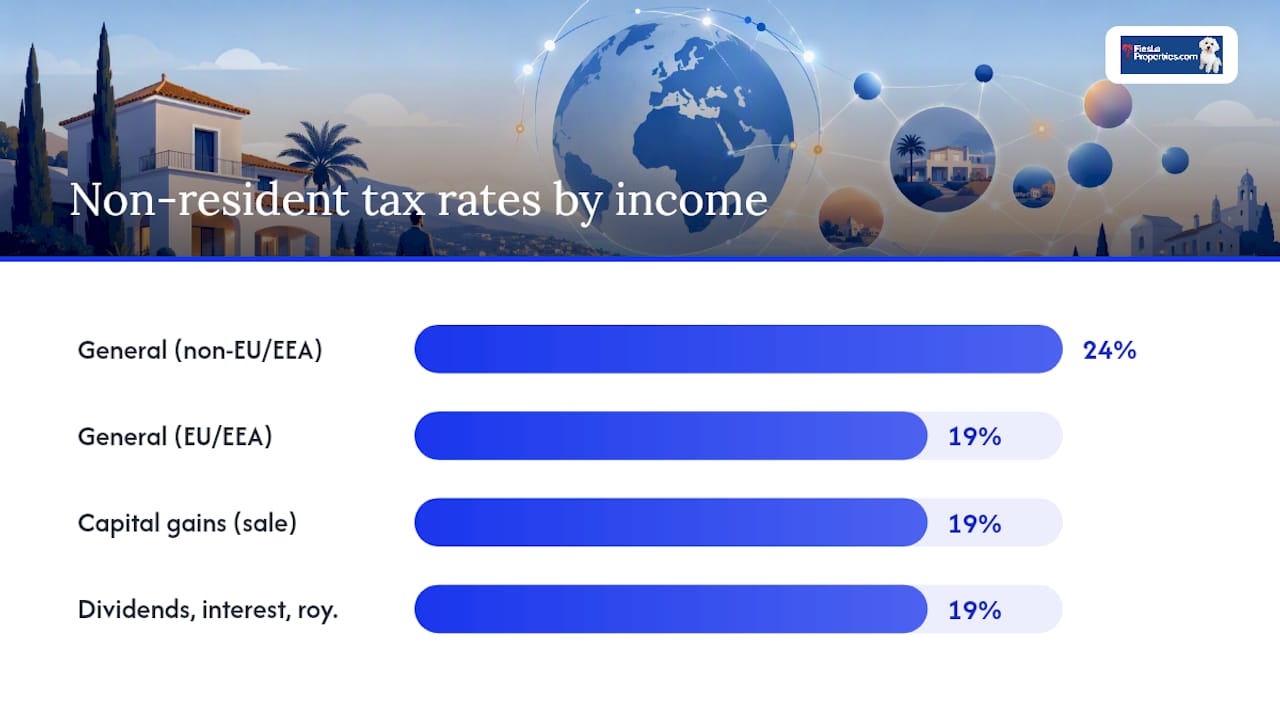
Quick fact: non-EU/EEA residents pay a general IRNR rate of 24%, while EU/EEA residents with effective information exchange arrangements pay 19% on the same income.
Key Takeaways
| Point | Details |
|---|---|
| Check residency first | Apply the 183-day, centre-of-interests and family tests before assuming non-resident status. |
| Know your rate | EU/EEA residents pay 19%, others pay 24%, on most Spanish-source income. |
| File Form 210 correctly | Use it for imputed income, rental returns and capital gains, with deadlines varying by type. |
| Expect 3% withholding on sale | Buyers withhold 3% of the price, and sellers must file to settle or reclaim the difference. |
| Get local support | Fiesta Properties can connect buyers and sellers with trusted gestores for filing help alongside a purchase or sale. |
Table of Contents
What is non-resident tax in Spain and when does it apply?
The Impuesto sobre la Renta de No Residentes, or IRNR, taxes only income that originates within Spanish territory. Unlike resident income tax (IRPF), which taxes worldwide earnings, IRNR has a narrow scope: it only reaches money made or property held inside Spain. The Tax Agency’s guidance for non-residents sets out the framework, and it uses several forms depending on the situation, chiefly Form 210, alongside 211, 213 and 216 for specific circumstances such as withholding on property purchases or non-resident entities.
Common triggers for IRNR liability include:
-
Owning a Spanish property that sits empty for part or all of the year (the tax authorities assume you benefit from it, even unused)
-
Letting a holiday home to tourists or long-term tenants
-
Selling a Spanish property, which crystallises a capital gain
-
Receiving dividends, interest or royalties paid by a Spanish company or fund
-
Earning income from work physically carried out in Spain
A British couple with a closed-up apartment near Alicante that they visit twice a year still owes tax on it, even without a single night let out. That surprises a lot of first-time owners.
How does Spain decide who counts as a tax resident?
Spain applies three separate tests, and meeting just one is enough to make you tax resident for the entire year. The first and most cited is the 183-day rule: spend more than 183 days in Spain during a calendar year, counting sporadic absences unless you can prove tax residency elsewhere, and you are resident. Short trips abroad do not reset the clock.
The second test looks at where your main economic interests sit, meaning where the bulk of your income arises or your assets are based, even if you are physically present in Spain for fewer than 183 days. The third is a family presumption: if your spouse and dependent minor children live in Spain, tax authorities will presume you are resident too, unless you can rebut it.
Crucially, the Tax Agency treats residency as an all-or-nothing status for the whole calendar year. You cannot be resident for six months and non-resident for the other six; the classification applies retroactively to 1 January once the threshold is crossed. A certificate of tax residence from your home country’s authority is the standard way to prove you belong there instead.
Pro Tip: Keep a simple travel log with flight tickets, boarding passes and hotel receipts. If the Tax Agency ever questions your day count, contemporaneous records carry far more weight than a reconstructed estimate months later.
Which income types are taxed and at what rates?
Rates depend heavily on where you are resident and what kind of income you receive. The table below sets out the headline figures that apply most often to property owners and investors.
| Income type | Rate | Notes |
|---|---|---|
| General income (non-EU/EEA resident) | 24% | Applies to most Spanish-source income without a specific lower rate |
| General income (EU/EEA resident) | 19% | Requires effective exchange of tax information with Spain |
| Capital gains on property sale | 19% | Applies regardless of residence within EU/EEA or otherwise for most gains |
| Dividends, interest, royalties | 19% | Double taxation treaties can reduce withholding further |
Owners who leave a property empty face a separate charge called imputed income. It is calculated by applying 1.1% to the cadastral value if that value was revised within the last decade, or 2% if it was not, with the resulting figure then taxed at the standard IRNR rate.
EU/EEA residents can generally deduct expenses directly tied to earning rental income, something non-EU owners historically could not do. Recent administrative decisions covering 2024 to 2026 have started to widen deductible expenses for certain non-EU owners and clarify when the optional 19% regime applies, so it is worth checking your specific case against current guidance rather than assuming the old rules still hold.
Form 210 and other filings: who files, when and how
Form 210 is the workhorse of non-resident taxation, used for imputed income declarations, rental income returns and capital gains from property sales. The AEAT’s dedicated guidance for income without a permanent establishment explains taxable base calculation and withholding in detail. Related forms cover narrower cases: Form 211 relates to withholding on property purchases from non-residents, Form 213 applies to certain non-resident entities holding Spanish property, and Form 216 covers withholding by payers of specific income types.
Deadlines vary by income type:
-
Imputed income on unused property: file by 31 December of the year following the tax year
-
Rental income: quarterly filing windows, generally within 20 days of each quarter’s end
-
Capital gains on a sale: within four months of the transaction completing
A practical filing checklist looks like this:
-
Obtain your NIE or NIF if you do not already have one
-
Gather the property’s cadastral value from the annual IBI receipt
-
Calculate the taxable base for imputed income or actual rental profit
-
Pay the liability or confirm any withholding already applied
-
Submit electronically through the Agencia Tributaria portal or via a gestor
Keep title deeds, the sale deed where relevant, and receipts for any deductible expenses on file, since the tax authority can request evidence well after the filing date.
How is owning property taxed: imputed income versus rental
Two very different regimes apply depending on how you use your Spanish property, and mixing them up is one of the most common mistakes non-resident owners make.
For a property left empty, imputed income is calculated on the cadastral value, applying 1.1% or 2% depending on when that value was last revised; the result is then taxed at 19% or 24%. A villa with a €300,000 cadastral value revised within the past decade generates imputed income taxable at the applicable rate, resulting in a tax liability that differs depending on residency status.

Rental income works differently. EU/EEA residents are taxed on net income after deducting genuine costs such as agency fees, repairs and mortgage interest tied to the letting. Non-EU owners have traditionally been taxed on gross rental receipts, though as noted above, some recent rulings are chipping away at that gap. Either way, IBI, the annual council property tax, remains payable regardless of your IRNR position and sits entirely separate from it; for a broader view on property taxes, see Property Taxes in Italy | Living Italy.
Pro Tip: If you let your property through a platform, check its local tourist licence registration rules before advertising. Unregistered short lets can trigger fines on top of any tax owed, and platforms increasingly share booking data with Spanish authorities.
Selling Spanish property: buyer withholding and capital gains
When a non-resident sells Spanish property, the buyer is legally required to withhold 3% of the purchase price and pay it directly to the Tax Agency on the seller’s behalf. That withholding acts as an advance payment against the seller’s eventual capital gains liability, not the final tax bill itself.
Costs that reduce the taxable gain include notary and land registry fees, documented improvement works, and the original acquisition tax paid when the property was bought.
-
File Form 210 within four months of completion
-
Deduct verified acquisition and improvement costs to lower the taxable gain
-
Claim back any excess withholding once the calculation is filed
Refunds typically take several months to process, so filing promptly with clean documentation speeds things up considerably.
How do you pay, and what happens if you miss a deadline?
Payment runs through the Agencia Tributaria’s online portal, via direct bank transfer, or through a gestor acting on your behalf, and every route requires your NIE or NIF as the reference identifier. The main deadlines to track are the quarterly rental return windows, the 31 December deadline for imputed income on unused property, and the four-month window after a property sale for capital gains.
Miss a deadline and you face a surcharge that increases the longer the delay runs, plus daily interest on unpaid amounts. Persistent non-payment can escalate to formal enforcement action, including charges against the property itself in serious cases. If you genuinely cannot pay on time, it is possible to request instalments through the tax authority rather than simply letting the debt accumulate.
Pro Tip: Register for the Agencia Tributaria’s online system well before your first deadline. The registration process alone can take a few days, and leaving it until the week a payment is due is a common, avoidable cause of late filing.
What practical steps reduce risk for non-resident owners?
Getting the paperwork right from day one saves far more time than untangling problems after the fact.
-
Apply for your NIE or NIF as early as possible
-
Open a Spanish non resident bank account to handle IBI, IRNR payments and utility bills. We at Fiesta Properties can help with that
-
Request the cadastral value from your local town hall or IBI receipt
-
Confirm whether any letting platform requires tourist licence registration
-
Keep a dated log of days spent in Spain for residency purposes
Pro Tip: A non-resident account opened with just your passport is often enough to get started, and you can later convert it to a resident account once your NIE comes through. Engaging a local gestor for Form 210 filings, particularly around a property sale, tends to pay for itself in avoided errors and faster refunds.
Author perspective: cautious, practical advice for non-resident owners
The mistake I see most often isn’t underpaying tax, it’s guessing at residency status instead of checking it properly. Verify the 183-day and centre-of-interests tests first, keep every receipt and cadastral document, and file Form 210 on time or hand it to a gestor if the calculation feels unclear. As someone who works alongside Fiesta Properties advising buyers through the practical side of Spanish ownership, I’d rather see readers spend an hour confirming their position now than months unwinding a penalty later.
How Fiesta Properties helps with the practical side of buying or selling
Fiesta Properties is the alternative to piecing together Spanish property administration alone, with over 3,000 listings across Costa Blanca and Murcia and local knowledge of exactly which paperwork buyers and sellers need at each stage. Whether you’re weighing up a new build purchase or preparing to sell and need to understand the buyer withholding process, our team can point you towards trusted local gestores who handle Form 210 and residency questions daily.

If you’re actively looking at property in the region, browse our properties for sale in Costa Blanca South or read through our buying process guide to see exactly how we support you from viewing through to completion, including introductions to advisers who can manage your non-resident tax filings alongside the purchase itself.
Frequently asked questions
Do I owe Spanish tax if my property sits empty all year? Yes. Empty properties are taxed on imputed income calculated from the cadastral value, even without a single day of letting or personal use.
What is the difference between IRNR and IRPF? IRNR applies to non-residents and only taxes Spanish-source income; IRPF applies to residents and taxes worldwide income.
Can I deduct rental expenses as a non-resident? EU/EEA residents can generally deduct genuine letting costs; non-EU owners have historically faced gross taxation, though recent rulings are narrowing that gap in some cases.
File Form 210 to calculate your real capital gain and claim a refund of the excess withheld amount.
Do I need a gestor to file Form 210? It is not compulsory, but many owners use one for property sales or complex rental situations to avoid calculation errors and missed deadlines.
This article is general information, not a substitute for advice from a qualified financial advisor. Consult a qualified financial professional about your own circumstances before acting on anything here.