






Most property prices in Spain carry genuine room for negotiation, typically anywhere from a few percentage points to twenty or more depending on how long a listing has sat on the market. Before naming a figure, secure an independent Spanish lawyer, gather proof of funds and your NIE, and pull together recent comparables. The contrato de arras, usually backed by a 10% deposit, is the binding step that follows a successful negotiation.
TL;DR:
Buyers should base their opening offer on recent comparable sales and adjust for property condition rather than relying on gut feeling.
A cash purchase can secure a discount of 3 to 5 percent on second hand property, as it removes financing risks and speeds up the process. On new build properties , you can get freebies, i.e white goods or air conditioning included in the price
The contrato de arras typically requires a 10 percent deposit, which grants the buyer a costed exit if they withdraw and penalizes the seller for withdrawal.
Having proof of funds, recent comparables, and legal representation lined up gives buyers a strong negotiating advantage in Spain.
Table of Contents
-
Contracts, deposits and red flags — what signing the arras actually means
-
Practical checklist and offer template outline you can use today
-
Publisher perspective: why Fiesta Properties recommends this approach
-
How Fiesta Properties can help you negotiate and complete the purchase
How offers and the negotiation sequence work in Spain
Negotiating a Spanish property purchase follows a fairly fixed sequence, and knowing where each stage sits helps you judge when to push and when to hold back.
-
Initial conversation with the agent — verbal interest, questions about flexibility, and an informal read on the seller’s motivation.
-
Written offer — figures, conditions, and a deadline, submitted through the agent or directly to the seller’s representative.
-
Reservation deposit — a modest sum that takes the property off the market while paperwork is checked.
-
Contrato de arras — the private purchase contract, commonly backed by a 10% deposit.
-
Escritura pública — the deed signed before a notary, who acts impartially and does not represent either party’s interests.
Your own lawyer, separate from the notary and the agent, is the only party whose sole job is protecting you, although Fiesta properties will give you a choice of lawyer and if you decide to use them, then there is no charge for legal fees. Timelines vary by finance route: cash purchases usually complete in 6 to 12 weeks, mortgage-backed purchases take 8 to 16 weeks, and off-plan developer purchases can run 12 to 24 months depending on construction progress.
Due diligence to complete before you make an offer
Skipping the checks below does not just risk your deposit. It weakens your negotiating hand, because sellers can tell when a buyer has not done the groundwork.
-
Order a nota simple from the Registro de la Propiedad and confirm the registered owner, any mortgages or liens, and the recorded surface area. This will be done by your lawyer
-
Check the Catastro’s valor de referencia, which sets a minimum tax base and gives useful context when comparing asking prices against official values.
-
Review community rules and, where relevant, whether a tourist rental licence applies to the property.
-
Obtain your NIE (foreigner’s tax identification number), open a Spanish bank account or confirm your existing IBAN is workable, and get mortgage pre-approval or a bank statement ready as proof of funds. This can also be done by your lawyer too
Pro Tip: Order the nota simple before you fall in love with a property, not after. It costs little, takes days, and can rule out homes with hidden debts before you waste time negotiating on them.
Setting your opening offer and expected negotiation margins
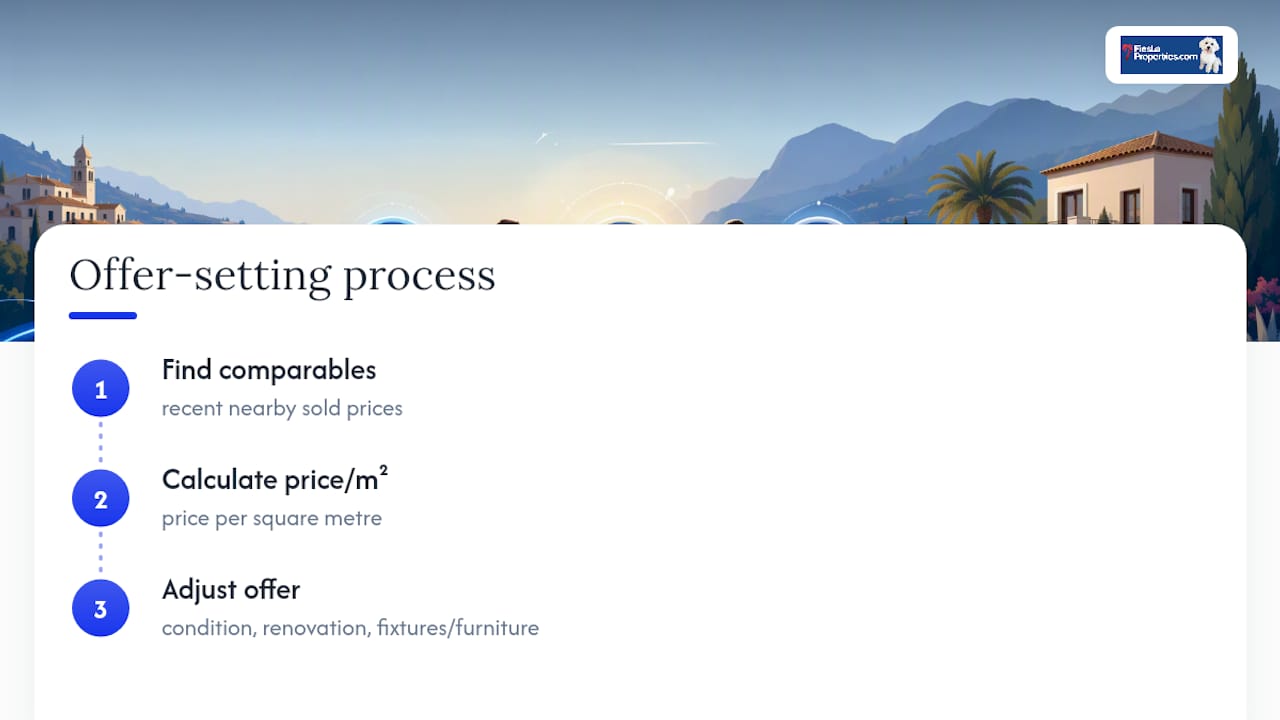
The right opening figure depends on how the property compares with recent sales, not on a gut feeling about what “feels fair.” Start by calculating the price per square metre from genuinely comparable, recently sold properties nearby, then adjust for condition, renovation costs, and whatever fixtures or furniture are included.
Cash offers or a short, clean completion window tend to strengthen your position because they remove the funding risk and chain delays that make sellers nervous. Cash buyers often secure discounts of 3 to 5% over buyers who still need mortgage approval, purely because the sale feels more certain.
Rules of thumb on realistic room vary sharply by situation:
These ranges reflect general market patterns rather than guarantees. A sought-after coastal villa in a tight local market can behave very differently from a rural finca that has sat unsold for a year. New-build developers rarely move much on headline price, so ask for furniture packages, upgraded fittings, or parking instead of a discount that will not be granted.
How to handle counter-offers and extract non-price value
A seller’s counter-offer tells you more than the number itself. A small counter, close to the asking price, signals limited room to move. A large counter, conceding a meaningful chunk of the gap, usually means there is more flexibility left to find.
Counter with intent rather than just splitting the difference evenly. Experienced negotiators open below their true target but not so low as to look dismissive, then move in calculated steps that lean towards their number. Using a specific, non-round figure, say €267,500 rather than €270,000, signals that your offer is based on genuine arithmetic rather than a guess.
Price is not the only lever available:
-
Furniture, white goods, and appliances can be added or removed to bridge a price gap.
-
A flexible or accelerated completion date sometimes matters more to a seller than a few thousand euros.
-
Who pays which notary or agency costs is negotiable in many transactions.
-
Fixtures such as air conditioning units, awnings, or built-in wardrobes are worth listing explicitly.
-
Deposit timing and size can be adjusted to suit both sides once the headline price is settled.
Contracts, deposits and red flags — what signing the arras actually means
Three distinct payments appear in a typical Spanish purchase, and confusing them is one of the costliest mistakes a buyer can make. A reserva is a small holding deposit that takes the property off the market while checks proceed. The contrato de arras follows once due diligence clears, and it commonly requires a 10% deposit payable within one month. The escritura is the final deed signed at the notary.
The arras penitenciales clause carries real financial teeth. If you, the buyer, pull out after signing, you forfeit the deposit outright. If the seller withdraws, they must return double the sum received. This is precisely why the contract deserves careful legal review before signature, not a quick skim.
-
Insist on seeing the nota simple before any money changes hands, this will always be done by a lawyer
-
Treat pressure for a verbal commitment, or reluctance to confirm details in writing, as a warning sign.
-
Watch for a shifting list of included fixtures between viewing and contract, which often signals a seller trying to claw back value informally.
-
If a seller resists a second inspection or delays sharing paperwork, be prepared to walk away rather than press ahead on trust alone.
A quick reality check: under Article 1454 of the Código Civil, the arras penitenciales mechanism exists specifically to give both sides a costed exit, which is why the deposit size and wording matter far more than most first-time buyers expect.
Practical checklist and offer template outline you can use today
A written offer travels faster and gets taken more seriously than a verbal number passed through an agent. Before you send one, confirm you have:
-
Recent comparables and how long the property has been listed.
-
Any price history or previous reductions on the listing.
-
The nota simple, or confirmation it is being ordered.
-
Proof of funds or a mortgage pre-approval letter.
-
Your own walk-away number, decided before emotion enters the room.
Build the offer itself around these elements:
-
The price, stated in both figures and words to avoid ambiguity.
-
Your deposit plan and proposed timeline to arras.
-
Evidence of proof of funds attached or referenced.
-
A firm deadline for acceptance, typically 48 to 72 hours.
-
Clear conditions, such as mortgage approval or a satisfactory nota simple and survey.
A tight deadline paired with clean conditions and solid evidence tends to force a faster, more honest answer than an open-ended offer ever will.
Publisher perspective: why Fiesta Properties recommends this approach
Since 2010, Fiesta Properties has guided buyers through more than 3,000 listings across Costa Blanca and Murcia, from resale flats to off-plan new builds. That range exposes a consistent pattern: buyers who arrive with comparables, proof of funds, and legal representation already lined up negotiate from strength, while those without it negotiate from hope, especially depending on the best areas to buy and local considerations.
— Mike
How Fiesta Properties can help you negotiate and complete the purchase
Fiesta Properties works as your negotiating partner from the first viewing through to the notary, not just a listings portal you browse alone. That means access to market comparables drawn from an inventory of over 3,000 properties, help preparing proof of funds so your offer is taken seriously, and introductions to independent lawyers who handle the nota simple and escrow properly.

Where other routes leave you negotiating blind against an agent who represents the seller, Fiesta Properties’ team sits on your side of the table, coordinating the paperwork, the timeline, and the counter-offers so nothing gets missed between arras and escritura. If you are weighing up a resale villa or an off-plan new build in Costa Blanca, start by requesting comparables for the area you have in mind through the property search tool, or book a viewing to talk through your target price and walk-away number before you put anything in writing.