




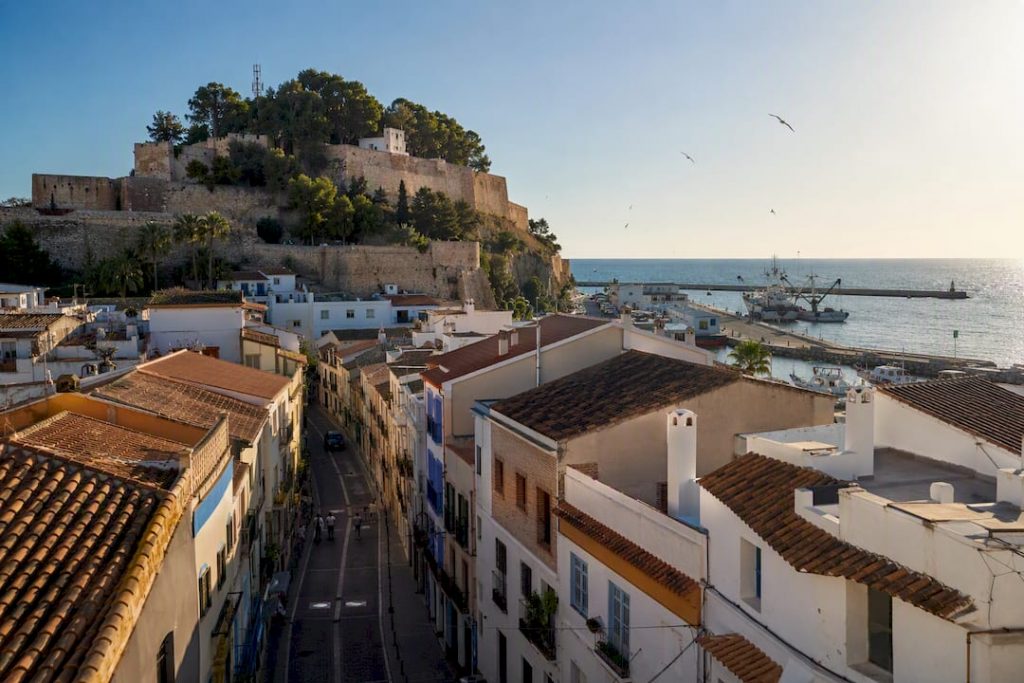
Denia suits UK movers who want a genuine, year-round Spanish town rather than a seasonal resort. It works particularly well for families needing schools and healthcare, retirees wanting an authentic setting with services close at hand, and remote workers happy to trade a fast city pace for a slower Mediterranean rhythm.
The town has around 45,000 permanent residents, a public hospital, and its own ferry port with sailings to the Balearic Islands.
- Population: roughly 45,000, rising sharply in summer
- Healthcare: Marina Salud public hospital serves the wider Marina Alta region
- Transport: ferry connections to Ibiza and Mallorca, plus road and rail links to Alicante
- Climate: mild Mediterranean weather with warm, dry summers and gentle winters
Fiestaproperties, working across Costa Blanca since 2010, deals daily with UK buyers weighing up Denia against nearby towns, so the practical detail below reflects what actually matters once you’re deciding where to live rather than just visit.
Key Takeaways
Denia suits UK movers seeking year-round Spanish town life, with a public hospital, ferry links, and family schooling all within reach of the centre.
| Point | Details |
|---|---|
| Verdict for UK movers | Denia works well for families, retirees, and remote workers wanting genuine year-round services, not just a summer resort. |
| Visit both seasons | See Denia in summer and winter before buying, since the town’s character shifts dramatically between the two. |
| Budget beyond rent | Expect a one-bed flat in the centre to run €750 to €800 a month, plus a cushion for move-in costs. |
| Sort the paperwork early | Get your NIE and register at the town hall promptly, and confirm post-Brexit residency rules with official UK and Spanish sources. |
| Local property help | Fiestaproperties offers local knowledge and access to over 3,000 new-build and resale properties across the Marina Alta and wider Costa Blanca. |
This article is general information, not a substitute for advice from a qualified lawyer. Consult a qualified legal professional about your own circumstances before acting on anything here.
Table of Contents
- Who Denia suits: quick pros and cons for UK movers
- Where to live in Denia: neighbourhoods and housing types
- What does it cost to live in Denia?
- What healthcare, schools, and transport are available?
- What is daily life and culture like in Denia?
- What is the job market like in Denia?
- Are there higher education and adult learning options nearby?
- How safe is Denia, and what should you know about emergency services?
- What outdoor activities and leisure options are available?
- How easy is it to get around Denia without a car?
- How do UK movers settle in and integrate locally?
- A local view on who Denia really suits
- Ready to look at property in Denia?
- Sources
Who Denia suits: quick pros and cons for UK movers
Denia works best for people who want a real town, not a holiday backdrop. Weigh these before you commit.
Pros:
- Year-round infrastructure, so life doesn’t shut down after September
- Marina Salud hospital and the Lady Elizabeth British school sit close to the centre
- Long sandy beaches and a working port with ferries to the Balearics
- A mix of authentic Spanish life and an established international community
Cons:
- Streets and roads get genuinely busy from June to September
- English isn’t reliably spoken outside tourist zones, town hall offices, or estate agents used to UK clients
- Good properties in central neighbourhoods move quickly during viewing season
- Spanish bureaucracy rewards patience, and sometimes a translator
Families weighing schooling and healthcare access, and retirees comparing value against quieter neighbours, tend to find Denia the more practical choice.
Where to live in Denia: neighbourhoods and housing types
Denia splits into a handful of distinct areas, and each attracts a different kind of buyer. The town centre, with its narrow streets climbing towards the castle, suits people who want to walk everywhere and live among locals year-round. Property here tends to be older Spanish townhouses and apartments, many needing renovation, though second-hand listings turn over regularly.
Les Marines, the beachfront strip north of the port, is where most new-build apartment developments sit. Expect modern blocks with communal pools, sea glimpses, and a stronger holiday-let market. It’s popular with UK buyers wanting a lock-up-and-leave second home as well as full-time residents.
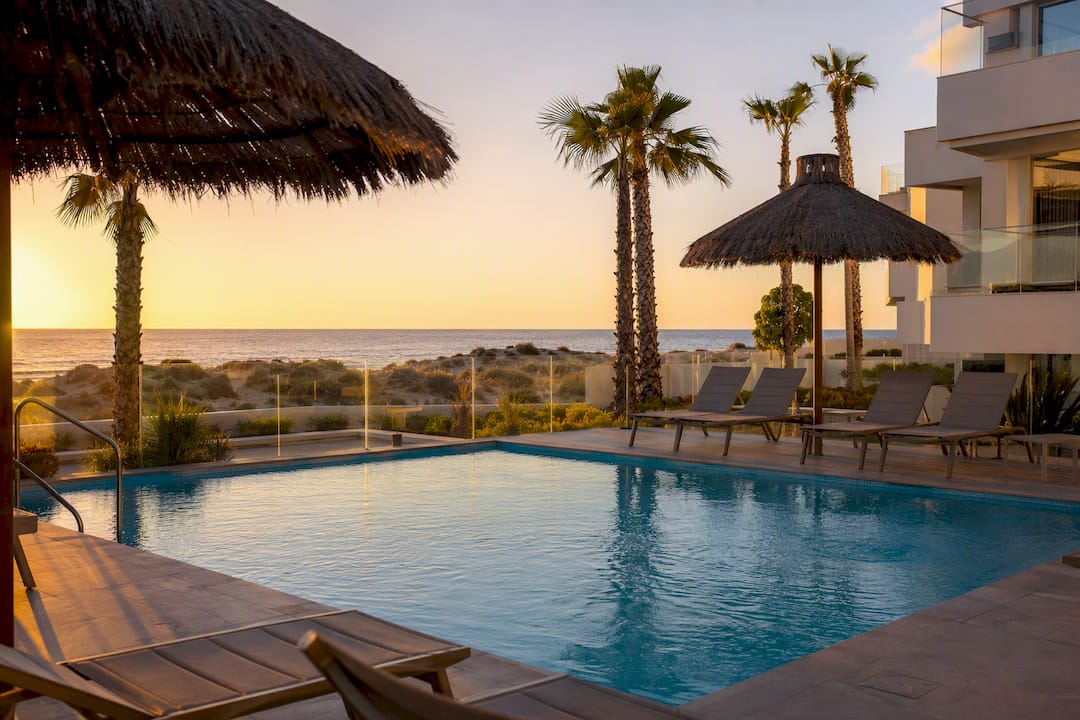
Montgó, on the lower slopes of the mountain that gives the neighbourhood its name, is villa territory. Detached houses with private pools and larger plots sit here, generally at a premium over apartment living, and it suits families or retirees wanting space and quiet over walkability.
La Pedrera, inland and more residential, offers a calmer, more affordable alternative with a mix of villas and townhouses favoured by long-term residents rather than holiday buyers.
New-build stock in the wider area has grown steadily, and developments like those at Terra Nova Hills illustrate the kind of modern, low-maintenance housing now competing with older resale stock across the Marina Alta. Deciding between a new build and a second-hand property often comes down to how much renovation you’re willing to take on versus paying a premium for something move-in ready.
What does it cost to live in Denia?
Rental prices give the clearest early signal of what your money buys. A one-bedroom flat in the town centre typically runs €750 to €800 a month, with noticeably lower rents once you move outside the centre or away from the beachfront.
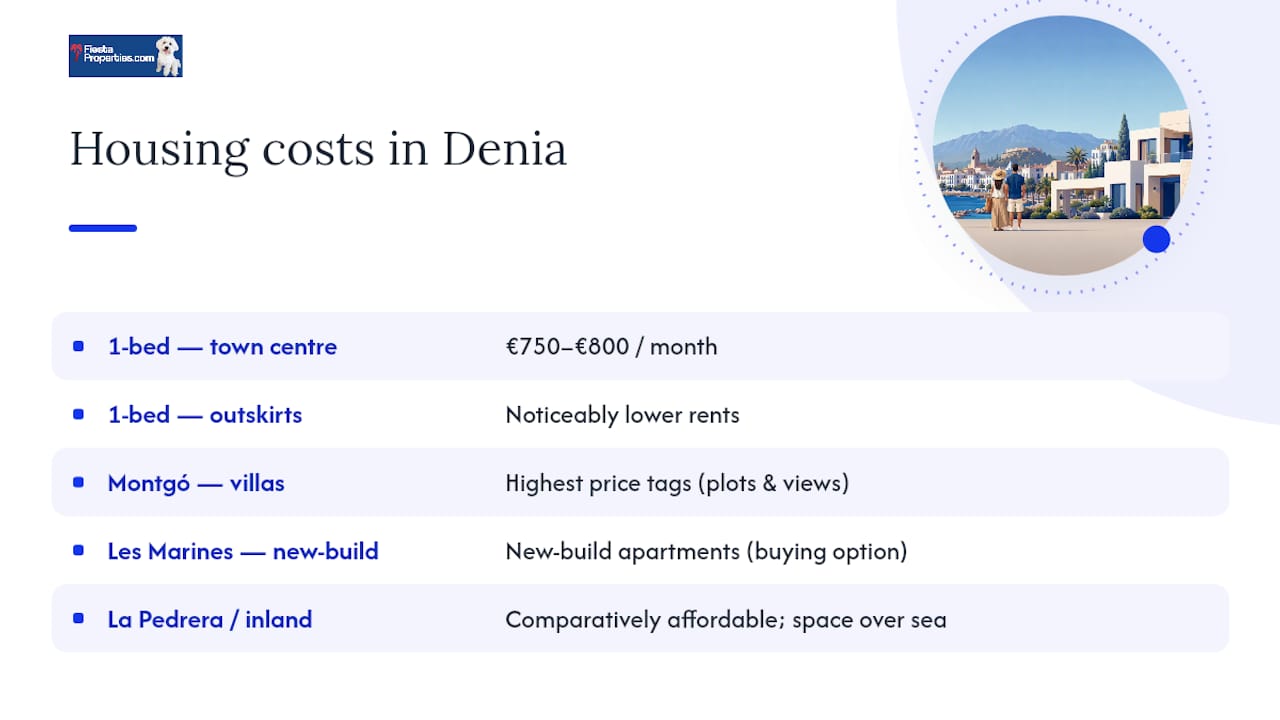
Buying works differently depending on whether you’re after a resale townhouse in the old town or a new-build apartment in Les Marines. Villas on Montgó carry the highest price tags given their plot size and views, while La Pedrera and inland pockets remain comparatively affordable for buyers prioritising space over sea proximity.
Renting first is worth serious consideration, especially if you haven’t lived through a Denia summer. The town’s population swells well past 100,000 during peak season, and rental demand, restaurant queues, and beach crowds all spike accordingly. Spending three to six months renting lets you test a neighbourhood in both its quiet winter mode and its busy summer version before committing to a purchase.
Day-to-day costs beyond housing sit lower than most UK equivalents: groceries, utilities, and eating out generally cost less than in comparable English or Welsh coastal towns, though imported goods and anything aimed squarely at tourists carry a premium. Build in a financial cushion for move-in costs, deposits, and the inevitable early bills that arrive before you’ve settled into local routines.
What healthcare, schools, and transport are available?
Denia functions as the services hub for the entire Marina Alta district, which is precisely why it appeals to permanent residents rather than just holidaymakers. The Marina Salud hospital covers the public healthcare needs of the surrounding towns, and residents registered within the Spanish system access it directly, with private health insurance available as a faster-access alternative many UK movers choose to run alongside it.
Schooling options range from Spanish state schools, which offer full immersion and are free, through to the Lady Elizabeth School nearby, which follows a British curriculum and draws families wanting continuity with the UK system. Several other international and bilingual options operate across the wider Marina Alta for families who want a middle ground.
Getting in and out of Denia is straightforward. Alicante airport sits roughly an hour’s drive south, handling regular UK routes, while the ferry port connects directly to Ibiza and Mallorca, a genuine lifestyle perk if you fancy an island weekend without flying. Local buses link Denia to Javea, Calpe, and other Marina Alta towns, and the weekly markets, supermarkets, and independent shops in the centre cover daily essentials without needing a car for every errand.
What is daily life and culture like in Denia?
Fiestas define the local calendar in a way few UK towns can match. The Bous a la Mar festival each July, when bulls are chased through the streets towards the harbour, and the wider Fallas celebrations, give Denia a rhythm that’s unmistakably Spanish, whatever the size of its foreign community.
Dining reflects the town’s fishing heritage. Rice dishes, fresh seafood, and the local red prawn, a genuine delicacy sold at auction on the harbourside, sit alongside a growing scene of international restaurants catering to residents from across Europe.
The balance between international community and authentic Spanish life tips more towards the latter than in some nearby towns. Comparative guides note that neighbouring Javea leans more towards a quieter, expat-focused character, while Denia keeps a broader mix of ages, nationalities, and working locals, giving it more the feel of a functioning town than a retirement enclave. That’s a genuine draw if you want your children mixing with Spanish classmates, or you simply prefer a high street with more than gift shops and estate agents.
Learning basic Spanish speeds up everything from doctor’s appointments to sorting a parking fine. English isn’t reliably spoken outside tourist-facing businesses, and town hall staff, in particular, expect at least an attempt at the local language.
What is the job market like in Denia?
The local economy leans heavily on tourism, hospitality, retail, and property services, sectors that expand considerably each summer and contract again by November. If you’re planning to find local employment rather than bring your income with you, expect seasonal contracts to be more available than permanent, year-round roles.
Remote work has changed the equation for many UK movers. Denia’s reliable broadband and its appeal as a lifestyle destination have drawn a steady flow of people working for UK or international employers while living locally, a pattern that has grown across the wider Costa Blanca in recent years. If your income doesn’t depend on the local job market, Denia offers considerably more flexibility than towns without decent connectivity.
For those actively job-hunting, hospitality management, real estate, marine services connected to the port and marina, and healthcare support roles around Marina Salud represent the more consistent local sectors. Spanish fluency matters far more here than in the property or holiday-let trades, where English-speaking clients are common.
Freelancers and small business owners should factor in Spain’s autónomo registration system, which carries its own monthly social security contributions regardless of income level in the early stages. This is a genuine cost to budget for, distinct from UK self-employment, and worth discussing with an accountant familiar with both systems before you commit to working locally.
Are there higher education and adult learning options nearby?
Denia itself doesn’t host a university campus, but Alicante and Valencia, both within reasonable driving or train distance, offer full university provision for anyone relocating with older children or considering further study themselves.
Locally, adult learning tends to centre on Spanish language schools, several of which specifically cater to the foreign resident community with courses pitched at complete beginners through to conversational fluency. Vocational and community courses run through local cultural centres and the town hall, covering everything from cookery to computing, though these are conducted in Spanish and suit residents already past the survival-phrasebook stage.
For remote workers or retirees wanting structured learning without relocating their whole household to a university town, online study through UK-based providers remains a practical fallback, paired with in-person Spanish classes for the language side.
How safe is Denia, and what should you know about emergency services?
Denia carries a reputation as a low-crime, family-friendly town, and most UK residents report feeling notably safer here than in equivalent-sized UK towns. Petty theft, such as bag-snatching in busy tourist areas during peak summer, remains the most common concern rather than anything more serious.
Emergency services operate on the same national framework as the rest of Spain, with 112 as the single number covering police, fire, and ambulance response. The presence of Marina Salud hospital in the town itself, rather than a long drive away, matters considerably here: response times for anything requiring hospital care are shorter than in more rural parts of the Costa Blanca.
Road safety is worth flagging separately. Summer traffic congestion and unfamiliar Spanish driving norms catch out some new arrivals in their first year, so it’s worth taking things cautiously until local routes and roundabout etiquette become second nature.
What outdoor activities and leisure options are available?
Beaches are the obvious draw, and Denia doesn’t disappoint on variety. Las Marinas offers long, family-friendly sandy stretches to the north, while Les Rotes to the south gives way to rockier coves better suited to snorkelling and quieter swimming.
Montgó Natural Park rises directly behind the town, offering serious hiking with genuine elevation and views back over the coastline, a rare thing to have literally on your doorstep rather than requiring a drive. Sailing, paddleboarding, and diving are all well established given the town’s working marina and port heritage.
Parks, padel courts, and municipal sports facilities are scattered through the newer residential areas, and the weekly markets double as a social outing as much as a shopping trip. For a town of its size, the range of things to actually do outside the beach season is genuinely broader than many coastal alternatives.
How easy is it to get around Denia without a car?
The town centre and Les Marines are genuinely walkable, with flat, well-maintained pavements linking the port, old town, and beachfront in a single manageable stretch. Cycling has grown as an option too, with dedicated paths appearing along parts of the coastal route in recent years.
A local bus network connects the outer neighbourhoods, including Montgó and La Pedrera, to the centre, though services thin out considerably in winter compared with the summer timetable. For day trips or commuting further afield, the narrow-gauge train line running along the coast toward Gata de Gorgos and beyond offers a scenic, if slow, alternative to driving.
Most residents living outside the immediate centre still find a car useful, if not essential, particularly for the weekly supermarket run or reaching Alicante airport within the hour.
How do UK movers settle in and integrate locally?
Community integration in Denia tends to happen through overlapping channels rather than one obvious route. Established expat groups organise regular meetups, walking clubs, and social evenings, giving newcomers an immediate social circle while Spanish improves.
Volunteering with local charities, animal shelters being a particularly popular option among the British community, offers a genuine way to meet both fellow residents and Spanish locals outside the usual expat bubble. Joining a local sports club, whether padel, sailing, or a walking football group, tends to work faster than language classes alone at building real friendships.
Pro Tip: Visit Denia in both August and February before deciding where to live. The town changes character dramatically between the two, and a neighbourhood you love in high summer might feel very different, and quieter, come winter.
Before you relocate, a short practical checklist helps avoid the common early mistakes:
- Get your NIE (foreigner identification number), required for almost everything from opening a bank account to buying property, as early as possible
- Register at the town hall (empadronamiento) once you have an address, which underpins healthcare and school access
- Open a Spanish bank account before you need one for utility direct debits or a property purchase
- Check your residency status against current post-Brexit rules, since UK nationals no longer have automatic EU residency rights
Residency, tax, and visa rules change and carry real legal consequences, so always confirm your specific position with the UK government’s official Spain guidance and, where needed, a solicitor or gestor familiar with both British and Spanish systems before making firm plans.
A local view on who Denia really suits
Fiestaproperties has spent years helping UK buyers across Costa Blanca, and the pattern with Denia is consistent: it attracts families needing schools and hospital access, retirees who want a proper town rather than a quiet enclave, and remote workers happy with a slower pace once the summer crowds thin out.
The families that settle in fastest tend to choose Montgó or La Pedrera over the busier centre, and almost everyone who visits only in summer underestimates how different, and quieter, Denia feels in January. Seeing both seasons before buying isn’t optional advice. It’s the single biggest mistake we see people skip.
Ready to look at property in Denia?
If Denia’s mix of year-round services, beaches, and authentic town life sounds right for you, the next sensible step is seeing what’s actually available rather than browsing listings from a distance. Fiestaproperties has operated across Costa Blanca since 2010, working with a network of over 3,000 properties spanning new-build developments, off-plan homes, and second-hand listings, with particular strength in new-build inventory around the Marina Alta.
Unlike a general portal search, Fiestaproperties gives you direct access to local market knowledge, from which Denia neighbourhood suits your priorities to genuine build quality on new developments, backed by international marketing reach that keeps listings moving. You can request a tailored shortlist matching your budget and preferred area, book an in-person viewing trip, or arrange a remote video tour if you can’t travel yet. Start by exploring the buying process to understand what’s involved, or head straight to current properties for sale across Costa Blanca South to see what’s on the market right now.