






Spanish Inheritance and Succession Tax (Impuesto sobre Sucesiones y Donaciones, or ISD) applies to all property located in Spain, regardless of whether the owner is a UK resident or a Spanish national. If you own a villa in Alicante or an apartment in Málaga, your heirs will face a Spanish tax bill. The three actions to take now: arrange NIE numbers for likely heirs, locate the title deeds and any existing will, and note that the filing deadline is six months from the date of death. The region where the property sits will largely determine how large that bill actually is, so checking regional rules is the logical next step.
- Obtain NIE numbers for all potential heirs before a death occurs, not after.
- Locate the title deeds, any existing will, and the most recent IBI (council tax) receipt.
- If probate will delay filing, apply for a six-month extension within the first five months after death.
Key takeaways
Spanish ISD applies to all property located in Spain, and the autonomous community where the property sits is the single most important variable in determining the effective tax bill for UK heirs.
| Point | Details |
|---|---|
| ISD applies to all Spanish property | UK owners’ heirs pay Spanish ISD on Spanish-located assets regardless of UK domicile. |
| Six-month filing deadline | Modelo 650 must be filed within six months of death; apply for an extension within the first five months. |
| Region decides the effective bill | Direct heirs in Madrid, Andalusia, and the Canary Islands can face near-zero ISD; other regions offer less relief. |
| A Spanish will saves time and money | Notarial fees of €40–€90 avoid costly apostille and translation requirements for a foreign will. |
| Fiestaproperties connects buyers to specialists | The team can introduce buyers to succession lawyers and surface properties in favourable ISD regions across Costa Blanca. |
Table of Contents
- How Spanish ISD applies to UK owners and non-resident heirs
- How ISD is calculated: taxable base, state scale and the multiplier
- Why the autonomous community matters more than the national rate
- How Spanish ISD interacts with UK inheritance tax and Brussels IV
- Step-by-step: documents, forms and the six-month deadline
- Valor de referencia, valuation disputes and capital gains when heirs sell
- Practical planning tips for UK owners and the mistakes that cost most
- If heirs plan to sell the inherited Spanish property
- Sources
How Spanish ISD applies to UK owners and non-resident heirs
Spanish Inheritance and Succession Tax is levied on two categories of transfer: acquisitions mortis causa (inheritance and bequests) and inter vivos transfers (gifts). For UK owners, the key principle is limited liability: non-resident heirs are taxed only on assets physically located in Spain, not on worldwide estates. A Spanish resident heir, by contrast, faces ISD on their entire global inheritance.
The taxable assets most commonly encountered by UK families include:
Which authority administers the filing depends on the circumstances. When the deceased was a Spanish resident, the autonomous community (comunidad autónoma) where they lived handles the case. When the deceased was a non-resident, the National Tax Management Office (ONGT) at the AEAT manages the filing, though following a 2014 Court of Justice of the EU ruling (C‑127/12), non-resident heirs can in many situations apply the regional rules of the comunidad where the property is located. That ruling changed the planning landscape for foreign owners considerably.
How ISD is calculated: taxable base, state scale and the multiplier
The calculation moves through four steps, and understanding each one helps heirs avoid paying more than they owe.
Step 1: Establish the taxable base. The starting point is the market value of the Spanish assets on the date of death, minus any deductible debts (such as a mortgage secured on the property) and reasonable funeral expenses. Life insurance payouts from Spanish policies are added on top.
Step 2: Apply kinship reductions. Spain groups heirs into four kinship bands. Groups I and II cover direct descendants, spouses, and ascendants — the relatives most UK families are concerned with. The state law provides a modest personal allowance for each group (for example, children under 21 receive a higher state allowance than adult children), but the autonomous community rules frequently replace these with far more generous figures.
Step 3: Apply the state progressive scale. The national ISD scale runs from 7.65% to 34%, applied in bands to the reduced taxable base. This produces the cuota íntegra (gross tax liability).
Step 4: Apply the multiplier coefficient. The multiplier adjusts the gross liability upward based on the heir’s pre-existing wealth and their kinship group. A direct heir with modest existing assets will typically face a multiplier of 1.0, meaning no increase. Distant relatives or heirs with substantial pre-existing wealth face higher multipliers, which can push the bill significantly above the headline rate.
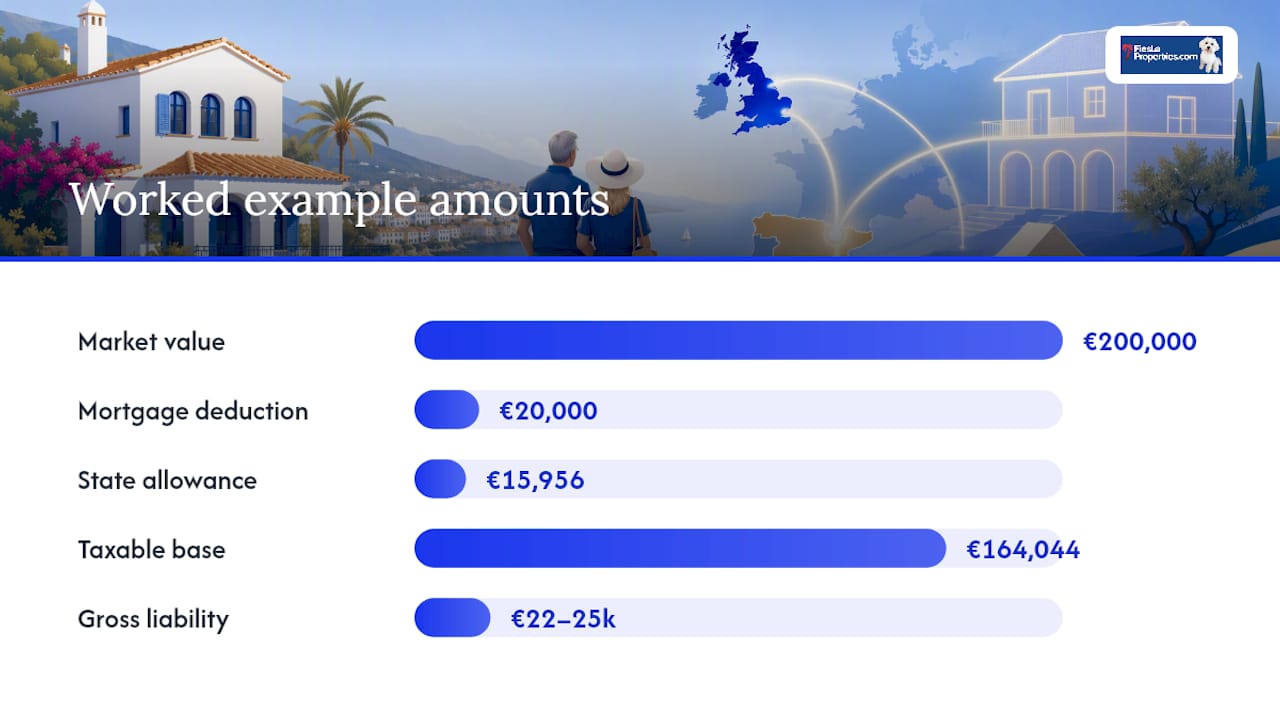
Worked example. A parent leaves a Spanish apartment valued at €200,000 to an adult child (Group II). After a state personal allowance of roughly €15,956 and deducting a small mortgage balance of €20,000, the taxable base is approximately €164,044. Applying the state scale produces a gross liability of around €22,000–€25,000 before any regional bonificación. In a region with no broad bonificación, the heir pays close to the full amount.
Practical calculation steps to run before consulting an adviser:
- List all Spanish assets and obtain current market valuations.
- Deduct outstanding mortgages and any documented debts secured on Spanish property.
- Add any Spanish life insurance payouts.
- Identify the kinship group for each heir.
- Check the specific comunidad’s current bonificaciones and allowances for that group.
- Apply the state scale to the reduced base, then check the multiplier for each heir’s wealth band.
- Apply any regional bonificación to the resulting figure.
Confirm the current conditions with a local adviser, as the retention requirement and percentage vary by comunidad.*
Why the autonomous community matters more than the national rate
The state ISD law is the legal skeleton; the autonomous communities add the substance. Regional bonificaciones are the decisive factor for most estates: the same inheritance can be nearly tax-free for direct heirs in Madrid or Andalusia and substantially taxed in a region with no broad relief.
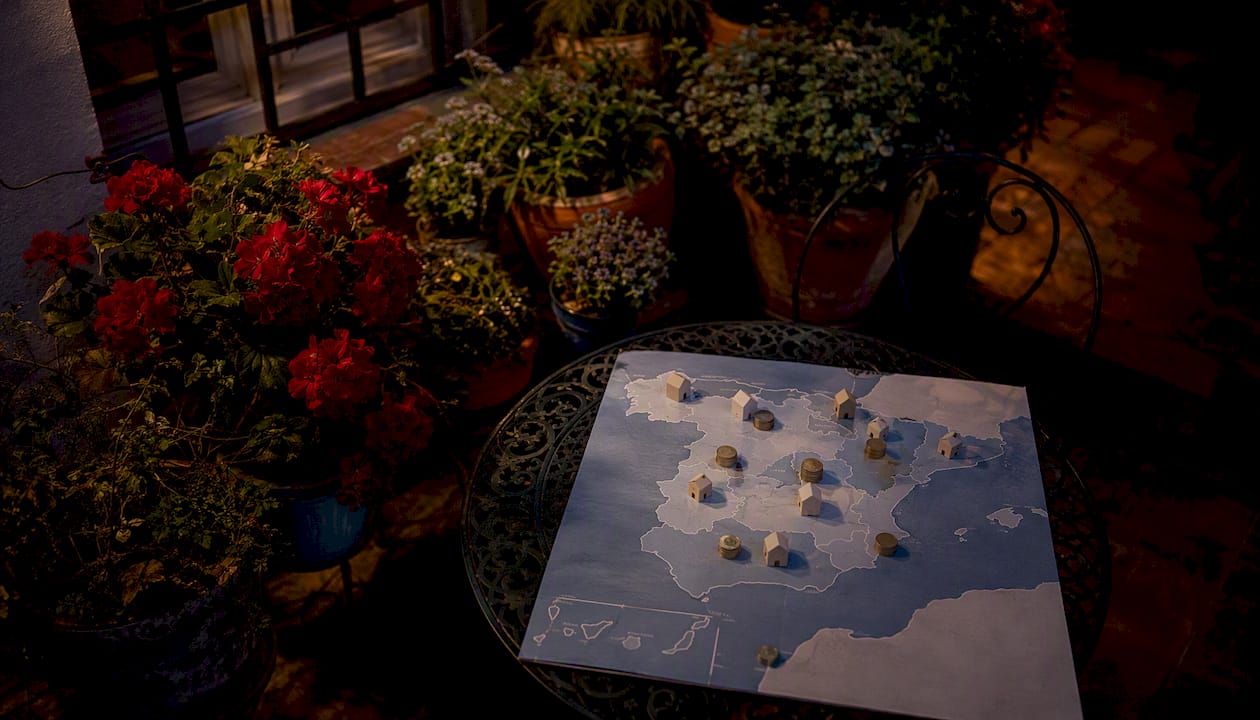
Following the 2014 CJEU ruling, non-resident heirs can often apply the regional rules of the comunidad where the property is located, which makes the choice of purchase location a genuine long-term financial consideration.
| Region | Practical impact for direct heirs (Groups I & II) |
|---|---|
| Madrid | Near-zero bonificación for Groups I and II |
| Andalusia | Near-zero bonificación for Groups I and II |
| Canary Islands | Near-zero bonificación for Groups I and II |
| Balearic Islands | Very favourable: substantial bonificaciones, conditions apply |
| Galicia | Very favourable bonificación for Groups I and II |
| Valencia | Improved: significant bonificaciones introduced in recent years |
| Cataluña | Moderate: reductions available but effective rates remain meaningful |
| Murcia | Moderate: bonificaciones exist but less comprehensive than Madrid/Andalusia |
| País Vasco / Navarra | Foral regime: separate rules outside the common system; generally favourable |
País Vasco and Navarra operate entirely outside the standard ISD framework under their own foral (charter) regimes. Heirs inheriting property in these regions should seek advice specific to those territories rather than relying on national-scale guidance.
Readers should confirm the current position for their specific comunidad before relying on any summary. Regional rules have been subject to revision, and several comunidades adjusted their bonificaciones during 2025–2026.
How Spanish ISD interacts with UK inheritance tax and Brussels IV
Two separate legal frameworks operate in parallel here, and conflating them is a common source of confusion.
Brussels IV (EU Regulation 650/2012) and Article 22 govern succession law: who inherits, and under which country’s legal rules. A UK national can elect under Article 22 to have their estate governed by English law, which may preserve testamentary freedom and simplify the distribution of assets. Coordinating two wills and electing national law under Article 22 can preserve testamentary freedom while ensuring Spanish assets are administered efficiently. Critically, this election does not alter Spain’s right to levy ISD on Spanish-located assets. Tax obligations follow the asset’s location, not the law governing succession.
UK inheritance tax (IHT) applies to the worldwide estate of UK-domiciled individuals. A UK-domiciled person who owns Spanish property may therefore face both Spanish ISD on the Spanish assets and UK IHT on the same assets as part of the global estate. The UK–Spain double taxation agreement on estates is limited in scope, so heirs should take specific advice on whether a credit is available to offset one tax against the other.
Practical guidance on coordinating wills:
- When to elect English law under Article 22: if the estate is complex, if there are minor children, or if the default Spanish forced heirship rules would conflict with the deceased’s wishes.
- When two wills make sense: a Spain-only will covering Spanish assets and a separate UK will covering everything else. Each will should explicitly state its geographic scope to avoid one inadvertently revoking the other.
- When a Spanish will speeds administration: almost always. A will already registered with the Spanish Notarial Registry removes the need for apostilles and sworn translations of a foreign will, saving heirs weeks of delay and meaningful cost.
Pro Tip: Drafting a Spanish will typically costs between €40 and €90 in notarial fees. The legalisation costs heirs would otherwise pay — apostille, sworn translation, and legal opinions for the Spanish registry — routinely exceed that figure many times over. The will pays for itself before the ink is dry.
Step-by-step: documents, forms and the six-month deadline
The practical process follows a clear sequence, and delays early in the chain risk missing the six-month tax deadline. Modelo 650 is the self-assessment form non-resident heirs must file for inheritances (adquisiciones mortis causa); Modelo 651 covers gifts (inter vivos transfers).
Documents required:
- Death certificate with Apostille of The Hague and sworn Spanish translation
- Certificate from the Spanish Wills Registry (Registro de Actos de Última Voluntad) confirming whether a Spanish will exists
- Original will (Spanish or foreign, with apostille and translation if foreign)
- NIE numbers for all heirs
- Title deeds (escritura de compraventa) for the Spanish property
- Most recent IBI (council tax) receipt
- Spanish bank statements as at the date of death
- Proof of kinship (birth certificates, marriage certificate, with apostille and translation)
- Mortgage statement if a loan is secured on the property
Timeline from death to final registration:
| Step | Realistic duration |
|---|---|
| Obtain death certificate and apostille | 1–3 weeks |
| Request Spanish Wills Registry certificate | 2–3 weeks (15 working days minimum after death) |
| Obtain NIE numbers for heirs (if not already held) | 2–6 weeks (longer from abroad) |
| Professional asset valuation | 2–4 weeks |
| Prepare and file Modelo 650 with AEAT/ONGT | 2–4 weeks |
| Pay ISD and obtain tax clearance certificate | 1–2 weeks |
| Register property transfer at Land Registry | 2–6 weeks |
| Total realistic minimum | approximately 12 weeks |
The six-month deadline runs from the date of death. Heirs who need more time can apply for a single six-month extension, but the application must be submitted within the first five months. The extension accrues late-payment interest, though it avoids the higher surcharges that apply to genuinely late filings. Appointing a Spanish lawyer with a power of attorney to manage the process from the UK is strongly advisable — it removes the need for heirs to travel to Spain for each administrative step.
Valor de referencia, valuation disputes and capital gains when heirs sell
Since 2022, Spain’s tax authority (Hacienda) has used an official valor de referencia (reference value) as the minimum taxable base for property transfers, including inheritances. The reference value is calculated from cadastral data and recent sales in the area. It does not always reflect actual market conditions, and in some cases it exceeds the price a property would realistically achieve on the open market.

An inflated reference value creates a double problem. It increases the ISD liability at the point of inheritance, and it also sets a higher acquisition cost for capital gains purposes when heirs eventually sell. If the heir later sells for less than the reference value used for ISD, they may face a capital gains calculation that produces an artificial loss — or, conversely, if the market rises, the higher acquisition base reduces the taxable gain.
Heirs can contest the reference value using market evidence: recent comparable sales in the same area, a professional RICS-standard or Spanish-certified appraisal, and any survey reports. The challenge is submitted to the relevant tax authority before or alongside the ISD filing. Acting early matters, because accepting the reference value on the tax return without objection makes it harder to challenge later.
Municipal plusvalía is a separate local tax levied by the town hall (ayuntamiento) on the increase in the cadastral value of urban land since the property was last transferred. It applies to inheritances as well as sales. The heir, not the estate, is liable. The amount varies by municipality and the number of years since the last transfer, and it is calculated independently of ISD. Heirs should budget for this separately and confirm the figure with the local town hall or a solicitor before completing the transfer.
Pro Tip: If the reference value appears higher than the property’s realistic market value, instruct a local surveyor to produce a formal valuation before filing the ISD return. Challenging the figure at that stage is considerably more straightforward than seeking a correction after the tax has been paid.
Practical planning tips for UK owners and the mistakes that cost most
The most effective planning steps are also the simplest, and most of them cost very little to put in place.
Planning options worth considering:
- Draft a Spain-only will that explicitly limits its scope to Spanish-situated assets and includes a clause preserving the home-country will. This avoids unintended revocation of a global estate plan.
- Check the regional bonificaciones for any comunidad you are considering buying in before exchanging contracts. The difference between a near-zero ISD bill and a substantial one can be the single largest variable in the long-term cost of ownership.
- Consider lifetime gifts of Spanish property, but note the 30-working-day gift deadline for Modelo 651 and the donor’s potential capital gains exposure on the transfer.
- Use Article 22 of Brussels IV to elect English law where it protects testamentary freedom, but do so with legal advice — the election affects succession law, not tax.
Common mistakes that create cost or delay:
- Relying solely on a UK will for Spanish property. Foreign wills require apostille, sworn translation, and legal opinions before Spanish registries will accept them, adding weeks and meaningful expense.
- Missing the six-month filing deadline. Surcharges and interest accrue quickly, and the property cannot be registered in the heirs’ names until ISD is settled.
- Failing to obtain NIEs for heirs before a death occurs. Every heir must have an NIE to sign the acceptance deed and appear on the tax filing. NIE applications from abroad can take six weeks or more.
- Overlooking municipal plusvalía. It is a separate bill from ISD and catches many heirs off guard.
- Ignoring the donor’s capital gains position when gifting property. The donor is treated as having disposed of the asset at market value, which may trigger a Spanish capital gains liability even if no cash changes hands.
Pro Tip: Appoint a Spanish lawyer with a durable power of attorney before any health issues arise. A well-drafted power of attorney allows the lawyer to obtain NIEs, sign acceptance deeds, file tax returns, and register the property transfer entirely from Spain, without heirs needing to travel. The cost of drafting one is modest; the time it saves during a bereavement is considerable.
Why a Spanish will saves your heirs time and money
Specialist lawyers consistently report that the most common and costly administrative mistake is assuming a home-country will is sufficient for Spanish property. When heirs present a UK will to a Spanish notary or land registry, they must first obtain an Apostille of The Hague, commission a sworn Spanish translation, and in some cases provide a legal opinion confirming the will’s validity under English law. Each step adds time and cost.
A Spain-only will, drafted by a Spanish notary and registered with the Registro de Actos de Última Voluntad, removes every one of those steps. Notarial fees for a straightforward Spanish will typically fall in a modest range. The legalisation costs heirs would otherwise face routinely exceed that figure many times over — and that is before accounting for the weeks of delay while documents are apostilled and translated.
The practical instruction is straightforward: ask a Spanish notary to draft a will that is explicitly limited to Spanish-situated assets and that contains a clause confirming it does not revoke any existing home-country will. That single document, registered centrally, means the Spanish registry can confirm its existence within 15 working days of a death — and the administration can proceed without the legalisation bottleneck.
If heirs plan to sell the inherited Spanish property
Selling an inherited Spanish property involves a distinct set of administrative and tax steps that run alongside, and after, the ISD process.
Immediate steps before any sale can proceed:
- Obtain the justificante de pago or certificado de no sujeción (tax clearance certificate) from the AEAT confirming ISD has been settled or that no tax is due.
- Register the property transfer at the Land Registry in the heirs’ names. A sale cannot proceed until the property is registered in the seller’s name.
- Obtain the certificado de pago de plusvalía from the town hall confirming municipal plusvalía has been settled.
This is not a final tax — it is a payment on account.
Non-resident sellers are currently subject to capital gains tax on Spanish property at a rate applicable to EU/EEA residents and non-EU residents respectively — the applicable rate should be confirmed with a tax adviser at the time of sale, as rates are subject to legislative change.
Documents the conveyancing solicitor will need:
- Title deeds registered in the heirs’ names
- NIE numbers for all selling heirs
- ISD tax clearance certificate
- Plusvalía settlement certificate
- Energy performance certificate (certificado de eficiencia energética)
- Most recent IBI receipt
Fiestaproperties’ perspective on inheritance tax and where you buy
The region of a Spanish property is not just a lifestyle choice — it is a financial one. That is a material factor in the long-term cost of ownership, and one that buyers rarely factor in at the point of purchase. Asking the question before signing, rather than after, is simply good planning.
How Fiestaproperties can help you buy with confidence in Costa Blanca
Fiestaproperties has been helping buyers find properties in Costa Blanca and Murcia since 2010, and the team understands that a purchase decision involves more than the asking price.

For buyers who want to understand the succession implications of a specific location before committing, Fiestaproperties can introduce you to local notaries and specialist lawyers experienced in cross-border succession and Spanish tax matters. The team does not provide legal or tax advice directly, but it can connect buyers with the right professionals and help with the practical paperwork and local processes that accompany a purchase. With over 3,000 properties across the network, including new build and key-ready homes in regions with favourable ISD regimes, there is a broad range to consider. Explore properties for sale in Costa Blanca South or review the buying process to understand what to expect at each stage.
Sources
The AEAT’s Modelo 650 guidance page is the authoritative starting point for non-resident heirs: it hosts the filing form, explanatory notes, and procedural guidance for the ONGT. The Administración del Estado’s ISD overview provides a plain-language summary of the tax’s scope and the offices involved.
For regional comparisons, practitioner guides from Spanish law firms with English-language resources offer the most current picture of bonificaciones, as comunidad rules change more frequently than the state framework. The Lextax guide for non-residents and the Recording Law ISD overview are useful references, though neither replaces advice from a qualified Spanish tax adviser or notary for a specific estate.
Web summaries, including this one, provide a reliable framework but cannot substitute for professional advice on a specific estate. Regional rules, reference values, and bonificación percentages are updated periodically, and the consequences of an error — a missed deadline, an unchallenged reference value, or a poorly drafted will — can be costly. A Spanish notary or a specialist cross-border succession lawyer is the appropriate first call when a death has occurred or when a purchase is being planned with succession in mind.
This article provides general information only and is not a substitute for professional legal or tax advice. Readers should confirm current rules with the AEAT, the relevant autonomous community tax office, or a qualified Spanish adviser before making decisions.
- Sede
- Spanish succession tax rules — Administración del Estado
- Spanish Inheritance Tax: How the ISD Works and Why the Region Decides the Bill (Recording Law)
- Inheritance & gift tax in Spain for non-residents — Lextax
- The comprehensive guide to Spanish wills — Abad Abogados
- Coordinate your Spanish will — CostaLuz Lawyers