






Yes, UK buyers can purchase residential property in Costa Blanca’s golf resort communities on the same legal footing as any other foreign buyer, Spanish or otherwise. There is no residency requirement, no special licence, and no restriction tied to nationality that applies specifically to Britons since Brexit changed the paperwork rather than the principle.
The immediate priorities are narrower than most guides suggest. Before paying a reservation deposit, confirm the property’s rental licence status and check whether the community of owners has voted to restrict tourist lettings, and make sure your NIE application and currency transfer plan are already moving. Skip these steps and you risk buying a home that looks perfect on paper but cannot legally be let to holidaymakers, or one carrying community debts nobody mentioned during the viewing.
- Confirm rental licence eligibility and comunidad vote status before arras
- Apply for your NIE early. It underpins every later step
- Set a currency transfer plan in motion before you need the funds
Pro Tip: A property that looks identical to its neighbour on Rightmove can carry a completely different rental status. Always ask for the comunidad’s minutes, not just the estate agent’s summary.
Key Takeaways
Buying a residential property in a Costa Blanca golf-resort community is straightforward for UK buyers provided the rental licence and comunidad vote are confirmed before any deposit changes hands.
| Point | Details |
|---|---|
| Confirm rental status first | Check comunidad vote status and rental licence eligibility before paying arras. |
| Budget the full uplift | Expect an all-in cost roughly 10% to 13% above the headline price once tax and fees are added. |
| Watch the Valencian ITP change | The rate on qualifying resale properties drops from 10% to 9% from 1 June 2026. |
| Sort NIE and FX early | Apply for your NIE and settle your currency transfer plan before exchange. |
| Get cross-border tax advice | Non-resident rental income is taxable in Spain and reportable in the UK. |
| Use a local specialist | Fiestaproperties builds a compliance-checked shortlist from over 3,000 Costa Blanca properties. |
Table of Contents
- What are golf resort communities in Costa Blanca?
- Buying steps: from shortlist to escritura
- What does buying property in Costa Blanca actually cost?
- How do you avoid buying a property you can’t legally let?
- Financing and currency transfers for UK buyers
- How do Costa Blanca’s golf courses compare?
- What makes Costa Blanca appealing beyond golf?
- What accommodation is available within golf resorts?
- How much do golf memberships and access fees cost?
- How accessible are these resorts from the UK?
- Why the residential angle changes the advice you need
- How Fiestaproperties helps you buy with confidence
- Frequently asked questions
- Sources
What are golf resort communities in Costa Blanca?
“Golf resort” in this context means residential developments built in or around a golf course, not a hotel offering golf breaks. These are permanent or part-time homes: villas, townhouses, and apartments, sold as new-build off-plan, key-ready, or resale stock. Buyers choose these communities for the setting as much as the sport, and increasingly for the setting more than the sport.
Regional analysts consistently point to the same driver of demand: it is the managed grounds, communal security, and clubhouse amenities that keep rental occupancy and resale values steady, not proximity to the eighteenth green. Buyers who prioritise these lifestyle features over pure golf access tend to see stronger long-term letting demand, because tenants and second-home buyers alike are paying for the environment.
Costa Blanca splits into distinct pockets worth understanding before you shortlist anything:
- Alicante province, north of the city: Older, more established golf communities with mature landscaping and higher average prices, generally a shorter drive to Alicante Airport.
- Orihuela Costa and south of Torrevieja: The largest concentration of newer golf-adjacent developments, with a broader mix of new-build and resale stock and typically lower entry prices than the north.
- South Costa Blanca border with Murcia: Emerging developments offering more space for the money, though with fewer established resale comparables.
Whichever pocket you consider, proximity to a beach and an airport tends to matter more for resale liquidity than the course rating itself.
Buying steps: from shortlist to escritura
Buying in a golf-resort community follows the same legal skeleton as any Spanish purchase, but the community layer adds checks that generic guides often skip. Work through these in order.
- Shortlist and view properties across seasons. Walk the development at different times of day and, ideally, in both high and low season, since community noise and activity levels shift considerably between August and February.
- Request comunidad de propietarios accounts. Ask for at least two years of minutes and financial statements before you commit to anything in writing.
- Confirm the rental-vote status. Establish whether the community has passed a resolution prohibiting or restricting tourist lettings.
- Check coastal-zone exposure. Properties near the shoreline can fall under Ley de Costas restrictions that limit alterations or, in rare cases, threaten the structure itself.
- Apply for your NIE (Número de Identificación de Extranjero), the tax identification number every foreign buyer needs before signing anything binding.
- Open a Spanish bank account or confirm an accepted IBAN, then agree the reservation deposit, known as arras.
- Instruct an independent lawyer to review the contract, run land registry searches, and confirm there is no outstanding debt attached to the property.
- Sign at the notary (escritura pública) and register the change of ownership at the Land Registry.
The most common hold-ups are a stalled comunidad vote, an unexpected community debt surfacing during due diligence, or a municipal rental licence quota that has already been reached in that town.
Pro Tip: Never pay arras before the comunidad vote question is answered in writing. A verbal “no restrictions” from a seller is not a legal safeguard.
What does buying property in Costa Blanca actually cost?
The advertised price is never the full picture. Budget for taxes, notary fees, land registry charges, legal fees, and possible plusvalía liability on top of the headline figure, and treat any quote that ignores these as incomplete.
- ITP (Impuesto de Transmisiones Patrimoniales): Payable on resale properties in the Valencian Community. Notably, the Valencian Community’s ITP rate for certain properties under €1 million is set to reduce from 10% to 9% from 1 June 2026, so confirm the live rate with your lawyer before finalising a budget.
- IVA and AJD: Apply instead of ITP on new-build purchases bought directly from a developer.
- Notary and land registry fees: Fixed by regulation but scale with the declared purchase price.
- Lawyer or gestoría fees: Typically a percentage of the purchase price, agreed upfront.
- Plusvalía municipal: A local tax on land value increase, occasionally contested at sale but worth clarifying who pays before exchange.
Worked examples from regional buying-cost guides suggest an all-in uplift of roughly 10% to 13% above the headline price once every fee and tax is added, with the Valencian Community landing around the lower end of that range for resale purchases. On a €300,000 resale villa, that means budgeting an additional €30,000 to €39,000 once ITP, notary, registry, and legal costs are all accounted for, and that figure moves if the ITP reduction has come into force by your completion date.
How do you avoid buying a property you can’t legally let?
Four separate layers determine whether a golf-resort property can be let to tourists, and missing any one of them can cost you the rental income you were counting on.
- Community of owners’ vote: Many developments have voted, or could vote, to prohibit short-term tourist lettings entirely.
- Municipal zoning: Some towns have declared themselves “zona saturada”, capping the number of new tourist licences issued.
- Regional licence eligibility: Properties must typically qualify for the relevant regional short-term letting licence, broadly equivalent to the ETV or VFT categories used elsewhere in Spain.
- NRUA registration: The national unified holiday-rental registry that properties must appear on to let legally.
A thorough pre-purchase compliance check verifies all four layers before you commit a deposit, and it is far cheaper than discovering the problem at escritura. A routine failure sees buyers pay arras first and only later find the comunidad already voted against tourist lets, by which point renegotiating or withdrawing is considerably harder.
Pro Tip: Ask the seller’s agent to produce written confirmation of NRUA registration and comunidad vote status, not just a verbal assurance that “it’s fine for holiday lets”.
Financing and currency transfers for UK buyers
Non-resident mortgages are available from several Spanish lenders, though expect closer scrutiny than a UK mortgage application: valuation fees, an arrangement fee, and often a requirement to take out life or home insurance tied to the loan. These lender-imposed costs add predictably to your upfront outlay and, if unbudgeted, can delay completion at the worst possible moment.
- Confirm the notary’s and developer’s accepted payment methods well ahead of exchange.
- Resolve your currency transfer timing before signing arras, not after.
- Compare specialist FX brokers rather than relying on a high street bank’s exchange rate.
- Set a rate alert or forward contract if the ITP change affects your completion timing.
Providers such as Wise are widely used for these transfers, though it’s worth comparing rates against a couple of specialist brokers before moving a significant sum, since spreads vary more than buyers expect. Non-resident rental income is also taxable in Spain and must be declared in the UK under the Spain–UK double taxation arrangements, so get cross-border tax advice sorted before you start earning rental income, not after your first tax return is due.
How do Costa Blanca’s golf courses compare?
Course quality across Costa Blanca varies more than the marketing suggests, and the differences matter for resale value as much as for your own golf. Established courses in the north, around Alicante province, tend to have mature layouts and more demanding terrain, often carrying a stronger reputation among serious golfers. Newer developments further south, around Orihuela Costa, typically offer flatter, more forgiving courses designed with a broader range of ability in mind.
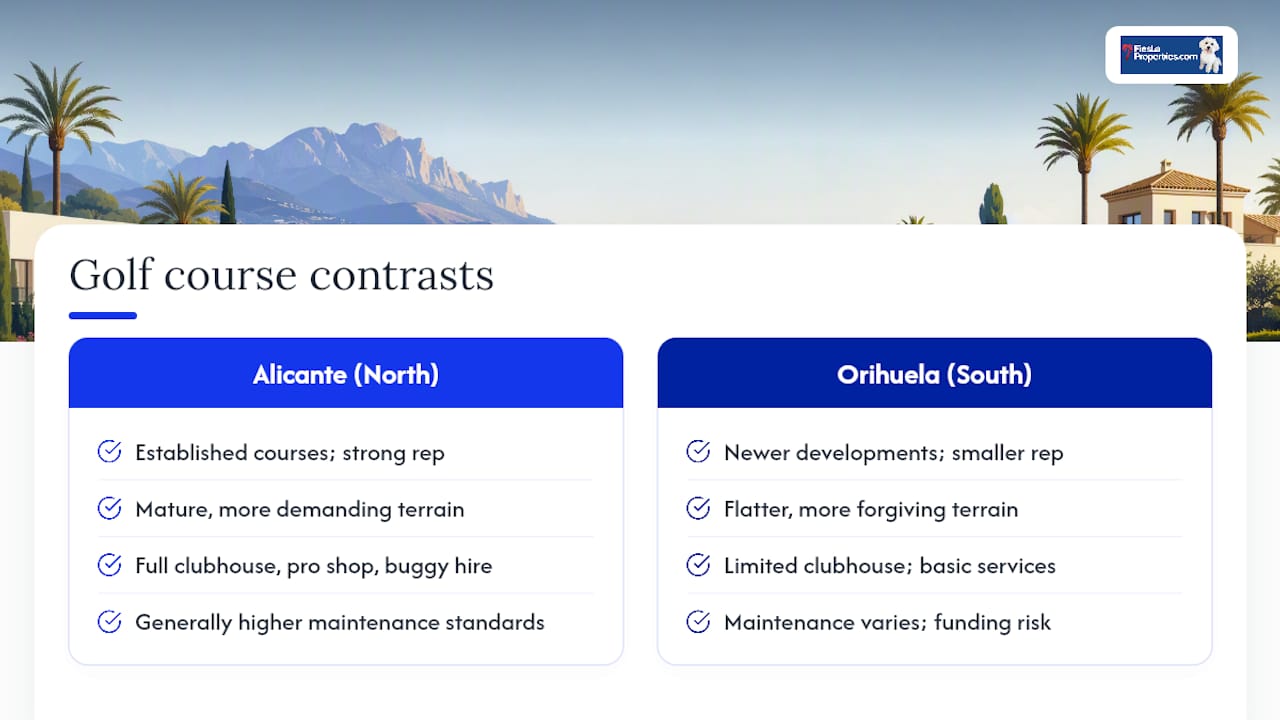
Facilities differ just as much as difficulty. Some resorts run a full clubhouse with restaurant, pro shop, and buggy hire included, while others are effectively a course with minimal supporting infrastructure. For a buyer, the facilities matter more than the par rating. A clubhouse with year-round activity supports rental demand and daily life in the development even when nobody in the household actually plays golf.
Course maintenance standards also vary by season and by the resort’s financial health, which is worth checking through the same comunidad accounts you request during due diligence. A course with declining maintenance often signals a wider funding issue in the development, one that could eventually show up as a special levy on owners. It is a detail easy to overlook during a viewing but expensive to discover after completion.
What makes Costa Blanca appealing beyond golf?
The climate does most of the heavy lifting here: over 300 days of sunshine a year, mild winters rarely dropping below double figures in the daytime, and a Mediterranean coastline within a short drive of almost every golf development in the region. That climate is the reason many UK buyers first considered the area at all, before golf entered the conversation.
Beyond the course, the appeal sits in everyday things. Salt lakes near Torrevieja draw walkers and birdwatchers in the cooler months. Traditional market towns inland offer a slower pace and genuinely local produce, a contrast to the resort atmosphere on the coast. English is widely spoken in the more established expat areas, which eases everything from opening a bank account to booking a dentist.
The evening breeze off the Mediterranean, and the long dining hours that go with it, are part of what keeps second-home owners coming back rather than treating the property as a once-a-year holiday asset. That distinction, between a home you use and a home you merely own, tends to show up directly in how well a property lets and resells.
What accommodation is available within golf resorts?
Property types within golf-resort communities generally fall into three categories, and each carries a different rental and resale profile.
Apartments sit at the more affordable end and typically come with shared communal pools and gardens managed by the development. They suit buyers prioritising low maintenance and straightforward letting to couples or small families.
Townhouses offer more space and often a private garden or terrace, usually at a moderate premium over apartments in the same development, and tend to appeal to families wanting more room without a villa’s upkeep.
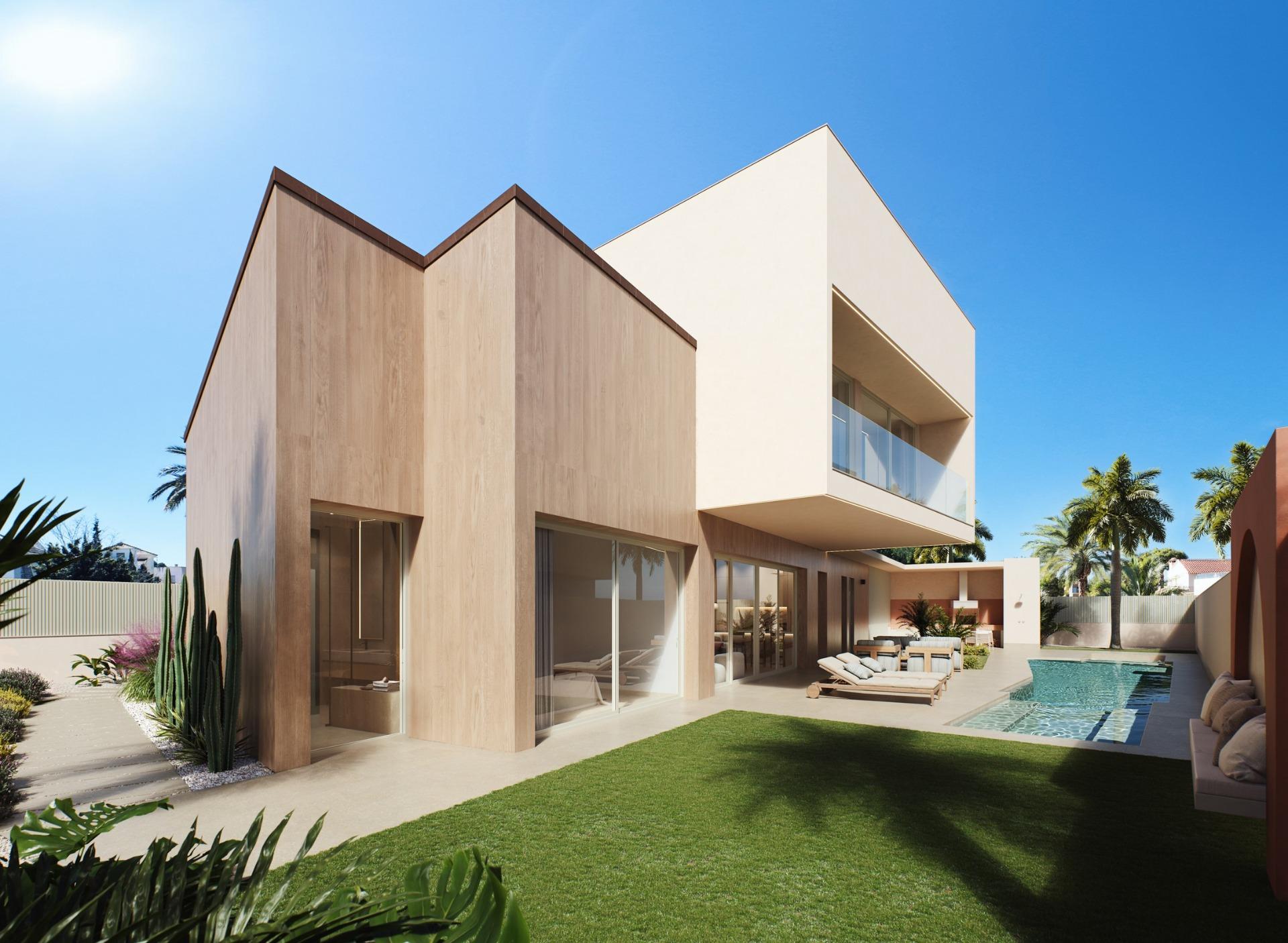
Villas sit at the top of the range, frequently with a private pool and larger plot, and command the strongest nightly rates for holiday letting, though they also carry higher running costs and community fees.
Rental potential depends less on the property type than on the compliance checks covered earlier. A villa with no valid rental licence earns nothing from tourist lets regardless of its size or pool. Buyers focused purely on investment yield should weigh new-build against resale carefully. New-build often comes with lower initial maintenance costs and modern construction standards, while resale can offer a more established rental track record if the previous owner already let successfully.
How much do golf memberships and access fees cost?
Access to the course itself usually falls into one of three arrangements, and it is worth clarifying which applies before you buy, since it affects both your own use and the property’s appeal to tenants.
Some developments include a form of resident discount or priority booking as part of the community fee, without a separate membership requirement. Others operate a genuine membership scheme, with an initial joining fee and ongoing annual dues, granting members preferential tee times and reduced green fees. A third group runs entirely pay-and-play, where residents and visitors alike book and pay per round with no membership layer at all.
Green fees themselves vary by season, course reputation, and time of day, generally peaking during the winter high season when demand from UK visitors escaping the cold is at its strongest. Buyers renting out a golf-resort property should check whether course access transfers to tenants or is tied strictly to the owner, since a course that markets itself as a golf destination but restricts tenant access can undercut a property’s letting appeal considerably.
How accessible are these resorts from the UK?
Alicante Airport is the primary gateway for most Costa Blanca golf resort communities, with direct flights from a wide spread of UK regional airports, and journey times from touchdown to most developments in the south of the province running under an hour. Murcia’s Región de Murcia Airport serves the southern border areas and can be the shorter drive for developments near the Murcia frontier.
Road links within the region are generally straightforward, with the AP-7 motorway running the length of the coast and connecting most golf communities to both airports and the larger towns. Public transport is more limited within the resorts themselves. Most owners rely on a car, and buyers planning to let their property should factor airport transfer distance into the listing, since it genuinely affects booking rates.
For buyers weighing north against south Costa Blanca, the accessibility difference is often the deciding factor once budget and course preference are already settled. A shorter airport run tends to translate directly into a wider pool of potential tenants and a smoother personal-use pattern for owners flying out for long weekends.
Why the residential angle changes the advice you need
Most coverage of Costa Blanca golf resorts is still written for holidaymakers booking a golf break, which leaves UK buyers relying on advice that never touches the questions that actually decide whether a purchase works: comunidad votes, rental licence eligibility, and the Valencian ITP change landing in mid-2026.
The conventional wisdom that “any golf-adjacent property will let well” undersells how much community-level restrictions have tightened in recent years. A property blocked from tourist lettings by its own comunidad is not a rare edge case; it is a routine outcome of buying without asking the right question at the right time.
If there is one priority worth putting above every other item in this guide, it is sequencing: NIE and compliance checks come before arras, not after. Buyers who reverse that order are the ones who end up renegotiating, or walking away from a deposit, once the paperwork catches up with the enthusiasm. Get the sequence right and the rest of the process, taxes, financing, and completion, tends to follow without drama.
How Fiestaproperties helps you buy with confidence
Fiestaproperties has been matching UK buyers with Costa Blanca homes since 2010, and the advantage over researching this alone is straightforward: you get a shortlist filtered against the exact compliance checks covered above, rather than a generic listings feed you have to vet yourself.

With more than 3,000 properties across the network, including golf-resort villas, apartments, and new-build developments, Fiestaproperties builds a tailored shortlist based on your budget, location preference, and rental intentions, then runs the pre-purchase compliance checks on comunidad votes and licence eligibility before you view a single property. Where needed, Fiestaproperties introduces buyers to trusted local lawyers and gestorías to handle NIE applications, contract review, and the escritura process. If you are weighing options in the south of the province, the properties for sale in Costa Blanca south listing is a practical starting point, and the buying process guide walks through exactly how the team supports you from first enquiry to keys in hand. Get in touch to request a shortlist matched to your budget and rental plans.
Frequently asked questions
Can UK citizens buy property in Costa Blanca golf resorts after Brexit?
Yes. UK buyers face the same purchase process as any other non-EU foreign buyer, requiring an NIE and standard due diligence, with no additional restriction on residential purchases.
Do I need a Spanish mortgage, or can I buy in cash?
Both are common. Non-resident mortgages are available from Spanish lenders but typically involve stricter valuation and insurance requirements than a UK mortgage.
How do I know if a golf-resort property has a valid rental licence?
Ask the seller or agent for written confirmation of NRUA registration and comunidad vote history, then have a lawyer verify municipal licence eligibility before signing arras.
Is the Valencian ITP change relevant to every Costa Blanca purchase?
It applies to qualifying resale properties under €1 million from 1 June 2026. New-build purchases fall under IVA and AJD instead, so confirm which regime applies to your specific purchase.
This article is general information, not a substitute for advice from a qualified financial advisor. Consult a qualified financial professional about your own circumstances before acting on anything here.