





Yes, a first occupancy licence (or its regional equivalent) is normally required before a Spanish property can be legally connected to permanent utilities, mortgaged, or let to tourists. It confirms the building matches its approved project and meets habitability standards. Before completing any purchase, request a copy of the licence from the seller or developer and pause the transaction until the town hall confirms it has been granted.
TL;DR:
- A valid first occupancy licence is essential for legally connecting utilities, mortgaging, or renting a property to tourists in Spain, and must be confirmed before purchase.
- The licence is issued by the town hall after inspection confirms the building matches approved plans and is habitable, often demanding specific documents like the architect’s certificate.
- Regional differences exist, with some communities requiring a cédula de habitabilidad or a declaración responsable instead of or alongside the municipal licence.
- Missing, expired, or mismatched licences can hinder utility connections, mortgage approval, tourist rentals, and resale, making timely verification crucial.
- Buyers should request official documentation, cross-check with municipal records, and include licence delivery as a contractual condition to mitigate legal and financial risks.
Table of Contents
- What is a first occupancy licence in Spain and who issues it?
- How to apply for the licence: documents and process
- Regional differences: cédula, LPO, and declaración responsable
- What happens if the licence is missing, expired, or mismatched
- Buyer checklist and contract clauses that protect you
- Typical costs and timings for issuing the licence
- Regularising a property with no licence
- How Fiesta Properties approaches licence checks for buyers
- Get help checking a property’s paperwork before you commit
- Where to verify licence status yourself
- Sources
What is a first occupancy licence in Spain and who issues it?
The licence of first occupation (LPO), sometimes called licencia de primera ocupación, is a municipal certificate confirming a new or substantially renovated property complies with urban planning rules and building regulations. It is issued by the town hall, or ayuntamiento, and it is normally what makes a property legally fit to live in, not the sale contract or the notary deed.
Town halls typically grant the LPO once the finished construction has been inspected against the original building licence and the approved architectural project. It sits at the end of a chain of paperwork that starts with planning permission and ends with occupation:
- The building licence, granted before construction begins, permitting the works.
- The approved project, the technical plans the town hall signed off on.
- The public deed signed at the notary, which transfers ownership but does not itself prove habitability.
- The energy performance certificate, a separate document rating the property’s energy efficiency, required for any sale or letting regardless of LPO status.
A notary can process a sale without an LPO in hand. That is precisely why so many buyers assume the deed is enough, and precisely why it is not.
How to apply for the licence: documents and process
On a new build, the developer normally applies for the licence, and buyers should treat its absence as a red flag rather than a technicality. The dossier submitted to the town hall typically includes:
- The architect’s end-of-works certificate (certificado final de obra), confirming construction matches the approved plans.
- A copy of the original building licence and stamped project documents.
- The construction book (libro del edificio), covering materials, installations, and maintenance instructions.
- Proof of payment of local property tax (IBI) and any outstanding municipal charges.
- Any additional forms the specific town hall requires, which vary by municipality.
Once the paperwork is filed, a technical inspection is usually carried out either by a municipal architect or an approved technical body, checking the finished building against the project on file. This is the municipal technical inspection that ultimately decides whether the licence gets granted.
As a buyer, you are not expected to file any of this yourself, but you are entitled to see it. Ask for the architect’s certificate and the licence number, then verify both directly with the planning office rather than taking a sales agent’s word for it.
Pro Tip: Ask the town hall’s planning department (urbanismo) for a written confirmation of the LPO status using the property’s cadastral reference. A phone call rarely gets you anything usable; a written request does.
Regional differences: cédula, LPO, and declaración responsable
Spain does not run one uniform system, and this catches out plenty of buyers who assume a term used in one region applies everywhere. Some autonomous communities layer a regional habitability certificate on top of the municipal licence, while others fold everything into the town hall’s own process.
- Catalonia, Valencia, and the Balearic Islands commonly still require a cédula de habitabilidad alongside or instead of the LPO.
- Madrid, Andalucía, and the Basque Country generally rely on municipal systems, where the LPO or an equivalent declaration covers habitability without a separate regional cédula.
- Some regions accept a declaración responsable (a signed statement of compliance) from a technician in place of a full municipal inspection for certain works.
The practical consequence is straightforward: the correct document depends entirely on where the property sits. Never assume that because a friend’s purchase in one province needed only an LPO, yours in another will follow the same path. Confirm the specific requirement with the local town hall or a conveyancer familiar with that community.
What happens if the licence is missing, expired, or mismatched
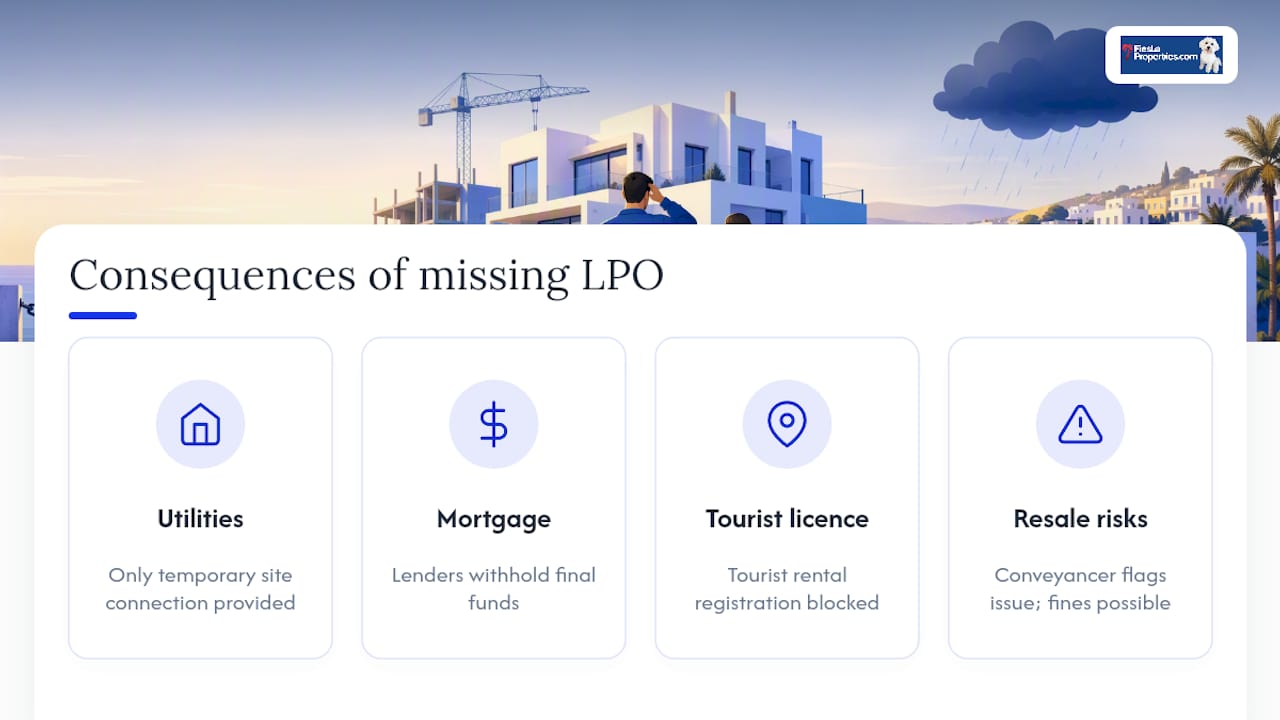
Without a valid LPO, utility companies will typically only offer a temporary construction-site connection rather than a permanent residential contract for water and electricity. Mortgage lenders routinely withhold final release of funds until the licence is confirmed, and tourist licence applications get blocked outright, since proof of legal dwelling status is a prerequisite for tourist rental registration in most regions.
Resale gets harder too. A buyer’s own conveyancer will flag the gap, insurers may query cover on an unlicensed dwelling, and the town hall can, in some cases, pursue fines against the owner of record rather than the developer who built the property.
Habitability certificates also carry expiry dates, commonly somewhere between 10 and 25 years depending on the region, so an older resale property may need renewal before a sale can complete cleanly. A developer’s verbal assurance that “the licence is coming” is not a legal safeguard. Only the paperwork, checked at source, protects you.
Buyer checklist and contract clauses that protect you
Due diligence on this point takes an afternoon and saves months of dispute. Before signing anything binding, work through this sequence:
- Request a copy of the LPO or, on off-plan purchases, written confirmation of the expected application date.
- Obtain the architect’s end-of-works certificate and cross-check the reference number.
- Run an independent town hall search confirming licence status against the cadastral reference, not just the developer’s word.
- Check the energy performance certificate is current and matches the finished property.
- Confirm the construction book has been handed over, since lenders and insurers sometimes ask for it.
Contractually, the strongest protection is a clause making completion conditional on delivery of the LPO, or one that holds back a portion of the final payment in escrow until it appears. This shifts the risk of town hall delay onto the developer rather than the buyer, which is the approach conveyancing specialists recommend when a completion date is being pushed through ahead of the paperwork.
Foreign buyers unable to attend every step in person often grant a power of attorney to a Spanish conveyancer, who can chase the town hall, review documents, and sign on their behalf. A structured due diligence process at this stage is worth far more than a discount on the asking price.
Pro Tip: If a developer pushes hard for completion before the LPO lands, ask why. A genuine short delay is normal; reluctance to put a completion date in writing is not.
Typical costs and timings for issuing the licence
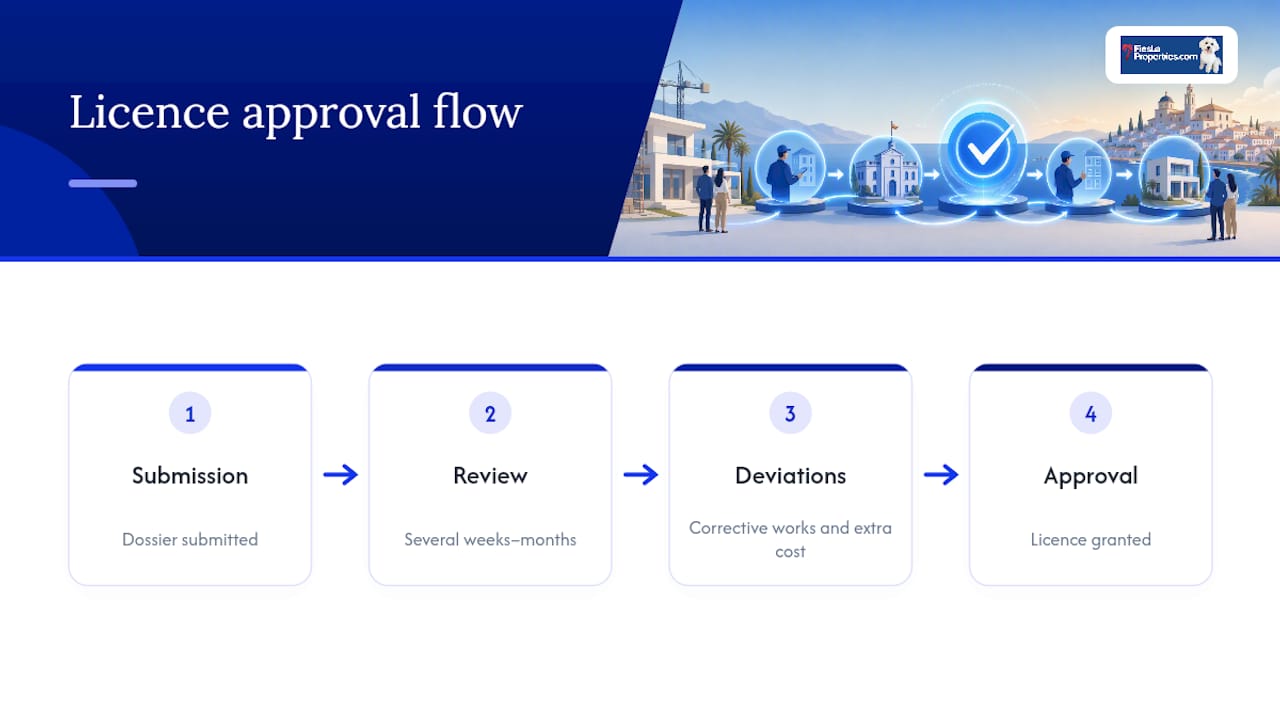
On new builds, the developer usually absorbs architect fees and municipal charges as part of the build cost; on resales, the seller conventionally arranges any outstanding paperwork before marketing the property. Once a complete dossier reaches the town hall, processing commonly takes several weeks to a few months, though timescales vary sharply by municipality and by how busy the local planning office is. The most common cause of delay is an incomplete file or a deviation between the built property and the approved project, which can trigger a demand for corrective works and additional cost before the licence is granted.
Regularising a property with no licence
When a property was built with unauthorised changes, deviations from the approved project, or simply never had the paperwork completed, regularisation is sometimes possible but rarely quick. Realistic routes include:
- Corrective works to bring the building back in line with the approved project.
- Retrospective legalisation, where permitted, for minor deviations.
- Rural regularisation schemes (AFO or DAFO), used in limited cases for older rural buildings outside the standard licensing framework.
Where deviations are too severe to correct, the town hall can refuse the licence outright, and legalisation costs can run high enough to eat into any margin on a sale. If you inherit or discover this situation, instruct a lawyer and an architect together, early, to get a realistic cost and timescale estimate before committing further funds.
How Fiesta Properties approaches licence checks for buyers
Licence verification is not an afterthought we bolt on after an offer is accepted. Fiesta Properties builds it into the due diligence stage of every transaction we handle, requesting documentary proof of the LPO or its regional equivalent directly from the developer or seller before recommending a buyer proceed to contract.
Where a licence has not yet been granted, particularly on off-plan purchases, we work to make delivery of that paperwork a condition of completion rather than leaving it to trust. If you are further along in a purchase and unsure whether the property you are considering has the right documentation, it is worth asking us to check the status before you sign anything binding.
Get help checking a property’s paperwork before you commit
Chasing a town hall for licence confirmation, cross-referencing an architect’s certificate, and reading a Spanish building file are not things most buyers want to do alone, especially from abroad. Licence and documentation checks should be built into every property purchase, so you do not have to rely solely on a developer’s assurances before signing.

Whether you are looking at a new build property in Costa Blanca or a resale that needs its paperwork double-checked, our buying process covers exactly this kind of verification alongside liaison with developers and conveyancers on your behalf. If you already have a property in mind, consider asking a professional to confirm its occupancy licence status before you commit to completion.
Where to verify licence status yourself
- Your property’s local town hall planning office (urbanismo) holds the definitive record of licence status.
- Regional housing departments can confirm whether a cédula de habitabilidad applies in that community.
- A specialist property lawyer can cross-check documents against municipal records rather than relying on developer summaries alone.
Always confirm directly with the municipal planning office. Summaries, including this one, are a starting point, not a substitute for a written answer from the town hall itself.
Sources
- Licencia primera ocupacion Spain – Waypoint Sur guide
- First occupation licence Spain: what buyers must check — Costa Luz Lawyers
- Licence of First Occupation in Spain (LFO) explained — Platinum Legal Spain
- Occupation licence vs certificate of habitability in Spain — Sandin Abogados 2025
- Cédula de habitabilidad: Spain’s habitability certificate — Buvivo 2026 guide