





An escritura is the notarised public deed that formally records a property transfer in Spain. The RAE defines escritura in its legal sense as a public document signed before a notary, and in property transactions this document is the decisive proof of ownership. Once signed, it creates binding obligations between buyer and seller immediately. Full legal protection against third parties, however, only takes effect once the deed is inscribed at the Registro de la Propiedad.
At the moment of signing, buyers should act on four points without delay:
-
Confirm that your full legal name, NIE number, and the property’s cadastral reference appear correctly in the deed before you sign.
-
Collect the copia autorizada (the certified copy issued by the notary) on the day, as this is the document needed for registration and administrative procedures.
-
Arrange for a gestor or lawyer to submit the deed to the Registro de la Propiedad and pay any applicable transfer tax or stamp duty within 30 days of signing.
-
Keep all receipts and official correspondence from the notary, as these form part of the tax and registration paper trail.
Key takeaways
An escritura is the notarised public deed that transfers property ownership in Spain, and registration at the Registro de la Propiedad is what secures that ownership against third parties.
| Point | Details |
|---|---|
| Definition of escritura | A notarised public deed (escritura pública) authenticated by a Spanish notary, creating legal title between the parties. |
| Registration is essential | Inscription at the Registro de la Propiedad protects ownership against third parties and establishes legal priority. |
| Check before you sign | Order a fresh nota simple and verify the cadastral reference at sedecatastro.gob.es within days of the notary appointment. |
| Budget for additional costs | Notary fees typically fall in the — range; transfer tax (ITP) or VAT and AJD add significantly to the purchase price depending on property type and region. |
| Fiestaproperties local support | Fiestaproperties connects buyers in Costa Blanca and Murcia with trusted lawyers and gestores for deed checks, notary coordination, and post-signing registration. |
Table of Contents
-
How does an escritura differ from a nota simple and a private contract?
-
What are the typical costs of signing and registering an escritura?
-
Practical checklist for buyers at signing and immediately afterwards
-
How Fiestaproperties supports buyers through the escritura process
What legally counts as an escritura in Spain?
The word escritura derives from Latin and carries a range of meanings in everyday Spanish, from general writing to handwriting and script. In a property context, though, the term is used exclusively to refer to the escritura pública, the notarised public deed authenticated by a Spanish notary. The Cambridge Dictionary and bilingual resources such as SpanishDict both confirm this dual usage, which is why the term can confuse buyers encountering it for the first time on paperwork.
The notary’s role is central to what makes an escritura legally valid. Under Spanish law, a notary holds fe pública notarial, meaning their attestation gives the document the status of a public instrument. As Emilio Pino Lawyers explain, an escritura pública is signed, sealed, and recorded by a notary, and property deeds are normally submitted to the Land Registry for registration. Without notarial intervention, a deed is simply a private agreement and carries far less legal weight.
Several types of escritura appear in property transactions:
-
Escritura de compraventa: The standard purchase deed, signed when a property sale completes. SpanishDict translates this as the deed signed before a notary to complete the purchase.
-
Escritura de hipoteca: The mortgage deed, executed when a lender registers a charge over the property.
-
Escritura de donación: A deed of gift, used when property is transferred without payment.
-
Escritura de división horizontal / parcelación: Used to divide a building into separate registered units, or to subdivide land.
Pro Tip: If you receive paperwork described simply as a ‘contrato’ rather than an ‘escritura pública’, it has not yet been notarised. A private contract is binding between the parties, but it does not create a registered title. Always confirm that the final document is an escritura pública before treating the transaction as complete.
What information does a property escritura contain?
A valid escritura de compraventa follows a structured format, and knowing what to look for helps buyers spot errors or missing clauses before signing. The deed opens with the identities of all parties, including full legal names, passport or DNI numbers, NIE numbers for foreign nationals, and marital status where relevant. The agreed purchase price and the payment method are stated explicitly, alongside the date of the contract.
The property description section is particularly detailed. It records the full address, the cadastral reference number, the surface area, the boundaries, and any fixtures or fittings included in the sale. The cadastral reference is the key link between the deed and the official Spanish cadastre; buyers can cross-check this at Sedecatastro to confirm that the description in the deed matches the official cadastral record. Discrepancies here are one of the most common sources of post-sale disputes.
The deed also records any charges or encumbrances attached to the property:
-
Existing mortgages, including the outstanding balance and the lender’s details.
-
Liens or embargoes registered against the property.
-
Easements, rights of way, or other restrictions on use.
-
Community of owners’ obligations, including any outstanding community fees.
Key contractual clauses cover the payment schedule, any conditions precedent (such as mortgage approval or planning confirmation), and the parties’ rights and obligations at completion.
Pro Tip: Watch for clauses that describe the sale as subject to conditions that have not yet been met, or that transfer obligations for outstanding debts to the buyer. Phrases such as ‘libre de cargas’ (free of charges) should be verified against a fresh nota simple, not simply accepted on the seller’s word.
How does an escritura differ from a nota simple and a private contract?
Buyers in Spain typically encounter three main documents during a purchase, and understanding the role of each prevents confusion about which one actually transfers ownership.
The nota simple is an informative extract issued by the Registro de la Propiedad. It shows who is registered as the current owner, the property’s description as recorded at the Registry, and any charges or encumbrances registered against it. A nota simple does not transfer ownership and has no contractual force. Its value lies in verification: ordered before signing, it confirms that the seller is who they say they are and that no hidden charges exist.
The private contract (contrato privado de compraventa) is the agreement signed between buyer and seller before the notary appointment. It is legally binding between the parties and typically records the agreed price, the deposit paid, and the conditions of the sale. This contract is conditional, however, and does not create a registered title.
The escritura is the document that completes the transaction. Once signed before a notary, it supersedes the private contract and creates the formal, authenticated record of the transfer.
In a typical purchase timeline:
-
The buyer orders a nota simple to check the current registered position.
-
The parties sign a private contract and the buyer pays a deposit.
-
Both parties attend the notary to sign the escritura de compraventa.
-
The deed is submitted to the Registro de la Propiedad for inscription.
What happens at the notary when you sign the escritura?
The notary appointment is the formal completion of the purchase. The notary’s role goes well beyond witnessing signatures: they verify the identities of all parties, confirm that the property is correctly described, check that outstanding mortgages or charges have been settled or are being cancelled simultaneously, and confirm that applicable tax and statutory requirements have been met.
Step-by-step signing process
-
Appointment confirmation: Both buyer and seller (or their legal representatives with a valid power of attorney) attend the notary’s office at the agreed time.
-
Identity verification: The notary checks passports, NIE certificates or TIE cards, and any powers of attorney. Foreign buyers without a NIE cannot complete.
-
Reading of the deed: The notary reads or summarises the deed aloud. Buyers who do not speak Spanish have the right to a sworn translator; in practice, many notaries in tourist areas have bilingual staff, but arranging a translator in advance is advisable.
-
Confirmation of funds: Proof of cleared funds, typically a bank cheque (cheque bancario) or confirmation of a bank transfer, is presented and recorded in the deed.
-
Signing: All parties sign each page of the deed. The notary signs and seals the document, giving it the status of a public instrument.
-
Delivery of the copia autorizada: The notary issues the certified copy to the buyer on the day or within a short period. This copy is needed for registration and for administrative procedures such as utility transfers.
Documents to bring to the notary
-
Valid passport or national identity document.
-
NIE certificate or TIE card (mandatory for foreign buyers).
-
The signed private contract and any prior correspondence.
-
Bank cheque or transfer confirmation for the purchase price balance.
-
Power of attorney if a representative is signing on your behalf (must be apostilled if executed outside Spain).
-
Proof of payment of any agreed deposit.
The Gov recommends that UK buyers use a qualified independent lawyer throughout the process, including at the notary stage.
Why registration at the Registro de la Propiedad matters
Signing the escritura transfers ownership between the parties, but registration at the Registro de la Propiedad is what protects that ownership against third parties. The Registradores explain that the Registry provides a public record of property rights, and inscription creates a legal presumption that the registered owner holds valid title. Until the deed is inscribed, a subsequent buyer or creditor who registers first could, in certain circumstances, take priority.
Registration also triggers the principle of fe pública registral: once a right is inscribed, third parties acting in good faith and relying on the Registry record are protected. This is the practical reason why buyers should never delay submission of the deed.
Key points about registration:
-
The deed is typically submitted by a gestor or lawyer within days of signing.
-
The Registro issues a nota de despacho confirming receipt and the date of entry, which establishes the priority date.
-
Inscription can take several weeks, depending on the Registry’s workload and whether any queries arise.
-
During the interval between submission and inscription, the buyer’s priority is protected from the date of the initial entry (asiento de presentación).
-
Once inscribed, buyers can order a new nota simple to confirm the registration in their name.
If other charges appear in the Registry between signing and inscription, a lawyer should be consulted immediately to assess whether the submission date protects the buyer’s priority.
What are the typical costs of signing and registering an escritura?
Buyers should budget for several distinct cost items beyond the purchase price. The amounts vary by region, by whether the property is a new build or a resale, and by the purchase price itself.
Regional variation in ITP is significant. Andalucía, Valencia, and Murcia each set their own rates, so buyers must confirm the applicable rate for their specific autonomous community before completion.
Pro Tip: For new-build purchases, confirm in writing with the developer whether the price quoted is inclusive or exclusive of VAT and AJD. Fiestaproperties’s guide on buying new-build homes in Spain covers these costs in detail.
Common pitfalls buyers face with escrituras
Most problems with escrituras stem from insufficient checks before signing rather than errors in the deed itself. Understanding the most frequent issues allows buyers to address them before they become costly.
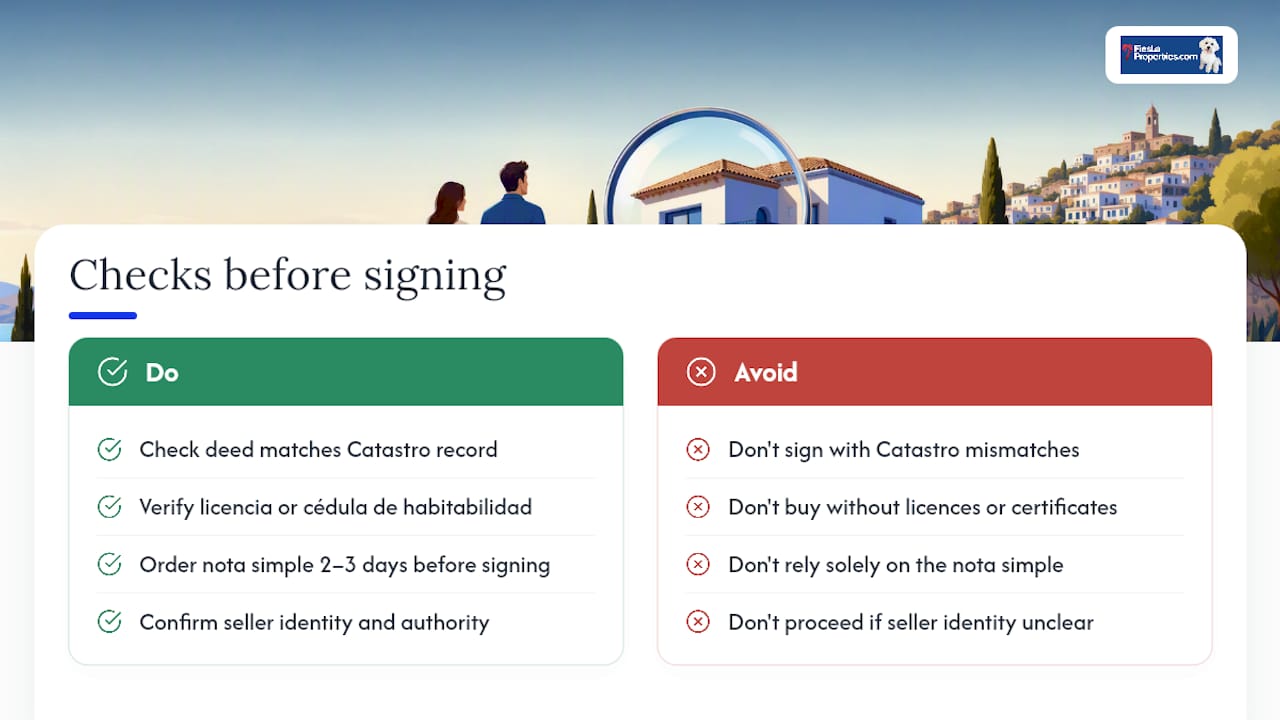
Mismatch with the Catastro: The property description in the deed must align with the cadastral record at sedecatastro.gob.es. Discrepancies in surface area, boundaries, or cadastral reference are common, particularly in older properties. A mismatch does not automatically block a sale, but it can complicate future transactions and mortgage applications.
Missing licences or occupancy certificates: In Spain, a property requires a licencia de primera ocupación (first occupation licence) or cédula de habitabilidad (habitation certificate) to be legally occupied. Some properties, particularly rural or older builds, lack these documents. Buying without them can affect the ability to connect utilities, obtain a mortgage, or resell.
Undisclosed debts and liens: Community fees, local taxes (IBI), and utility debts can attach to the property rather than the seller personally. A nota simple shows registered charges, but community debts may not appear there. Requesting a certificate from the community of owners confirming no outstanding fees is a standard precaution.
Seller identity discrepancies: The name on the deed must match the name registered at the Registro de la Propiedad exactly. Inherited properties or properties held in company names require additional documentation to confirm the seller’s authority to sell.
Pro Tip: Order a fresh nota simple no more than two to three days before the notary appointment. Conveyancing guides, including the SpanishPropertyInsight escritura FAQ, consistently recommend this as the single most effective check against last-minute charges or registrations. If anything unexpected appears, postpone signing until it is resolved.
How to verify an escritura and obtain official copies
Buyers and owners sometimes need to obtain or verify copies of their escritura, whether for a future sale, a mortgage application, or an administrative procedure. There are three main official routes.
Obtaining a copia autorizada from the notary
-
Contact the notary’s office where the deed was signed and request a copia autorizada.
-
Provide proof of identity and your connection to the deed (as buyer, seller, or authorised representative).
-
Pay the notary’s fee for issuing the copy; the amount is modest and set by official tariff.
-
The copia autorizada carries the notary’s seal and signature and is accepted by the Registro de la Propiedad and public administrations.
Checking the Registro de la Propiedad
-
A nota simple can be ordered online through the official Registradores portal or in person at the relevant Registry office.
-
A certificación registral provides a more detailed and legally binding extract; it is advisable when there is any doubt about encumbrances or ownership history.
-
The nota simple costs a small fee and is typically available within one to two working days online.
Verifying the cadastral record
-
Visit sedecatastro.gob.es and search by cadastral reference, address, or owner name.
-
The cadastral record shows the official surface area, boundaries, and cadastral value (valor catastral), which is used to calculate IBI and other taxes.
-
Cross-reference the cadastral reference shown in the deed against the Catastro entry to confirm they match.
Recommended sequence before completion
-
Order a fresh nota simple from the Registro de la Propiedad.
-
Check the cadastral record at sedecatastro.gob.es against the deed description.
-
Request a certificación registral if any encumbrances or ownership queries remain unresolved.
-
Retain all official receipts and copies for tax submissions and future administrative use.
The GOV.UK guidance for UK buyers specifically recommends instructing a qualified lawyer to carry out these checks independently of the seller’s agent.
How to correct mistakes in an escritura
Errors in an escritura are more common than buyers expect, particularly in older deeds where property descriptions may not reflect subsequent extensions or boundary changes. The correction route depends on the nature of the error.
Minor clerical errors (a misspelled name, an incorrect digit in the cadastral reference) can often be corrected by a notarial rectification deed (acta de rectificación). Both parties return to the notary, the error is identified and corrected, and the rectification is submitted to the Registro.
Substantive errors (incorrect surface area, missing charges, wrong parties) require a new deed or, in contested cases, a court order. The Registro de la Propiedad may also raise a calificación negativa, refusing inscription if the deed contains errors or inconsistencies. In that case, the registrar issues a written explanation of the defect, and the parties have a set period to correct and resubmit.
Subsequent changes to the property, such as a division into separate units, a change of use, or the cancellation of a mortgage charge, each require a new escritura. Common examples include:
-
Escritura de cancelación de hipoteca: cancels a mortgage charge once the loan is repaid; the lender must cooperate and the deed must be submitted to the Registro.
-
Escritura de división horizontal: divides a building into separate registered properties.
-
Escritura de segregación: splits a plot of land into two or more separate cadastral units.
When the Registro refuses inscription or when ownership is genuinely contested, instructing a Spanish property lawyer is the appropriate step. Timescales for corrections vary: a simple notarial rectification can be resolved within days, while a contested matter requiring court intervention may take considerably longer.
Practical checklist for buyers at signing and immediately afterwards
Before signing
-
Confirm that the nota simple ordered within the past few days matches the property description in the draft deed.
-
Check that your full legal name, NIE number, and nationality are recorded correctly in the deed.
-
Verify that the cadastral reference in the deed matches the entry at sedecatastro.gob.es.
-
Confirm that all agreed conditions precedent (mortgage approval, licence confirmation) have been satisfied.
-
Arrange a sworn translator if you are not confident reading the deed in Spanish.
At signing
-
Collect the copia autorizada from the notary before leaving the office.
-
Confirm that cleared funds have been received and recorded in the deed.
-
Note the notary’s protocol number and office details; you will need these to request further copies later.
-
Check that any simultaneous mortgage cancellation by the seller has been executed and will be submitted to the Registro.
Within 30 days of signing
-
Submit the escritura to the Registro de la Propiedad (usually handled by your gestor or lawyer).
-
Pay transfer tax (ITP) or VAT and AJD to the relevant regional tax authority; the 30-day deadline is strict and late payment attracts surcharges.
-
Notify utility providers (electricity, water, gas) of the change of ownership and arrange transfer of accounts into your name.
-
Contact your insurer to update or arrange buildings insurance from the date of completion.
-
Update your address for IBI (local property tax) billing with the local council (ayuntamiento).
Pro Tip: Buyers who use a gestor for the tax and registration submissions should request written confirmation of each submission date and the corresponding receipt. These records are needed for future tax returns and for any subsequent sale.
A note from Mike at Fiestaproperties
Having worked alongside buyers in Costa Blanca since 2010, the team at Fiestaproperties has seen first-hand how the escritura process can feel unfamiliar, particularly for buyers completing their first Spanish purchase. The document itself is straightforward once you know what to look for, but the surrounding steps, the notary appointment, the tax deadlines, and the registration process, require careful coordination.
Fiestaproperties works with trusted local lawyers and gestores who can guide buyers through the signing process, check the deed for accuracy, and manage the post-signing submissions.
The reassurance that comes from having local support at the notary, and in the weeks that follow, is something buyers consistently find valuable, particularly when navigating an unfamiliar legal system in a second language.
How Fiestaproperties supports buyers through the escritura process
Buying property in Costa Blanca or Murcia involves more than finding the right home. The legal and administrative steps that follow, from the notary appointment to registration and tax filings, require local knowledge and reliable contacts.

Fiestaproperties has been guiding buyers through the full property purchase process in Costa Blanca since 2010, with a network of over 3,000 properties spanning new builds, off-plan developments, and resale homes. The team connects buyers with trusted independent lawyers and gestores who handle deed checks, notary coordination, and post-signing registrations, so nothing falls through the gaps between signing and inscription. Whether you are purchasing a new-build apartment in Costa Blanca or a resale villa, having an experienced local team alongside you at every stage makes the difference between a smooth completion and an avoidable delay. Contact Fiestaproperties directly to discuss your purchase and arrange personalised guidance from the notary stage onwards.
Sources
The following official sources are the most reliable references for buyers verifying an escritura or navigating the Spanish property purchase process.
This article is general information, not a substitute for advice from a qualified lawyer. Consult a qualified legal professional about your own circumstances before acting on anything here.