





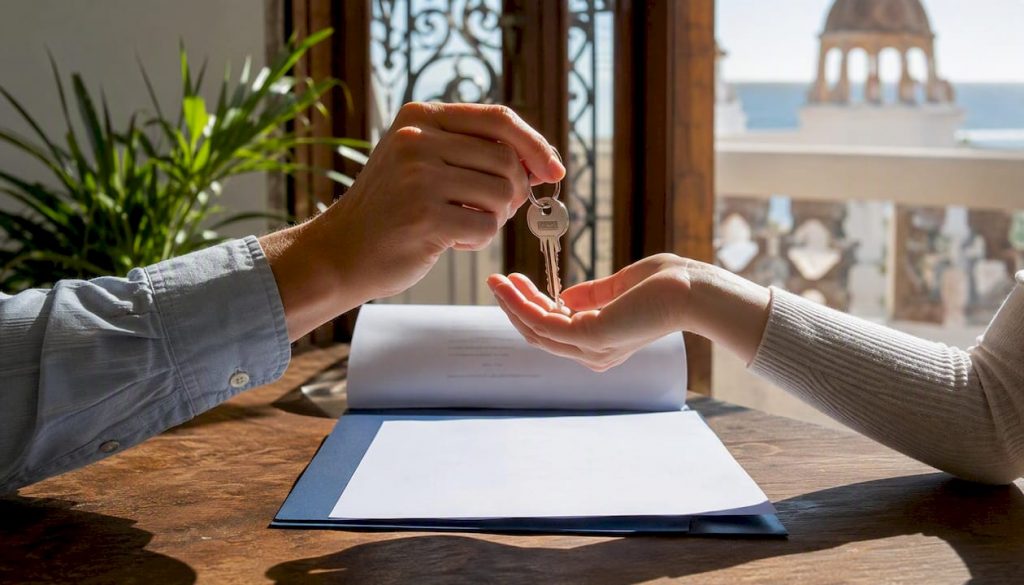
Completion in Spain happens at a single moment: signing the escritura pública before a notary. That signature transfers legal ownership from seller to buyer, and it is the one decisive event in the whole purchase, unlike the two-stage exchange-and-completion process familiar to British buyers.
In brief: once the deed is signed, you become the legal owner and keys are usually handed over there and then. Full public protection, however, only arrives once the deed is registered at the Registro de la Propiedad, the Land Registry that records who owns what across Spain. That gap between signing and registration matters more than most buyers realise, and it shapes almost everything in this guide.
Key Takeaways
Completion in Spain is legally decisive at the notary signing, but full protection and tax compliance depend on strict follow-up action within days, not months.
| Point | Details |
|---|---|
| Notary signing is completion | Ownership transfers when the escritura is signed; registration afterwards gives public protection. |
| The 30-day tax deadline is strict | File and pay ITP or VAT/AJD within 30 days of signing to avoid automatic surcharges. |
| Order a fresh nota simple | Request an updated nota simple 24 to 48 hours before signing to catch last-minute charges. |
| Non-resident tax runs beyond 3% | Sellers must file a separate return after the 3% withholding; owners face ongoing annual filings. |
| Get local support early | Fiestaproperties coordinates gestores, notaries and developers to help buyers avoid completion-day delays. |
Table of Contents
- The completion process in Spain: stages from offer to signing
- What documents do buyers and sellers need before completion?
- How much does completion cost and who pays it?
- How long does it take to complete a property purchase in Spain?
- What actually happens at the notary on completion day?
- What happens immediately after the escritura is signed?
- What extra steps apply to new-build and off-plan purchases?
- How does a mortgage affect the completion timeline?
- What legal pitfalls should you watch for at completion?
- Do you need a gestor, and what should you ask them?
- What should foreign buyers prepare for translation and certification?
- What tax obligations do non-residents face beyond the 3% retention?
- Frequently asked questions
- Sources
The completion process in Spain: stages from offer to signing
Spanish completion is a sequence of fixed stages, each with its own paperwork and its own opportunity to go wrong. Here is the order most transactions follow:
- Accepted offer. Price and terms agreed verbally or by email between buyer and seller.
- Reservation deposit. A small holding sum, often €3,000 to €6,000, taken off the market while contracts are prepared.
- Contrato de arras. The private deposit contract, typically 10% of the purchase price, which legally binds both parties and fixes the completion date.
- Mortgage finalisation, if you’re borrowing, including valuation and a binding offer from the lender.
- Pre-completion checks, covering the nota simple, debts, and licences (covered fully below).
- Notary appointment and signing of the escritura.
- Submission of the deed to the Land Registry for formal registration.
Timing varies sharply by purchase type. Cash buyers can move from accepted offer to keys in six to twelve weeks; mortgage-backed purchases usually run longer, often eight to sixteen weeks, once valuation and binding-offer delays are factored in.
Pro Tip: Never hand deposit money directly to a seller or developer. Route it through your lawyer’s client account or a regulated escrow arrangement, so if the deal collapses, you have a clear paper trail and a real chance of recovering your money.
Under the standard arras penitenciales format, walking away costs you the deposit; a seller who pulls out must return double. That asymmetry is worth understanding before you sign anything.
What documents do buyers and sellers need before completion?
Both sides arrive at the notary with a paper trail. Missing even one item can delay signing by weeks.
Buyers should have:
- A current nota simple from the Land Registry confirming ownership and any charges
- An NIE (foreigner identification number)
- A Spanish bank account, since most banks won’t accept deposits without one
- Proof of funds or a confirmed banker’s draft
- A binding mortgage offer, if applicable, noting Spain’s common 10-day cooling-off period before acceptance
Sellers should have:
- Original title deeds and an up-to-date nota simple
- The latest IBI (property tax) receipt
- A certificate from the comunidad de propietarios confirming no unpaid community fees
- An energy performance certificate
- For new builds, the licencia de primera ocupación and final certificado de obra
Cross-check that the cadastral reference and boundaries on the nota simple actually match what’s on the ground. Confirm community debts are clear, since unpaid charges can attach to the property rather than the previous owner. Order a fresh nota simple 24 to 48 hours before signing, because charges can appear between your initial check and completion day.
How much does completion cost and who pays it?
Taxes and fees due at completion follow a fairly predictable pattern, though the exact rate depends on region and property type.
- Resale properties: buyer pays transfer tax (ITP), which varies by autonomous community, commonly in the range of 6% to 10% of the declared value.
- New builds: buyer pays VAT (typically 10%, or 4% for certain protected housing) plus AJD (stamp duty), rather than ITP.
- Notary fees: usually split by local custom, though the buyer conventionally covers the copy used for registration.
- Land Registry fees: paid by the buyer, calculated on a sliding scale tied to purchase price.
- Gestor or lawyer fees: paid by whichever party engaged them, agreed upfront as a fixed fee or percentage.
The tax filing deadline is strict: ITP, or VAT and AJD for new builds, must be settled and filed within 30 days of signing the escritura. Miss that window and you face surcharges and interest, calculated automatically by the tax office rather than negotiated case by case. This is one deadline where “I’ll get to it” genuinely costs money.
How long does it take to complete a property purchase in Spain?
Cash purchases move fastest, often wrapping up within six to eight weeks once arras is signed. Mortgage-backed purchases need extra time for valuation, underwriting, and that 10-day cooling-off period on the binding offer, commonly pushing the total closer to three or four months. Off-plan purchases run longest of all, tied to the developer’s own construction schedule rather than anything the buyer controls.
Delays most often trace back to four causes: a mortgage valuation lower than the agreed price, missing or mismatched paperwork, unpaid community debts surfacing late, or developer delays on new-build handover. Ordering your nota simple close to the signing date, keeping funds ready in a Spanish account, and starting the mortgage process early all reduce the odds of a stalled completion.
What actually happens at the notary on completion day?
Completion day itself is short, usually 30 to 45 minutes, but every step matters.
- The notary checks identity documents for buyer, seller, and any representatives present.
- The escritura is read aloud in Spanish, covering price, property description, and any charges.
- Buyer and seller sign; a bank representative may attend if a mortgage is involved.
- The buyer hands over a certified banker’s draft or confirms a verified transfer.
- Keys are handed over, typically at the same appointment.
Buyers, sellers, the notary, and sometimes a bank representative all attend. If you can’t be there in person, a power of attorney is common and workable, and a sworn translator (traductor jurado) should attend if you don’t speak Spanish fluently.
Pro Tip: Personal cheques are almost never accepted at Spanish notaries. Arrange a certified cheque bancario or a fully confirmed bank transfer well in advance, and double-check the deed description matches your nota simple before you sign anything.
What happens immediately after the escritura is signed?
Signing transfers ownership, but it isn’t the end of the paperwork. The notary sends the signed escritura to the Land Registry, and registration is what gives you public protection against third-party claims. It typically takes a few weeks to process, though the deed’s protective effect usually dates back to submission.
Within the same window, your gestor should file and pay the transfer tax or VAT/AJD, deal with the municipal plusvalía (a local tax on land value increase, usually a seller liability), and handle any AEAT non-resident withholding obligations. Beyond the tax office, there’s a practical checklist too: transferring utility contracts into your name, notifying the comunidad de propietarios of the change of ownership, and setting up direct debits for IBI and community fees so nothing lapses.
What extra steps apply to new-build and off-plan purchases?
Off-plan completion carries risks that resale purchases don’t, chiefly because you’re paying before the property exists.
- Insist on the licencia de primera ocupación and final certificado de obra before completion, not promised “shortly after.”
- Confirm the developer has provided a bank guarantee or insurance policy covering your staged deposits, as required under Spanish consumer protection rules.
- Check the new build is properly registered at the Land Registry under the developer’s name before you sign.
- Ask for evidence that any developer mortgage on the plot has been cancelled or will be cancelled at completion.
Pro Tip: Get written confirmation that the developer’s mortgage on the land will be cleared at, or before, your signing. Otherwise your new home could carry someone else’s unpaid debt.
How does a mortgage affect the completion timeline?
Financing adds several moving parts to what is otherwise a fairly linear process. Spanish banks typically require a formal valuation of the property before issuing a binding offer, and that valuation can come in below the agreed price, particularly on older resale stock, forcing renegotiation or a larger deposit at short notice.
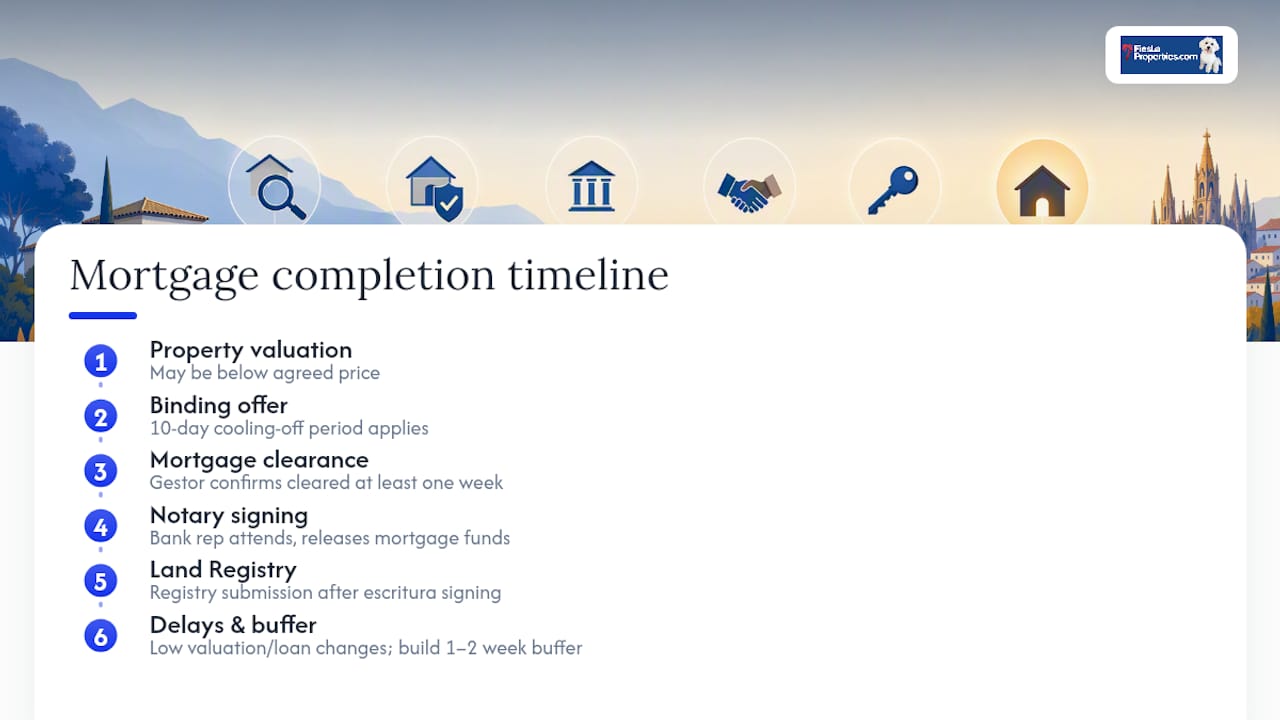
Once a binding offer arrives, borrowers are entitled to a 10-day cooling-off period before accepting it, which has to be built into your completion date rather than treated as a formality. Sign the notary appointment too early and you risk a clash with that mandatory reflection window.
On the day itself, a bank representative usually attends the notary signing to release mortgage funds directly, so the timing of transfer, escritura signing, and Land Registry submission all need to line up in the right order. Any last-minute change to the loan amount or the property valuation can force a rescheduled appointment, which is why most gestores confirm the mortgage is fully cleared to complete at least a week before booking the notary slot. Non-resident buyers face an added layer: some Spanish lenders cap loan-to-value ratios lower for non-residents, often around 60% to 70% rather than the 80% available to residents, which changes how much cash needs to be ready in your Spanish account before signing.
Building in a buffer of a week or two between mortgage approval and the scheduled completion date is one of the simplest ways to absorb any last-minute lender query without losing your notary slot.
What legal pitfalls should you watch for at completion?
Most completion disputes trace back to a handful of recurring mistakes rather than exotic legal problems.
The first is signing arras without full due diligence, committing 10% of the price before the nota simple has been checked properly. If undisclosed charges or debts surface afterwards, unwinding the contract is far harder than it would have been beforehand. Always check the nota simple before, not after, signing the private contract.
The second is a mismatch between the cadastral registration and what’s physically built, common on older rural properties or those with informal extensions. A boundary or floor-area discrepancy can block registration entirely after you’ve already paid.
The third is community debt attaching to the property rather than the previous owner, which is why the certificate from the comunidad de propietarios is not optional paperwork, it’s a genuine financial safeguard.
The fourth, and one foreign buyers underestimate most, is relying on informal translations of the escritura rather than a sworn translator or independent legal review. The notary confirms the deed is legally valid, but that isn’t the same as confirming you understood every clause and every charge attached to the property, and a notary generally won’t flag a bad commercial decision, only an illegal one.
The single best defence against all four is independent legal advice engaged early, not brought in to firefight once the arras is already signed.
Do you need a gestor, and what should you ask them?
A gestor (or independent conveyancing lawyer) handles the administrative and tax side of completion that a notary won’t touch: filing transfer tax, registering the deed, and chasing paperwork between banks, town halls, and the Land Registry. Notaries verify legality and authenticate signatures, but they represent neither party, so a gestor or lawyer acting purely in your interest fills a genuinely different role.
Before appointing one, ask a few direct questions. Are their fees fixed or percentage-based, and what exactly is included? Will they personally attend the notary signing, or send a junior colleague? Can they act under a power of attorney if you can’t be present? Do they have direct experience with your specific property type, resale, new build, or rural land with cadastral quirks tend to throw up different problems.
Ask, too, how they handle the 30-day tax deadline in practice, whether they file it as a matter of course or whether you need to chase them. A good gestor treats that deadline as non-negotiable, because surcharges and interest apply automatically once it passes, regardless of whose fault the delay was.
Fees vary, but a fixed-fee arrangement agreed in writing before you start avoids disputes later. Word-of-mouth recommendations from other foreign buyers in the same area are often more reliable than online directories, since local reputation tends to reflect how a gestor actually performs under pressure, not just their marketing.
What should foreign buyers prepare for translation and certification?
Foreign buyers face two separate administrative tracks that need starting well before completion, not the week of.
The first is the NIE, the Número de Identificación de Extranjero, which is mandatory for any property transaction and can be applied for through a Spanish consulate in your home country or in Spain itself. Processing times vary by consulate, so this should be one of the very first steps taken, ideally before you’ve even signed arras.
The second is translation and certification. If you don’t speak fluent Spanish, a sworn translator, traductor jurado, should attend the notary appointment to translate the escritura in real time. This isn’t a courtesy, it’s how you demonstrate genuine understanding of what you’re signing. Separately, if you sign a power of attorney outside Spain to let a lawyer or representative complete on your behalf, that document typically needs a Hague Apostille before a Spanish notary will accept it. Apostilling and legalising documents abroad can take several weeks depending on your country’s process, so this needs to sit on your timeline from the very start, not as a last-minute add-on when you realise you can’t fly out for signing day.
What tax obligations do non-residents face beyond the 3% retention?
The 3% withholding on the purchase price, deducted by the buyer from a non-resident seller and paid directly to AEAT, is only the opening move in a longer tax relationship with Spain, not the end of it.
A separate tax return has to be filed afterwards to calculate the actual gain and either claim back any overpayment or settle the balance owed. Skipping that return doesn’t make the liability disappear; it just leaves an open obligation with the tax authority.
For non-resident buyers who go on to own the property, there are ongoing annual obligations too. Non-resident property owners in Spain typically file an annual imputed income tax return (Modelo 210) even when the property isn’t rented out, based on a notional rental value of the cadastral value. If the property is let, actual rental income needs declaring, and the tax treatment differs depending on whether you’re resident in an EU/EEA country or elsewhere. None of this is optional bureaucracy: AEAT enforces these filings, and gaps in your tax history can complicate a future sale.
A gestor familiar with non-resident taxation is worth engaging early, not just at completion, because the annual filing cycle starts the moment you own the property, not when you next visit.
A local agent’s view on completion day
The mistakes we see most often are late funds, missing community debt certificates, and buyers assuming a verbal translation is enough. Book notary slots early, confirm bank draft lead times, and only use a power of attorney with an apostille already sorted.
Need help completing a purchase in Costa Blanca or Murcia?
Fiestaproperties is the practical alternative to piecing this process together alone: our team coordinates directly with local gestores, notaries, and developers, so document gaps and missed deadlines get caught before they cost you money, not after.

We support buyers through the entire buying process, from nota simple checks and NIE guidance through to notary day itself, drawing on more than a decade of transactions across Costa Blanca and Murcia. If you’re weighing up new-build or resale stock, our current Costa Blanca South listings are a good starting point. Get in touch through the buying process page to talk through your timeline and have your completion date planned properly from the outset.
Frequently asked questions
What is the completion process for buying property in Spain?
It centres on signing the escritura pública before a notary, which transfers legal ownership, followed by registration at the Land Registry for full public protection.
How long does the Spanish property completion process take?
Cash purchases often complete in six to eight weeks from accepted offer; mortgage-backed purchases usually take longer, and off-plan timelines depend on the developer’s build schedule.
Do I need to be in Spain to complete on a property?
No. A power of attorney lets a representative sign on your behalf, though if it’s signed outside Spain it typically needs a Hague Apostille to be accepted by the notary.
What tax deadline applies after completion in Spain?
Transfer tax (ITP), or VAT and AJD for new builds, must generally be filed and paid within 30 days of signing the escritura to avoid surcharges.
It’s a withholding a buyer deducts from a non-resident seller’s proceeds and pays to AEAT as an advance against Capital Gains Tax; the seller must still file a separate tax return afterwards.
This article is general information, not a substitute for advice from a qualified lawyer. Consult a qualified legal professional about your own circumstances before acting on anything here.