





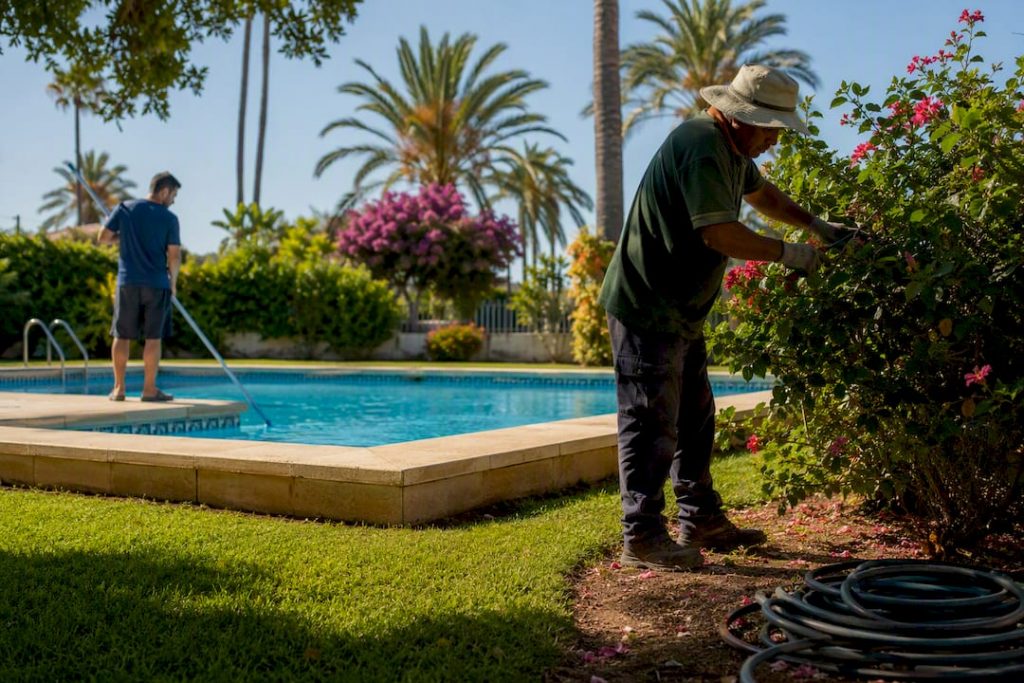
Community fees, known locally as cuota de comunidad, are mandatory monthly or quarterly contributions paid by every owner in a comunidad de propietarios to cover the shared running costs of a building or urbanisation. Spain’s Ley de Propiedad Horizontal (LPH) makes this a legal obligation under Article 9, not a discretionary charge you can opt out of once you own a flat or townhouse within a shared development.
For a UK buyer weighing up an apartment on the Costa Blanca, the numbers vary hugely by property type:
- Basic apartments with no shared amenities often sit at €50 to €120 a month.
- Complexes with a pool and communal gardens typically run €150 to €350.
- Luxury developments with concierge, security, or extensive grounds can exceed €400 to €700 or more.
The community should also hold a reserve fund, commonly kept at around 10% of the annual budget as a buffer against major repairs. Before completion, always request the community certificate confirming the seller has no outstanding debts.
Key Takeaways
Community fees in Spain are a statutory obligation under the LPH, and unpaid quotas can transfer to a new owner unless a debts certificate is obtained before completion.
| Point | Details |
|---|---|
| Legal basis | Article 9 of the LPH obliges every owner to contribute to shared building costs. |
| Cost bands vary widely | Fees range from €50 a month for basic flats to €700+ for luxury complexes with security. |
| Derramas are separate | Extraordinary levies for major repairs need an AGM vote and land on top of regular fees. |
| Debts attach to the property | Always get the certificado de estar al corriente before completion, not after. |
| Fiestaproperties checks fees for you | The firm requests certificates, reviews minutes, and flags reserve fund risks before you buy. |
Table of Contents
- What do community fees in Spain actually cover?
- How much are community fees in Spain?
- Ordinary expenses versus derramas: what’s the difference?
- How are community fees calculated, and who is legally liable?
- How are payments collected and administered?
- What happens if community fees go unpaid?
- Can landlords pass community fees to tenants in Spain?
- What should UK buyers check before completing on a Spanish property?
- How Fiestaproperties checks community fees for buyers
- Get help checking community fees before you buy
- Frequently asked questions about community fees in Spain
- Sources
What do community fees in Spain actually cover?
Your monthly quota funds the everyday costs of keeping a shared building or urbanisation functioning. That typically includes buildings insurance, communal cleaning, lift maintenance, pool upkeep, garden care, and the administrator’s fee. It does not cover your local property tax (IBI), your own utility bills, or contents insurance for your individual unit, all of which stay entirely your responsibility.
The legal foundation is the Ley de Propiedad Horizontal, and Article 9 specifically obliges every owner to contribute to general expenses that cannot reasonably be split out and billed individually. This applies whether you use the pool once a year or never set foot near it.
Governance runs through the junta de propietarios (the owners’ assembly), which elects a president and usually appoints an administrador de fincas to handle day-to-day administration and hold the funds in a dedicated community account. If you ever want to dispute a charge, the LPH and your community’s own statutes, agreed at the AGM, are what you cite. Vague objections rarely get anywhere; a specific clause reference usually does.
How much are community fees in Spain?
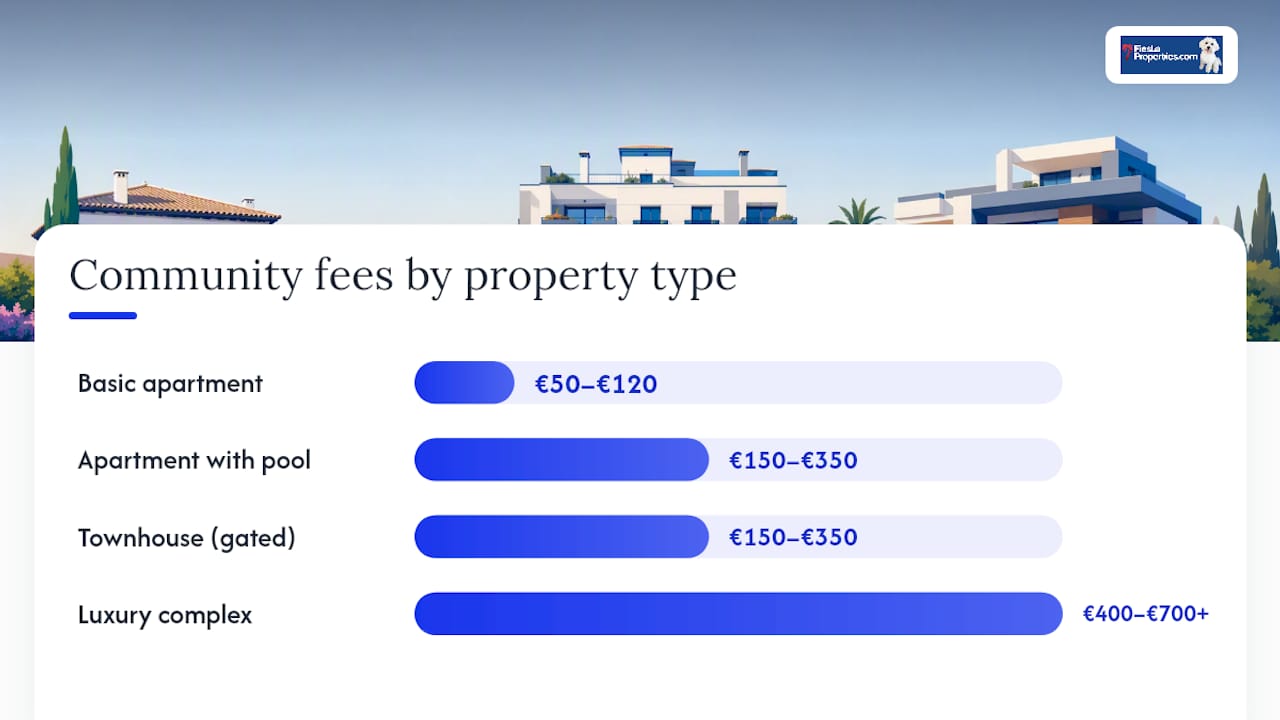
Cost bands vary enormously depending on what the community actually offers. A no-frills apartment block with a lift and basic cleaning might sit at the lower end, while a gated urbanisation with pools, landscaped gardens, and 24-hour security climbs steeply from there.
| Property type | Typical monthly range |
|---|---|
| Basic apartment (lift, cleaning only) | €50–€120 |
| Apartment with communal pool | €150–€350 |
| Townhouse in gated urbanisation | €150 to €350 |
| Luxury complex with concierge/security | €400–€700+ |
Several factors push these figures up or down: the number of units sharing costs (more owners usually means lower individual quotas), the building’s age and maintenance backlog, how healthy the reserve fund is, and simple geography. A development near Marbella with manicured grounds and staffed security will always cost more to run than a comparable block in a quieter Costa Blanca town.
Here’s a quick worked example. A community with an annual budget of €60,000 spread across owners whose combined coeficiente de participación totals 100% might allocate 1.2% to your unit, giving an annual fee of €720, or €60 a month. That’s before any derrama lands.
Fees can genuinely range from next to nothing to several hundred euros monthly, and a one-off derrama for a roof or lift replacement can add thousands in a single year regardless of how low your regular quota looks on paper.
Ordinary expenses versus derramas: what’s the difference?
Gastos ordinarios are the routine, budgeted costs baked into your regular quota: cleaning contracts, insurance premiums, lift servicing, pool chemicals. These get approved annually at the general assembly and rarely surprise anyone who reads the paperwork.
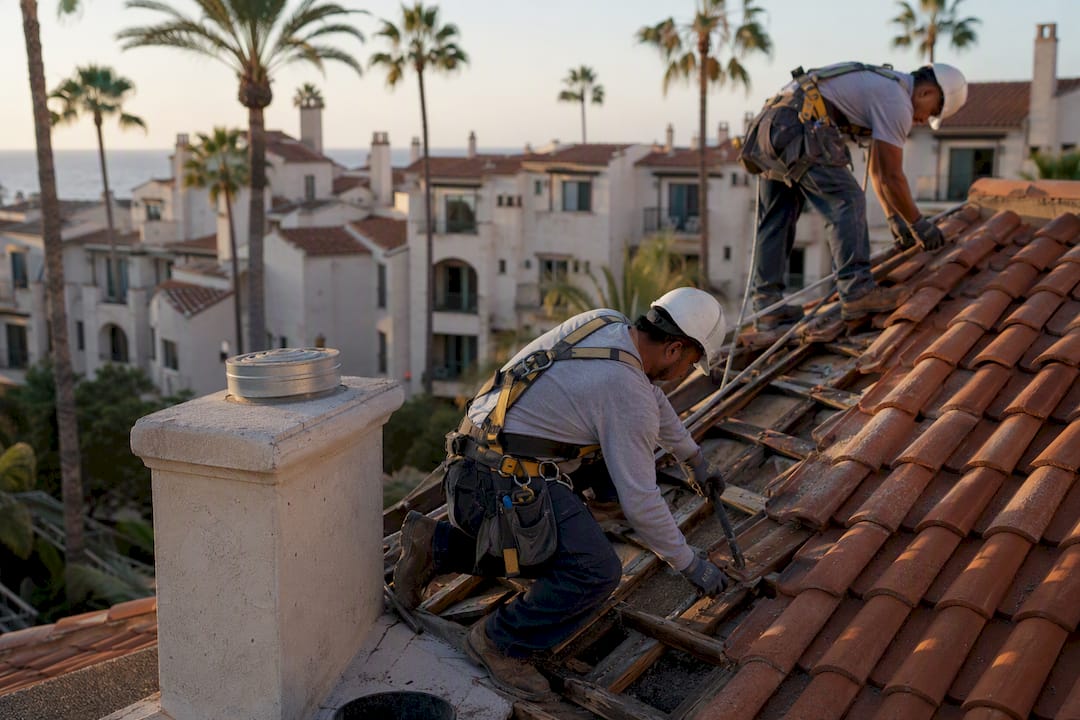
Derramas are different. These are extraordinary, one-off assessments raised to fund capital works that the reserve fund cannot cover, and they need a qualified majority vote at an AGM or an extraordinary meeting called specifically for the purpose. Common triggers include roof replacement, lift overhauls, façade repairs, pool resurfacing, or funding a legal dispute.
Communities either draw on the reserve fund first or, if that’s depleted, levy owners immediately with a fixed payment deadline. Either way, you’re liable for your share once the vote passes, even if you weren’t at the meeting.
Pro Tip: Ask to see the last 12 months of AGM minutes and the current reserve fund balance before you commit to a purchase. If a derrama vote is already scheduled, that cost belongs to you as the incoming owner, not the seller.
How are community fees calculated, and who is legally liable?
Most communities divide costs using the coeficiente de participación, a percentage assigned to each unit and recorded permanently in the property’s escritura (title deed). It’s typically based on floor area, floor level, and sometimes aspect or terrace size, and it determines your exact share of every euro the community spends.
The calculation is straightforward: total annual budget divided by the sum of all coefficients gives you the rate per percentage point. A €50,000 annual budget with your unit assigned 2% means you owe €1,000 for the year, or roughly €83 a month.
Some smaller communities skip the coefficient system entirely and charge a flat fee per unit regardless of size, which tends to disadvantage owners of the smallest apartments.
Liability sits with the property, not just the person who racked up the debt. If a seller has unpaid quotas, those arrears can attach to the unit and transfer to you as the new owner unless you obtain a current debts certificate before completion. This single document protects you from inheriting someone else’s unpaid history.
How are payments collected and administered?
Most communities collect fees by direct debit on a quarterly cycle, though bank transfer remains common in smaller, informally run blocks. Invoices and payment requests typically come from the treasurer or the appointed administrador de fincas, who also manages the dedicated community bank account and prepares annual accounts for the AGM.
Pro Tip: Before exchange, always request the last three bank statements, the most recent annual accounts, and 12 months of meeting minutes. Gaps in any of these are worth querying directly.
Very small, older communities sometimes still handle cash informally with no proper account at all. For a UK buyer used to transparent paper trails, that’s a clear red flag worth raising with your solicitor.
What happens if community fees go unpaid?
Non-payment follows a fairly predictable path, and it’s worth understanding before you ever consider skipping a payment or buying into a community with existing arrears.
- Friendly reminders. The administrator or president contacts the owner directly, usually by letter or email, requesting payment.
- Formal demand. If ignored, a formal written demand follows, often citing the specific LPH articles that make the debt enforceable.
- Judicial claim. The community can take the matter to court, seeking a court order for payment plus accrued interest and legal costs.
- Enforcement. Where a court order still isn’t satisfied, enforcement can extend to embargo of the property, and in the most severe cases, forced auction.
Solicitors handling Spanish property purchases routinely flag this as one of the most overlooked risks for British buyers: a debt attached to a property doesn’t disappear just because ownership changes hands. Getting proper legal advice before exchange, not after, is what actually protects you.
If you discover arrears during due diligence, act in this order: request the official debts certificate immediately, ask your solicitor to make completion conditional on a clean certificate, negotiate a price reduction to cover outstanding sums if the seller won’t clear them first, and never rely on a verbal assurance that “it’s all sorted.”
Can landlords pass community fees to tenants in Spain?
Under Spain’s rental law (LAU), the property owner remains legally responsible for community fees. Landlords can pass ordinary fees on to a tenant, but only when the exact amount and frequency are written explicitly into the Contrato de Arrendamiento. A vague reference won’t hold up if disputed.
- Tenants are never liable for derramas. Extraordinary levies stay with the landlord regardless of what the lease says.
- If you’re renting out a Spanish property, spell out the euro figure and payment schedule in the contract itself.
- If you’re a tenant, check listings carefully for “gastos de comunidad incluidos” (included) versus “no incluidos” (excluded) before signing anything.
What should UK buyers check before completing on a Spanish property?
Due diligence on community fees is where deals genuinely go wrong for British buyers, and it’s entirely avoidable with the right paperwork requests.
Ask your solicitor or gestor to obtain:
- The certificado de estar al corriente de pagos, confirming the seller owes nothing to the community.
- The last three to twelve months of AGM minutes.
- The most recent annual accounts and current reserve fund balance.
- Recent community bank statements.
- The community statutes and the escritura, showing your unit’s participation coefficient.
Watch for red flags: a reserve fund sitting well below the usual 10% benchmark, a recently approved or pending derrama, a high percentage of owners in arrears, or unresolved legal disputes mentioned in the minutes. Ask the seller or administrator directly about the reserve balance, any recent fee increases, and pending votes. Solicitors advising UK buyers generally recommend delaying completion until every one of these documents checks out clean.
A low monthly fee can be misleading if it’s masking deferred maintenance rather than genuine efficiency. Cheap isn’t always cheaper once a derrama lands.
How Fiestaproperties checks community fees for buyers
Fiestaproperties builds community fee verification into every purchase it supports, because it’s one of the most common places British buyers get caught out.
- Requesting the community certificate and confirming there are no outstanding debts attached to the property.
- Obtaining recent AGM minutes and checking the reserve fund balance against the property’s age and condition.
- Estimating realistic running costs and flagging any recently approved or upcoming derramas before you commit.
Fiestaproperties also translates the paperwork, liaises directly with the administrador de fincas on your behalf, and connects you with trusted local solicitors when a deeper legal check is needed. Get in touch and ask for a community-fee check on a specific property before you make an offer.
A UK agent’s view: what actually catches buyers out
The surprise is rarely the monthly fee itself. It’s the derrama nobody mentioned during viewings. My advice: never complete without the certificado de deudas in hand.
Get help checking community fees before you buy
Community fee documents are written in Spanish, held by administrators who may not respond quickly to overseas buyers, and full of detail that’s easy to misread under time pressure. Fiestaproperties bridges that gap for UK buyers by handling the checks directly with the administrador de fincas, rather than leaving you to chase paperwork from a distance.

That means requesting the community debts certificate, reviewing recent minutes and reserve fund figures, and translating anything that isn’t immediately clear, all before you’re locked into a purchase. If you’re browsing properties for sale in Costa Blanca South or considering a new build development, get in touch and ask for a community-fee check on the specific property you have in mind before you make an offer.
Frequently asked questions about community fees in Spain
Do all Spanish properties have community fees?
Only properties within a comunidad de propietarios, meaning apartments, townhouses in shared urbanisations, or developments with communal areas. A standalone villa with no shared facilities typically has none.
Can I refuse to pay community fees if I disagree with a charge?
No. Article 9 of the LPH makes payment mandatory regardless of individual disputes; you challenge charges through the AGM or legally, not by withholding payment.
How often are community fees paid in Spain?
Most communities collect quarterly by direct debit, though some smaller blocks use monthly or annual schedules depending on their statutes.
Do community fees affect mortgage eligibility or resale value?
Lenders and buyers both factor ongoing costs into affordability, and a poorly managed community with high fees or looming derramas can make a property harder to sell or finance.
What’s the difference between community fees and IBI?
Community fees fund shared building costs; IBI is the annual local property tax paid to the town hall and is entirely separate.
This article is general information, not a substitute for advice from a qualified lawyer. Consult a qualified legal professional about your own circumstances before acting on anything here.