






If you’re a UK resident selling property in Spain, expect Spanish capital gains tax to apply at the flat rate charged to non-EU sellers post-Brexit, generally higher than the rate for EU/EEA non-residents. At completion, the buyer will withhold 3% of the sale price and pay it to the Spanish tax authorities using modelo 211. That withholding is only an advance payment, not your final bill.
You then have four months to file modelo 210, reconcile the true gain, and either pay any shortfall or claim back an overpayment. Spanish tax residents use modelo 100 instead, during the annual campaign. Either way, the sale also needs reporting to HMRC.
At completion, you need to:
- Confirm the buyer has actually filed modelo 211 and holds a payment receipt, since buyers carry joint liability for the withholding
- Gather every invoice for acquisition costs and capital improvements before the four-month clock starts
- Diarise the modelo 210 deadline and, separately, your UK Self-Assessment reporting obligation
24% is the flat non-resident rate that generally applies to UK sellers, against 19% for EU/EEA residents and 19-30% on the progressive scale for Spanish tax residents.
Key Takeaways
| Point | Details |
|---|---|
| Expect the flat rate | Non-resident UK sellers are typically taxed at 24%, not the 19% EU/EEA rate. |
| Withholding is not final | The 3% held back via modelo 211 is an advance payment, reconciled through modelo 210. |
| Four months to file | Modelo 210 must be filed within four months of completion to reconcile or claim a refund. |
| Invoices decide the gain | Documented improvements and acquisition costs reduce the taxable gain far more than most sellers expect. |
| Plusvalía is separate | The municipal land-value tax is distinct from capital gains tax and often forgotten until completion. |
If you’re weighing up selling this year, Fiestaproperties’ buying and selling process guide sets out how the agency supports sellers through documentation and buyer sourcing, alongside its wider Costa Blanca South listings for anyone considering their next move in the region.
Table of Contents
- How Hacienda calculates the taxable gain
- The 3% withholding and your filing deadlines
- What costs can you actually deduct?
- Can you claim the main-home or over-65 exemption?
- Plusvalía municipal: the separate tax people forget
- Reporting the sale to HMRC and claiming treaty relief
- Mistakes UK sellers keep making, and a pre-sale checklist
- What the conventional advice gets wrong
- Sources
How Hacienda calculates the taxable gain
The Spanish tax authority, Hacienda, works from a simple formula: sale value minus acquisition value, adjusted for allowable costs on both sides. Get the adjustments right and the taxable gain can shrink substantially.
On the acquisition side, you can add back:
- The original purchase price stated in the deed
- Transfer tax (ITP) or VAT and AJD stamp duty paid at purchase
- Notary, land registry, and legal fees from the original purchase
- Documented capital improvements carried out since
On the sale side, deduct the estate agent’s commission and your own legal fees for the sale itself. Hacienda calculates everything in euros, so currency movements between your purchase date and sale date genuinely change the taxable gain, even if nothing changed in sterling terms. Keep a record of the exchange rate you used on each date.
A quick worked example: you bought for €200,000 in 2015, paid €16,000 in ITP and fees, and spent €25,000 on a documented extension. Your adjusted acquisition cost is €241,000. You sell for €340,000, minus €17,000 in agent commission and legal fees, giving a net sale value of €323,000. The taxable gain is €82,000, and deductible costs here have already cut the raw €140,000 headline gain by more than 40%.
The 3% withholding and your filing deadlines
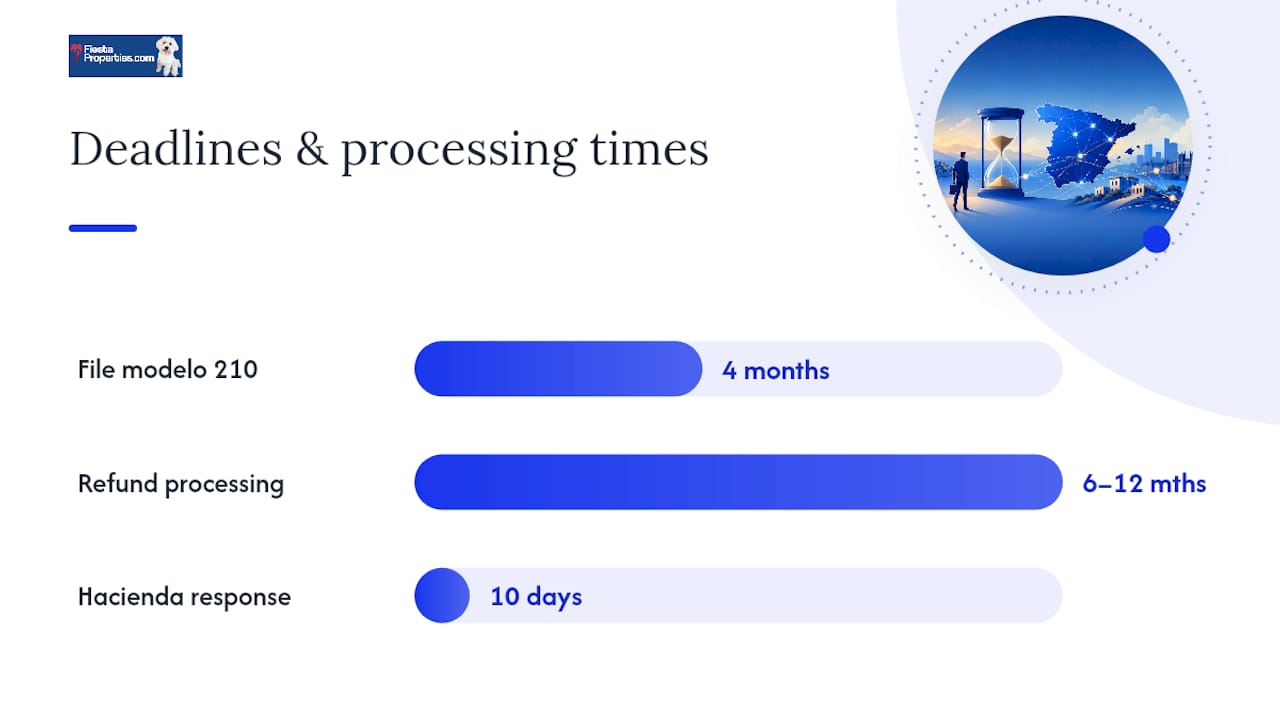
That figure rarely matches your actual tax bill. If your real liability is lower, you’re owed a refund; if it’s higher, you owe the difference. Either way, non-resident sellers must file modelo 210 within four months of completion to reconcile the position. Residents for tax purposes use modelo 100 in the standard annual campaign instead.
Refunds are not quick. Expect six to twelve months for Hacienda to process and pay a refund, and it’s common for the tax office to open a documentation request midway through.
- Keep the deed, all purchase and improvement invoices, and proof of the 3% payment together in one file
- Respond fast if Hacienda asks for supporting paperwork, since a slow reply can stall the refund further
- Consider whether a Spanish gestor should hold copies on your behalf once you’re back in the UK
Pro Tip: Hacienda’s document requests often carry a tight 10-day response window. If you’re back in the UK by then, a gestor who already holds your paperwork can respond same-day instead of waiting for scanned copies to reach you.
What costs can you actually deduct?
The line between deductible improvement and non-deductible maintenance catches out more UK sellers than any other part of this process. Improvements that change or extend the property, a new roof, an extension, rewiring, a swimming pool, generally qualify. Routine maintenance, repainting, boiler servicing, gutter clearing, does not.
Hacienda wants proper invoices (facturas) showing the contractor’s tax identification number, a description of the work, and the amount paid, ideally matched to a bank transfer rather than cash. Well-documented improvements materially reduce your taxable gain, so it’s worth chasing down paperwork before you list rather than after you’ve completed.
If invoices from years ago have gone missing, don’t assume the deduction is lost. Hacienda will often accept a reconstructed dossier: notary copies, bank statements showing payments to a named contractor, and even a sworn statement from the supplier confirming the work.
- Contact the original contractor or supplier, if still trading, for a duplicate invoice
- Pull historic bank statements covering the payment dates as corroborating evidence
- Present everything as one organised file rather than loose scans, since a scattered submission invites a longer review
Pro Tip: Weak evidence rarely means Hacienda rejects the deduction outright. It’s more likely to trigger a slower review, so submit your reconstructed dossier as one complete package rather than in stages.
Can you claim the main-home or over-65 exemption?
Almost certainly not, if you’re selling as a non-resident, and this is the single most common misunderstanding among UK sellers. Both reliefs are built around Spanish tax residency, not simply owning and using the property.
- The reinvestment exemption requires putting the sale proceeds into a new main home within a two-year window, either side of the sale, and reinvesting only part of the proceeds gives a proportional, not full, exemption
- The over-65 habitual residence exemption carries the same strict residency and occupation tests, and non-residents typically cannot meet them since the property must genuinely be your main home, not a holiday base
- Becoming a Spanish tax resident ahead of a sale is sometimes floated as a workaround, but it triggers its own worldwide income and wealth tax consequences, so it needs proper advice before assuming it helps
Plusvalía municipal: the separate tax people forget
Plusvalía municipal is a town hall tax on the increase in land value during your ownership, entirely separate from the capital gains tax you pay to Hacienda. Many UK sellers only discover it exists when the notary raises it at completion.
Since a 2021 Constitutional Court ruling, you can generally choose between two calculation routes: an objective formula based on cadastral value and years of ownership, or a method based on the actual gain in land value. Choose whichever produces the lower liability.
- The town hall usually expects payment within 30 days of completion
- If you, as seller, bear the plusvalía cost rather than the buyer, it can be added to your deductible costs for the CGT calculation
- Ask the notary or your gestor to run both calculation methods before you commit to either
Reporting the sale to HMRC and claiming treaty relief
Spain has the first right to tax a gain on Spanish property, but you still need to declare the sale on your UK Self-Assessment return. The double taxation treaty between the two countries means you can generally claim a foreign tax credit for Spanish tax already paid, rather than paying twice.
The two calculations rarely match exactly, because UK and Spanish rules treat allowable costs and reliefs differently. If your UK CGT liability works out higher than what you’ve paid Hacienda, you’ll owe HMRC the difference; if Spain’s bill is higher, the credit simply offsets what you owe in the UK.
HMRC will typically want to see:
- Proof of Spanish tax paid, including your filed modelo 210 and the receipt for the 3% withholding
- The completion statement and deed showing sale price and date
- Invoices for acquisition costs and improvements used in your Spanish calculation
Pro Tip: Don’t wait for the Spanish refund to land before filing your UK return. Report the sale and the tax paid to date, then amend the UK figures once Hacienda’s reconciliation is final.
Mistakes UK sellers keep making, and a pre-sale checklist
The same handful of errors turn up again and again, and nearly all of them are avoidable with a bit of preparation before the property goes on the market.
The most common mistakes:
- Selling without gathering improvement invoices first, then trying to reconstruct evidence under time pressure
- Overlooking plusvalía municipal entirely until the notary raises it at completion
- Missing the four-month modelo 210 deadline, which can mean losing the straightforward route to a refund
- Assuming the 3% withholding is the final tax bill and never filing to claim back an overpayment
Before listing, assemble the original purchase deed, every invoice for capital improvements, proof of ITP or VAT paid at purchase, your NIE (Número de Identidad de Extranjero), and a valid energy performance certificate. If you don’t yet hold an NIE, you’ll need to apply through the Spanish consulate in the UK or a police station in Spain, since it’s required on every tax filing tied to the sale.
Pro Tip: File modelo 210 as soon as the four-month window allows, rather than waiting until the deadline. Refunds already take six to twelve months, so an early filing date shortens the wait.
Getting these filings wrong doesn’t just cause delay. Late or incorrect modelo 210 submissions can attract surcharges and interest on top of the tax due, on a sliding scale depending on how late the filing is, so treat the four-month window as fixed rather than flexible.
How a Spanish agent supports UK sellers through this process
Fiestaproperties works with sellers across Costa Blanca and Murcia on exactly this kind of paperwork, alongside marketing and buyer sourcing. Having a local agent involved from the start tends to keep the compliance side on track.
- Coordinating with the buyer’s representative to confirm modelo 211 is actually filed at completion
- Helping sellers assemble the invoice trail Hacienda expects before the modelo 210 deadline
- Flagging plusvalía and NIE requirements early, rather than at the notary’s desk
What the conventional advice gets wrong
It’s a deposit, not a tax bill, and sellers who fixate on it often neglect the part that genuinely determines what they owe: the paperwork trail behind acquisition costs and improvements.
The bigger failure I see in how this gets discussed is the assumption that exemptions are worth chasing for non-residents. They rarely are. The main-home and over-65 reliefs are built for Spanish tax residents, and trying to engineer residency purely to access them usually creates more tax exposure than it saves, through worldwide income and wealth tax rules most sellers haven’t considered.
If you take one thing from this, prioritise the invoices, not the exemptions. A well-documented improvement history can cut a taxable gain by tens of thousands of euros. Chasing a residency-based exemption you likely don’t qualify for is time spent on the wrong problem entirely.
— Mike
Sources
For the underlying rules rather than summaries of them, go direct to the source.
- Agencia Tributaria — capital gains for non‑residents (practical guidance)
- Taxes for Expats — capital gains tax in Spain
- Frank Partners — plusvalía and non‑resident sale practical guide
This article is general information, not a substitute for advice from a qualified financial advisor. Consult a qualified financial professional about your own circumstances before acting on anything here.