






Yes, a UK buyer can complete a property purchase in Murcia, and the process follows a well-established legal path that thousands of British buyers have used since the region opened up to international buyers. The three actions that matter most right now: apply for your NIE (Número de Identificación de Extranjero), instruct an independent Spanish lawyer who works for you and nobody else, and get your funding route sorted, whether that means a Spanish bank account, a currency transfer plan, or a Power of Attorney if you cannot travel for every stage.
Most resale purchases in Murcia run from first viewing to completion in 8 to 12 weeks; cash buyers often move faster, mortgage buyers need longer for valuation and approval. Budget an extra 13% on top of the purchase price for taxes and fees. Expect the whole thing to feel procedural rather than dramatic, provided you have the right people working for you from day one.
Three things to do this week:
-
Apply for your NIE through the Spanish Consulate in London or Manchester, or via a Spanish gestor, since it can take several weeks to come through.
-
Appoint an independent Spanish lawyer, not one suggested solely by the seller or developer, before you sign anything.
-
Decide how you will fund the purchase: open a Spanish bank account, speak to a currency broker, or arrange a Power of Attorney if you will be buying from the UK.
If you want a walkthrough tailored to Murcia’s Costa Cálida market, Fiesta Properties’ buying-process guide sets out exactly how the agency supports each stage.
Key Takeaways
| Point | Details |
|---|---|
| Get your NIE first | Apply through a Spanish Consulate or gestor as early as possible; it can take several weeks and blocks every later stage. |
| Hire an independent lawyer | Choose one not recommended by the seller or developer to avoid conflicts of interest during due diligence. |
| Open a Spanish bank account | Needed for mortgage applications, receiving transfers, and setting up utility direct debits after completion. |
| Budget 10 to 12% extra | Covers ITP or IVA plus AJD, notary, registry, and legal fees on top of the purchase price. |
| Check Valor de Referencia and arras type | A higher reference value raises your ITP bill; confirm your contract uses arras penitenciales for deposit protection. |
| Work with an established local agency | Fiesta Properties has supported UK buyers across Costa Blanca and Murcia since 2010, offering local introductions and paperwork support through completion. |
Table of Contents
The step-by-step buying process in Murcia
Buying property in Murcia follows a fixed sequence, and understanding each stage removes most of the anxiety that catches first-time buyers off guard. The steps are broadly the same whether you are buying a resale villa near Los Alcázares or an off-plan apartment on the Costa Cálida, though the documents involved differ in a few key places.
1. Search and viewings. You shortlist properties, view them (ideally in person, though remote viewings via video call are common for buyers who cannot travel immediately), and narrow down to a firm choice.
2. Reservation deposit (reserva). Once you have chosen a property, you pay a reservation deposit, typically between €3,000 and €6,000, to take it off the market while legal checks are carried out. This is a short, simple document, but it is not legally trivial: read it before signing, because some reservation agreements include forfeiture clauses.
3. Legal due diligence. Your lawyer runs the Nota Simple check, confirms there are no outstanding debts (cargas) on the property, and, for new builds, verifies planning permissions and the habitation licence.
4. Private purchase contract (contrato de arras). This is the document that commits both parties. You typically pay a deposit of around 10% of the purchase price at this stage. Most Murcia contracts use arras penitenciales, meaning you lose your deposit if you withdraw, but the seller must pay you double the deposit back if they pull out.
5. Mortgage offer (if applicable). If you are financing the purchase, your Spanish mortgage offer needs to be in place before completion, which usually means starting the application well before you sign the arras contract.
6. Notary signing (escritura). Both parties sign the title deed in front of a Spanish notary, who verifies identities, confirms the terms, and formally transfers ownership. This is the completion moment.
7. Registration at the Land Registry. Your lawyer registers the new title deed at the Land Registry (Registro de la Propiedad), which finalises your legal ownership on public record.
For new builds, the sequence adds developer-issued payment stage certificates and, crucially, the habitation licence (licencia de primera ocupación), which must exist before you complete.
Documents to have ready:
-
Valid passport
-
NIE certificate
-
Proof of funds or mortgage pre-approval letter
-
Proof of UK address (recent utility bill or bank statement)
-
Spanish bank account details
Pro Tip: If you cannot be in Murcia for every signing, grant Power of Attorney to your lawyer before you leave the UK. It lets them sign on your behalf at the notary and register the property without you needing to fly back for completion, which saves both money and stress.
What you pay and when: taxes and purchase costs
The tax you pay depends entirely on whether you are buying a resale property or a new build, and getting this wrong in your budgeting is the single most common mistake UK buyers make.
For resale properties, you pay Property Transfer Tax (ITP), which in the Region of Murcia runs at around 8% of the purchase price. ITP and AJD are paid shortly after completion, usually within 30 days; IVA is charged by the developer as part of the purchase price itself.
Valor de Referencia: Spain’s tax authority sets a reference value for every property, and ITP is calculated on whichever figure is higher, your agreed purchase price or the Valor de Referencia. If the reference value comes in above what you actually paid, you will be taxed on the higher figure, not your contract price. Ask your lawyer to check this early, since it affects how much cash you need at completion.
On top of the tax itself, budget for:
-
Notary fees, which scale with the purchase price band
-
Land Registry fees for registering the deed
-
Legal fees, commonly around 1.25% to 1.5% of the purchase price
-
Mortgage arrangement fees, if applicable
Total additional costs land somewhere near €20,300 to €20,800, close to the commonly cited 11% to 12% budgeting guideline.
Once you own the property, recurring costs kick in immediately:
-
IBI (annual local property tax), billed by the town hall each year
-
Comunidad fees, if the property sits within a managed development or urbanización
-
Home insurance, which most mortgage lenders require and most sensible buyers arrange regardless
Mortgages, transfers and opening a Spanish bank account
UK buyers can get a Spanish mortgage, but the process differs from a British one in ways that catch people out if they haven’t planned ahead. Non-resident mortgages are available from most major Spanish banks, though lenders require an NIE and full proof of funds before they will even value the property. Loan-to-value ratios for non-residents typically sit lower than for Spanish residents, so expect to fund a larger deposit than you might with a UK mortgage.
Opening a Spanish bank account early solves several problems at once: it gives you somewhere to receive transferred funds, it satisfies mortgage lenders, and it lets you set up direct debits for utilities and IBI once you own the property. Banks generally ask for your passport, NIE, proof of income, and sometimes a UK bank reference.
Moving money from the UK to Spain is where many buyers lose more than they realise. Standard bank transfers carry weaker exchange rates and higher fees than specialist providers; Fiesta properties can recommend Currency brokers to give you the best rates
-
Compare a currency broker against your bank before transferring completion funds
-
Ask about forward contracts if you’re worried about exchange rate movement between now and completion
-
Confirm cut-off times with your bank or broker so funds clear before the notary appointment, not after it
Pro Tip: Book your currency transfer to land in your Spanish account at least three working days before the notary signing. Bank transfers occasionally get delayed by compliance checks, and a missed completion date can mean losing your arras deposit through no fault of your own.
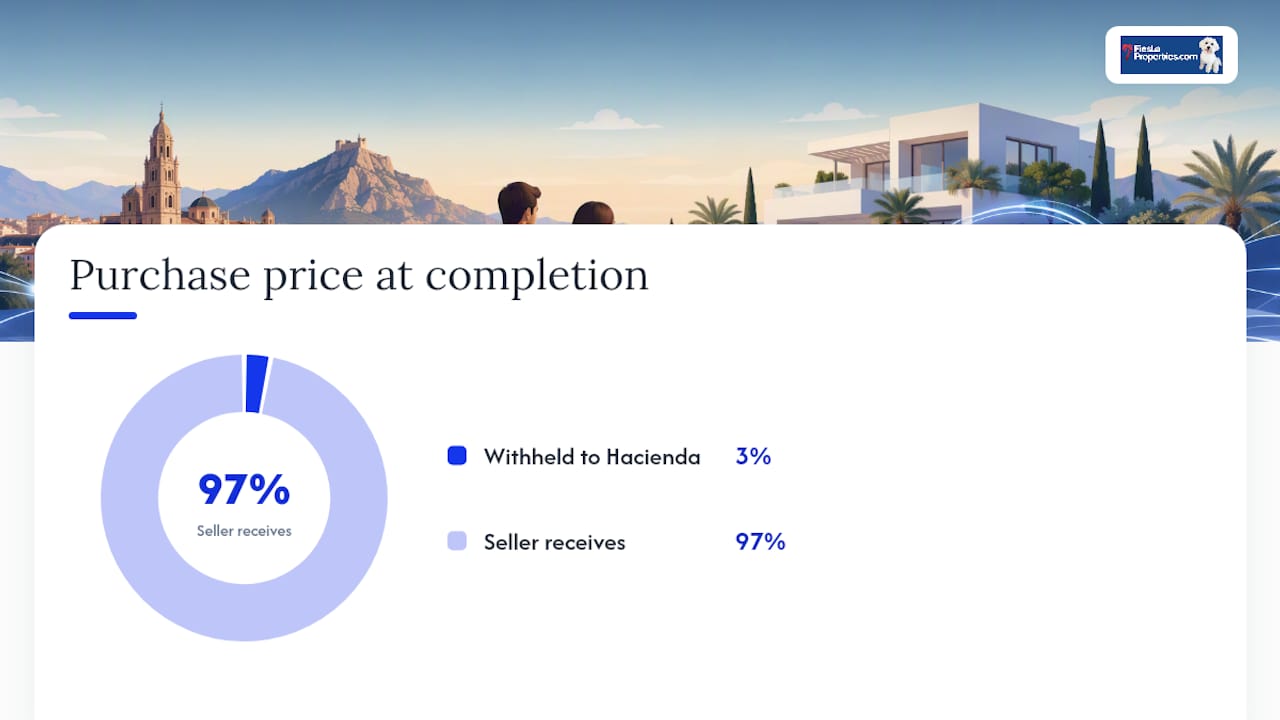
One tax obligation catches many UK buyers by surprise: if you’re buying from a non-resident seller, you will have to withhold 3% of the price and pay it directly to Hacienda as an advance against the seller’s capital gains tax. Your lawyer handles this at completion; you don’t need to calculate it yourself, but you do need to know it reduces the cash that actually reaches the seller, which sometimes needs explaining during negotiation.
Who to hire and what legal due diligence covers
Four professionals matter in a Murcia purchase, and each does a distinct job that the others cannot substitute for.
Your independent Spanish lawyer is the one non-negotiable hire. They run the Nota Simple check, verify there are no debts attached to the property, confirm planning and urbanistic status, and draft or review every contract you sign. Using the lawyer your agent or developer recommends risks a conflict of interest, since that lawyer’s fee often comes, directly or indirectly, from the same transaction they’re meant to be checking on your behalf. An independent lawyer answers only to you.
The notary is a Spanish public official who verifies identities and the legality of the transaction at signing, but the notary does not act for either buyer or seller specifically, so their checks don’t replace your own lawyer’s due diligence.
A gestor handles administrative paperwork, tax filings, and registrations, often working alongside your lawyer rather than instead of them.
A surveyor inspects the physical condition of the property, something Spanish transactions don’t require by law but that UK buyers, used to a formal survey process, should still commission for anything beyond a brand-new build.
Due-diligence checklist your lawyer should complete before you sign the arras contract:
-
Nota Simple confirming ownership and any registered debts (cargas)
-
Confirmation there are no outstanding community fee disputes
-
Habitation licence in place for new builds, or confirmation it’s due before completion
-
Urbanistic status check, particularly important on rural or coastal Murcia plots
-
Water rights and connection confirmed, especially for rural properties
Red flags that should stop you and prompt further investigation: names on the Nota Simple that don’t match the seller you’re dealing with, a missing habitation licence on a supposedly finished new build, unresolved comunidad disputes, or any property flagged as AFO (Declaración de Asimilado a Fuera de Ordenación), which signals an unregularised or partially illegal build.
Common questions worth asking your lawyer directly:
-
Is this ITP or IVA, and has the Valor de Referencia been checked against the agreed price?
-
What type of arras contract are we signing, and what happens if either party withdraws?
-
Are there any pending community assessments or works I would inherit?
Pro Tip: Ask specifically whether your arras contract is “arras penitenciales.” It’s the standard form and it protects you: if the seller pulls out, they owe you double your deposit back. If your lawyer uses different wording, get them to explain the practical difference before you sign.
Realistic timelines and a worked cost example
How long the process takes depends heavily on whether you’re paying cash or financing with a mortgage, and on how quickly the seller’s paperwork is in order.
Total: roughly 8 to 10 weeks.
Total: typically 11 to 14 weeks.
This example assumes the Valor de Referencia sits at or below the agreed purchase price. If the reference value comes in higher, say at €210,000 instead of €200,000, ITP is calculated on that higher figure, adding a further €800 to the tax bill even though you paid the lower agreed price. Always ask your lawyer to check this figure before you finalise your budget.
What extends a timeline beyond these ranges: missing documentation on the seller’s side, developer delays on new builds (particularly around habitation licence issuance), or complex community disputes that need resolving before a lawyer will sign off. The mitigation is the same in every case: start your lawyer’s checks the moment you reserve, not after you’ve signed the arras contract.
What happens after completion
Signing at the notary is not the final step. Your lawyer or gestor still needs to register the deed at the Land Registry, a process that can take several weeks even though your ownership is legally effective from the moment of signing. You’ll receive a copia simple (a simple copy of the deed) immediately, with the fully registered original following later.
Once you own the property, a short list of administrative tasks needs handling promptly:
-
Register with the local town hall for padrón purposes if you’ll be resident, and confirm your IBI billing details
-
Set up utility accounts and direct debits (electricity, water, and if relevant, community fee payments) linked to your Spanish bank account
-
File Modelo 210, the non-resident income tax return, annually if you’re a non-resident owner
-
Arrange buildings and contents insurance, which most mortgage lenders require and every sensible owner should have regardless
Ongoing costs to budget for annually include IBI (varies by council and cadastral value), comunidad fees (varies by development, often higher where pools and gardens are shared), and insurance. If you’re planning to rent the property out or spend long periods away, hand a written checklist to your property manager or gestor covering utility payment dates, IBI deadlines, and who holds keys for emergency access, since unpaid community charges and taxes can attach to the property itself, not just the previous owner.
How Fiesta Properties supports UK buyers through this process
Fiesta Properties has worked with British buyers purchasing in Costa Blanca and Murcia since 2010, and the practical value the agency adds sits mostly in the connective work between stages, the parts that cause delays when nobody is managing them.
The agency helps with property search across Murcia and the wider Costa Cálida, drawing on a network of over 3,000 listings spanning new build, key-ready, and resale properties. Beyond search, the team provides local market advice specific to Murcia’s coastal and inland zones, introductions to independent lawyers and surveyors (never the same lawyer representing both sides), and hands-on assistance coordinating viewings, paperwork, and communication between buyer, seller, and notary.
For a UK buyer managing a purchase remotely, the practical benefit is straightforward: fewer gaps between stages where nothing moves because nobody flagged the next document needed. A typical scenario looks like this: a buyer identifies a resale villa during a short viewing trip, returns to the UK, and completes legal checks, mortgage arrangements, and contract signing entirely from home, coordinated by phone and email, with Power of Attorney covering the notary signing. The stages don’t change, but the coordination between them determines whether the process takes 8 weeks or 16.
If you’re weighing up areas within the region, Fiesta Properties’ guide to Murcia’s Costa Cálida market breaks down the zones and typical buyer profiles for each.
Negotiation strategies and common pitfalls
Negotiating in Murcia works differently from the UK, where offers move fast and gazumping is a live risk. In Spain, once you’ve signed the arras contract, the price is fixed and both sides face real financial consequences for backing out, which gives you room to negotiate hard before that point and then rely on the contract’s protection afterwards.
The most effective lever is time on the market combined with proof of readiness: sellers respond to buyers who can demonstrate funds are in place (a bank statement or mortgage pre-approval) far more than to buyers who simply offer a lower number.
The most common pitfall is negotiating price while skipping due diligence, then discovering a problem, an unpaid comunidad debt, an unregularised extension, a boundary dispute, that costs far more than the discount achieved. Another frequent mistake: agreeing verbally on furniture, fixtures, or completion dates without getting them written into the arras contract, which leaves you with no recourse if the seller changes their mind after signing.
Local market variations across the Murcia region
Murcia is not one market. The coastal Costa Cálida strip around Los Alcázares, San Pedro del Pinatar, and the Mar Menor lagoon behaves very differently from inland towns near the city of Murcia itself or the traditional expat pockets around Mazarrón.
Coastal Costa Cálida properties tend to be priced more affordably than equivalent coastal properties in neighbouring regions, which is part of the appeal for UK buyers, but that lower price point sometimes reflects genuine local risk rather than simple market inefficiency. The Mar Menor’s environmental issues have affected certain waterfront developments and local planning decisions in recent years, and legacy unfinished urbanisations from the pre-2008 building boom still dot parts of the coast. Inland properties, meanwhile, carry different considerations entirely, more traditional Spanish-style villages, different rural building regulations, and often a slower resale market if you’re thinking about exit plans.
None of this means avoid the region; it means investigate the specific development and its history before falling for a headline price. A villa in an established, fully-licensed urbanización with an active, financially healthy comunidad carries a very different risk profile from an identical-looking property in a half-finished development where the developer went bust a decade ago.
Agent perspective: mistakes UK buyers keep making in Murcia
The mistake I see most often isn’t legal ignorance, it’s buyers letting price anchor every other decision. A property that’s €15,000 cheaper than the one next door usually has a reason, and that reason rarely shows up until the Nota Simple check or a conversation with the comunidad administrator. Buyers who insist on due diligence before falling in love with a price tend to end up happier owners, even when they pay slightly more.
The second recurring mistake is trusting a lawyer purely because the selling agent recommended them. That lawyer might be entirely competent, but competence isn’t the issue, independence is. A lawyer whose ongoing referral relationship depends on deals closing has a structural incentive that doesn’t align perfectly with yours. It’s not usually malicious; it’s just not the arrangement that protects you best.
Third: buyers skim the arras contract because it looks like a formality compared to the “real” signing at the notary. It isn’t. The arras contract is where the financial consequences of walking away get fixed in writing, and by the time most buyers ask detailed questions about it, they’ve already signed.
Three practical fixes, drawn from what actually works:
Pro Tip: Ask your lawyer for a written summary of every finding from the Nota Simple check before you sign the arras contract, not after. If they can’t produce one, that’s your answer about how thorough the check actually was.
Pro Tip: Get an independent quote from a second lawyer, even briefly, if the one you’re considering was recommended by the agent or developer. A short paid consultation costs little against a purchase price in the hundreds of thousands.
Pro Tip: On coastal Murcia properties near the Mar Menor or in older urbanisations, ask specifically about the comunidad’s financial health and any environmental restrictions tied to the development, not just the property itself.
Local traps worth naming specifically: urbanización developments with unresolved infrastructure obligations to the town hall, and Mar Menor-adjacent properties where environmental management plans can affect future development rights. Neither is a reason to avoid the region. Both are reasons to have a lawyer who knows Murcia specifically, not just Spanish property law generally.

How Fiesta Properties can help you buy in Murcia
Fiesta Properties gives you what a solo search on portals doesn’t: a local team that already knows which Murcia developments have clean paperwork, which comunidades are financially sound, and which lawyers actually work independently rather than off a referral fee. That local knowledge, built since 2010, is the difference between a purchase that takes 8 weeks and one that drags on for six months chasing missing documents.

When you get in touch, you’ll get a shortlist matched to your budget and priorities across Murcia’s Costa Cálida, straightforward guidance on next steps, and introductions to independent legal and survey professionals if you don’t already have your own. There’s no obligation attached to a first conversation.
The most useful next step is to look through the full breakdown of how the agency supports buyers at each stage on the Fiesta Properties buying-process page, then get in touch to arrange a viewing or a no-obligation chat about what you’re looking for in Murcia. If you’d rather start by browsing what’s currently available, the properties for sale listings are a good place to see the range on offer.
This article is general information, not a substitute for advice from a qualified financial advisor. Consult a qualified financial professional about your own circumstances before acting on anything here.