






Yes, buy-to-let property in Spain remains a sound option for many international investors, but the maths only works if you get three things right from the outset. Gross rental yields in the strongest coastal corridors run comfortably above the national average, yet you need to budget 10 to 15% on top of the purchase price for taxes and fees, and you must verify the property’s rental licence and community-of-owners position before you sign anything. Skip that last step and you can own a flat you are legally barred from letting.
TL;DR:
- Budget at least 10 to 15% of the purchase price for taxes and fees, which vary significantly depending on whether the property is resale or new-build.
- Verify short-term rental licences with regional authorities and review community meeting minutes to avoid buying a property with restrictions on holiday lets.
- Non-resident loans typically cover 60% to 80% of the property value, with fixed or variable rates and extra documentation requirements like translated income proof.
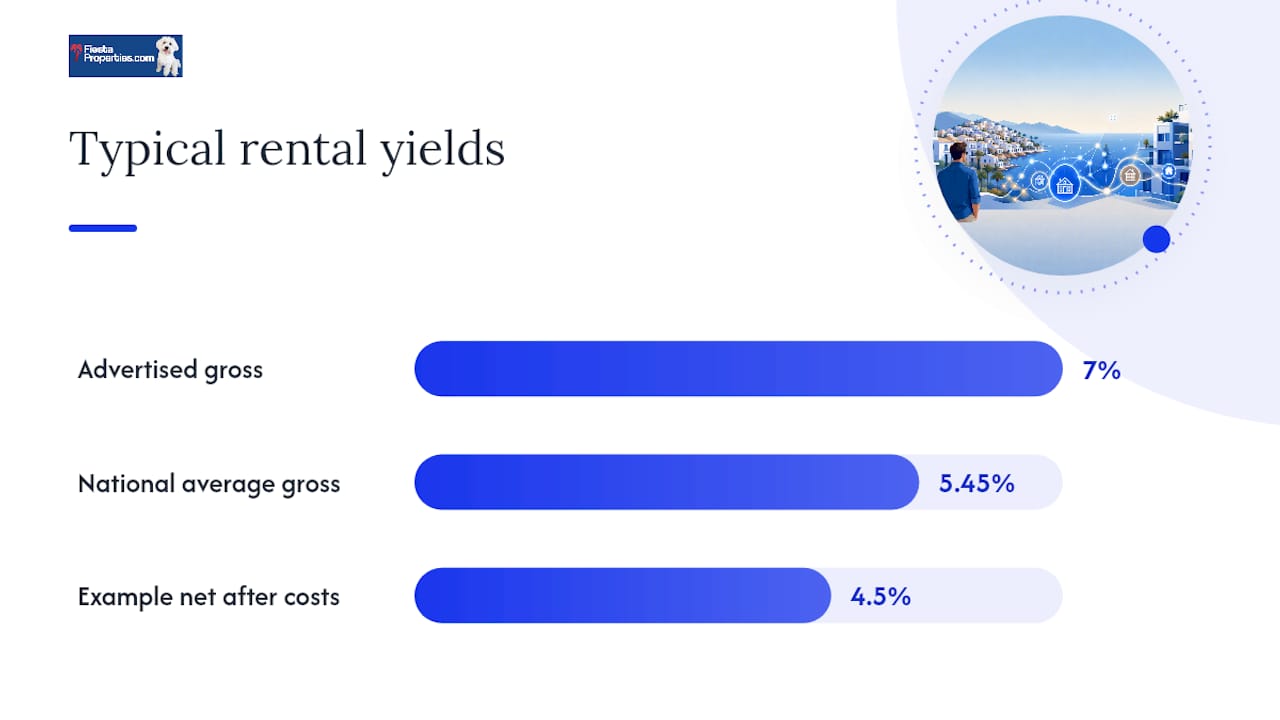
- Gross yields above 5.45% can drop to around 4.5% after costs, so focus on net yield calculations and local demand types for better investment planning.
- Engaging a lawyer to check community restrictions, licences, and land registry details before paying a deposit significantly reduces post-purchase risks.
Table of Contents
- Why and where to invest in buy-to-let property in Spain
- What does buy-to-let cost beyond the purchase price?
- How does the buying process actually work, step by step?
- Can non-residents get a buy-to-let mortgage in Spain?
- Short-term lets or long-term rentals: which works in 2026?
- What should you check before paying a deposit?
- How Fiesta Properties helps buy-to-let investors move faster
- What actually matters when you’re evaluating buy-to-let Spain
- Ready to look at buy-to-let opportunities on the Costa Blanca?
- Where to check the official rules yourself
- Sources
Why and where to invest in buy-to-let property in Spain
The national average gross rental yield sits around 5.45%, which already compares favourably with much of Western Europe. That figure hides a wide spread, though.
Gross and net yield are not the same number, and confusing the two is the single most common mistake first-time buy-to-let investors make in Spain. Gross yield is simply annual rent divided by purchase price. Net yield strips out community fees, IBI (the local property tax), insurance, maintenance, management commission, and income tax. A property advertised with a punchy 7% gross yield can easily fall to 4.5% net once those costs are deducted, particularly for non-EU owners taxed on gross rental income rather than net.
Strip out roughly €1,800 in community fees and insurance, €1,200 in IBI, and a management fee if you are letting remotely, and you are left with something closer to €8,000 to €8,500 before tax. That is still a healthy return, but it is not the number on the listing.
Demand drivers shape which strategy suits which town. Three distinct tenant pools compete for Spanish rental stock, and each behaves differently:
- Tourists chasing summer sun push short-term rents and occupancy sky-high from June to September, then leave properties near-empty from November to February in resort towns with little else going on.
- Digital nomads and remote workers increasingly favour medium-term lets of one to six months, smoothing out the seasonal cliff that pure holiday-let operators face.
- Students and local workers underpin the long-term rental market in cities like Alicante and Murcia, offering lower headline rent but far steadier occupancy.
Micro-location matters more than most buyers assume. Proximity to a bus route, a supermarket, and a beach within walking distance tends to matter more to long-term tenants than sea views ever will. Inland towns near Rojales or Algorfa trade some rental premium for lower entry prices and steadier year-round demand from residents rather than holidaymakers.
What does buy-to-let cost beyond the purchase price?
Budget 10 to 15% on top of the purchase price for one-off costs; this rule holds fairly consistently across the Spanish market.
Resale properties attract Impuesto de Transmisiones Patrimoniales (ITP), a regional transfer tax that differs sharply by autonomous community. That distinction alone can shift your one-off tax bill by thousands of euros on a mid-market purchase, which is one reason new-build stock appeals to investors who want a predictable tax line from day one.
| Cost item | Resale property | New-build property |
|---|---|---|
| Transfer tax | ITP, 6% to 10% depending on region | Not applicable |
| VAT | Not applicable | 10% of purchase price |
| Stamp duty (AJD) | Not applicable | 0.4% to 1.3% depending on municipality |
| Notary and registry | 0.4% to 1.3% | 0.4% to 1.3% |
| Independent legal fees | Roughly 1% | Roughly 1% |
Ongoing ownership costs then chip away at your net yield every year. IBI runs 0.4% to 1.3% of the property’s cadastral value, set by the municipality rather than the region, so two nearby towns can charge noticeably different rates. Community fees on a well-run urbanisation with a pool and gardens can range from €30 to over €300 a month depending on the development’s size and amenities.
Income tax is where nationality creates a genuinely large gap. EU/EEA residents pay 19% on net rental income, meaning they can deduct mortgage interest, community fees, IBI, insurance, and depreciation before tax is calculated. Non-EU residents typically pay a higher flat tax rate on gross rental income with limited to no deductions available.
How does the buying process actually work, step by step?
Completion typically takes six to eight weeks from an accepted offer, assuming paperwork moves without delay. Here is the sequence that gets you there.
- Define your strategy and secure mortgage pre-approval. Decide whether you are chasing short-term holiday yield, steady long-term rent, or a resale-to-flip play, because that decision affects which regions and licence types matter to you. If you need financing, get pre-approval before you start viewing, since non-resident mortgage decisions can take longer than domestic ones.
- Obtain your NIE. Every foreign buyer needs a Número de Identificación de Extranjero, Spain’s tax identification number for non-residents, before you can buy, open a bank account, or pay any tax. Apply early through a Spanish consulate or, once in Spain, at a national police station, since Gov on this step is worth reading closely if you hold a British passport.
- Open a Spanish bank account. You will need one for utility direct debits, community fee payments, and mortgage servicing even if you are paying cash.
- Hire an independent Spanish lawyer before you pay any deposit. This is the step buyers most often shortcut, and it is the one that causes the most expensive regrets. A competent lawyer runs a nota simple (an official land registry extract showing ownership and any outstanding debts or charges), confirms the cédula de habitabilidad (habitation certificate) is valid, and checks the property matches its registered description.
- Sign the reservation contract and pay a holding deposit. This typically ranges from €3,000 to €6,000 and takes the property off the market while contracts are prepared.
- Sign the private purchase contract (contrato de arras) and pay a larger deposit, usually 10% of the purchase price. This contract sets a completion date and, crucially, sets out what happens to the deposit if either party pulls out.
- Complete at the notary. Both parties sign the escritura (title deed) in front of a Spanish notary, funds transfer, and keys change hands.
- Register the property at the Registro de la Propiedad, a step your lawyer should handle on your behalf which is clearly explained in the property registration process provided by Yigal Realty.
Delays cluster around two points: mortgage approval for non-residents taking longer than the seller’s patience allows, and last-minute discoveries during the nota simple check, such as an unpaid community debt attached to the property rather than the seller personally. Neither is common when a lawyer is engaged early, but both are expensive when they surface after a deposit has already changed hands.
Pro Tip: Ask your lawyer to confirm in writing, before you sign the private contract, exactly which party is responsible for the plusvalía municipal, a local tax on the increase in land value since the seller last bought. Sellers are meant to pay it, but disputes over who covers it are one of the most common post-completion arguments.
Can non-residents get a buy-to-let mortgage in Spain?
Non-resident buyers can access Spanish mortgages, though terms are less generous than for residents. Loan-to-value ratios typically run 60% to 80% for non-residents, with many mainstream lenders sitting nearer 70%, and select lenders stretching to 75%. Terms usually extend up to 25 or 30 years, subject to the borrower’s age at the end of the term.
Rate structure matters more than headline percentage. Fixed rates offer payment certainty across the full term, which suits investors modelling a fixed net yield. Variable rates, often linked to Euribor, can start lower but move with the European Central Bank’s rate decisions, and Euribor has swung sharply over recent cycles.
Non-resident applications require more paperwork than a domestic mortgage: proof of income (often payslips or tax returns from your home country, translated and apostilled), bank statements, existing credit commitments, and your NIE. Building in extra time for document translation and certification before you commit to a completion date avoids a scramble later.
Leverage cuts both ways once currency and rate risk enter the picture. A 1 percentage point rate rise on that balance adds roughly €2,100 a year in interest on an interest-only basis, a meaningful bite out of net yield on a mid-sized rental. Locking a currency rate at the point of transfer, rather than leaving it to the notary date, removes one variable from that equation.
- Typical non-resident LTV: 60% to 80%, commonly 70%
- Typical term: up to 25 to 30 years, subject to age limits
- Rate types: fixed for certainty, Euribor-linked variable for potential short-term savings
- Extra documentation: translated and apostilled income proof, bank statements, NIE
Short-term lets or long-term rentals: which works in 2026?
Short-term holiday lets generate higher gross income per night than long-term residential lets, but they carry a management burden and a regulatory risk that has grown sharply since 2024. Long-term lets, typically 11-month or annual contracts under Spain’s Ley de Arrendamientos Urbanos, produce lower gross rent but far more predictable net income once you factor in occupancy, cleaning, and compliance costs.
Regional tourist licence regimes are now the binding constraint on the short-let strategy, not the theoretical income. A national tourist rental registry proposed in 2025 was ultimately ruled out in 2026, leaving each autonomous community, and in many cases each municipality, to set its own rules. Some cities have frozen new holiday-let licences outright. Others require the property’s community of owners to formally approve short-term letting before a licence can even be applied for, and that approval is not automatic just because the previous owner held one.
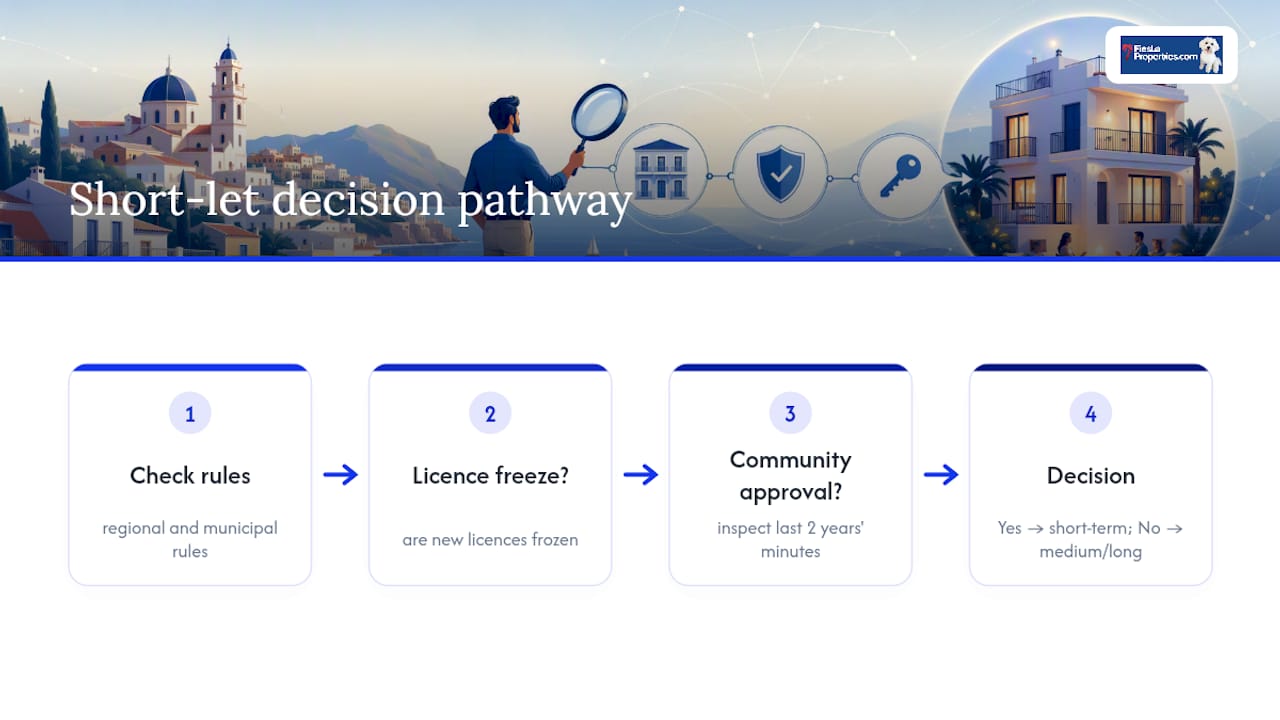
This is why checking community minutes before you make an offer is not a bureaucratic nicety, it is the difference between a working investment and a flat you can only let long-term. A community can vote, after your purchase, to ban new holiday-let licences in the building, and existing licences are sometimes grandfathered while new applications are refused outright. Ask for the last two years of community meeting minutes and get your lawyer to review them specifically for any resolution touching short-term rentals.
Where a licence is blocked or the community has voted against holiday lets, a pivot to medium-term letting, typically one to eleven months, often preserves much of the yield without needing a tourist licence at all. One analysis of Spanish rental income modelling suggests long-term lets frequently deliver more predictable net yields than holiday lets once compliance and management costs are fully accounted for, particularly in areas where tourist licences are restricted or frozen. A hybrid approach, short lets through the high season and medium-term contracts filling the shoulder and low season, can improve risk-adjusted returns, though it demands tighter contract structuring and reliable local management to execute well.
Pro Tip: Never rely on the estate agent’s word that a property “has a licence”. Ask for the licence number itself and verify it directly with the regional tourism department before you commit a deposit, since licences are sometimes suspended or under review without the listing being updated.
What should you check before paying a deposit?
Run through this list with your lawyer before any money leaves your account.
- Verify the rental licence number directly with the regional tourism authority, not just through the seller or agent, if a short-term letting strategy is part of your plan.
- Request the community of owners’ minutes from the last two years and check for any resolution restricting or banning holiday lets.
- Obtain a nota simple from the land registry to confirm the seller’s ownership and check for outstanding mortgages, liens, or unpaid community debts attached to the property itself.
- Confirm the cédula de habitabilidad is current and valid, with particular care in Andalucía and the Canary Islands, where habitation certificate rules and rural or coastal building status can complicate older properties.
- Have your NIE application underway or completed, and confirm your Spanish bank account arrangements, including whether you are handling this in person or delegating via power of attorney.
- Lock a currency exchange rate for the transfer if you are converting from a non-euro currency, rather than leaving the rate exposed until the notary date.
- Clarify in writing who pays the AJD stamp duty and the plusvalía municipal tax, since disputes over these two items are a common source of post-completion friction between buyer and seller.
How Fiesta Properties helps buy-to-let investors move faster
Sixteen years of operating across the Costa Blanca and Costa Cálida has taught Mike and Tatiana at Fiesta Properties exactly where the buying process for investors tends to stall, and it is rarely the property itself. It is mortgage timelines, legal checks, and currency transfers running on separate tracks with no one coordinating them.
Fiesta Properties addresses that by putting mortgage, legal, and currency specialists inside the same client journey. Mortgage pre-approval for non-residents, legal checks on licences, community status, and land registry standing, and currency transfer services are coordinated in-house without charging an exchange fee. That coordination is what keeps a purchase inside the typical six-to-eight-week window rather than drifting past it while paperwork bounces between disconnected parties.
What actually matters when you’re evaluating buy-to-let Spain
The conventional advice on Spanish buy-to-let has not caught up with 2026. Most guides still treat licensing as a formality and tax residency as an afterthought, when both now decide whether a purchase works at all. A property that clears every viability check on paper can become unlettable the moment a community votes against short-term rentals, and that vote can happen after your deposit is down.
If I had to rank priorities for a first-time investor, licence and community verification comes before yield modelling, not after it.
What is overrated is chasing the highest headline yield in the flashiest resort town. What is underrated is a lawyer who actually reads community minutes before you sign anything.
— Mike Kalia
Ready to look at buy-to-let opportunities on the Costa Blanca?
Going it alone on a Spanish buy-to-let purchase means coordinating a mortgage broker, an independent lawyer, and a currency specialist yourself, usually across three separate relationships and three separate fee structures. These services are offered under one roof, without charging legal fees or currency exchange fees to clients.

For investors specifically, that structure matters most on new-build purchases, where the VAT and AJD tax treatment is more predictable than resale ITP and where off-plan pricing can be secured early. Fiesta Properties’ portfolio of new build properties across the Costa Blanca covers the higher-yield corridors around Torrevieja, Orihuela Costa, and Guardamar del Segura that this guide has pointed to throughout. If you want to see what is currently available and get a realistic read on licensing status for a specific development, search the current property listings or get in touch directly to talk through mortgage pre-approval and next steps.
Where to check the official rules yourself
Before bidding, verify tax rules on Spain’s buying and renting guidance from GOV.UK, confirm registered ownership through the Registro de la Propiedad, and check tourist licence status directly with your region’s own licensing portal.