






Rentals follow different rules entirely: under the Ley de Arrendamientos Urbanos, the landlord pays the agent for a primary-residence let, never the tenant. Fixed-fee and buyer-paid models exist too, but they remain the exception rather than the norm.
TL;DR:
Agency fees in Spain generally range from 3% to 5%, with luxury properties depending on services and location.
The party responsible for paying the agent’s commission is usually the seller, but buyers can encounter fees if they want a specialist property finder
Additional costs for buyers include transfer tax or VAT, notary fees, land registry fees, and legal expenses, which can total 11.5–15% of the purchase price.
For rentals, the landlord pays the agent’s fee in primary residence lettings, and tenants should always demand a proper invoice if charged, as fees outside the Ley de Arrendamientos Urbanos are invalid.
Table of Contents
-
Who actually pays the agency fees for a Spain property sale?
-
How much are agency fees in Spain, and what are the alternatives?
Who actually pays the agency fees for a Spain property sale?
Spanish law does not fix who pays an estate agent. Whoever signs the intermediation contract, known as the nota de encargo, becomes responsible for the fee, and in practice that is almost always the seller. The agent’s job is to bring a buyer to the table on the seller’s behalf, so the commission sits with the party who hired them.
That said, a handful of alternative arrangements turn up along the coast, particularly where international buyers are involved:
-
Buyer-paid models, common with buyer’s agents or “personal shopper” services who search and negotiate exclusively for the purchaser, charging them directly instead of the seller.
-
Shared commission structures, where two agencies split a fee after a joint sale, one representing the seller and one bringing the buyer.
-
Multiple non-exclusive listings, where a seller instructs several agencies at once. This can quietly push up the asking price, since each agency needs to protect its own margin, and buyers end up funding overlapping commissions without realising it. This only happens with second hand properties
Before making an offer on a second hand property, ask directly who has signed the nota de encargo and whether the listing is exclusive. It costs nothing to ask, and it can save you from paying more than you think you are.
How much are agency fees in Spain, and what are the alternatives?
Commission in Spain is unregulated, which means it is always negotiable and varies by region, property type, and agency model. The practical average sits around 5%, with a working range of 3–7% depending on the market.
-
Standard resale properties: typically 3–5%, occasionally touching the top of that band in slower inland markets where agents work harder to shift stock.
-
Coastal and foreign-facing markets: often 4–6%, reflecting the extra marketing spend and multilingual service that international buyers expect.
-
Fixed-fee or online agencies: charge flat fees from roughly €1,000 up to €6,000 depending on the service package, trading a lower cost for less hands-on support, fewer viewings arranged, and often no negotiation assistance.
-
Developer-paid commissions: on new-build purchases, the developer typically pays the selling agent directly, so the buyer rarely sees a separate agency line item at all.
A word of caution on the newer “instant buyer” or buy-to-sell models cropping up in some cities: they simplify the sale but usually reduce net proceeds more than a well-negotiated traditional commission would.
VAT, taxes, and the real cost of buying a Spain property
For buyers, agency fees are only part of the picture. Budget an additional 11.5–15% of the purchase price for:
-
ITP (transfer tax) on resale properties, or IVA and AJD (stamp duty) on new builds.
-
Notary fees for signing the title deed.
-
Land registry fees to record the change of ownership.
-
Legal or gestor fees for handling paperwork and due diligence. These are Free if you buy a property through fiestaproperties.com
Sellers get a small consolation on the tax side: agency commission is generally deductible as an expense when calculating capital gains, which softens the net cost of the sale once the numbers are filed.
Rentals and the LAU: what tenants and landlords must know
Rental fees work on a completely different legal footing to sales, and it catches many tenants out. Under the Ley de Arrendamientos Urbanos, the landlord pays the agent’s commission when a property is let as a primary residence. Tenants should never be billed for this.
-
Know the rule before you view a property. If an agent asks a prospective tenant for a “finder’s fee” or “administration charge” on a standard residential let, that request sits outside the LAU and deserves scrutiny.
-
Ask for the invoice. A legitimate charge always comes with a proper IVA invoice addressed correctly. Vague cash requests or informal “processing fees” are a warning sign.
-
Check the contract wording. The tenancy agreement should make clear that agency costs are the landlord’s responsibility, not buried in a separate side agreement.
-
Contest it if charged wrongly. If a tenant has been charged in error, the first step is to request a refund directly and in writing from the agency; unresolved cases can be escalated to local consumer protection bodies.
Holiday lets and commercial tenancies sit outside these LAU protections, so the same fee split does not automatically apply there.
When and how agency fees get paid
Timing matters as much as the amount. Two payment points are standard in a sale:
-
A partial payment at the arras (deposit) stage, often triggered once a reservation agreement is signed.
-
The balance at completion, when the public deed is signed before a notary.
Paying the full commission at deed signing is the safer route for sellers, since it ties the fee directly to a completed, irreversible transaction rather than a deposit that could still fall through for reasons outside anyone’s control.
Pro Tip: Before signing anything, insist on seeing a written nota de encargo, a proper IVA invoice, and a receipt for any advance paid. If the agency resists putting terms in writing, treat that as a signal to look elsewhere.
A fair contract should also specify what happens to any advance if the sale collapses through no fault of the seller, such as the buyer withdrawing after mortgage refusal.
Negotiating commission and spotting red flags
Commission is always up for discussion in Spain, and a few levers genuinely move the number:
-
Offer exclusivity. Agencies typically reward a sole listing with a lower percentage, since they are not competing against three other firms for the same buyer.
-
Use transaction size. On sales above roughly €300,000–€400,000, there is usually room to shave at least one percentage point off the headline rate.
-
Bring competing quotes. A second or third agency’s proposal gives you a concrete benchmark to negotiate against, rather than negotiating in the dark.
Watch for a handful of behaviours that suggest trouble ahead: evasive answers when you ask whether IVA is included, pressure to pay a large non-refundable advance before any real work has begun, or vagueness about whether the property is being co-marketed by undisclosed sub-agents.
Pro Tip: Ask for a written scope of service and a sample invoice before you sign anything. A serious agency will have both ready without hesitation.
Before committing, request references from recent clients and a clear fee schedule in writing. It takes an afternoon and it removes almost all the guesswork from the arrangement.
How Fiesta Properties approaches fees and transparency
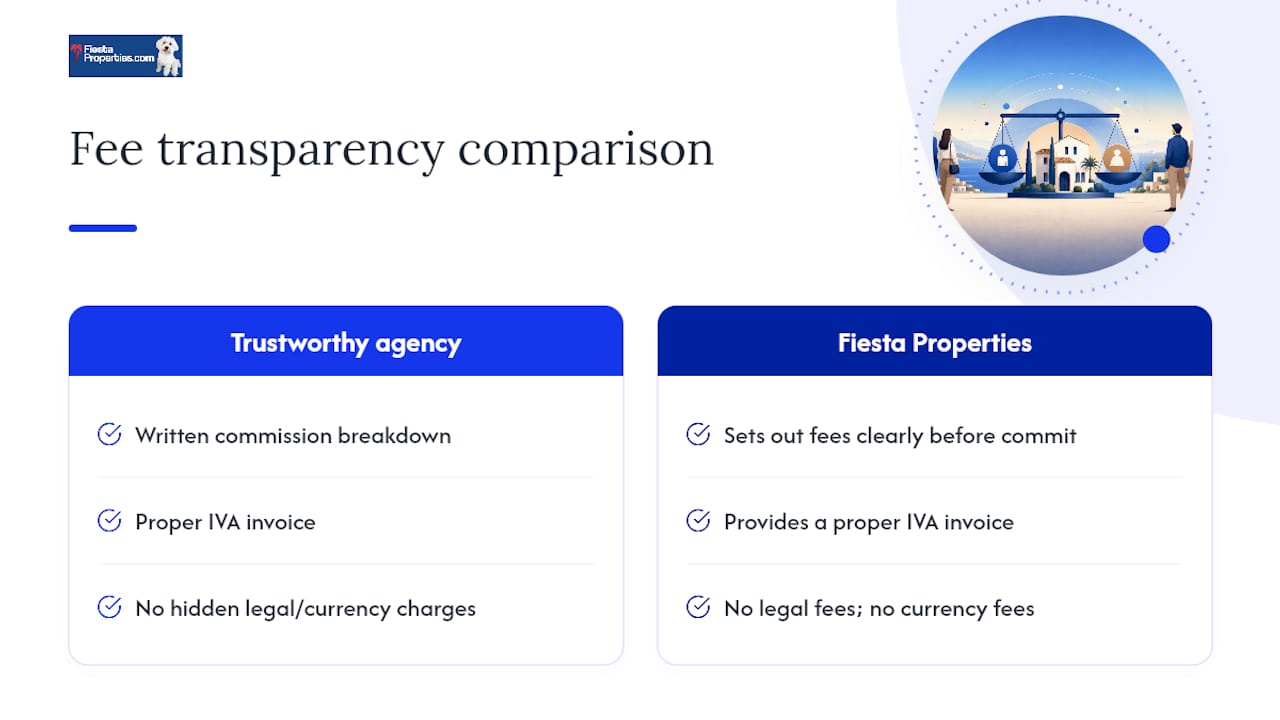
Fiesta Properties has operated on the Costa Blanca since 2010 as a family-run agency, and that longevity comes from doing the paperwork properly rather than cutting corners on it. Every fee, whether it touches legal work or currency exchange, gets set out clearly before a client commits to anything.
A trustworthy agency should give you, at minimum: a written breakdown of any commission due, a proper IVA invoice rather than a vague figure, and no hidden charges layered on for legal or currency services. Fiesta Properties charges no legal fees and no currency exchange fees, which removes two of the most common places costs creep in unnoticed on an international purchase.
For buyers coordinating a purchase from abroad, that clarity matters more than most people expect. It turns fee negotiation from a guessing game into a straightforward conversation.
Why the fee conversation matters more than the fee itself
Most guidance on Spanish agency fees fixates on the percentage, and that is the wrong starting point. The number that actually protects a buyer or seller is whether the fee arrangement was put in writing before anyone signed anything.
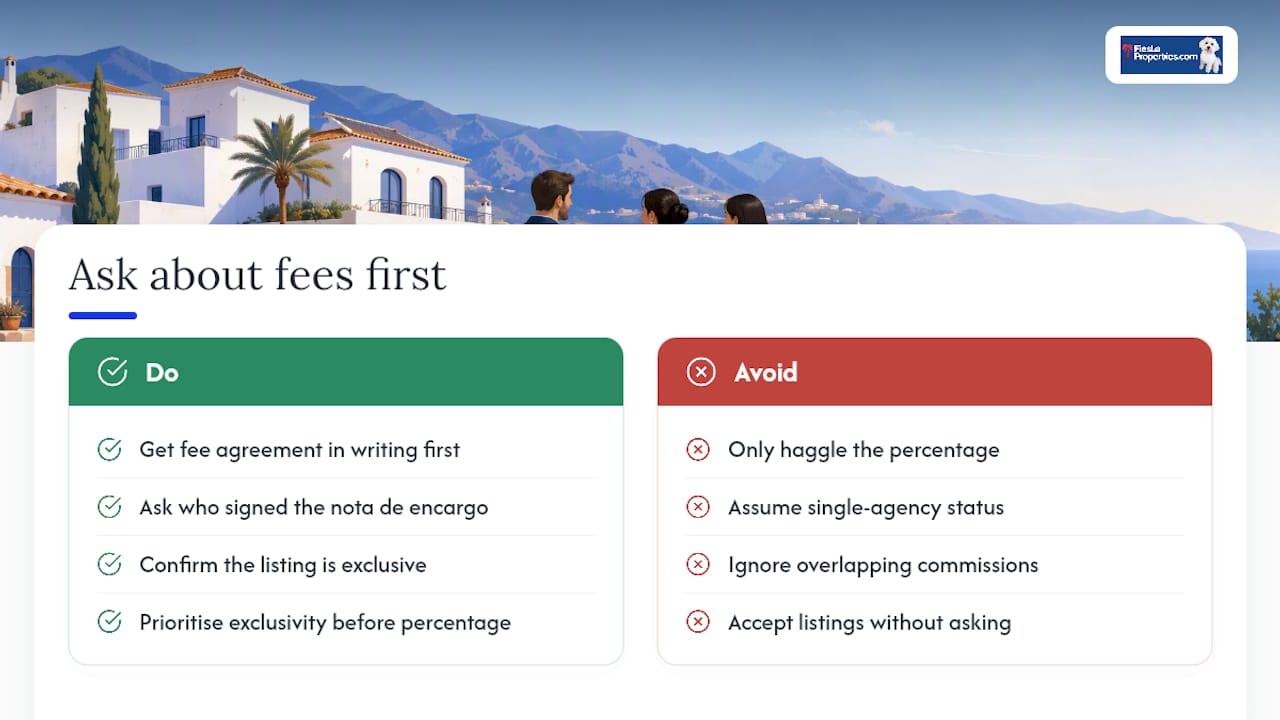
The conventional advice to “just negotiate the percentage” also undersells the bigger risk on Spain’s coast: multiple non-exclusive listings quietly inflating the asking price through overlapping commissions. That costs buyers more than a poorly negotiated single-agency fee ever would, and almost nobody asks about it upfront.
If there is one thing to prioritise, it is asking who signed the nota de encargo and whether the listing is exclusive, before discussing percentages at all. Get that answer first. The rest of the negotiation becomes far simpler once you know exactly who is paying whom, and why.
— Mike Kalia
Ready to buy on the Costa Blanca or Costa Cálida?
A trustworthy agency should give you, at minimum: a written breakdown of any commission due, a proper IVA invoice rather than a vague figure, and no hidden charges layered on for legal or currency services.

If you are weighing up new-build options along the Costa Blanca, the current new build properties in Costa Blanca portfolio is a practical place to start. Browse what is available, and get in touch with the team to talk through fees, financing, and timelines before you commit to anything.